

Age of Big Business: Rockefeller and Carnegie

Presentation
•
Social Studies
•
9th - 12th Grade
•
Hard

Joseph Anderson
FREE Resource
12 Slides • 15 Questions
1
Big Business and the Government
2
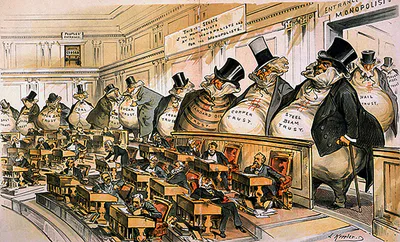
Trusts and monopolies concentrated capital—and power—in the hands of a few people. With less competition, companies grew larger and became more profitable. As corporate influence expanded, Americans began to refer to these industrial giants as “big business.” Unlike owners of small, traditional businesses, those who ran huge corporations seldom knew their workers. Big business was impersonal, extremely profit-driven, and responsive mainly to investors.
3
Businesses Grow Larger and More Powerful
Corporations generally expanded in one of two ways. The first strategy was horizontal integration, an approach which called for joining together as many firms from the same industry as possible. An example of this method was Standard Oil’s practice of buying up refineries to gain control of the oil-refining industry.
A second strategy was known as vertical integration. This approach involved taking control of each step in the production and distribution of a product, from acquiring raw materials to manufacturing, packaging, and shipping. Carnegie expanded his steel company through vertical integration when he bought the iron mines and coalfields that sent raw materials to his company’s mills, as well as the ships and railroads that transported supplies and finished products. Vertical integration gave Carnegie complete control of the production process and the power to dominate the steel industry.
4
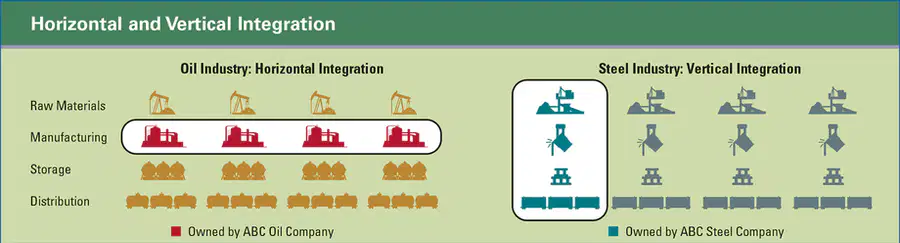
Some industrialists, like John Rockefeller, expanded their business through horizontal integration. In this method, they worked to buy up as many companies within the same industry as possible. In Rockefeller’s case, horizontal integration led to monopoly. Others, like Andrew Carnegie, expanded through vertical integration, through which they worked to bring every process of their business—from generating raw materials to marketing the finished product to consumers—under their control.
5
6
The Government Leaves Business Alone
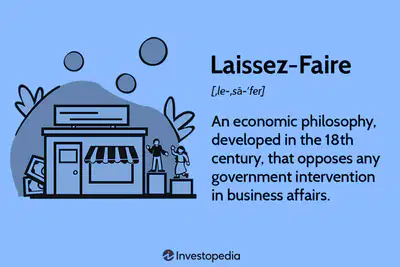
By the late 1800s, many Americans realized that big business was limiting competition. Lack of competition allowed prices to rise, which helped producers but hurt consumers. However, lawmakers were unwilling to stop such business practices. Most politicians had long favored a policy of laissez-faire. This doctrine held that the market, through supply and demand, would regulate itself if government did not interfere. The French phrase laissez-faire translates as “allow to do.” To political leaders, this meant “leave business alone.”
7
Another influential idea, social Darwinism, also discouraged government regulation of business practices. Based on Charles Darwin’s theory of evolution, social Darwinism held that the best-run businesses led by the most capable people would survive and prosper. This doctrine’s most avid supporter, Herbert Spencer, coined the phrase “survival of the fittest.” Social Darwinists argued that government should leave businesses alone to succeed or fail on their own.

8
9
In reality, the federal government did not leave businesses alone, but instead supported many of them. It gave the railroads hundreds of millions of dollars’ worth of land and sold natural resources such as forests and minerals at very low prices to companies that were prepared to exploit them. The government also imposed protective tariffs on foreign goods to make them more expensive than American-made goods, and forced consumers to pay higher prices than they would have in a free market.
During the late 1800s, some businesses successfully bribed legislators to pass laws favoring their companies. Much of the free land handed out to the railroads, for example, came in return for cash payments to politicians. In 1904, journalist Lincoln Steffens criticized this practice, writing, “Our political leaders are hired, by bribery . . . to conduct the government of city, state, and nation, not for the common good, but for the special interests of private business.”
10
In essence, tariffs and other government aid enabled industry to prosper. In the late 1800s, the American economy grew rapidly, so much so that from 1877 to 1900, the value of American exports doubled. By 1900, the United States had the strongest industrial economy in the world.

This cartoon, titled “The Protectors of Our Industries,” depicts four wealthy industrialists—Marshall Field, Cornelius Vanderbilt, Jay Gould, and Russell Sage—atop their moneybags. These “protectors” amassed huge fortunes while paying their workers, seen below, as little as possible. Gould was widely viewed as the most corrupt of the robber barons. In fact, he considered himself the most hated man in 19th-century America.
11
Government Takes Some Action to Limit Business
As trusts and monopolies multiplied, many Americans became alarmed, noting that opportunities were being denied to smaller businesses. In response, a few states passed laws or filed lawsuits to try to restore competition. Big business, however, just kept getting bigger.
Increasing public concern finally provoked a response from the federal government, and in 1890, Congress passed the Sherman Antitrust Act. This act outlawed trusts, monopolies, and other forms of business that restricted trade. However, the government made only feeble attempts to enforce the new law. One problem was the wording of the law. Written by lawyers who favored laissez-faire, the Sherman Antitrust Act was filled with vague language. Congress left it to the courts to clarify the law, but the courts were not impartial, or unbiased, and often interpreted the law in favor of big business. For example, in 1895, the Supreme Court blocked government efforts to break up a sugar trust that controlled most of the nation’s sugar manufacturing. In United States v. E.C. Knight Co., the Court ruled that the Sherman Act applied only to trade, not to manufacturing.
12
13
Drag and Drop
Vertical integration
Laissez-faire
Monopoly
14
Dropdown
15
Drag and Drop
Horizontal integration
Vertical integration
Monopoly
16
Multiple Choice
What effect did the limitation of competition by large companies have at the end of the 19th century in the United States?
Lowered prices for consumers
Raised prices harming consumers
Improved relations between large companies and the government
Reduced profits for large companies
17
Drag and Drop
Capitalism
Laissez-faire
Socialism
18
Dropdown
19
Drag and Drop
Vertical integration
Diversification
Monopolization
20
Dropdown
21
Dropdown
22
Multiple Choice
What did the federal government do to support businesses in the late 1800s?
It imposed high taxes on businesses
It gave railroads land and resources at low prices
It discouraged businesses from expanding
It broke up monopolies
23
Drag and Drop
The economy declined
The government went into debt
Unemployment rates increased
24
Dropdown
25
Multiple Choice
What was the purpose of the Sherman Antitrust Act passed in 1890?
To establish a federal banking system
To outlaw trusts, monopolies, and other forms of business that restricted trade
To provide subsidies to big businesses
To enforce stricter labor laws
26
Multiple Choice
What was a significant problem with the enforcement of the Sherman Antitrust Act?
It was written in a foreign language
It was too strict and caused businesses to close
It was filled with vague language and the courts were often biased
It only applied to small businesses
27
Multiple Choice
In the case of United States v. E.C. Knight Co., how did the Supreme Court interpret the Sherman Antitrust Act?
It applied only to manufacturing
It applied to all forms of trade, including manufacturing
It applied only to trade, not to manufacturing
It did not apply to any business activities
Big Business and the Government
Show answer
Auto Play
Slide 1 / 27
SLIDE
Similar Resources on Wayground

17 questions
Civil Rights 1
Presentation
•
9th - 12th Grade
17 questions
Powers of the President
Presentation
•
9th - 12th Grade
19 questions
Surplus and Shortage
Presentation
•
9th - 12th Grade
23 questions
World War I Vocabulary (narrated)
Presentation
•
9th - 12th Grade
20 questions
Constitutional Principles
Presentation
•
9th - 12th Grade
22 questions
Demand
Presentation
•
9th - 12th Grade
20 questions
Ch. 1, Lesson 2: Types of Government
Presentation
•
9th - 12th Grade
19 questions
American Imperialism
Presentation
•
9th - 12th Grade
Popular Resources on Wayground
24 questions
PBIS-HGMS Day 10

Quiz
•
6th - 8th Grade
10 questions
HCS SCI 03 Summer School Review 3
Quiz
•
3rd Grade
11 questions
Home Scope
Quiz
•
7th - 8th Grade
15 questions
HCS SCI 05 Summer School Assessment 3 Review
Quiz
•
5th Grade
35 questions
Lufkin Road Middle School Student Handbook & Policies Assessment
Quiz
•
7th Grade
18 questions
Geo 11.3 Area of Circles and Sectors
Quiz
•
9th - 11th Grade