Biology EOC Water Macromolecules
Presentation
•
Biology
•
7th - 9th Grade
•
Hard

Joseph Anderson
FREE Resource
4 Slides • 34 Questions
1
Biology EOC Review Biomolecules and Water
2
3
Multiple Choice
Which of the following is NOT an example of a food containing lipids?
Banana
Olive oil
Margarine
Peanut Butter
4
Multiple Choice
When will lipids in your body be used as fuel or energy?
After carbohydrates have been burned
After proteins and carbohydrates have been burned
Before any other macromolecule is burned
Lipids are the last to be used as fuel, after DNA
5
Multiple Choice
If you start running a mile, what macromolecule will be "burned" first for energy?
Carbohydrates
Proteins
Lipids
Nucleics
6
Multiple Choice
The shape and size of proteins determine the function of the protein
True
False
7
Multiple Choice
When amino acids are linked together they form a polypeptide, which is also called a
carbohydrate
lipid
protein
nucleic acid
8
Multiple Choice
Which group of biomolecules is involved in storing and transmitting genetic information?
carbohydrates
lipids
proteins
nucleic acids
9
Multiple Choice
Glucose, Lactose, and Sucrose all end in -ose. This means they are sugars...which group of biomolecules do they belong to?
carbohydrates
lipids
proteins
nucleic acids
10
Multiple Choice
The breakdown of ________ supplies immediate, quick energy for all cell activities.
carbohydrates
lipids
proteins
nucleic acids
11
Multiple Choice
Which group of biomolecules contains glycerol and fatty acids?
carbohydrates
lipids
proteins
nucleic acids
12
Multiple Choice
Which group of biomolecules includes genetic material (DNA and RNA)?
carbohydrates
lipids
proteins
nucleic acids
13
Multiple Choice
Enzymes, which speed up chemical reactions, belong to which group of biomolecules?
carbohydrates
lipids
proteins
nucleic acids
14
Multiple Choice
Which type of biomolecule makes up cell membranes?
carbohydrates
lipids
proteins
nucleic acids
15
Multiple Choice
A mutation in DNA would initially start with which biomolecules?
carbohydrates
lipids
proteins
nucleic acids
16
Multiple Choice
If athletes "pasta load" the day before a big event, which biomolecule are they consuming the most of?
carbohydrates
lipids
proteins
nucleic acids
17
Multiple Choice
Which biomolecule plays a role in muscle development and repair?
carbohydrates
lipids
proteins
nucleic acids
18
Multiple Choice
Which biomolecule is involved in long term energy storage?
carbohydrates
lipids
proteins
nucleic acids
19
Multiple Choice
Which biomolecule is a source of fast, quick energy for cells?
carbohydrates
lipids
proteins
nucleic acids
20
Multiple Choice
________ are small individual molecules that when linked together form a _______
polymers, monomer
carbohydrates, lipid
proteins, nucleic acid
monomers, polymer
21
22
Multiple Choice
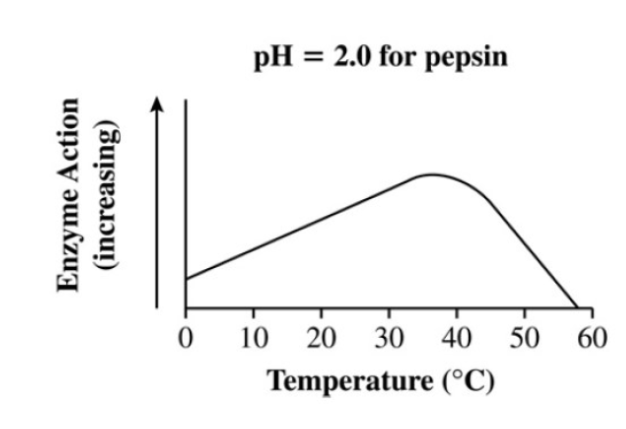
Enzymes are substances that speed up the rate of chemical reactions. The rate of enzyme action is affected by several factors. A researcher studying these factors made this graph. Which would be an appropriate title for this graph?
Enzyme Action and Changes in pH
The Effect of Temperature on Enzyme Populations
How Enzyme Action Alters Temperature
The Effect of Temperature on Enzyme Action
23
Multiple Choice
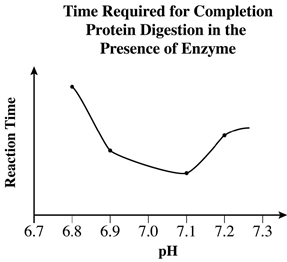
A student measured the time required for a protein sample to be completely digested in the presence of an enzyme under different pH levels. At which pH is the enzyme least active?
7.1
6.9
6.8
7.2
24
Multiple Choice
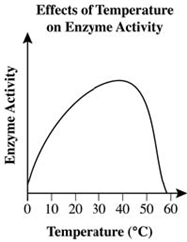
Based on the graph above, at what temperature range is enzyme activity at its greatest?
15-25 ºC
25-35 ºC
35-45 ºC
45-55 ºC
25
Multiple Choice
A student measured the time required for a protein sample to be completely digested in the presence of an enzyme under different pH levels. At which pH is the enzyme most active?
7.1
6.9
6.8
7.2
26
Multiple Choice
The diagram represents one way an enzyme can be inhibited.
Which statement explains the effect of an inhibitor on an enzyme?
A substrate will be able to bond with the enzyme.
The enzyme will likely be attacked by immune cells.
The enzyme will be unable to produce more enzymes.
A substrate will be unable to attach to the enzyme.
27
Multiple Choice
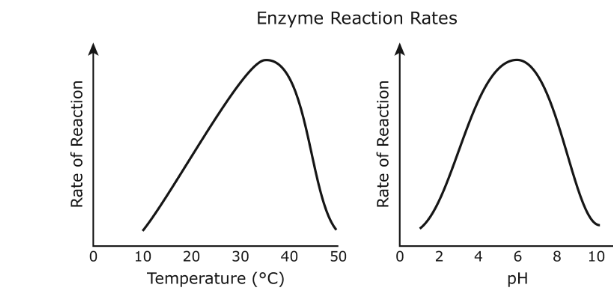
The graphs show the reaction rate for an enzyme across a range of temperatures and pH.
Based on these data, this enzyme functions best as what temperature and pH?
Temperature of 27oC and a pH of 4
Temperature of 37oC and a pH of 6
Temperature of 40oC and a pH of 8
Temperature of 50oC and a pH of 10
28
29
Multiple Choice
Water being the Universal Solvent is important to living organisms because
it acts as a lubricant for our joints and our eyes
it dissolves nutrients and helps to transport them thru the body
it dissolves wastes so that they can be transported out of the body
it helps to regulate body temperature
All of these!
30
Multiple Choice
31
Multiple Choice
32
Multiple Choice
Which property controls temperature fluctuations in an animals body?
High Heat Capacity
Lower Density
Surface Tension
Universal Solvent
33
Multiple Choice
Water is very versatile in which it dissolves many substances. This is why water is called ___________.
the universal solute
the universal solution
the universal solvent
the universal dilution
34
Multiple Choice
It takes a lot of energy to heat and cool water, this is important because...
Water helps keeps our climate from fluctuating violently
It takes forever to boil water for pasta
Surface Tension
Polar
35
Multiple Choice
Which properties of water help a plant get water to the top of its leaves?
Capillary Action
Surface Tension
Polar
High Heat of Vaporization
36
Multiple Choice
Water molecules bonding to other molecules or things, such as a leaf is ___________.
Adhesion
Specific Heat
Cohesion
Expansion
37
Multiple Choice
This graph demonstrates what property of water?
Universal Solvent
High Specific Heat
Cohesion
Less Dense as Solid
38
Multiple Choice
A water molecule has a positive region and a negative region and is therefore...?
non-polar
Hydrophilic
Hydrophobic
Polar
Biology EOC Review Biomolecules and Water

Show answer
Auto Play
Slide 1 / 38
SLIDE

Similar Resources on Wayground
36 questions
Cell Membranes (Diffusion and Osmosis)
Presentation
•
8th Grade
36 questions
DNA Intro Review
Presentation
•
9th Grade
29 questions
Protein Synthesis Lesson (Complete)
Presentation
•
9th Grade
32 questions
Mcas cells structure and function
Presentation
•
9th Grade
35 questions
The Cell
Presentation
•
6th - 8th Grade
33 questions
G9 Chap 7.3 Cell Structures and Organelles
Presentation
•
9th Grade
32 questions
Cell Transport **
Presentation
•
8th Grade
32 questions
Cell Transport *
Presentation
•
8th Grade
Popular Resources on Wayground
10 questions
HCS SCI 03 Summer School Assessment 1
Quiz
•
3rd Grade
15 questions
HCS SCI 05 Summer School Assessment 1 Review
Quiz
•
5th Grade
22 questions
Day 9 Equations and Inequalities Review
Quiz
•
9th Grade
10 questions
Writing and Identifying Ratios Practice
Quiz
•
5th - 6th Grade
7 questions
PYRAMID PERSPECTIVES part 1
Presentation
•
9th - 12th Grade
12 questions
Understanding the Fourth of July
Quiz
•
9th Grade
15 questions
Soccer World Cup Quiz Questions
Quiz
•
7th Grade