

Cold War Alliances

Presentation
•
Social Studies
•
12th Grade
•
Hard

Joseph Anderson
FREE Resource
9 Slides • 5 Questions
1

Copyright © by Houghton Mifflin Harcourt Publishing Company
2
The Origins of the Cold War
LESSON
1
The United States and the Soviet Union
emerge from World War II as two
“superpowers” with vastly different political
and economic systems.
2

Copyright © by Houghton Mifflin Harcourt Publishing Company
3
The Origins of the Cold War
LESSON
1
Former Allies Clash
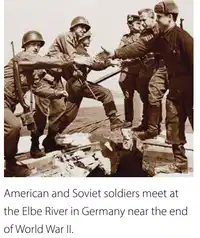
■Following WWII, the U.S. and Soviet Union emerge as world’s two superpowers.
■Former allies become bitter rivals
Political and Economic Differences
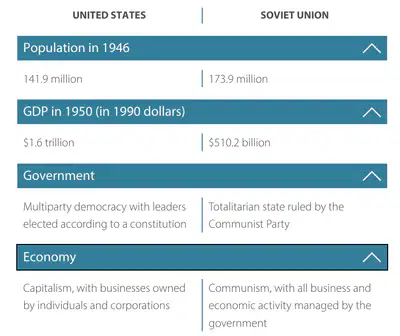
■U.S.: democracy governed by the people; USSR: communist, totalitarian government
–communist party removed czar by force
–U.S. doesn’t recognize Communist government for 16 years
■Economically ideological opposites; USSR has state controlled economy, U.S. free enterprise
Continued…
3
4
5
Multiple Choice
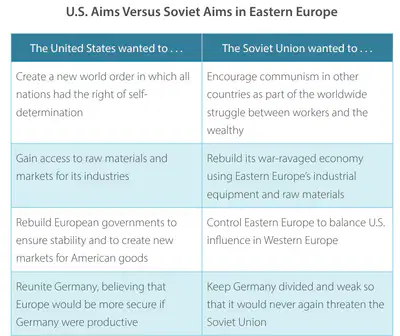
Which of the following was an aim of the Soviet Union?
balancing U.S. influence in Western Europe
encouraging self-determination
rebuilding Eastern European economies
reuniting Germany
6

Lesson 1
Copyright © by Houghton Mifflin Harcourt Publishing Company
4
Former Allies Clash (continued)
Wartime Tensions
■U.S. suspicious of Stalin because he had been Hitler’s ally
■Stalin resents that U.S. delayed attacking Germany and hid atom bomb
■Stalin does not allow free, multiparty elections in Poland as promised
–bans democratic parties in countries under Soviet control
–arrests non-Communist leaders
■Harry Truman wants access to raw material and markets in Eastern Europe for growing U.S. economy
Soviets Tighten Their Grip on Eastern Europe
■Soviet Union also has great economic, military strength
■Unlike U.S., Soviet Union suffered heavy devastation on own soil
■Installs communist rule in satellite nations, countries it dominates
■1946, Stalin announces war between communism, capitalism inevitable
■Europe divided by “iron curtain” into two political and economically different regions
Continued…
7
Multiple Choice
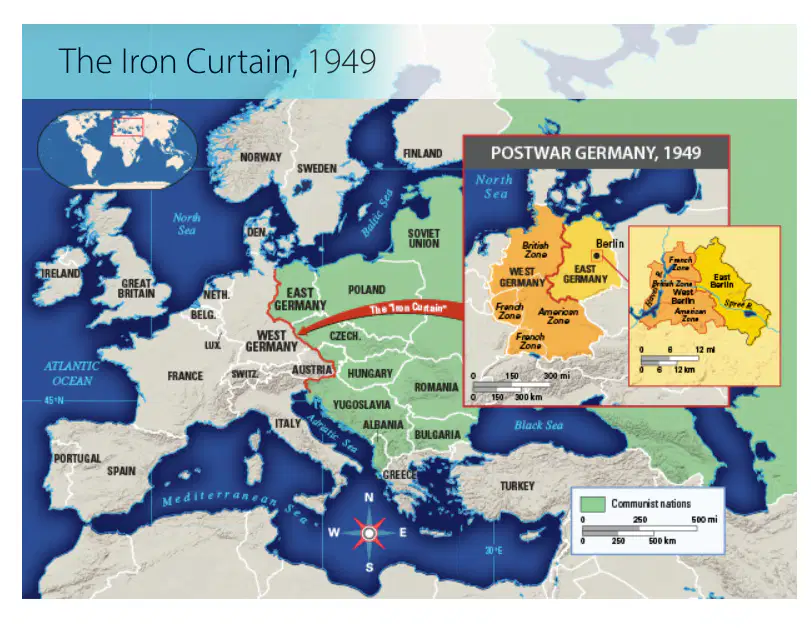
Which of the following European countries did not lie beyond the iron curtain?
Poland
Bulgaria
Hungary
West Germany
8

Lesson 1
Copyright © by Houghton Mifflin Harcourt Publishing Company
5
Former Allies Clash (continued)
Conflict in the United Nations
■ 1945, United Nations established as new
peacekeeping body
■ UN becomes arena where U.S., U.S.S.R. compete
– Structure of UN feeds tensions; General
Assembly and Security Council
– Security Council veto used to block
discussion, creates stalemate
9

Copyright © by Houghton Mifflin Harcourt Publishing Company
6
The Origins of the Cold War
LESSON
1
New Foreign Policies
■Conflict and tension between U.S. and USSR turns into Cold War
■Cold War lasts from 1945 to 1991
United States Establishes a Policy of Containment
■U.S. policy of containment—measures to prevent spread of communism
■Western Europe first region to receive U.S. financial aid
■Later, U.S. sends financial aid and military troops to Asia, Africa, and Latin America
■U.S. intervenes many times in conflicts to support anti-communist forces around the world
United States Creates and Intelligence Community
■National Security Act creates two new intelligence agencies
–National Security Agency to identify potential threats
–Central Intelligence Agency (CIA) gathers intelligence and performs covert operations in foreign
countries
10
Open Ended
What factors caused tension between The Soviet Union and the United States after World War 2?
11

Copyright © by Houghton Mifflin Harcourt Publishing Company
7
The Origins of the Cold War
LESSON
1
Efforts to Rebuild Europe
■WWII leaves much of Europe in ruins; leads to political and economic instability
The Truman Doctrine
■U.S. replaces British aid to Greece, Turkey; reduce communist threat
■Truman Doctrine—support against armed minorities, outsiders
The Marshall Plan
■Post-war Western Europe in chaos
–factories destroyed; millions of refugees
–1946–1947, harsh weather makes problems worse
■1947, Sec. of State George Marshall proposes U.S. aid to nations in need
■Marshall Plan revives 16 nations; even offers aid to USSR and its allies
–Soviets refuse
–aid helps U.S. build strong ties to Western Europe
12
Multiple Choice
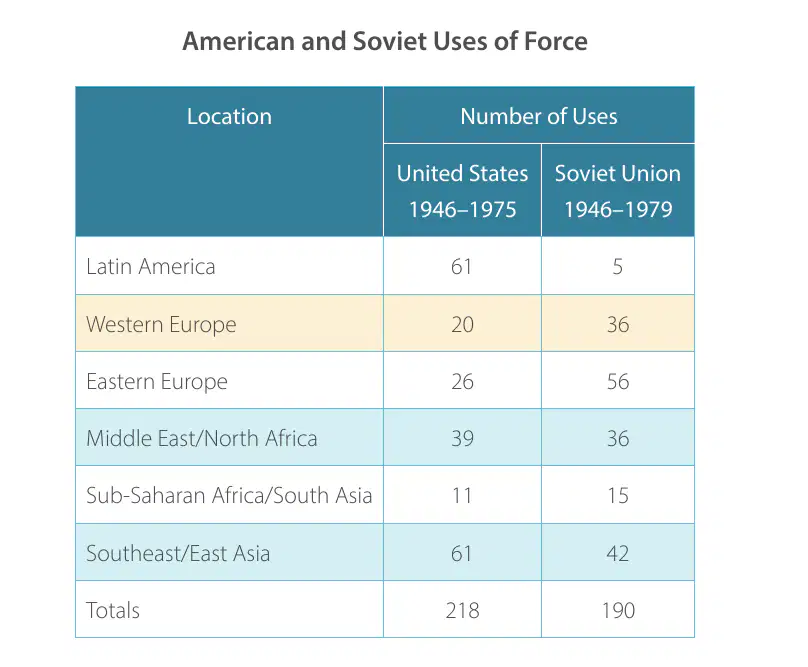
Which region did the Soviet Union most often use force?
Eastern Europe
Western Europe
the Middle East and North Africa
Southeast and East Asia
13

Copyright © by Houghton Mifflin Harcourt Publishing Company
8
The Origins of the Cold War
LESSON
1
Superpowers Struggle over Germany
■U.S. and USSR clash over German reunification; Germany divided in 4 zones
■Britain, France, and U.S. combine their zones; West Berlin surrounded by Soviet zone
■1948, Stalin closes all access to West Berlin, only enough food and fuel for 5 weeks
The Berlin Airlift
■Berlin airlift—Britain, U.S. fly food, supplies into West Berlin
■1949, Stalin lifts blockade
■Federal Republic of Germany (West Germany), including West Berlin, German Democratic Republic (East Germany), including
East Berlin, are formed
The NATO Alliance
■Fear of Soviet aggression leads to North Atlantic Treaty Organization (NATO)
■European nations, U.S., Canada pledge mutual military support
■Peacetime military alliance and Cold War end policy of U.S. isolationism.
■1952, Greece and Turkey join NATO; 1955, West Germany joins
14
Open Ended
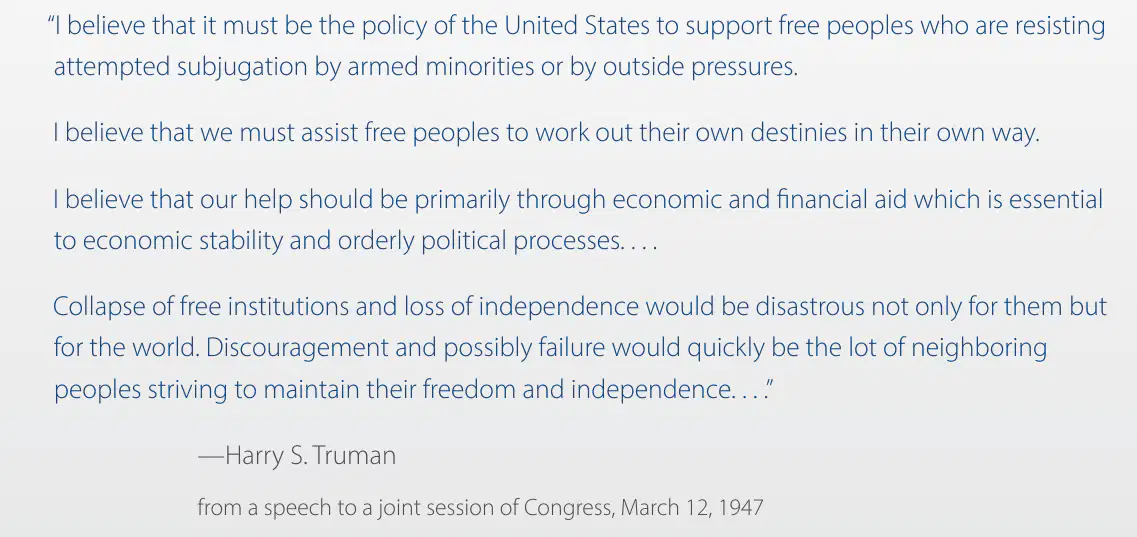
How does Truman intend to help other countries resist Communist influence?
Copyright © by Houghton Mifflin Harcourt Publishing Company
2
The Origins of the Cold War
LESSON
1
The United States and the Soviet Union
emerge from World War II as two
“superpowers” with vastly different political
and economic systems.
Show answer
Auto Play
Slide 1 / 14
SLIDE
Similar Resources on Wayground

11 questions
Legislative Branch Fill in the Blank Review
Presentation
•
12th Grade
8 questions
Fake News Friday - Oct 20 2023
Presentation
•
12th Grade
10 questions
Algebra - Lesson Distance Between Points
Presentation
•
12th Grade
11 questions
Modernisasi
Presentation
•
12th Grade
10 questions
Sai's Thai
Presentation
•
KG
11 questions
Elements of a state
Presentation
•
12th Grade
9 questions
Government Alive! Ch. 2 - Comparing Forms of Government
Presentation
•
12th Grade
11 questions
2.3 Liberty
Presentation
•
12th Grade
Popular Resources on Wayground
16 questions
Grade 3 Simulation Assessment 2

Quiz
•
3rd Grade
19 questions
HCS Grade 5 Simulation Assessment_1 2526sy
Quiz
•
5th Grade
10 questions
Cinco de Mayo Trivia Questions

Interactive video
•
3rd - 5th Grade
17 questions
HCS Grade 4 Simulation Assessment_2 2526sy
Quiz
•
4th Grade
24 questions
HCS Grade 5 Simulation Assessment_2 2526sy
Quiz
•
5th Grade
13 questions
Cinco de mayo
Interactive video
•
6th - 8th Grade
20 questions
Math Review
Quiz
•
3rd Grade
30 questions
GVMS House Trivia 2026
Quiz
•
6th - 8th Grade
Discover more resources for Social Studies
20 questions
AP GOV - Unit 2 Review Questions
Quiz
•
12th Grade
15 questions
AP Gov Required SCOTUS Cases
Quiz
•
10th - 12th Grade
46 questions
AP Government Exam Review
Quiz
•
12th Grade
28 questions
AP Psychology Unit 3: Developmental Psychology and Learning
Quiz
•
12th Grade
48 questions
Civics EOC Practice Questions
Quiz
•
12th Grade
50 questions
US History EOC Review
Quiz
•
9th - 12th Grade
18 questions
Foundational Documents
Quiz
•
11th - 12th Grade
46 questions
Unit 5 Exam Review Govt.
Quiz
•
12th Grade