

Dark Energy Big Bang

Presentation
•
Science
•
6th Grade
•
Hard

Joseph Anderson
FREE Resource
21 Slides • 6 Questions
1

The Universe
Lesson 4.4.4
2
balloon
marker
Science 6 Notebook
Materials
analyze the evidence for an expanding universe and evaluate its implications for understanding cosmology
evaluate evidence related to the universe's formation, and construct an argument for how this evidence supports the Big Bang Theory
formulate hypotheses about the roles of dark matter and dark energy in the universe
What will we learn...
Lesson Objectives
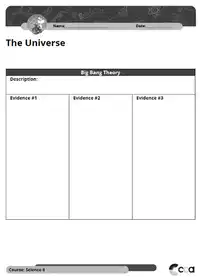
3
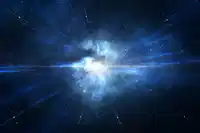

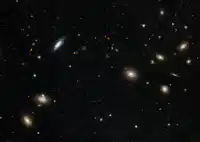

the commonly accepted scientific theory for how the universe formed
Big Bang Theory
theoretical form of energy that cannot be detected
Dark Energy
matter that does not emit light
dark matter
all of matter and space
Universe
4
Drag and Drop
The smallest unit of an element is an
5

Experiment Time!
6
What you will need
Balloon
Marker


7

Before inflating the balloon, use a marker to draw several small dots on its surface.
These dots represent galaxies.
Step 1
8

Next, slowly blow up the balloon and observe what happens to the dots.
Step 2
9
Open Ended
What do you observe about the dots as you inflate the balloon?
You can begin your response with:
When I inflate the balloon, I notice . . .
10

As the balloon inflated you probably noticed that the dots moved away from each other, but their size stayed the same.
Inflating the balloon models our expanding universe.
The balloon surface is space and the dots are galaxies that move away from each other.
Inflating the Balloon
11

Edwin Hubble was one of the first to observe distant galaxies in te 20th century.
In his observations
galaxies are a vast collection of millions or billions of stars.
found some distances to many galaxies.
Today scientists believe the universe contains a hundred billion galaxies.
Created Hubble's Law which states, the further away a galaxy is , the faster it is moving away. Or that the universe is expanding.
Let's learn more about the universe.
Universe History
12
13
Thoughts?
What do you think about how big the universe is?
Some space travel tips
If you could travel at the speed of light it would take you 2 seconds to travel from the Earth to the Moon.
If you could travel at the speed of light it would take you 100,000 years to reach the edge of the Milky Way.
If you could travel at the speed of light it would take you 13 billion years to travel to the known edge of the universe.
14
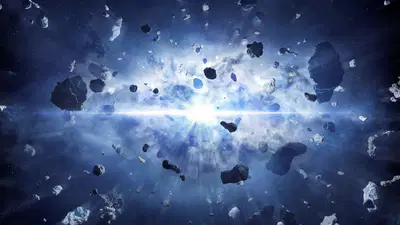
Theory of how the universe was formed.
About 13.7 billion years ago, the universe was compressed into a tiny volume.
An enormous explosion caused it to expand rapidly.
Let's look at a timeline of events
Big Bang Theory
15

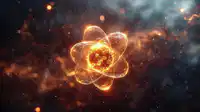
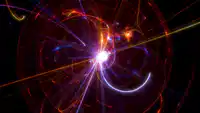

The universe was very hot and dense. It then expanded and became less dense.
Beginning
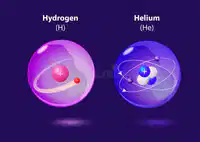
Hydrogen was create from protons, electrons, and neutrons forming.
First Atoms
Nuclear fusion produced helium atoms
Nuclear Fusion
Dense regions of matter formed gas clouds, stars, galaxies, etc.
Development
16
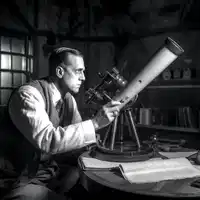

His observations of galaxies moving away and expanding suggests that it originated at a single point.
Edwin Hubble
Background radiation has been observed throughout the universe, which provides evidence of its hot and dense origin.
Background Radiation
Large amounts of elements like hydrogen and helium support the theory that they were formed early after the Big Bang.
Light Elements
Evidence to Support the Theory
17
Open Ended
Thoughts?
Do you think all of the evidence and information collected shows how the universe was created?
18
Poll
The universe has been expanding since the Big Bang
true
false
19
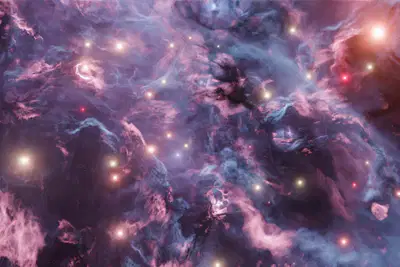
Invisible component of space.
Does not emit, absorb, or reflect light.
Only detectable through gravitational effects.
Shown through the uniform rotation speed of galaxies
Believed to be a mix of ordinary matter and unknown particles.
Dark Matter
20
Invisible component of space.
Believed to be accelerating the universe's expansion.
More mysterious than dark matter.
Majority of the energy in space is dark energy according to astronomers.
Dark Energy
21
22
Thoughts?
What are your thoughts/opinion on dark matter and energy?
23
Multiple Choice
What evidence supports the existence of dark matter?
the temperature of black holes
the color of stars
the rotation speed of galaxies
the brightness of galaxies
24
Let's Review
What did we learn today...
the universe contains all matter, energy, space, and time;
observations show that galaxies are moving apart, indicating that the universe is expanding;
the Big Bang Theory suggests the universe formed from an enormous explosion; and
recent evidence reveals the existence of dark matter and dark energy.
25
Open Ended
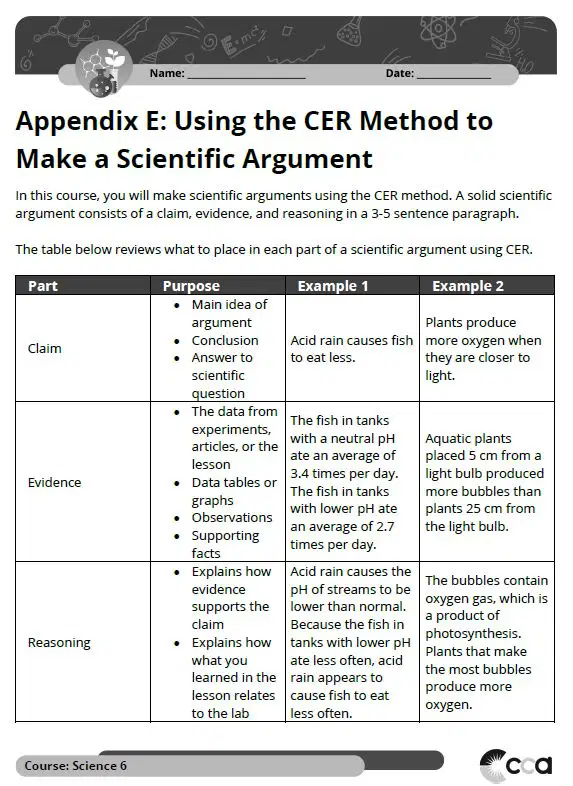
Using your notes, evaluate the claim that the universe was formed during an event known as the Big Bang. Be sure to provide at least two supporting pieces of evidence, and explain the reasoning for how this evidence supports the claim.
26
If you want to know what scientists think will happen to the universe in the future, check out the link on the next slide.
27

Edio | Commonwealth Charter Academy
You can open this webpage in a new tab.
The Universe
Lesson 4.4.4
Show answer
Auto Play
Slide 1 / 27
SLIDE
Similar Resources on Wayground

19 questions
Food Web and Energy Pyramids
Presentation
•
6th Grade
20 questions
8.1 Rocks, MInerals, and Soil
Presentation
•
6th Grade
18 questions
Cell Theory Lesson
Presentation
•
6th Grade
22 questions
Respiratory System
Presentation
•
6th - 7th Grade
23 questions
Asteroids, Meteors, and Comets
Presentation
•
6th Grade
20 questions
Integumentary System
Presentation
•
6th Grade
21 questions
Respiratory System
Presentation
•
6th Grade
19 questions
Photosynthesis
Presentation
•
6th Grade
Popular Resources on Wayground
19 questions
Naming Polygons

Quiz
•
3rd Grade
10 questions
Prime Factorization
Quiz
•
6th Grade
20 questions
Math Review
Quiz
•
3rd Grade
15 questions
Fast food
Quiz
•
7th Grade
20 questions
Main Idea and Details
Quiz
•
5th Grade
20 questions
Context Clues
Quiz
•
6th Grade
20 questions
Inferences
Quiz
•
4th Grade
19 questions
Classifying Quadrilaterals
Quiz
•
3rd Grade
Discover more resources for Science
16 questions
Interactions within Ecosystems
Presentation
•
6th - 8th Grade
20 questions
Rocks and The Rock Cycle
Quiz
•
6th Grade
20 questions
Moon Phases and Eclipses
Quiz
•
6th - 8th Grade
20 questions
Human Body Systems
Quiz
•
6th Grade
22 questions
6th & 8th Grade Science Material SOL Review
Quiz
•
6th - 8th Grade
15 questions
Punnett Squares
Quiz
•
6th Grade
20 questions
Cells! Cell Theory and Characteristics of Eukaryotes/Prokaryotes
Quiz
•
6th Grade
35 questions
Amplify Weather Patterns Unit Review
Quiz
•
6th Grade