Doppler Effect Sonar Lesson
Presentation
•
Physics
•
9th - 12th Grade
•
Hard

Joseph Anderson
FREE Resource
27 Slides • 18 Questions
1
Open Ended
What happens if we place a droplet of water on the still water?
2
Wavefronts -
imaginary surface that represents the locus of all the points in an optical field having the same phase at a given instant.
Locus - particular position or place where something occurs or is situated
Wavefronts
3
A wavefront is dependent on the shape of the source of disturbance
A wavefront does not travel backwards.
Single point source - spherical wavefronts
Wavefronts
4
Open Ended
On the diagram which part of the diagram represents the wavefronts?
What is the distance between 2 wavefronts?
5
Distance between 2 wavefronts = 1 wavelength
Spherical Wavefronts
6
Open Ended
A musician is playing his saxophone. Describe what is heard by the 3 different observers.
7
When the observer and source of sound are both stationary, the number of waves per second reaching the observer will be the same frequency as the source.
Spherical Wavefronts
8
What happens to the wavefronts when the point source moves?
Discuss
9
Moving Point Source
10
11
12
uThe frequency change due to the relative motion between a source of sound or light and an observer is known as Doppler effect.
Doppler Effect
13
State the difference between the 2 wavefronts.
Doppler Effect (approaching)
14
When the source moves towards the observer, the effect is to shorten the wavelength of the waves reaching the observer.
Doppler Effect (approaching)
15
Let v be the speed of sound in air.
A source of sound has frequency f and wavelength λ.
Doppler Effect (approaching)
16
The source moves towards the observer with speed vs.
The period of oscillation of the source of sound is T=1/f
Doppler Effect (approaching)
17
In the time of one oscillation, the source moves towards the observer a distance vs T
Hence the wavelength is shortened by this distance.
The wavelength of the sound received by the observer is λ-vs T
Doppler Effect (approaching)
18
Doppler Effect (approaching)
19
Doppler Effect (receding)
The source is moving away from a stationary observer.
The observed length would longer.
20
Doppler Effect (receding)
In the time of one oscillation, the source moves towards the observer a distance vs T
Hence the wavelength is longer by this distance.
The wavelength of the sound received by the observer is λ+ vs T
21
Doppler Effect (receding)
22
Doppler Effect
The frequency is increased when the source moves towards the observer and the frequency is decreased when the source moves away from the observer.
23
The above expressions apply only when the source of the waves is sound.
24
Doppler Effect
However, a change of frequency (Doppler Shift) is observed with all waves, including light.
In astronomy, the wavelength tends to be measured rather than the frequency.
25
Doppler Effect
However, a change of frequency (Doppler Shift) is observed with all waves, including light.
In astronomy, the wavelength tends to be measured rather than the frequency.
26
Doppler Effect
If the measured wavelength of an observed spectral line is less than that measured for a stationary source, then the distance between the source(star) and detector is decreasing, i.e. moving towards (blue shift).
27
Doppler Effect
If the measured wavelength is greater than the value of a stationary source, then the source is moving away from the detector (red shift).
28
Doppler Effect
29
Doppler Effect
uThe blue and red shift are referred to in this way as the red shift has the longest wavelength in the visible spectrum and blue the shortest.
30
Multiple Choice
What is the Doppler Effect?
A change in frequency due to the relative motion of a wave source and an observer
When a wave overlaps with another wave
When a wave bounces off of another object
When a wave bends due to traveling through a different medium
31
Multiple Choice
the doppler effect causes a shift in...
pitch
wavelength
frequency
All of the above
32
Multiple Choice
The pitch of a sound wave relates to the wave's _________________.
Amplitude
Frequency
Wavelength
Period
33
Multiple Choice
An ambulance is driving towards you as you stand on the sidewalk. What happens to the pitch of the siren as it comes towards you?
It increases
It decreases
34
Multiple Choice
You are driving in a car and honk the horn at a person standing in the street. As you approach the person, what happens to the pitch of the horn according to you in the car?
It increases
It decreases
It stays the same because you are in the car moving with the sound.
35
Multiple Choice
You are standing on the side of the road when a police car races past you with its siren on. After the police car passes you, what happens to the pitch of the siren?
It increases
It decreases
It turns red
36
Multiple Choice
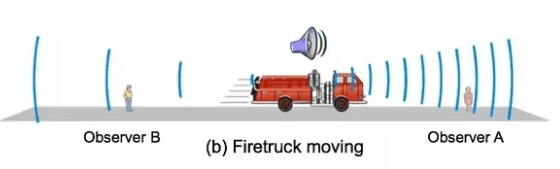
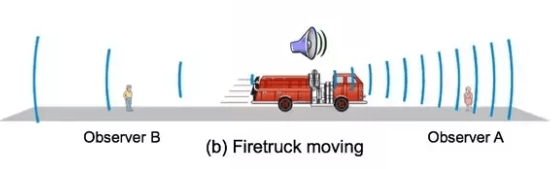
Look at the picture. Who is experiencing a higher pitched sound?
Observer A
Observer B
There's no difference
37
Multiple Choice
Light can change color due to the Doppler Effect.
True
False
38
Multiple Choice
An astronomer looks at a star in the night sky. Based on his calculations the star's light is shifting towards the color blue. What does this mean about the star?
It's moving towards the astronomer
It's moving away from the astronomer
It's not moving at all
39
Multiple Choice
when a noise is moving towards an observer, the closer it comes...
the lower the pitch
the longer the noise
the higher the pitch
the quieter the noise
40
Multiple Choice
Look at the picture. Who is experiencing a lower pitched sound?
Observer A
Observer B
There is no difference
41
Multiple Choice
Galaxies make lots of sound waves.
Galaxies are blue shifted and moving toward us.
Galaxies are redshifted and moving away from us.
No connection. Light waves aren't visible in the universe.
42
Multiple Choice
The Doppler effect applies to light waves as well as sound waves. Astronomers use this to measure the motion of stars and galaxies. In 1929, Edwin Hubble discovered that light from distant galaxies was shifted away from the blue end of the spectrum and towards the red end of the spectrum. Red light has a longer wavelength (and a lower frequency) than blue light. What could Hubble conclude about these galaxies?
The distant galaxies are growing smaller.
The distant galaxies are moving towards the Earth.
The distant galaxies are moving away from earth
43
Multiple Choice
The car below emits sound waves, represented by red circles, that are heard by an observer. Based on the pattern of sound waves, what is the direction and speed of the car?
toward the observer, faster than the speed of sound
toward the observer, slower than the speed of sound
away from the observer, faster than the speed of sound
away from the observer, slower than the speed of sound
44
Multiple Choice
Assuming the speed of sound is 340 m/s, what is the most likely speed of the jet shown below?
200 m/s
500 m/s
100 m/s
340 m/s
45
What happens if we place a droplet of water on the still water?
Show answer
Auto Play
Slide 1 / 45
OPEN ENDED

Similar Resources on Wayground
38 questions
Thermodynamics
Presentation
•
9th - 12th Grade
39 questions
Commas
Presentation
•
9th - 12th Grade
42 questions
Credit Score
Presentation
•
9th - 12th Grade
40 questions
Magnetism
Presentation
•
8th - 11th Grade
37 questions
Intro to Chemical Bonding
Presentation
•
9th - 12th Grade
38 questions
Waves
Presentation
•
9th - 12th Grade
42 questions
Diffraction & Interference of Light
Presentation
•
9th - 12th Grade
41 questions
Interactions between organisms
Presentation
•
9th - 11th Grade
Popular Resources on Wayground
16 questions
Grade 3 Simulation Assessment 2
Quiz
•
3rd Grade
19 questions
HCS Grade 5 Simulation Assessment_1 2526sy
Quiz
•
5th Grade
10 questions
Cinco de Mayo Trivia Questions
Interactive video
•
3rd - 5th Grade
17 questions
HCS Grade 4 Simulation Assessment_2 2526sy
Quiz
•
4th Grade
24 questions
HCS Grade 5 Simulation Assessment_2 2526sy
Quiz
•
5th Grade
13 questions
Cinco de mayo
Interactive video
•
6th - 8th Grade
20 questions
Math Review
Quiz
•
3rd Grade
30 questions
GVMS House Trivia 2026
Quiz
•
6th - 8th Grade
Discover more resources for Physics
11 questions
Electricity Explained
Interactive video
•
9th - 12th Grade
18 questions
Series and Parallel Circuits
Quiz
•
9th Grade
15 questions
waves and wave properties
Quiz
•
9th - 12th Grade
35 questions
Electricity and Magnetism SPS10
Quiz
•
8th - 10th Grade
10 questions
Exit Check 7.1 Intro to Waves
Quiz
•
9th Grade
10 questions
Exit Check 7.2: Electromagnetic Waves
Quiz
•
9th Grade
10 questions
Exit Check 7.3 - Analog and Digital
Quiz
•
9th Grade
18 questions
Unit 1 and 2 Concepts Review
Quiz
•
9th - 12th Grade