

Hess' Law

Presentation
•
Chemistry
•
9th - 12th Grade
•
Hard

Joseph Anderson
FREE Resource
36 Slides • 7 Questions
1

Hess's Law

2
Equation method for Hess’s law


3

4
Match
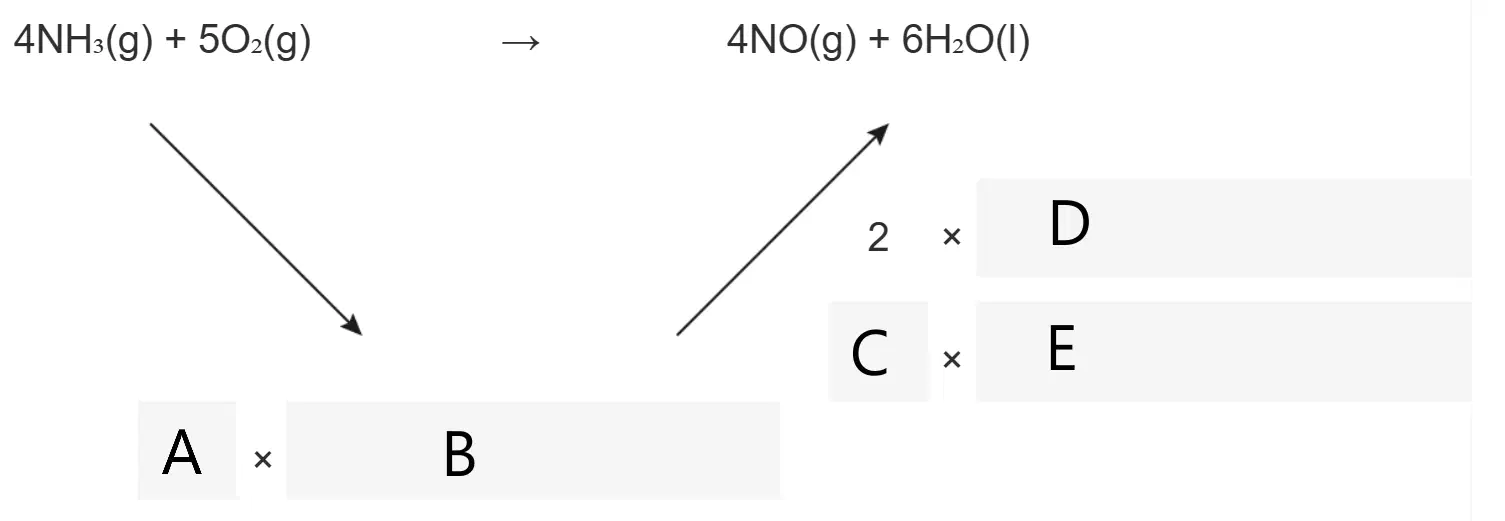
A
B
C
D
E
2
2NH3 (g) -> N2(g) + 3H2(g)
3
N2(g) + O2(g) -> 2NO(g)
2H2 (g) + O2 -> 2H2O(l)
2
2NH3 (g) -> N2(g) + 3H2(g)
3
N2(g) + O2(g) -> 2NO(g)
2H2 (g) + O2 -> 2H2O(l)
5

6


7

8


9

10

11

12

13
2. method: Energy cycle


14
2. method: Energy cycle

15

16

Piemērs, formācijas entalpijas aprēķināšana, jeb entalpijas izmaiņa reakcijai:
6C + 3H2 --> C6H6

17
Piemērs, formācijas entalpijas aprēķināšana, jeb entalpijas izmaiņa reakcijai:
6C + 3H2 --> C6H6

18

19

20
Poll
Can elements exist in their atomic form?
Yes
No
21

22
Bond dissociation enthalpy and mean bond enthalpy
The bond dissociation enthalpy is the energy needed to break one mole of the bond to give separated atoms - everything being in the gas state.
Important! The point about everything being in the gas state is essential. You cannot use bond enthalpies to do calculations directly from substances starting in the liquid or solid state.
23
Multiple Choice
Cik atomi veido saišu entalpiju?
1
2
3
Atkarīgs no situācijas
24
Multiple Choice
bond dissociation enthalpy, to break up 1 mole of gaseous hydrogen chloride molecules into separate gaseous hydrogen and chlorine atoms takes 432 kJ. The bond dissociation enthalpy for the H-Cl bond is:
-432 kJ mol-1.
+432 kJ mol-1.
25
What happens if the molecule has several bonds, rather than just 1?
Consider methane, CH4. It contains four identical C-H bonds, and it seems reasonable that they should all have the same bond enthalpy.
However, if you took methane to pieces one hydrogen at a time, it needs a different amount of energy to break each of the four C-H bonds.
Every time you break a hydrogen off the carbon, the environment of those left behind changes. And the strength of a bond is affected by what else is around it.
In cases like this, the bond enthalpy quoted is an average value.
26
Poll
Is bond breaking exothermic?
Yes
No
27

When you make a bond, as much energy is given out as you needed to break it, but the value is now negative - because we show exothermic changes with negative enthalpy changes.
28

When you are working out the enthalpy change when you are making bonds, you look up the bond enthalpy and reverse the sign.
29

Another example:
30

31
Multiple Choice
Cik molus C-H saites satur 1 mols CH4?
0.25
1
4
5
32
Multiple Choice
In the methane case, you can work out how much energy is needed to break a mole of methane gas into gaseous carbon and hydrogen atoms. That comes to +1660 kJ and involves breaking 4 moles of C-H bonds. Estimate the average bond energy of C-H bond!
103kJ/mol
415kJ/mol
1660kJ/mol
2320kJ/mol
33
Mean (or average) bond enthalpies
In fact, tables of bond enthalpies give average values in another sense as well, particularly in organic chemistry. The bond enthalpy of, say, the C-H bond varies depending on what is around it in the molecule. So data tables use average values which will work well enough in most cases
That means that if you use the C-H value in some calculation, you can't be sure that it exactly fits the molecule you are working with. So don't expect calculations using mean bond enthalpies to give very reliable answers
34

35

36

It is always a good idea to draw full structural formulae when you are doing bond enthalpy calculations. It makes it much easier to count up how many of each type of bond you have to break and make.
A shorter way to calculate:
All that has actually changed is that you have broken a C-H bond and a Cl-Cl bond, and made a new C-Cl bond and a new H-Cl bond. So you can just work those out.
37

38

39
Cases where you have a liquid present

If you have one or more liquids present, you need an extra energy term to work out the enthalpy change when you convert from liquid to gas, or vice versa. That term is the enthalpy change of vaporisation, and is given the symbol ΔHvap or ΔHv.
40

41

42

43

Hess's Law
Show answer
Auto Play
Slide 1 / 43
SLIDE
Similar Resources on Wayground

40 questions
Environmental interactions terms
Presentation
•
9th - 12th Grade
35 questions
Autentico 2A Grammar
Presentation
•
9th - 12th Grade
36 questions
Chemistry: Unit 1 Module 2 - What is Chemistry
Presentation
•
9th - 12th Grade
40 questions
Chemical Bonding
Presentation
•
8th - 11th Grade
38 questions
Final Review #1
Presentation
•
10th - 12th Grade
37 questions
Review: Measurement and Sig Figs
Presentation
•
10th - 12th Grade
35 questions
Unit 2 Lesson 1: Classification of Matter
Presentation
•
10th - 12th Grade
Popular Resources on Wayground
6 questions
Secondary Safety Quiz
Presentation
•
9th - 12th Grade
10 questions
MyPath Diagnostic Overview
Presentation
•
6th - 8th Grade
20 questions
Lab Safety Quiz

Quiz
•
6th Grade
21 questions
Continents and Oceans
Quiz
•
6th Grade
20 questions
Adding and Subtracting Decimals
Quiz
•
5th Grade
20 questions
Parts of Speech
Quiz
•
5th Grade
16 questions
Subject & Predicate
Quiz
•
5th Grade
21 questions
Lab Safety
Quiz
•
10th Grade
Discover more resources for Chemistry
21 questions
Lab Safety
Quiz
•
10th Grade
20 questions
Lab Equipment and Safety Quiz
Quiz
•
10th - 12th Grade
20 questions
Scientific Method
Quiz
•
10th - 12th Grade
20 questions
Lab Safety
Quiz
•
10th Grade
20 questions
Metric Conversions
Quiz
•
11th Grade
12 questions
Significant figures
Quiz
•
9th - 12th Grade
20 questions
Lab Safety and Lab Equipment
Quiz
•
9th - 12th Grade
16 questions
ACA Unit 1 Atomic Structure
Quiz
•
9th - 12th Grade