
Immigration at Ellis Island

Presentation
•
English
•
8th Grade
•
Hard

Joseph Anderson
FREE Resource
4 Slides • 7 Questions
1

Island of Hope
2
What role did
Ellis Island
play in America's history?
3

4
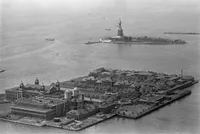
Ellis Island sits quietly in New York Harbor. For many years it was a beacon of hope for new immigrants. People came to America from around the world, searching for a better life. Some were fleeing poverty; others were seeking freedom from religious persecution. Reaching Ellis Island and the Statue of Liberty were a sign to immigrants they had arrived in America and could begin their new lives. For some of the 12 million people who passed through Ellis Island between 1892 and 1954, this was true. They were processed and admitted in just a few hours. Others had a much different experience.
The trip across the Atlantic Ocean was difficult, especially for passengers in third class, or steerage. People were often tired and sick when they arrived. They had spent several weeks aboard a large, crowded ship. First and second-class passengers had an easier time. If they passed a health check on board the ship, they would be quickly processed and released. The third-class passengers had to wait much longer sometimes, even days. When they did finally leave the ship, they were given identity tags and told to head for the main building on Ellis Island.
This was often a time of great confusion. Following directions in a language you don't understand is difficult! The passengers carry their most important belongings the items they had chosen to make the long trip across the ocean with them. They were tired, they were anxious, and they were often young children or elderly parents to keep track of.
On the way to the Great Hall (officially known as the Registry Room), doctors watched the immigrants as they waited in line. They looked for people who were having any sort of difficulty that could indicate they were ill. In the large, noisy room, the immigrants had to pass a health inspection. One of the worst parts was having your eyelid lifted by a tool called a buttonhook so that doctors could check for a contagious eye disease.
Immigrants who needed further inspection had a letter marked with chalk on their clothing. The letter indicated what sort of problem they were suspected of having. Immigrants who passed the health inspection were sent on to have their legal inspection. The big worry, of course, was separation. What if you passed the health inspection but your child or spouse did not?
At the next stop, immigrants were asked a series of questions, such as where they were born, where they were married, what sort of work did they do, how much money did they have, and so on. Their answers needed to match the answers on the list, or manifest, from the ship. Many people were admitted to the United states after passing the necessary requirements, that many were also detained. Some were immediately sent back to their home countries, while others spent days, or even months, in the Infirmary. Their cases would eventually be reviewed again and a decision would be made as to whether or not they could stay in America. About 3000 immigrants died on Ellis Island, and about 2% were denied entry into the United states.
For the fortunate immigrants who were given permission to stay, social workers were on hand to offer help as people made their way in a new and foreign country. They often met relatives at the kissing post, a column outside the Great Hall, where the new immigrants were reunited with friends and family.
The last immigrant passed through Ellis Island in 1954. Today, you can visit the museum and learn about the history of a place that played a role in the lives of so many American immigrants. In fact, about 40% of Americans today can trace at least one ancestor to Ellis Island. Are you one of them?
5
Open Ended
In paragraph one, what does the author mean by saying that Ellis Island was "a beacon of hope?"
6
Open Ended
How was the experience of third class passengers different from first and second class passengers?
7
Open Ended
Do you feel that it was fair or just for officials to detain passengers who were thought to be weak or ill? Why or why not?
8
Open Ended
What were Ellis Island and the Statue of Liberty a sign of for immigrants?
9
Open Ended
Even if a passenger did not pass the health inspection, he or she would be sent home.
Is this a true or false statement, provide evidence of your answer from the pair from the story.
10
Open Ended
What was the author's purpose in writing this article?
11
Open Ended
What are 4 adjectives you could use to describe how immigrants may have felt as they passed through Ellis Island?
Island of Hope
Show answer
Auto Play
Slide 1 / 11
SLIDE
Similar Resources on Wayground

8 questions
Standard Form to Scientific Notation
Presentation
•
8th Grade
10 questions
Revision for Vocab/Spelling Assessment 1 Term 2
Presentation
•
7th Grade
10 questions
Common and Proper Nouns
Presentation
•
8th Grade
10 questions
Freytag's Pyramid Practice
Presentation
•
8th Grade
9 questions
Asking and Giving Opinion
Presentation
•
8th Grade
9 questions
Study Skill: Annotations
Presentation
•
8th Grade
8 questions
Separating Adjectives
Presentation
•
7th - 8th Grade
8 questions
Product of Powers vs Power of Powers
Presentation
•
8th Grade
Popular Resources on Wayground
20 questions
Math Review

Quiz
•
3rd Grade
15 questions
Fast food
Quiz
•
7th Grade
20 questions
Context Clues
Quiz
•
6th Grade
20 questions
Inferences
Quiz
•
4th Grade
19 questions
Classifying Quadrilaterals
Quiz
•
3rd Grade
20 questions
Figurative Language Review
Quiz
•
6th Grade
20 questions
Equivalent Fractions
Quiz
•
3rd Grade
10 questions
Identify Fractions, Mixed Numbers & Improper Fractions
Quiz
•
3rd - 4th Grade
Discover more resources for English
41 questions
The Outsiders Test Review (Chapters 1-12)
Quiz
•
8th Grade
22 questions
Revise and Edit Final Review 3
Quiz
•
8th - 12th Grade
20 questions
Reading EOG Review
Quiz
•
6th - 8th Grade
10 questions
Test Your Knowledge of Junk Food Trivia

Interactive video
•
6th - 8th Grade
27 questions
EOG Words to Know
Quiz
•
6th - 8th Grade
38 questions
8th Grade Reading SOL Review
Quiz
•
8th Grade
45 questions
LOTF Chapters 1-12 Quiz
Quiz
•
8th - 11th Grade
20 questions
Romeo and Juliet Acts I-V
Quiz
•
8th Grade