

Redox Reactions

Presentation
•
Science
•
10th Grade
•
Hard

Joseph Anderson
FREE Resource
142 Slides • 4 Questions
1

2
3

There are four meanings for oxidation and reduction.
4
Reactions in which electrons are transferred from one species to another. Let’s see this in an experiment.

5

Zn is undergoing oxidation (losing electrons):
Zn(s) → Zn2+(aq) + 2e-
Cu2+ is undergoing reduction (gaining electrons):
Cu2+ + 2e- → Cu(s)
6

Recall, by definition ionic compounds are formed from a transfer of electrons.
7
Covalent compounds involve sharing of electrons.
When a more electronegative atom bonds with a less electronegative atom, the shared electrons spend more time closer to the more electronegative atom (so we say the electronegative atom “gained” these electrons).
8
Oxidation numbers are like an accounting system to keep track of electrons.
A + oxidation number means lost electrons (oxidation).
+2 means 2 electrons lost.
A - oxidation number means gained electrons (reduction),
-2 means 2 electrons gained.
9

10

11


Hint: Remember Rule 1!
Compounds add up to their charge (which is zero if ineutral).
So in NaF, you assign -1 to F first.
Then think algebraically, letting x be Na's oxidation number.
x + (-1) = 0
x = +1
12


13

14


Hint: If there is a polyatomic ion (common ones listed below), it is faster to deduce oxidation numbers by thinking of which ions were criss-crossed to give the formula of the compound.
Your teacher will demonstrate for Co(ClO)2
15

16

17

More Practice: Remember the tip about polyatomic ions that is faster.
18

19
You Try: 13, 16, 19

20
21
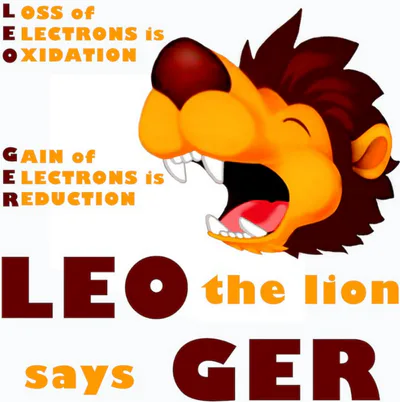
Oxidizing/Reducing Agents
A common way to remember this:
22

By finding changes in oxidation numbers, you can determine the following:
23

24

25

C2H2 is the reducing agent; O2 is oxidizing agent.
PbS is the reducing agent; O2 is oxidizing agent.
H2 is the reducing agent; O2 is oxidizing agent.
26

Cu is reducing agent; HNO3 is oxidizing agent
Cu is reducing agent; AgNO3 is oxidizing agent
27
#2, 4, 7, 9, 11, 12, 14, 15, 17, 18, 20 - 24, 26 - 36.

28

If there is no change in oxidation numbers, the reaction is not a redox reaction. Neutralization and double displacement reactions are examples of non-redox reactions:
29
You Try: #10
Answer B.
30

31
32

33

Recall: Spectator ions are ions that are present in both the reactants and products (ie, they didn't react).
34


35


36
A balanced chemical reaction needs to meet two requirements:


37
In some cases, we can balance charges by added electrons as reactants or products.

38
Method:
Add coefficients to balance the atoms first.
Count charges on both sides (taking into account coefficients)
Add electrons to balance the charges.

39

40
In acidic solutions, the charges may be balanced by incorporating ions from the solution. We use the CaWHe method to balance these.

41

Example: Balance Cr2O72- → Cr3+
42

43


44
You Try: MC 53, 54, 56
Written: 9


45
The examples previous to this have been balancing one half-reaction only (ie, oxidation or reduction). To balance full reactions, we need to apply CaWHe to both half-reactions.
46

47

48
You Try:
Written #14 - 18, 21 - 25, 27
Check answers in your printout.
49


50

Example: Balance Cr2O72- → Cr3+ in basic solution.
51

52

53


54

55

56
You Try:
Written #10 - 13 are balancing just half-reactions.
#20, 26, 28, 29 are balancing full equations.
Check answers in your printout.
57
Just like with acids and bases, we can do titrations with redox titrations because some redox titrations involve a color change (without any need for an indicator like in acid/base titrations).
58

Just like with acids and bases, we can do titrations with redox reactions because some redox reactions involve a color change (without any need for an indicator like in acid/base titrations).
Transition Metals
Usually change color when their oxidation state changes.
Note: We will do this as an experiment later.
59
Formation/Disappearance of some non-metals:
Br2 (brown) ⇆ Br- (colorless)
I2 (purple) ⇆ I- (colorless) or I3- (yellow)
S or S8 (yellow ppt) ⇆ S2- (colorless)

60

61

62

63

64

65


66

67
68
Written #30 to 35.
69
Recall oxidizing agents are chemicals that cause other chemicals to lose electrons (oxidize). Oxidizing agents undergo reduction by gaining electrons.
In your data booklet, the left side shows oxidizing agents with a ranking.
The strongest oxidizing agent is F2 (which makes sense as F is the most electronegative)

70
Recall reducing agents are chemicals that cause other chemicals to gain electrons (reduce). Reducing agents undergo oxidation by losing electrons.
In your data booklet, the right side shows reducing agents with a ranking.
The strongest reducing agents are metals since metals lose their electrons more easily.
71
If asked to rank oxidizing agents and reducing agents that are in the data booklet, simply follow the arrows to rank them.
72
Note: Some chemicals appear twice. For example, Sn2+ has two entries, one where it acts as an oxidizing agent and one where it acts as a reducing agent. There are others, can you find them?

73
Multiple Choice
Example: Which of the following is the strongest reducing agent (or in other words, which is most likely to oxidize / lose electrons?)
F-
Cr2+
Mg
Cs
74
Multiple Choice
Which of the following is the weakest reducing agent (or in other words, which is most likely to oxidize / lose electrons?)
A. F-
B. Cr2+
C. Mg
D. Cs
75
Multiple Choice
Which of the following is the weakest oxidizing agent (or in other words, which is most likely to reduce / gain electrons?)
MnO2 + H+ (also called acidified MnO2)
Br2
Pb2+
D. S2O8-
76
Multiple Choice
Which of the following is the strongest oxidizing agent (or in other words, which is most likely to reduce / gain electrons?)
MnO2 + H+ (also called acidified MnO2)
Br2
Pb2+
D. S2O8-
77
You Try:
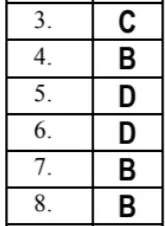
#3, 5, 6, 8, 38, 39


78
By reacting metals in solutions of other metal ions, we can rank their relative reactivities. “The more reactive becomes an ion”

79

Explanation:
Since zinc does not deposit onto the copper, it tells us zinc is more reactive (which in the case of metals means zinc loses its electrons more easily than copper).
Since Zn2+ has already lost its electrons, it will stay as an ion dissolved in the solution.
Observations: No reaction. Nonspontaneous.
80

81
Explanation:
Zn is more reactive, so becomes an ion by losing its electrons to the less reactive Cu2+ ions.
When Cu2+ in the solution gains electrons from the Zn, it forms elemental Cu and deposits as a solid metal.
As the Zn loses electrons and forms Zn2+, the ions dissolve into the water, so the Zn metal becomes smaller.
Since Cu2+ gives the solution a blue color, as it is removed from solution, the color changes to be lighter blue (or clear if all the Cu2+ deposits as Cu).
Spontaneous.


82

83

84
You Try:
#37, 40, 44
Written #4, 5


85

A more reactive metal displaces the less reactive metal.

86

87
In some questions, they may simply tell you the chemical equations and you need to deduce the reactivity from this.
88


We can also combine our data booklet with our knowledge of writing reactions to predict what will happen.
Example:
Cu2+ + Zn -> Zn2+ + Cu will occur as we know Zn is more reactive than Cu.
Zn2+ + Cu -> Cu2+ + Zn will not occur.
89
#41, 45 - 47

90
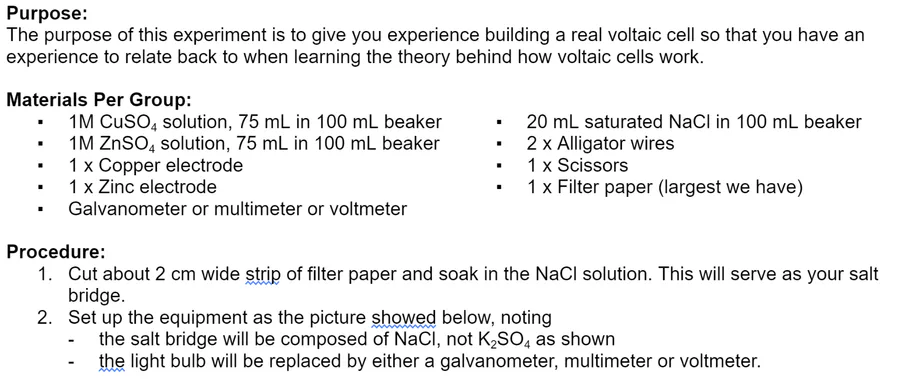
An electrochemical cell that converts chemical energy from redox reactions into electrical energy. For example, batteries are primary voltaic cells when discharging:

91
92


93
Cathode and anode of a voltaic cell: Use the data booklet’s ranking of reducing agents. The stronger reducing agent will oxidize (lose electrons) and be the anode. The other will reduce (gain electrons) and be the cathode.

LEO is A GERC
Lose Electrons Oxidation Anode, Gain Electrons Reduction Cathode
94
Positive and negative electrodes:
Anode is negative and the cathode is positive in primary cells (opposite for electrolytic cells, which we will cover in the future).
Electron flow is from the anode to cathode (from more reactive metal to less reactive metal).
95
The purpose of the salt bridge:
Complete the circuit, allowing ions to migrate.
To maintain electrical neutrality of the solutions. As negative electrons leave the anode, negative ions from the salt bridge replace the lost negative charges. As negative electrons enter the cathode, positive ions from the salt bridge cancel them out.
96
Choosing a Salt for Salt Bridge: A soluble ionic compound containing:
- an alkali metal (because their ions are weak oxidizing agents and won’t preferentially take electrons compared to the metal ion in the cathode solution).
- an anion that won't form a precipitate with the other ions (nitrate is safest).
97
Choosing a suitable solution for the anode and cathode:
Look at what the electrode (anode or cathode) is made of and choose a soluble ionic compound containing the same metal. Ie, Zn anode could be in a solution of Zn(NO3)2, while Cu could be in a solution of Cu(NO3)2.
98
Observations:
Cathode: An increase in mass. If the solution is colored, it will become paler over time.
Anode: A decrease in mass. If the solution is colored, it will become darker over time.
99
Writing Half-Reactions:
Cathode: Write reduction half-reaction as written in the data booklet.
Anode: Flip the half-equation in the data booklet to make it oxidation.
100
Writing net (overall) reaction:
Add the half reactions together, multiplying them if necessary to make electrons equal so that they cancel out.

101

102
You Try:
#64 - 68, 71 - 72, 74, 75, 77, 78, 80, 81, 83

103
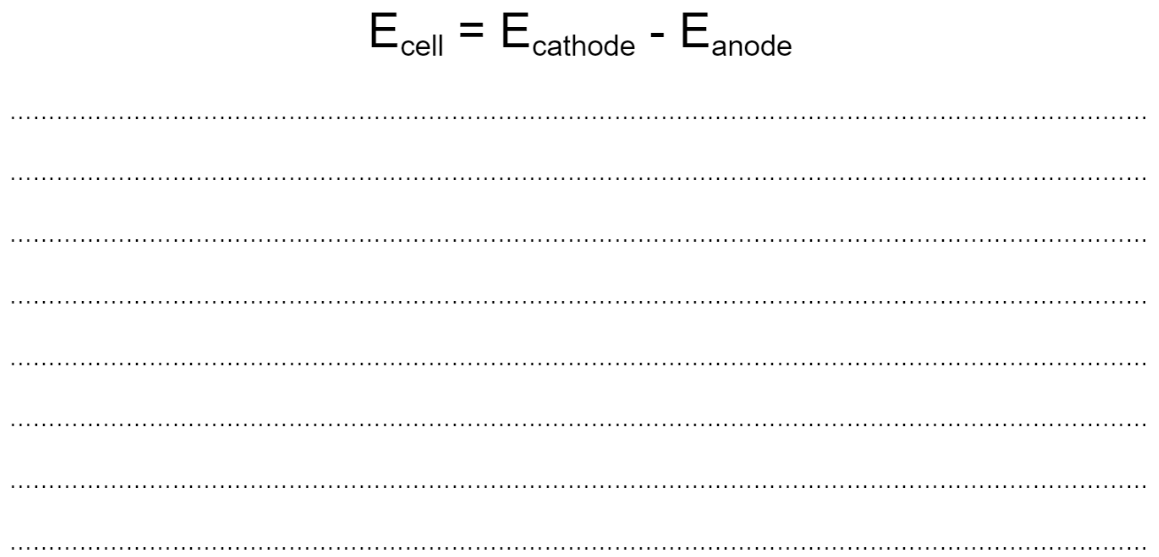
Also called electric potential or electromotive force, measures how strongly electrons want to flow. The higher the voltage is, the greater the flow of electrons (called current) in a circuit can be. We often use the analogy with water to understand it.

104
Summarize the example from the video showing how we use the formula:
105
106

Ans: 2.46 V
107
If the Ecell is positive, the reaction will happen spontaneously. If it is negative, it is nonspontaneous and would only happen if you set it up as an electrolytic cell (we will cover later)
Example: Zn as anode.
Zn2+ + 2e- --> Zn, E = -0.76 V
Cu2+ + 2e- --> Cu, E = +0.34 V
Ecell = 0.34 V - (-0.76 V) = 1.10V
Spontaneous because positive.
Example: Cu as anode.
Zn2+ + 2e- --> Zn, E = -0.76 V
Cu2+ + 2e- --> Cu, E = +0.34 V
Ecell = -0.76 V - (0.34 V) = -1.10V
Non-spontaneous because negative.
108
You Try:
#70, 73, 76, 79 82, 84, 85, 88 - 94.

109
Fuel cells are a primary cell that work like batteries, but they do not run down or need recharging. They produce electricity and heat as long as fuel is supplied. The hydrogen fuel cell emits water only and some new cars are made using hydrogen fuel cells.

110
Convert electrical energy by bringing about non-spontaneous reactions using an external voltage source. Below we will summarize the key differences.
111

112


113

Cathode
Cathode
Anode
Anode
114

Electrolysis of water with a small amount salt (to allow conduction). Set up a circuit as shown below and connect it to a 9V battery.
What do you notice about the volume of the gases in each test tube?
115
116
We can extract pure metals or gases from compounds.
117
We can coat cheaper metals with more expensive metals to lower cost.
We will do this later.

118
Called secondary cells, these reverse the chemical reaction that produces electricity when the battery is running.

119
Purifying extracted metals.

120
Whichever electrode you connect to the negative terminal (where the electrons come out) of the power source (ie, battery) will always be the cathode and therefore negatively charged. The anode is positive.

121
122


123

124

125
You Try:
#105, 109, 118 - 120

126
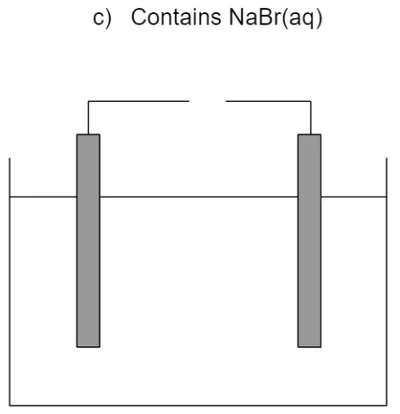
Aqueous solutions are more complex than electrolysis of molten salts.
This is because there are only 2 ions in molten salts, but in aqueous solutions we have 2 ions and water.
Water will sometimes react instead of the ions. As a result, depending on the ions dissolved, hydrogen gas (H2) can form at the cathode and oxygen (O2) can form at the anode.
127
Note: Water has multiple entries in the table of reduction potentials in the data booklet. Cross out the ones we will not be using.

128

Note: Water has multiple entries in the table of reduction potentials in the data booklet. Cross out the ones we will not be using.
129


130

131

132
133
You Try:
#106 - 108, 110, 111, 113

134

This is when you want to plate a metal onto the cathode (negative).
Solution: contains the ion of the metal you want to plate.
Anode: The same metal you want to plate (although inert is possible too)


135
Observations in Electroplating: You should observe that:
The anode loses mass over time.
The cathode gains mass over time.
The solution should remain a constant color (if colored) because as an ion is deposited at the cathode, another replaces it at the anode.
136
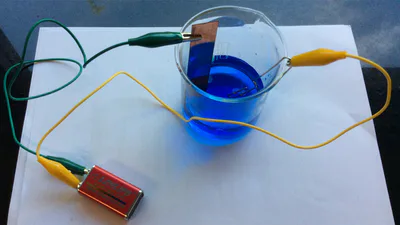
Let’s plate part of a paperclip with copper. You can bend it into a certain shape if you like first. When you have the shape you want, use the materials below to set up your circuit as shown in the photo.

137

138
You Try:
Multiple Choice #112, 114, 115
Written #56, 57 Check answers in printout.

139

Corrosion is an oxidation reaction in which metals lose electrons to oxygen in the air, forming oxides (ionic compounds). The metal can be considered the anode since it oxidizes.
Rust: Iron Oxides and Hydroxides
Ie, Fe + O2 → Fe2O3
Or the half-reaction:
Fe → Fe2+ 2e-
Rust is special in that it flakes off, exposing more iron under the surface to react too. Thus rust can completely degrade a metal.
140

Silver Oxide
Ie, Ag + O2 → AgO
Or the half-reaction: Ag → Ag+ + e-
Metals aside from iron form a protective oxide layer over the surface, which can be removed if needed.
141
There are 3 main ways to prevent corrosion, some are physical and some are chemical.
Painting (Physical)
The paint layer acts as a physical barrier, preventing oxygen from reaching the metal.

142
143

A more reactive metal replaces any electrons that iron may lose as it is in the water and reacting with oxygen, preserving the iron.
The reactive metal is called a sacrificial anode because when it loses electrons, it forms an ion and dissolves. So they must be replaced during maintenance.
144

145

Galvanizing is dipping iron into zinc (Zn is more reactive). The Zn then reacts with oxygen to form ZnO. The ZnO is a protective barrier (similar to paint) that prevents iron from reacting with oxygen.
146
You Try:

#98 - 103
Show answer
Auto Play
Slide 1 / 146
SLIDE
Similar Resources on Wayground

151 questions
Electron Configuration Gizmo
Presentation
•
10th Grade
137 questions
Topic 2.2-Electromagnetic Force-TN Standard: 8.PS2-2-Master
Presentation
•
8th Grade
141 questions
Ch. 12 L. 3 DNA, RNA, & Protein (transcription & translation)
Presentation
•
9th - 12th Grade
143 questions
F5 Revision Module Set 1 L27
Presentation
•
9th Grade
144 questions
Market Revolution Notes
Presentation
•
9th - 12th Grade
144 questions
3. Quarter 3 : W 5 & 6_ M3_Learning from Others and Reviewing
Presentation
•
11th Grade
132 questions
1GENBIO2 - GENETICS
Presentation
•
11th Grade
148 questions
Vocabulario Navideño - Ir + a + infinitivo
Presentation
•
9th - 12th Grade
Popular Resources on Wayground
10 questions
Safety Day 2026 – Student Review

Quiz
•
9th Grade
21 questions
Continents and Oceans
Quiz
•
6th Grade
20 questions
Parts of Speech
Quiz
•
5th Grade
16 questions
Subject & Predicate
Quiz
•
5th Grade
25 questions
Multiplication Facts
Quiz
•
5th Grade
12 questions
Map Skills
Quiz
•
3rd Grade
22 questions
Continents and Oceans
Quiz
•
5th Grade
15 questions
Rounding Decimals
Quiz
•
5th Grade
Discover more resources for Science
10 questions
Exploring Chemical and Physical Changes

Interactive video
•
6th - 10th Grade
10 questions
Exploring the Electromagnetic Spectrum for Middle School Science
Interactive video
•
6th - 10th Grade
10 questions
Exploring Force and Motion Concepts
Interactive video
•
6th - 10th Grade
10 questions
Exploring Air Masses and Weather Fronts
Interactive video
•
6th - 10th Grade
10 questions
Exploring the States of Matter
Interactive video
•
6th - 10th Grade
10 questions
Exploring Forces: Net Force, Normal Force, Gravity, and Friction
Interactive video
•
6th - 10th Grade
10 questions
Differentiating Thermal Energy and Temperature
Interactive video
•
6th - 10th Grade
10 questions
Exploring the States of Matter and Thermal Energy
Interactive video
•
6th - 10th Grade