Search Header Logo
Work, Power, and Simple Machines

Work, Power, and Simple Machines

Assessment

Presentation

Physics

12th Grade - University

Hard

Created by

Joseph Anderson

FREE Resource

67 Slides • 45 Questions

1

Work, Energy and Power

by Ronnie Lorilla

2

Multiple Choice

Question image

What is energy?

1

It is a form of heat

2

It is the capacity to burn coal

3

It is the ability to do work or to produce transformations

4

It is a property of the matter used to meassure forces

3

Open Ended

What is work?

4

Work, defined

  • Work carries a specific meaning in physics Simple form: work = force × distance

    W = F · d

    Work can be done by you, as well as on you Are you the pusher or the pushee Work is a measure of expended energy Work makes you tired Machines make work easy (ramps, levers, etc.) Apply less force over larger distance for same work

5

media

6

Kinetic Energy

media

7

Kinetic Energy

Mass in Motion

media

8

K.E. = ½mv2

  • The kinetic energy for a mass in motion is K.E.

  • Example: 1 kg at 10 m/s has 50 J of kinetic energy

  • The ball dropped from rest at a height h (P.E. = mgh) hits the ground with speed v. After ball falls, no PE left, all energy is now KE. Expect mgh =½mv2

9

Multiple Choice

Question image

Suppose a cart has a kinetic energy of 0.5 J. If you add enough mass to double the mass and make the cart go three times as fast, its kinetic energy is now ---.

1

6 J

2

3 J

3

18 J

4

9 J

10

Multiple Choice

Question image

Two equal mass marbles are at the top of a ramp. One marble falls to the ground off the back while the other rolls down the ramp. What is true about the marbles when they reach the ground?

1

The marble that rolled down the ramp is moving faster than the marble that fell.

2

The marble that fell down the back of the ramp is moving faster than the marble that rolled.

3

The marble that rolled down the ramp is not moving when it reaches the ground.

4

The two marbles are moving with the same speed.

11

Multiple Choice

Kinetic energy is associated with ---.

1

speed

2

position

3

direction

4

temperature

12

media

13

media

14

Gravitational Potential Energy

15

media

16

Work and Power

media

17

Multiple Choice

Energy stored because of gravity is called:

1

Gravitational Potential Energy

2

Kinetic Energy

3

Mechanical Advantage

4

Chemical Energy

18

Multiple Choice

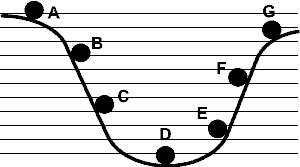
Question image

At which point does the ball has the greatest gravitational potential energy (GPE)?

1

A

2

G

3

D

4

C

5

G

19

Multiple Choice

Which would have the LEAST gravitational potential energy (GPE)?

1

A ball sitting on the ground

2

Moon viewed from the Earth

3

An airplane flying 30,000 feet above the ground

4

A rock sitting on top of Mt. Everest

20

Multiple Choice

How could you increase the gravitational potential energy of an object without changing its mass and gravity?

1

Make the object larger

2

Lower the object towards the ground

3

Raise the object farther off the ground

4

Allow the object to roll on the ground

21

Multiple Choice

When does a yo-yo have the most potential energy?

1

When it's at its highest point.

2

When it's at its lowest point.

3

When it's moving between its highest and lowest points.

4

When it's moving at its top speed.

22

Power

Power is the rate at which something does work over a period of time

media

23

media

24

media

25

media

26

Power units

  • The unit of power is watts.

  • 1 watt = 1 joules divided by seconds.

media

27

media

28

What is power in physics?

  • In science and engineering, Power is the time rate of doing work or delivering energy, expressible as the amount of work done W, or energy transferred, divided by the time interval (Power=W/t)

  • The rate of energy transfered.

media

29

media

30

media

31

media

32

media

33

Multiple Choice

What is the equation used for calculating power from force and velocity

1

Power = force/velocity

2

Power = force * velocity

3

Power = force + velocity

4

Power = velocity / force

34

Multiple Choice

Standard unit for Power

1

Ampere

2

Newton

3

Joule

4

Watt

35

Multiple Choice

To solve for power, we use the formula: Power = Work divided by _________.

1

Velocity

2

Force

3

Distance

4

Time

36

Multiple Choice

In physics, power is the rate at which _________ is used.

1

Current

2

Speed

3

Energy

4

Force

37

Multiple Choice

If a person does the same amount of work as someone else in half the time, which of the following is true?
1
they did twice the work
2
they did half the work
3
they have twice the power
4
they have half the amount of power

38

Multiple Choice

It takes work to lift a rock. How much work does it take to lift a rock 3 times higher?
1
three times as much
2
two times as much
3
four times as much
4
ten times as much

39

Multiple Choice

Power is
1
the ability to do work.
2
the rate at which work is done.
3
the force applied to an object for a distance.
4
none of the above.

40

Multiple Choice

Which requires more power – a person walking up stairs or a person running up stairs?

1

walking

2

running

3

they require equal power output

4

no power is required at all

41

Multiple Choice

Which requires more work – a person walking up stairs or a person running up stairs?

1

walking

2

running

3

they require equal work

4

no work is required for either because the movement is vertical

42

Multiple Choice

The ( ) the force the ( ) work is done

1

less, more

2

smaller, more

3

bigger, more

4

bigger, less

43

Multiple Choice

The unit used to measure power is the 
1
Watt
2
Newton
3
Joule
4
Newton*meter

44

Multiple Choice

How much time is needed to produce 720 Joules of work if 90 watts of power is used? 
1
0.125 s
2
8 s
3
64800 s
4
80 s

45

Multiple Choice

Person A and Person B are both using the same amount of work to lift something. Person A takes half as much time to do it. Who has greater power.

1

Person A

2

Person B

46

Multiple Choice

Question image
Which of the following would produce the most power?
1
A mass of 10 kilograms lifted 10 meters in 10 seconds 
2
A mass of 10 kilograms lifted 10 meters in 5 seconds
3
A mass of 5 kilograms lifted 10 meters in 5 seconds
4
A mass of 5 kilograms lifted 5 meters in 10 seconds

47

Multiple Choice

Question image
You move an 8-newton weight five meters in 4 seconds. How much power have you generated?
1
160 watts
2
10 watts
3
6.4 watts
4
17 watts

48

media

49

media

50

media

51

media

52

media

53

media

54

media

55

media

56

media

57

Mechanical Advantage

A measure of the ratio of output force to input force in a system, used to analyze the forces in simple machines like levers and pulleys. Despite changing the forces that are applied the conservation of energy is still true and the output energy is still equal to the input energy. Typically the mechanical advantage is expressed in ideal terms, where there is no losses in energy between the input and output times, also known as 100% efficient systems. No machine can never do more mechanical work than the mechanical work put into it.

58

media

59

media

60

media

61

media

62

media

63

media

64

media

65

media

66

media

67

media

68

media

69

media

70

media

71

media

72

media

73

Work, Power and Machines AMA and IMA

I can understand work, input, output and simple machines.

media

74

Background on Simple Machines:

A machine is a device that does work. Most machines consist of a number of elements, such as gears and ball bearings, that work together in a complex way. Nonetheless, no matter how complex they are, all machines are based in some way on six types of simple machines.

media

75

Fill in the Blank

A machine is a device that does ________.

76

The 6 simple machines are:

the inclinded plane

the lever

the screw

the wedge

the wheel and axle

the pulley

media

77

Principles of Simple Machines:

*Machines simply transmit mechanical work from one part of a device to another part. 

*A machine produces force and controls the direction and the motion of force, but it cannot create energy.

*A machine's ability to do work is measured by two factors. These are (1) mechanical advantage and (2) efficiency.

media

78

Mechanical Advantage

A measure of the ratio of output force to input force in a system, used to analyze the forces in simple machines like levers and pulleys. Despite changing the forces that are applied the conservation of energy is still true and the output energy is still equal to the input energy. Typically the mechanical advantage is expressed in ideal terms, where there is no losses in energy between the input and output times, also known as 100% efficient systems. No machine can never do more mechanical work than the mechanical work put into it.

79

Multiple Choice

Machanical Advantage is the ratio of ________ to _______ in machines.

1

starting time to ending time

2

height to length

3

input force to output force

4

potential force to kinetic force

80

Efficiency

*The efficiency of a machine is the ratio between the work it supplies and the work put into it.

*The efficiency of a machine is the ratio between the work it supplies and the work put into it.

*A lever has a high efficiency due to the fact that it has low internal resistance. The work it puts out is almost equal to the work it receives, because energy used up by friction is quite small. 

*On the other hand, an a pulley might be relatively inefficient due to a considerably greater amount of internal friction.

81

Fill in the Blank

No simple machine can be 100% efficient because of ______________.

82

Inclined Plane

 The inclined plane is a simple device that hardly looks like a machine at all. The mechanical advantage increases as the slope of the incline decreases. But the load will then have to be moved a greater distance.

media

83

Inclined Plane

The ideal mechanical advantage (IMA) of an inclined plane is the length of the incline divided by the vertical rise, the so-called run-to-rise ratio. The mechanical advantage increases as the slope of the incline decreases, but then the load will have to be moved a greater distance. L = Length of the incline and h = distance of resistance.

media

84

Fill in the Blank

Question image

What is the IMA of this ramp? Remember: IMA = Distance effort (L) / Distance resistance (h)

85

Fill in the Blank

Question image

What is the IMA of this ramp? Remember: IMA = distance effort (L) / Distance resistance (h)

86

AMA of an Inclined Plane

Actual Mechanical Advantage AMA

  • Actual machines have friction.
  • They do not have as high of a mechanical advantage as ideal machines because some of the effort is lost in overcoming friction.
  • AMA = actual measured resistance force actual measured effort force 
media

87

Fill in the Blank

Question image

Calculate the AMA of the ramp below. Remember: AMA = Force resistance/Force effort

88

Efficiency

Efficiency. The efficiency of a machine is the ratio between the work it supplies and the work put into it. 


Efficiency = AMA/IMA x 100

media

89

Fill in the Blank

Question image

Determine the efficiency based on the following diagram.

90

MA of Levers

A lever is a bar resting on a pivot. Force (effort) applied at one point is transmitted across the pivot (fulcrum) to another point which moves an object (load).

media

91

IMA of Levers

The ideal mechanical advantage (IMA) - ignoring internal friction - of a lever depends on the ratio of the length of the lever arm where the force is applied divided by the length of the lever are that lifts the load. The IMA of a lever can be less than or greater than 1 depending on the class of the lever. There are three classes of levers, depending on the relative positions of the effort is applied, load, and fulcrum.

media

92

Calculating the IMA of a lever

*Determine the effort distance from the fulcrum

*Determine the resistance distance from the fulcrum

*Divide the Effort distance by the Resistance distance\

*IMA = dE/dR

media

93

Fill in the Blank

Question image

Determine the IMA for the following lever.


Remember IMA= dE/dR.

94

Fill in the Blank

Question image

Determine the IMA for the following lever.


Remember: IMA = dE / dR

95

AMA of levers

The differences between the three types of levers, is the location of the fulcrum to the input force and output force. Regardless of the type of lever, they all use the same equations to find AMA and IMA. The general formula for the actual mechanical advantage (AMA) of levers: AMAlever = Fo(output force) Fi (input force)  also written as AMA = resistant force (weight of object) / effort force

media

96

Fill in the Blank

Question image

Find the AMA of the following lever.


Remember: Resistance force (weight of the object) / effort force

97

Fill in the Blank

Question image

Find the AMA of the following lever:


Remember: AMA= resistance force (weight of the object) / effort force

98

Finding the efficiency of a lever

Efficiency = AMA/IMA x 100

99

Efficiency of Levers

Find the AMA = Fo / Fi = 45N/57.7N= 0.78

Find the IMA = dE / dR = 5.8m/6.3m= 0.92

Efficiency = AMA/IMA x 100 = .078/0.92 x 100 =

media

100

Multiple Choice

Question image

Find the AMA = Fo / Fi = 45N/57.7N= 0.78

Find the IMA = dE / dR = 5.8m/6.3m= 0.92

Efficiency = AMA/IMA x 100 = .078/0.92 x 100 =

1

80%

2

84.8%

3

92%

4

78.3%

101

Mechanical Advantage of Pulleys

In a pulley, the ideal mechanical advantage is equal to the number of rope segments pulling up on the object. The more rope segments that are helping to do the lifting work, the less force that is needed for the job.

media

102

Mechanical Advantage of Pulleys

In a pulley, to find the amount of force each rope holds, divide the total force by the total number of support ropes.

media

103

Fill in the Blank

Question image

Determine the IMA of the following pulley.

104

Fill in the Blank

Question image

Determine the IMA of the following pulley.

105

Fill in the Blank

Question image

Determine the IMA of the following pulley.

106

Fill in the Blank

Question image

Determine the IMA of the following pulleys.

107

Fill in the Blank

Question image

Determine the amount of force on each rope. Remember the last rope over the top is not a supporting rope.

108

Fill in the Blank

Question image

Determine the amount of force on each rope. Remember the last rope over the top is not a supporting rope.

109

Wheel and Axle

Radius = 1/2 the length of the inside of the circle


Diameter = the whole length of the inside of the circle.

media

110

Fill in the Blank

Question image

What is the IMA of the wheel and axle? The Radius of the axle is 1.5. The radius of the wheel will be 1/2 of the diameter given.

111

Fill in the Blank

Question image

What is the IMA of the wheel and axle.

112

More Simple Machines tomorrow!

Work, Energy and Power

by Ronnie Lorilla

Show answer

Auto Play

Slide 1 / 112

SLIDE