Search Header Logo
Math Practice

Math Practice

Assessment

Presentation

Mathematics

3rd Grade

Medium

CCSS
4.NBT.B.4, 4.NBT.B.6, 3.NF.A.3D

+20

Standards-aligned

Created by

DECK DUTREUIL

Used 8+ times

FREE Resource

20 Slides • 45 Questions

1

3rd Grade Fast Math Review

By DECK DUTREUIL

2

If the bottoms(denominators) are the same the fraction with the bigger top(numerator) is the winner(Greatest/biggest)

Same Denominator(Bottom)

If the top(numerators) are the same the fraction with the smaller bottom(denominator) is the winner(Greatest/biggest)

Same Numerator(Top)

Ordering and Comparing Fractions

3

Order these fractions from least to greatest.

Example:

4

Example:

Order from greatest to least

5

Multiple Choice

Question image

Compare the Fractions in the picture:

1

<

2

>

3

=

4

+

6

Multiple Choice

Question image

Compare the fractions in the image using >, < or =

1

<

2

=

3

>

4

+

7

Multiple Choice

Question image

Compare the fractions in the image using >, < or =

1

<

2

=

3

>

4

+

8

Multiple Choice

Which is greater? 
1
2/6
2
5/6

9

Multiple Choice

Which is less?
1
5/8
2
5/6

10

Identifying multiples.

How to find multiples?

  • When you are asked to find a multiple of a number, skip count by that number until you pass the number you are searching for.

  • If the number is on there then it is a multiple if it.

11

12

Fill in the Blanks

13

Multiple Choice

Which of the following numbers is a MULTIPLE of 5?

1

24

2

30

3

21

4

36

14

Fill in the Blanks

15

Multiple Choice

What are the first 5 MULTIPLES of 4?

1

4, 12, 20, 24

2

4, 8, 12, 16, 20, 24

3

8, 16, 24, 32, 40

4

4, 8, 16, 20, 24, 30

16

Multiple Choice

Which of the following numbers is a multiple 4?

1

22

2

17

3

16

4

18

17

One and Two Step Word Problems

How to solve word problems?

  • When solving word problems we attack it step by step.

  • We look for and underline our numbers

  • We then underline our key words.

18

Example: Word Problem

Sarah has 30 apples. She buys 15 more apples at the store. She then decides to share 23 of her apples with her friends. How many apples does Sarah have left?

19

Example:

A farmer has 10 baskets. Each basket contains 6 oranges. He sells 12 oranges at the market. How many oranges does the farmer have left?

20

Example:

A bakery packs 9 cookies into each box. They prepare 48 cookies in total. Later, they give 2 boxes of cookies to a customer. How many cookies does the bakery have left?

21

Example:

A classroom has 6 rows of desks, and there are 4 desks in each row. The teacher then adds 10 more desks to the classroom.

How many desks are there in total?

22

Create your own word Problem!!

23

Multiple Choice

A farmer has 8 baskets. Each basket holds 6 apples. He gives away 15 apples to his neighbors. How many apples does the farmer have left?

1
30
2
45
3
39
4

33

24

Fill in the Blanks

25

Fill in the Blanks

26

Multiple Choice

Sarah buys 7 packs of pencils. Each pack has 4 pencils. She finds 7 more pencils in her drawer. How many pencils does Sarah have now?

1
20
2
25
3
30
4

35

27

Multiple Choice

A candy shop starts with 90 candies. They sell 30 candies in the morning. In the afternoon, they pack the remaining candies into boxes, with 6 candies in each box. How many boxes can the shop pack?

1
15
2
12
3
10
4
8

28

Fill in the Blanks

29

Solve Multiplication Equations using Distributive Property

How to do distributive property

  • Choose a number that will remain the same usually the smaller one.

  • Decide two numbers that when they are added together makes the bigger number.

  • Inside the double parentheses put the number that stayed the same. Put on of the split numbers in one and one in the other.

30

Multiple Choice

4 x 25 Distributive Property?

1

(4X20)+(4X5)

2

(4x5)+(5x20)

3

(4+20)X(4+5)

4

(2x20)+(2X5)

31

Multiple Choice

Which breaks down 3x9 correctly?

1

(3x4)+(3x4)

2

(3x3)+(3x3)

3

(3x4)+(3x5)

32

Multiple Choice

Use the distributive property to solve: (4x3)+(4x5)

1

12+20 = 32

2

20+25 = 45

3

20+20 = 32

33

Addition with Regrouping

How to add with regrouping?

  • We always start in the back at the ones place.

  • We add and if it is 10 or more than we carry the tens place over.

  • We repeat until we complete the equation.

34

Multiple Choice

4789+1986 =

1
6775
2
6790
3
6785
4
6770

35

Fill in the Blanks

36

Multiple Choice

Question image

Solve this problem in your math notebook. Then choose your answer.

1

4,927

2

4,826

3

4,926

4

5,926

37

Multiple Choice

Question image

Solve in your math notebook first. Then choose your answer here!

1

5,537

2

4,537

3

5,527

4

4,637

38

Subtraction with Regrouping

How to subtract with regrouping

  • We always start from the ones place value.

  • We ask ourselves is the bottom bigger then the top number.

  • If it is we need to regroup, if not then we just subtract as normal.

  • When regrouping we go to the neighbor to borrow 1 and put the number in front of the one you are working with.

39

Multiple Choice

3,062-2,879=

1

5,941

2

183

3

293

4

1,817

40

Multiple Choice

4,003-3,915=

1

198

2

7,918

3

1,912

4

88

41

Multiple Choice

6,003-5,989=

1

14

2

1,986

3

11,992

4

1,986

42

Multiple Choice

3,000-1,388=

1

1,612

2

4,388

3

1,722

4

2,388

43

Multiplication and Division Inverse Functions

How to do inverse Functions

  • When you are dividing the largest number goes all the way to the left.

  • When you are multiplying the largest number goes all the way to the right.

  • Division Example: 88 / m = 8

  • Multiplication Example: m x 8 = 88

44

Multiple Choice

What is the inverse of

72÷8=972\div8=9  ?

1

9×8=729\times8=72  

2

7×2=147\times2=14  

3

72÷9=872\div9=8  

4

64÷8=864\div8=8  

45

Multiple Choice

What is the inverse of: 

24÷3=824\div3=8  

1

24÷8=324\div8=3  

2

7×3=217\times3=21  

3

3×8=243\times8=24  

4

bubbles

46

Multiple Choice

What does inverse mean?

1

fancy

2

backwards

3

inventive

4

opposite

47

Multiple Choice

What is the missing number from the division equation?

______  ÷\div  5  =   3

1

5

2

10

3

15

4

12

48

Multiple Choice

What is the inverse multiplication for the division problem?
8 ÷\div  4 = 2

1

4 x 2 = 8

2

2 x 4 = 8

3

4 x 2 = 10

4

2 x 8 = 16

49

Multiple Choice

What is the inverse multiplication for the division problem?


16  ÷\div  4 = 4

1

4 x 5 = 20

2

16 x 4 = 4

3

4 x 4 = 16

4

7 x 3 = 21

50

Multiple Choice

What is the inverse operation of division?

1

subtraction

2

addition

3

multiplication

4

equivalent

51

Multiple Choice

If 8 X 5 = 40, then which of the following is an inverse problem?

1

40 X 5 = 8

2

5 - 8 = 3

3

5 + 3 = 8

4

40 ÷\div   5 = 8

52

Multiple Choice

If 32 ÷ 4 = 8, then 4 X 8 = ?

1

28

2

8

3

4

4

32

53

Multiple Choice

What are the first six multiples of 7?

1

14, 35, 21, 28, 42

2

7, 28, 42, 35, 63

3

7, 14, 28, 35, 42, 56

4

7, 14, 21, 28, 35, 42

54

Multiple Choice

Which list shows the first 5 multiples of 6?

1

6, 12, 16, 22, 28

2

6, 12, 18, 24, 30

3

36, 42, 48, 58, 62

4

6, 18, 36, 42, 54

55

Area and Perimeter

How to solve area and perimeter?

  • Area: You solve area by multiplying the l x w. When doing area you only need two adjacent sides.

    • Area is how much space is within the rectangle

  • Perimeter: You solve perimeter by adding all four sides together.

    • Perimeter is the distance around the rectangle.

56

57

58

Multiple Choice

Question image

What is the area of the shape?

1

20 square units

2

18 square units

3

25 square units

4

16 square units

59

Multiple Choice

Question image
Find the area.
1
17 cm2
2
40 cm2
3
26 cm2
4
60 cm2

60

Multiple Choice

Question image
What is the area of this shape?
1
12 units
2
8 units
3
8 sq units
4
12 sq units

61

Multiple Choice

Question image

How do you find perimeter?

1

Add 2 side lengths

2

Add all the side lengths

3

Multiply length x width

4

Subtract 1 side length from another

62

Multiple Choice

Question image
What is the perimeter of the rectangle?
1
15 cm
2
16 cm
3
15 sq cm
4
15 cm

63

Multiple Choice

Question image

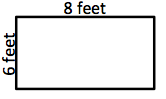
What is the perimeter of the rectangle?

1

16 feet

2

48 feet

3

28 feet

4

12 feet

64

Multiple Choice

Question image
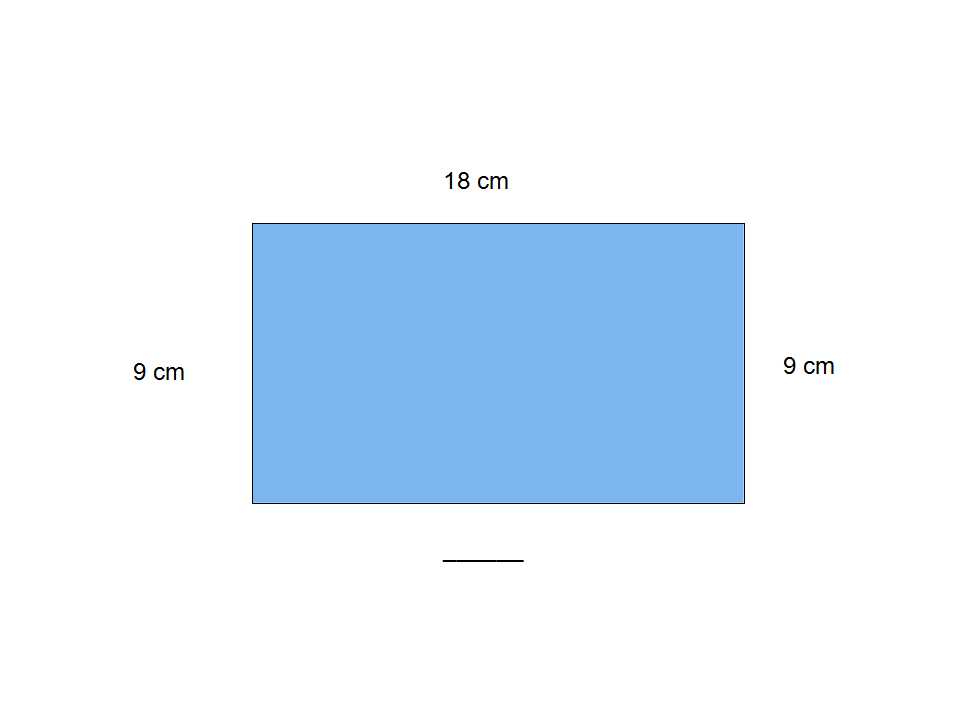
What is the missing measurement? 
1
9 cm
2
18 in
3
18 cm
4
9 in 

65

Number Patterns

  • First identify whether it is increasing or decreasing.

  • If it is increasing it can be multiplication or addition

  • If it is decreasing then it is division or subtraction.

3rd Grade Fast Math Review

By DECK DUTREUIL

Show answer

Auto Play

Slide 1 / 65

SLIDE