

PREPARE 3- UNIT 6: FAVOURITE THINGS

Presentation
•
English
•
6th - 8th Grade
•
Practice Problem
•
Hard

TRUNG TÂM GIÁO DỤC TOÀN CẦU GLOBAL EDUCATION
FREE Resource
100 Slides • 0 Questions
1
Unit 6: Favourite things
By TRUNG TÂM GIÁO DỤC TOÀN CẦU GLOBAL EDUCATION

2


Unit 6: Favourite things
3

Unit 6: Favourite things
Vocabulary and Reading: Materials


1. Look at the photos below. Match the materials in the box to the photos A-J
Listen and check. Then repeat
cotton glass gold leather metal paper plastic silver
wood wool
4
Unit 6: Favourite things
Vocabulary and Reading: Materials

1. Look at the photos below. Match the materials in the box to the photos A-J
Answers
A - plastic B - cotton C - gold D - wool E - metal
F - leather G - glass H - wood I - paper J - silver
5
Unit 6: Favourite things
Vocabulary and Reading: Materials
2. What are the things in the photos made of? Talk about the photos with your partner

Use: _____________ is/are made of ____________
6
Vocabulary and Reading: Materials
Answer:
A. The headphones are made of plastic.
B. The T-shirts are made of cotton.
C. The ring is made of gold.
D. The gloves are made of wool.
E. The coin is made of metal.
F The jacket is made of leather.
G The bowl is made of glass.
H The box is made of wood.
I The cat is made of paper.
J The necklace is made of silver.
2. What are the things in the photos made of? Talk about the photos with your partner.
7
Unit 6: Favourite things
Vocabulary and Reading: Materials
3. Look at the examples.
Which word is a noun and which is an adjective?
The box is made of wood. It's a wooden box
8
Unit 6: Favourite things
Vocabulary and Reading: Materials
3. Look at the examples. Which word is a noun and which is an adjective?
Answer
The box is made of wood. It's a wooden box
-> wood is a noun; wooden is an adjective
9
Unit 6: Favourite things
Vocabulary and Reading: Materials
4. Work with your partner. Use materials as adjectives to describe and find the things in the photo.

10
Unit 6: Favourite things
Vocabulary and Reading: Materials
4. Work with your partner. Use materials as adjectives to describe and find the things in the photo.
Answers
Photo A - They're plastic headphones.
Photo B - They're cotton T-shirts.
Photo C - It's a gold ring.
Photo D - They're wool gloves.
Photo E - It's a metal coin.
Photo F - It's a leather jacket.
Photo G - It's a glass bowl.
Photo H - It's a wooden box.
Photo I - It's a paper cat.
Photo J - It's a silver necklace.
11
Unit 6: Favourite things
Vocabulary and Reading: Materials
5. In pairs, look around the classroom and at what people are wearing. Find as many things as you can that are made from the materials in Exercise 1. Say what they are.
12
Unit 6: Favourite things
Vocabulary and Reading: Materials
6. Cam is doing a project for school. He asks three people in the street about their favourite things. Listen to the recording. Which thing was a present?


13
Unit 6: Favourite things
Vocabulary and Reading: Materials
6. Cam is doing a project for school. He asks three people in the street about their favourite things. Listen to the recording. Which thing was a present?
Answer : the origami bird
14
Unit 6: Favourite things
Vocabulary and Reading: Materials
7. Listen again and complete the table
| Speaker 1 | Speaker 2 | Speaker 3 |
|---|---|---|---|
What is the thing? | | | |
Who does it belong to? | | | |
What is it made of? | | | |
15
Unit 6: Favourite things
Vocabulary and Reading: Materials
7. Listen again and complete the table
Answer
| Speaker 1 | Speaker 2 | Speaker 3 |
|---|---|---|---|
What is the thing? | earing | elephant | origami bird |
Who does it belong to? | her mum | his dad | her parents |
What is it made of? | silver | wood | paper |
16
Unit 6: Favourite things
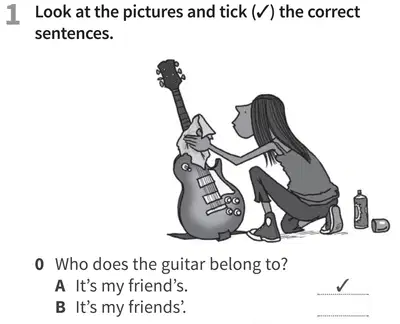
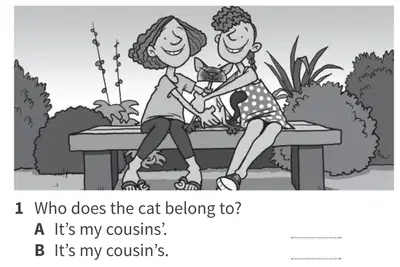
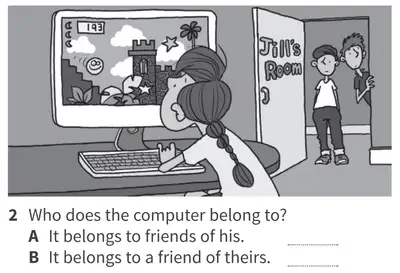
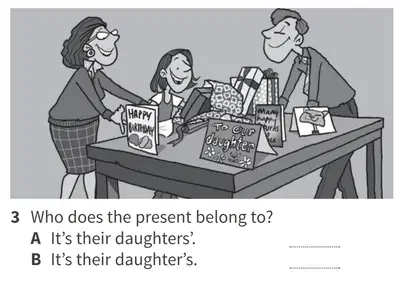
Grammar: Possesion
1. Look at the pictures. Match sentences 1 and 2 to picture A and B

1. It's my brother's dog
2. It's my brothers' dog
17
Unit 6: Favourite things
Grammar: Possesion
1. Look at the pictures. Match sentences 1 and 2 to picture A and B

Answer
2. It's my brothers' dog

1. It's my brother's dog
18
Unit 6: Favourite things
Grammar: Possesion
2. Look at sentences 1 and 2 in Exercise 1.
Which sentence has 's and which sentence has s'? Why?
1. It's my brother's dog.
2. It's my brothers' dog.
19
Unit 6: Favourite things
Grammar: Possesion
2. Look at sentences 1 and 2 in Exercise 1. Which sentence has 's and which sentence has s'? Why?
1. It's my brother's dog
2. It's my brothers' dog
Answer
Sentence 1 has 's because there is one person.
Sentence 2 has s' because there is more than one person.
20
Unit 6: Favourite things
Grammar: Possesion
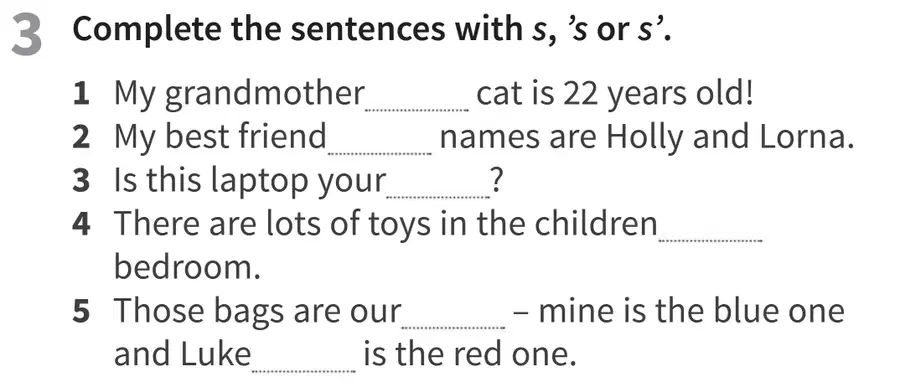
3. Complete the sentences. Use the word in brackets in the singular or plural and 's or s'.
1. That's my ........................(sister) car. My dad bought them one to share last year.
2. I don't have a computer, but I use my............................... (brother) when I need to. I lend him my camera when he needs it because he hasn't got a good one.
3. My little sister loves going to the............................... (child) disco. It's specially for little kids and there are games and activities.
4. Don't put any cake on those plates! I use them for the.................................... (dog) food. They don't like the bowls from the pet shop.
21
Unit 6: Favourite things
Grammar: Possesion
3. Complete the sentences. Use the word in brackets in the singular or plural and 's or s'.
Answer
1. That's my sisters' car. My dad bought them one to share last year.
2. I don't have a computer, but I use my brother's when I need to. I lend him my camera when he needs it because he hasn't got a good one.
3. My little sister loves going to the children's disco. It's specially for little kids and there are games and activities.
4. Don't put any cake on those plates! I use them for the dogs' food. They don't like the bowls from the pet shop.
22
Unit 6: Favourite things
Grammar: Possesion
4. Look at the words in purple in the two examples from the listening. Underline the determiners and circle the pronouns.
1. They're not mine. They're my sister's.
2. Oh and what are theirs? Your dad's for example.
23
Unit 6: Favourite things
Grammar: Possesion
4. Look at the words in purple in the two examples from the listening. Underline the determiners and circle the pronouns.
Answer:
1. They're not mine. They're my sister's.
2. Oh and what are theirs? Your dad's for example.
mine
theirs
24
Unit 6: Favourite things
Grammar: Possesion
5. Now complete the table.
Determiners | Pronouns |
|---|---|
my | mine |
your | |
his | |
her | |
our | |
their | |
25
Unit 6: Favourite things
Grammar: Possesion
5. Now complete the table.
Answer
Determiners | Pronouns |
|---|---|
my | mine |
your | your |
his | his |
her | hers |
our | ours |
their | theirs |
26
Unit 6: Favourite things
Grammar: Possesion
6. Look at the pictures and decide who the football player is. Match the sentences 1 and 2 to pictures A and B

1. He's a friend of theirs
2. He's a friend of hers
27
Unit 6: Favourite things
Grammar: Possesion
6. Look at the pictures and decide who the football player is. Match the sentences 1 and 2 to pictures A and B
Answer
1. He's a friend of theirs - A
2. He's a friend of hers - B
28
Unit 6: Favourite things
Grammar: Possesion
7. Complete the sentences with the correct word.
1. That's not Robert's book, it's Paula's. Robert lost ......................................... yesterday.
2. My parents had a holiday on a boat last summer. I think it belonged to a friend of ...................................................... .
3. A cat plays in our garden sometimes, but it's not ......................................... We've got a dog.
29
Unit 6: Favourite things
Grammar: Possesion
7. Complete the sentences with the correct word.
4. You can't use my brother's football. But you can borrow ............................... if you like. I got it for my birthday
5. Are you looking for your hat? I saw Paul's in the garden, but I don't know where ................................................. is.
6. Sally is so good at art. That picture is ................................................... .
30
Unit 6: Favourite things
Grammar: Possesion
7. Complete the sentences with the correct word. Answer:
1. That's not Robert's book, it's Paula's. Robert lost his yesterday.
2. My parents had a holiday on a boat last summer. I think it belonged to a friend of theirs .
3. A cat plays in our garden sometimes, but it's not ours We've got a dog.
4. You can't use my brother's football. But you can borrow mine if you like. I got it for my birthday
5. Are you looking for your hat? I saw Paul's in the garden, but I don't know where yours is.
6. Sally is so good at art. That picture is hers .
31
Unit 6: Favourite things
Grammar: Possesion
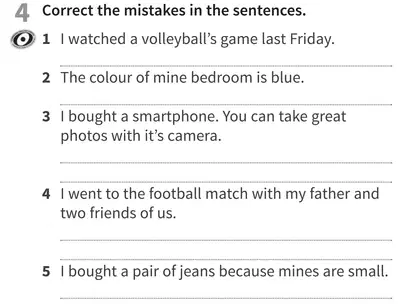
8. Correct the mistakes in the sentences.
1. You can read your favourite book's there.
2. My friends name's Ben.
3. The bus stop is just five minutes walk from my house.
4. Bring your computer because my is broken.
5. My bedroom is bigger than their.
32
Unit 6: Favourite things
Grammar: Possesion
8. Correct the mistakes in the sentences.
Answer:
1. You can read your favourite book's there.
-> You can read your favourite books there
2. My friends name's Ben.
-> My friend's name's Ben
3. The bus stop is just five minutes walk from my house.
-> The bus stop is just five minutes' walk from my house.
4. Bring your computer because my is broken.
-> Bring your computer because mine is broken
5. My bedroom is bigger than their.
-> My bedroom is bigger than theirs
33
Unit 6: Favourite things
Grammar: Possesion
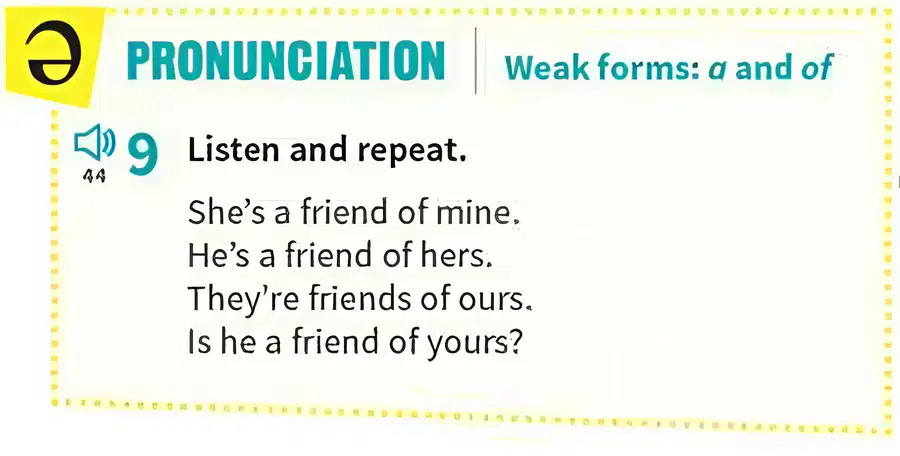
34
Unit 6: Favourite things
Grammar: Possesion
10. Think of three things that are special and belong to different people in your family. In pairs, tell each other about them.
Use the questions to help you.
1. What are they? What are they made of?
2. Who do they belong to?
3. Where did they come from?
4. Why are they special?
5. What else can you say about them?
35
Unit 6: Favourite things
Grammar: Possesion
10. Think of three things that are special and belong to different people in your family. In pairs, tell each other about them.
Use the questions to help you.
Possible answer:
Listen and take note:
- The thing: ___________________
- Belong to:______________________
- Why is it special?________________
36
Unit 6: Favourite things
Grammar: Possesion
10. Think of three things that are special and belong to different people in your family. In pairs, tell each other about them.
Use the questions to help you.
Possible answer:
My father has a cotton T-shirt from the 2018 World Cup in Russia. He went to a Brazil game and bought it at the stadium. His T-shirt is special because he really enjoyed his trip to Russia. I want a T-shirt like that!
37
Unit 6: Favourite things
Reading
1. In pairs, tell your partner about a special present someone gave you. What was it?
Possible answer:
Listen and take note:
- The thing/ What was it?:____________
- Who gave it to you?_____________________
- Do you love it and Why?:_______________
38
Unit 6: Favourite things
Reading
1. In pairs, tell your partner about a special present someone gave you. What was it?
For example: 'Two years ago my sister gave me a machine which makes ice- cream. I love ice-cream so I use it a lot!'
39
Unit 6: Favourite things
Reading
HILL CREST ACADEMY
Special Memories

ANJA, AGE 13
My special memory is from when I was three years old. We were staying with my grandparents at their house in the country. They lived in an old wooden house. I remember the house was always cold and it was near a forest. When it was time for bed, Grandma took me upstairs to read me a story. On my bed there was a lovely wool blanket. It was really colourful. I remember touching it and it was so, so soft. 'It's yours. I made it for you, my grandma said. I still have the blanket on my bed at home. It looks really small there, but I remember when I was younger it seemed so big!
40
Unit 6: Favourite things
Reading
HILL CREST ACADEMY
Special Memories
PETE, AGE 14
My special memory isn't from very long ago. I was opening presents on my 13th birthday. My older brother gave me a large box. It was very hard. What could it be? I opened it and felt inside. I'm blind, so I needed to touch everything because I can't see. It was smooth and round. I remember thinking 'It's a leather football' and feeling upset. I can't play football because I can't see the ball. I picked it up. It felt quite heavy, and it made a noise. My brother told me it was a special football for blind people. There are little metal balls inside that make a noise when someone kicks or throws it. Perfect! Now I play football all the time. c
41
Unit 6: Favourite things
Reading


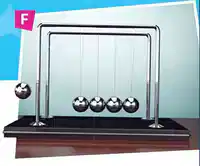
2. Anja and Pete wrote about special memories in their online school magazine. Look at objects A-F.
What present did Anja get?
What present did Pete get?

42
Unit 6: Favourite things
Reading
2. Anja and Pete wrote about special memories in their online school magazine. Look at objects A-F. Answer
Anja: a blanket (D)
Pete: a football for blind people (E)
43
Unit 6: Favourite things
Reading
3. Read the article again and answer the questions.
1. What was Anja's grandparents' house like?
2. When did Anja first see the blanket?
3. What was it like?
4. Why do you think Anja remembers it as big when in fact it's quite small?
44
Unit 6: Favourite things
Reading
3. Read the article again and answer the questions.
5. Who was Pete's present from?
6. What did it feel like?
7. Why did he feel sad when he first felt the present?
8. What happened when he took it out of the box and why?
45
Unit 6: Favourite things
Reading
3. Read the article again and answer the questions.
1. What was Anja's grandparents' house like?
It was an old, wooden house and it was always cold
2. When did Anja first see the blanket?
When she was three years old and staying at her grandparents' house.
3. What was it like?
It was beautiful, colourful and soft.
4. Why do you think Anja remembers it as big when in fact it's quite small?
Because she was small, the blanket seemed big to her.
46
Unit 6: Favourite things
Reading
3. Read the article again and answer the questions.
5. Who was Pete's present from?
It was from his older brother.
6. What did it feel like?
It felt round, hard and smooth (and quite heavy).
7. Why did he feel sad when he first felt the present?
Because he can't see and so can't play football.
8. What happened when he took it out of the box and why?
The ball made a noise because it had small metal balls inside.
47
Unit 6: Favourite things

48
Unit 6: Favourite things
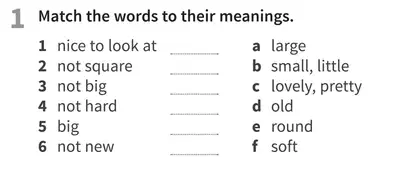
Vocabulary: Adjectives for describing objects
1. Match the words in the box to photos A-F.
colourful hard heavy large
little lovely old pretty
round small smooth soft


Listen and check
49
Vocabulary: Adjectives for describing objects
1. Match the words in the box to photos A-F.
Answer
Listen and check
A - hard, heavy, old
B - hard
C - little, lovely, pretty, small
D - colourful, lovely, pretty, soft
E - hard, heavy, round, smooth
F - round, small, smooth
50
Unit 6: Favourite things
Vocabulary: Adjectives for describing objects
2. In pairs, describe the objects in the photos. Use the adjectives from Exercise 1 and others you know.
51
Unit 6: Favourite things
Vocabulary: Adjectives for describing objects

3. Take turns to describe something in the classroom to your partner for them to guess what it is. Use the words from Exercise 1 to help you
52
Unit 6: Favourite things
Vocabulary: Adjectives for describing objects
2. In pairs, describe the objects in the photos. Use the adjectives from Exercise 1 and others you know.
Possible Answer:
A - It's a bell. It looks heavy. I think they used them in schools years ago.
B - It's a large box. It's made of plastic or wood and it looks hard.
C - It's a small wooden house and it looks old. It looks like a doll's house.
D - It's a blanket. It's really colourful and it looks soft too. I think it's lovely.
E - It's a football. Footballs are hard and round.
F - These are little metal balls. They are round and very smooth.
53
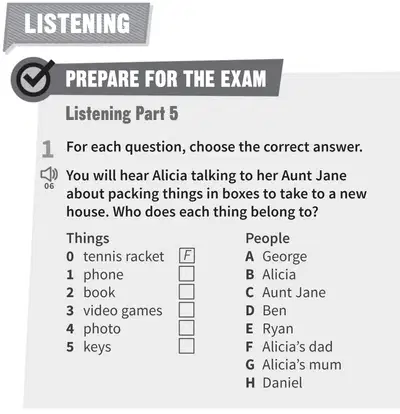
Unit 6: Favourite things
Listening


Prepare for the exam
54
Unit 6: Favourite things
Listening
Prepare for the exam
Answer
A
H
B
D
F
55
Unit 6: Favourite things
Writing


Read the notice from the museum and then read Ben's email reply. What's his favourite thing?
56
Unit 6: Favourite things
Writing
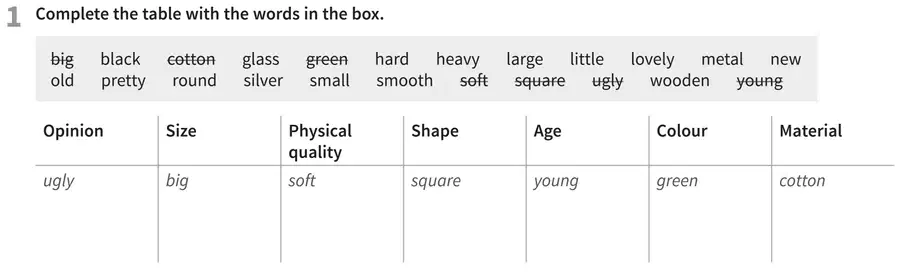
Put the adjectives from the email in the correct column in the table.
Opinion(pretty) | Size (big) | Physical quality (hard) | Shape (square) | Age (new) | Colour (blue) | Material (gold) |
|---|---|---|---|---|---|---|
| | | | | | |
Adjectives order
Find three more examples of pairs of adjectives in the texts on the page 38 and add them to the table
57
Unit 6: Favourite things
Writing
Put the adjectives from the email in the correct column in the table.
Answer
Opinion | Size | Physical quality | Shape | Age | Colour | Material |
|---|---|---|---|---|---|---|
beautiful, | small, | smooth | round | old | red | silver, wooden |
Adjectives order
58
Unit 6: Favourite things
Writing
PLAN: You are going to write to the museum about something special.
Use these questions to plan your email.
What is it? Where/who did it come from? What does it look like?
Plan your email to the museum.
What groups of adjectives can you use to describe your object?
What order do they go in?
WRITE: Write an email to the museum. Use Ben's email to help you. Write about 35 words.
Draw a picture of the object.
IMPROVE: In pairs, read each other's email. Check for mistakes with adjectives. Rewrite your emails.
59
Unit 6: Favourite things
Writing
Model answer:
I've got an interesting object for you. It's a 1966 paper poster of The Beatles, a fantastic old pop group. It's from my uncle's house and I found it in his bedroom.
From
Ben
60
Unit 6: Favourite things
Workbook

61
Unit 6: Favourite things
Workbook

62
Unit 6: Favourite things
Workbook
63
Unit 6: Favourite things
Workbook

64
Unit 6: Favourite things
Workbook
65
Unit 6: Favourite things
Workbook

66
Unit 6: Favourite things
Workbook
67
Unit 6: Favourite things
Workbook
68
Unit 6: Favourite things
Workbook

69
Unit 6: Favourite things
Workbook
70
Unit 6: Favourite things
Workbook
71
Unit 6: Favourite things
Workbook

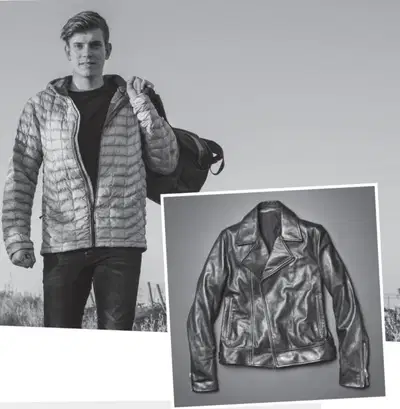
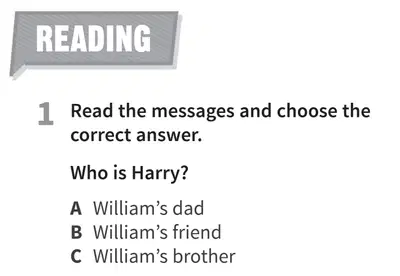
Hi Hasan, I can't find my jacket. Did I leave it at your house yesterday afternoon when Harry and I came to see your new scooter? It's a soft green jacket. I wore it to walk to your house, and I put it over that big wooden chair in your hall. I can't remember if I wore it to walk home. I hope you've got it - it cost a lot!
72
Unit 6: Favourite things
Workbook
Hi William, I have got your jacket, yes. I just went to look in the hall, and it was on the chair, as you thought. And I also found another jacket on that chair. It's a black, leather one. It's not mine and it's not my brother's. Do you think it's Harry's? I'm not going out this evening. So you can come and get your jacket then if you want to.
73
Unit 6: Favourite things
Workbook
Hi Hasan, that's great. I'm so glad it's there. My dad will be too-he bought it for me. I can come to your place at about six. Is that OK? I think that other jacket is Harry's. He was wearing a black leather jacket when we walked to your house. I can get it when I come to get mine - then I'll give it to him tomorrow. I'm going out for the day with his family. I'll call him and tell him his jacket's at yours.
74
Unit 6: Favourite things
Workbook


75
Unit 6: Favourite things
Workbook

76
Unit 6: Favourite things
Workbook
77
Unit 6: Favourite things
Workbook

78
Unit 6: Favourite things
Workbook
79
Unit 6: Favourite things
Workbook
80
Unit 6: Favourite things
Workbook
81
CULTURE
Secondary school in the UK
By TRUNG TÂM GIÁO DỤC TOÀN CẦU GLOBAL EDUCATION

82

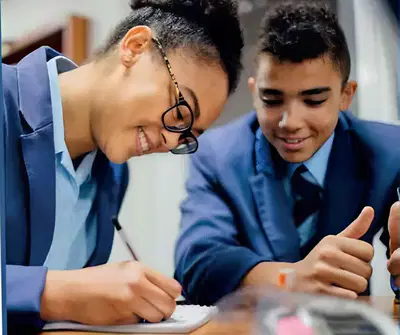

1. Discuss the questions with your partner.
1. Do you like going to school?
2. Why? / Why not?
3. At what age do people start secondary school in your country?
83
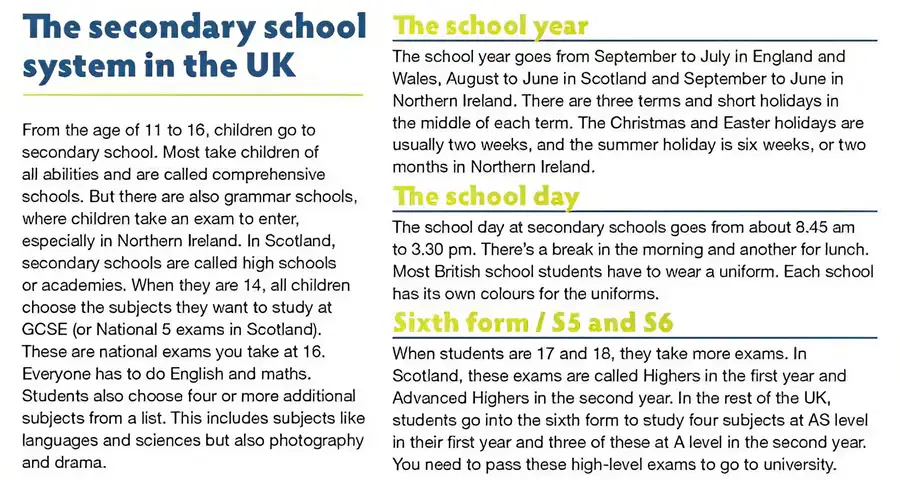
2. Work with a partner. What do you know about secondary schools in the UK? Discuss your ideas. Read the web page. Were any of your ideas mentioned?
84
The secondary school system in the UK
From the age of 11 to 16, children go to secondary school. Most take children of all abilities and are called comprehensive schools. But there are also grammar schools, where children take an exam to enter, especially in Northern Ireland. In Scotland, secondary schools are called high schools or academies. When they are 14, all children choose the subjects they want to study at GCSE (or National 5 exams in Scotland). These are national exams you take at 16. Everyone has to do English and maths. Students also choose four or more additional subjects from a list. This includes subjects like languages and sciences but also photography and drama.
85
The school year goes from September to July in England and Wales, August to June in Scotland and September to June in Northern Ireland. There are three terms and short holidays in the middle of each term. The Christmas and Easter holidays are usually two weeks, and the summer holiday is six weeks, or two months in Northern Ireland.
The school year
86
The school day at secondary schools goes from about 8.45 am to 3.30 pm. There's a break in the morning and another for lunch. Most British school students have to wear a uniform. Each school has its own colours for the uniforms.
The school day
87
When students are 17 and 18, they take more exams. In Scotland, these exams are called Highers in the first year and Advanced Highers in the second year. In the rest of the UK, students go into the sixth form to study four subjects at AS level in their first year and three of these at A level in the second year. You need to pass these high-level exams to go to university.
Sixth form / S5 and S6
88
3. Read the web page again and complete the table.
Types of public secondary schools in the UK
1. .......................................... schools-These schools take children of all abilities.
2. .......................................... schools - Children need to pass an exam to get in these schools.
3. .......................................... schools or academies - These are secondary schools in Scotland.
Secondary school | England and Wales | Northern Ireland | Scotland |
|---|---|---|---|
National exams at age 16 | GCSEs | 4. ...................................... | National 5 exams |
National exams at age 17 | AS levels | AS levels | 5. ....................................... |
National exams at age 18 | 6. ....................................... | AS levels | Advanced Higher |
School year starts | September | 7. ....................................... | August |
School year finishes | 8. ....................................... | June | June |
89
3. Read the web page again and complete the table.
Answer
Types of public secondary schools in the UK
1. Comprehensive schools- These schools take children of all abilities.
2. Grammar schools - Children need to pass an exam to get in these schools.
3. High schools or academies - These are secondary schools in Scotland.
Secondary school | England and Wales | Northern Ireland | Scotland |
|---|---|---|---|
National exams at age 16 | GCSEs | 4. GCSEs | National 5 exams |
National exams at age 17 | AS levels | AS levels | 5. Highers |
National exams at age 18 | 6. A levels | AS levels | Advanced Higher |
School year starts | September | 7. September | August |
School year finishes | 8. July | June | June |
90

TALKING POINTS
In groups, compare the UK secondary school system with your own.
91
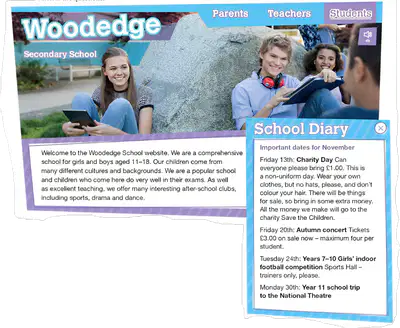
4. Read the information on the Woodedge Secondary School website. Is this school similar to your school? Answer the questions.
92
4. Read the information on the Woodedge Secondary School website. Is this school similar to your school?
Answer the questions.
Welcome to the Woodedge School website. We are a comprehensive school for girls and boys aged 11-18. Our children come from many different cultures and backgrounds. We are a popular school and children who come here do very well in their exams. As well as excellent teaching, we offer many interesting after-school clubs, including sports, drama and dance.
93
School Diary
Important dates for November
Friday 13th: Charity Day Can everyone please bring £1.00. This is a non-uniform day. Wear your own clothes, but no hats, please, and don't colour your hair. There will be things for sale, so bring in some extra money. All the money we make will go to the charity Save the Children.
Friday 20th: Autumn concert Tickets £3.00 on sale now-maximum four per student.
Tuesday 24th: Years 7-10 Girls' indoor football competition Sports Hall -trainers only, please.
Monday 30th: Year 11 school trip to the National Theatre
94
4. Read the information on the Woodedge Secondary School website. Is this school similar to your school?
Answer the questions.
1. At what age do students leave Woodedge School?
2. Why do students need to bring money to school on 13th November?
3. Do students have to wear their school uniform on 13th November?
4. How many tickets can each student buy for the concert?
5. What must students wear for the football competition?
6. Where are Year 11 students going on 30th November?
95
4. Read the information on the Woodedge Secondary School website. Is this school similar to your school?
Answer
1. At what age do students leave Woodedge School?
-> 18
2. Why do students need to bring money to school on 13th November?
-> for the charity Save the Children
3. Do students have to wear their school uniform on 13th November?
-> no
4. How many tickets can each student buy for the concert?
-> four
5. What must students wear for the football competition?
-> trainers
6. Where are Year 11 students going on 30th November?
-> the National Theatre
96
5. Listen to Aleesha talking about Woodedge School. Answer the questions.
1. How many pupils are there at Woodedge?
2. What is Aleesha's cultural background?
3. What time does school finish?
4. What do students learn about in PDT?
5. What kind of food can you get at lunchtime?
6. How does Aleesha pay for her lunch?
7. What after-school clubs is she doing this term?
8. What is she making for Charity Day?
97
5. Listen to Aleesha talking about Woodedge School. Answer the questions.
Answer
1. How many pupils are there at Woodedge?
-> 1,200
2. What is Aleesha's cultural background?
-> She is Asian.
3. What time does school finish?
-> 3.00 pm
4. What do students learn about in PDT?
-> What's in the news; money
98
5. Listen to Aleesha talking about Woodedge School. Answer the questions.
Answer
5. What kind of food can you get at lunchtime?
-> hot food and sandwiches
6. How does Aleesha pay for her lunch?
-> She has a card. (Her parents put money into an online account which she accesses with the card.)
7. What after-school clubs is she doing this term?
-> singing and badminton
8. What is she making for Charity Day?
-> cakes
99
6. Compare Woodedge School with your own. Talk to your partner about these things.
after-school clubs
how long the day is mix of cultures
number of students
school concerts
special days (like Charity Day)
school lunches
school trips
100
Unit 6: Favourite things
By TRUNG TÂM GIÁO DỤC TOÀN CẦU GLOBAL EDUCATION
Show answer
Auto Play
Slide 1 / 100
SLIDE
Similar Resources on Wayground

90 questions
Trigonometry Demo Lesson
Presentation
•
6th - 8th Grade
100 questions
Physical Science Part 1
Presentation
•
6th - 9th Grade
95 questions
7th Grade Math Review for Spring MAP
Presentation
•
7th Grade
97 questions
Q4-MODULE 13-16
Presentation
•
7th Grade
96 questions
PON UGC Lez 1
Presentation
•
6th - 8th Grade
95 questions
Chapter 2 Section 9 Lesson
Presentation
•
7th Grade
96 questions
Matter, Elements, Compunds and Mixtures
Presentation
•
7th Grade
101 questions
West African Kingdoms
Presentation
•
6th - 9th Grade
Popular Resources on Wayground
11 questions
Hallway & Bathroom Expectations

Quiz
•
6th - 8th Grade
10 questions
HCS SCI 03 Summer School Assessment 2
Quiz
•
3rd Grade
11 questions
Home Scope
Quiz
•
7th - 8th Grade
12 questions
2026 TAP Technology in the Classroom
Presentation
•
Professional Development
15 questions
HCS SCI 05 Summer School Assessment 2 Review
Quiz
•
5th Grade
15 questions
HCS SCI 04 Summer School Review 2
Quiz
•
4th Grade
59 questions
Geometry Unit 3 Review
Quiz
•
9th - 12th Grade
14 questions
FAST ELA READING SMAPLE TEST MATERIALS

Passage
•
3rd Grade