Search Header Logo
Simple Machines Part 1

Simple Machines Part 1

Assessment

Presentation

Science

10th - 12th Grade

Easy

NGSS
MS-PS2-2, MS-PS2-1

Standards-aligned

Created by

K Holder

Used 3+ times

FREE Resource

16 Slides • 17 Questions

1

Simple Machines, Part 1
Levers, Ramps, Wedges and Screws

The purpose of a simple machine is to
Make Work Easier

2

A simple machine is a mechanical device that changes the direction or magnitude of a force. There are 6 types as shown above.

What is a simple machine?

media

3

media

Simple machines can make work easier by reducing the force require to move an object by increasing the distance. The ramp shown is an example of this. If work = force x distance, then increasing the distance from 2 to 5 will decrease the force required.

Simple Machines make work easier

4

media

​Simple Machines make work easier

Simple machines can also make work easier by changing the direction of the force. In the example shown, it is easier to pull down on a rope than to lift up on the object. When pulling down, you use gravity and your weight to help.

5

How much easier it actually is to move something using the machine. AMA will always be less than IMA because of friction.
AMA = Force out (how much you lift) ÷
Force in
(how much you put in)

Actual Mechanical Advantage:

How much easier it should be to move something using the machine.

IMA = Effort Distance ÷
Load Distance

Ideal Mechanical Advantage:

There are two types of
Mechanical Advantage:

6

media

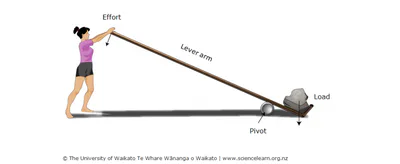
One way to find the ideal mechanical advantage of a lever is by dividing the distance of the Effort to the fulcrum by the distance from the Load to the fulcrum. Or by dividing the amount that the effort force moves by the distance the load moves.
Same amount of Work, less Force!

Ideal Mechanical Advantage of a Lever

media

7

The Actual mechanical advantage is found by dividing the force it takes to lift the object without the machine by the force to lift it with the machine.

Actual Mechanical Advantage of a Lever

media
media

​AMA = Force out (how much you lift)
Force in (how much you put in)

8

media

The ratio of AMA/IMA is called efficiency. A machine that has less friction is more efficient.

Efficiency

​EXAMPLE:

9

Multiple Choice

Question image

The fixed point on which a lever pivots is called the:

1

Bar

2

Wedge

3

Fulcrum

4

Screw

10

Multiple Choice

Question image

A person places a fulcrum 0.5 meters away from the load on a lever. This leaves 2.0 feet of lever on the effort side of the fulcrum. What is the ideal mechanical advantage of the lever? (mechanical advantage does not have any units)

1

2.5

2

4.0

3

0.4

4

1.0

11

Multiple Choice

Question image
To increase the mechanical advantage of a lever
1
make sure the fulcrum is in the middle of the lever
2
move the fulcrum closer to the load
3
move the fulcrum closer to the effort
4
use a bigger fulcrum

12

media

​Levers can be 1st, 2nd or 3rd class, depending on the location of the fulcrum.
A 3rd class lever has a mechanical advantage less than 1, so it only has an advantage of position.

Types of Levers

13

Multiple Choice

Question image

TYPE OF LEVER?

1

1st Class

2

2nd Class

3

3rd Class

14

Multiple Choice

Question image

TYPE OF LEVER?

1

1st Class

2

2nd Class

3

3rd Class

15

Multiple Choice

Question image

TYPE OF LEVER?

1

1st Class

2

2nd Class

3

3rd Class

16

Multiple Choice

Question image

TYPE OF LEVER?

1

1st Class

2

2nd Class

3

3rd Class

17

Multiple Choice

Question image

A box is lifted by a force F using a lever as shown below.

What is the mechanical advantage of the lever ?

1

0.5

2

2

3

3

4

6

18

Multiple Choice

Question image

Jeff is a landscaping contractor and lifts a rock weighing 600 Newtons by wedging a board under the rock. Jeff weighs 150 Newtons and puts all of his weight on the lever. How much mechanical advantage did the lever provide to Jeff in lifting the rock?

1

0

2

2

3

4

4

0.25

19

An inclined plane is a simple machine consisting of plane inclined at an angle to the horizontal. Work to lift the object does not change, but more distance = less force.


Inclined Planes (ramps)

media

20

media

Ideal mechanical advantage of an inclined plane is found by dividing the length of the plane (effort distance) by the height (load distance),


Ideal Mechanical Advantage of an Inclined Plane (ramp)

Less mechanical advantage

21

Actual mechanical advantage of an inclined plane is found by dividing the force out (force required to lift the object without the machine) by the force in (force required to lift the object with the machine)

AMA = Force out (how much you lift)
Force in (how much you put in)


Actual Mechanical Advantage of an Inclined Plane (ramp)

media

22

Multiple Choice

How does an inclined plane make work easier?

1

It reduces the amount of force needed to lift an object.

2

It changes the direction of the force needed to lift an object.

3

It increases the amount of force needed to lift an object.

4

It has no effect on the amount of force needed to lift an object.

23

Multiple Choice

Question image
Students pulled the same mass up an inclined plane that was 20 cm, 30 cm, and 40 cm long. Each time, they used a spring scale to measure the force needed to pull the mass up the inclined plane. What did they conclude?
1
Less force was needed on the 20 cm plane
2
More force was needed on the 40 cm inclined plane.
3
The least amount of force was needed on the 40 cm inclined plane.
4
The least amount of force was needed on the 30 cm inclined plane.

24

Multiple Choice

Question image

The ideal mechanical advantage of this inclined plane is...

1

2.5

2

10

3

0.4

25

Multiple Choice

Question image

What is the AMA of the inclined plane shown?

1

2.3

2

.56

3

1.77

4

2.1

26

media

Actual Mechanical Advantage

A Wedge is a type of Inclined Plane

The wedge is the least efficient simple machine due to the high amount of friction present.

​Ideal Mechanical Advantage

media

27

Multiple Choice

Question image
A door stop is an example of a
1
Screw
2
Wedge
3
Lever
4
Inclined Plane

28

Multiple Choice

If I have a wedge with a MA of 5 and an output distance (thickness) of 2, than what is the input distance (length of side)?

1

10

2

100

3

1000

4

10000

29

media

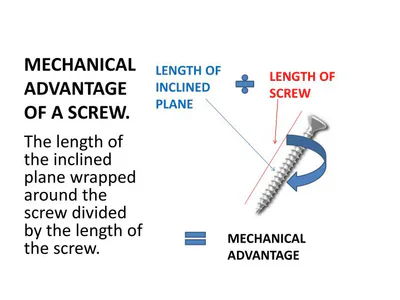
It is basically an inclined plane wrapped around a cylinder.

A Screw is a type of Inclined Plane

30

When calculating the mechanical advantage of a screw, remember that it is just a ramp, wrapped in a circle. To find the length of effort distance, find the circumference of the shaft using 2(π)r or πd, and multiply by the number of times it goes around the ramp. Then divide by the length.

We usually just calculate the ideal mechanical advantage of a screw. The actual mechanical advantage is difficult to calculate as you would have to figure out how much force would be required to drive the screw in like a nail.

media
media

31

There are many types of screws, jar lids, car jacks, light bulb, drill bits, bottle caps, corkscrews, wood screws, machine screws, etc.

​One special type of screw is called an Auger.
It is used to move large amounts of material quickly.

media

32

Multiple Choice

What kind of simple machine would work best to hold something to the wall?

1

screw

2

lever

3

gear

4

inclined plane

33

Multiple Choice

Question image

The screw in the picture has a diameter of 3.65 mm, and goes around the shaft 11 times. The length of the screw is 25 mm. What is the IMA of the screw?

1

5.0

2

1.6

3

8.3

4

10.0

Simple Machines, Part 1
Levers, Ramps, Wedges and Screws

The purpose of a simple machine is to
Make Work Easier

Show answer

Auto Play

Slide 1 / 33

SLIDE