

A1.2 Nucleic Acids

Presentation
•
Chemistry
•
9th - 12th Grade
•
Practice Problem
•
Hard

Mary Zwieg
FREE Resource
78 Slides • 22 Questions
1

2
Multiple Choice
Which of the following best describes the level of organization at which nucleic acids primarily function?
Organ systems
Cells
Molecules
Tissues
3
Open Ended
Why do you think nucleic acids are considered fundamental to both unity and diversity among living organisms?
4

5

6
Open Ended
How does the structure of nucleic acids allow hereditary information to be stored?
7

8
Multiple Choice
Which of the following statements best describes the structure of DNA as outlined in the IB syllabus?
DNA is a single helix made of one strand of nucleotides.
DNA is a double helix made of two antiparallel strands of nucleotides linked by hydrogen bonding between complementary base pairs.
DNA is a triple helix with three parallel strands of nucleotides.
DNA is a double helix with two parallel strands of nucleotides linked by covalent bonds.
9

10
Multiple Select
Select all the correct statements about the differences between DNA and RNA.
DNA contains deoxyribose sugar, while RNA contains ribose sugar.
DNA is usually double-stranded, while RNA is usually single-stranded.
Both DNA and RNA contain the base thymine.
RNA can act as a genetic material in some viruses.
11

12
Open Ended
Explain the significance of the conservation of the genetic code across all life forms as evidence of universal common ancestry.
13

14
Multiple Choice
Which of the following is NOT a key term related to nucleic acids?
Deoxyribose
Antiparallel
Metabolism
Chlorophyll
15

16
Fill in the Blanks
DNA as the genetic material of all living organisms is supported by the fact that some viruses use
Type answer...
17

18

19

20

21

22

23

24
Multiple Choice
Which component is present in both RNA and DNA nucleotides?
Phosphate
Thymine
Uracil
Amino acid
25

26
Multiple Choice
Which of the following nitrogen bases is found only in RNA and not in DNA?
Uracil
Thymine
Adenine
Cytosine
27

28

29
Multiple Select
Which of the following statements about polynucleotides is/are correct?
Both DNA and RNA are polynucleotides.
Polynucleotides form through condensation reactions.
Sugar-phosphate bonding forms the backbone of nucleic acids.
Polynucleotides are made only of amino acids.
30
Fill in the Blanks
A covalent bond forms between the phosphate of one nucleotide and the
Type answer...
31
Open Ended
Explain the significance of the sugar-phosphate backbone in the structure of DNA and RNA.
32

33

34
Open Ended
State the names of the nitrogen bases found in DNA and RNA.
35

36

37

38
Fill in the Blanks
The covalent bond in RNA connects the ribose sugar of one nucleotide to the
Type answer...
39
Multiple Select
Which of the following are components of a single RNA nucleotide?
Phosphate group
Ribose sugar
Nitrogen base
Deoxyribose sugar
40
Open Ended
Explain the process by which RNA nucleotides are joined together to form an RNA polymer. Include the type of bond formed and the components involved.
41

42
Multiple Choice
Which of the following nitrogen bases is found in RNA but not in DNA?
Uracil
Thymine
Adenine
Guanine
43

44
Open Ended
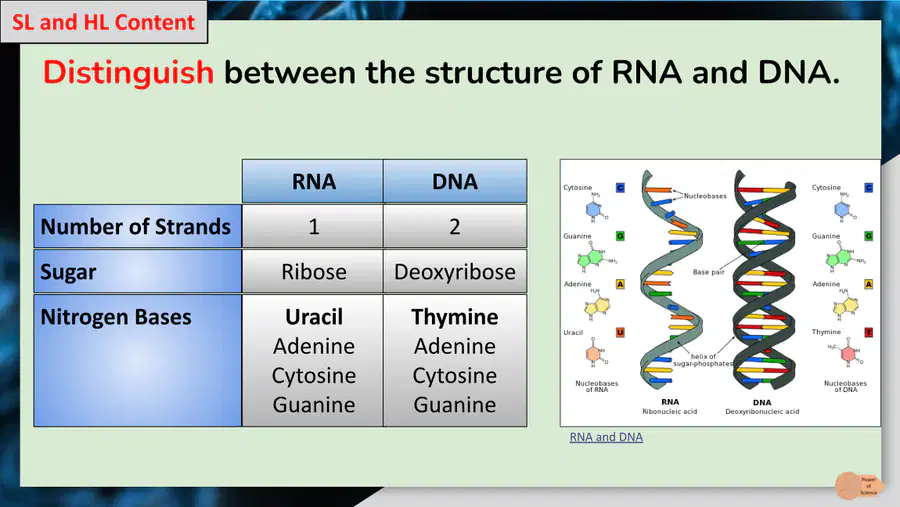
Describe two structural differences between DNA and RNA molecules.
45
Multiple Select
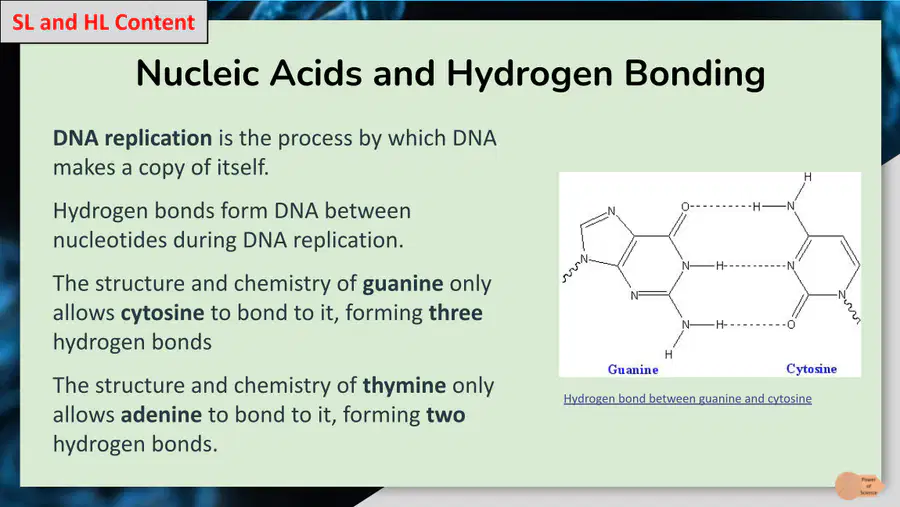
Which of the following base pairs are found in DNA?
Adenine-Thymine
Guanine-Cytosine
Adenine-Uracil
Cytosine-Thymine
46

47

48

49

50

51

52

53

54

55

56
57
58

59
60
61
62

63

64

65

66

67

68

69

70

71

72
73
74

75

76

77

78

79

80

81

82

83

84

85

86

87

88

89

90

91

92

93

94

95

96

97

98
99
Multiple Choice
Which of the following best describes the level of organisation discussed in the lesson on nucleic acids?
Cells
Tissues
Molecules
Organs
100
Open Ended
What is one new thing you learned about nucleic acids in this lesson?
Show answer
Auto Play
Slide 1 / 100
SLIDE
Similar Resources on Wayground

99 questions
Test de Posit Vente Commerce Niveau 4
Presentation
•
KG
100 questions
Unit 2 Notes Alterations of Ecosystems
Presentation
•
9th - 12th Grade
89 questions
Meiosis Notes
Presentation
•
9th - 12th Grade
95 questions
Everyday Use Full Lesson Cycle
Presentation
•
9th - 12th Grade
92 questions
Project Management Foundations
Presentation
•
KG
90 questions
S3U1 Indirect & Double Object Pronouns
Presentation
•
9th - 12th Grade
91 questions
New Deal
Presentation
•
9th - 12th Grade
91 questions
TEST REVIEW - LAB Equipment & Separation
Presentation
•
9th - 12th Grade
Popular Resources on Wayground
10 questions
How much do you know about our Portrait of an Eagle?

Quiz
•
10th Grade
10 questions
Fast Food Slogans
Quiz
•
6th - 8th Grade
21 questions
Continents and Oceans
Quiz
•
6th Grade
20 questions
Parts of Speech
Quiz
•
5th Grade
16 questions
Subject & Predicate
Quiz
•
5th Grade
25 questions
Multiplication Facts
Quiz
•
5th Grade
12 questions
Map Skills
Quiz
•
3rd Grade
22 questions
Continents and Oceans
Quiz
•
5th Grade
Discover more resources for Chemistry
20 questions
Metric Conversions
Quiz
•
11th Grade
20 questions
electron configurations and orbital notation
Quiz
•
9th - 12th Grade
26 questions
Atomic Structure, Isotopes and Ions
Quiz
•
10th Grade
20 questions
Periodic Trends
Quiz
•
10th Grade
5 questions
Atomic Theory Intro Video

Interactive video
•
10th Grade
20 questions
COUNTING ATOMS
Quiz
•
10th Grade
20 questions
Practice: E-Con, Orbital Notation, Noble Gas Notation
Quiz
•
10th Grade
11 questions
Balancing Chemical Equations
Presentation
•
9th Grade