Search Header Logo
  1. Resource Library
  2. Science
  3. Chemistry
  4. Lab Equipment
  5. Test Review Lab Equipment & Separation
TEST REVIEW - LAB Equipment & Separation

TEST REVIEW - LAB Equipment & Separation

Assessment

Presentation

Science

9th - 12th Grade

Medium

NGSS
MS-PS1-4, MS-PS1-2, MS-PS3-3

+3

Standards-aligned

Created by

Penny Turner

Used 2+ times

FREE Resource

44 Slides • 47 Questions

1

Lab Equipment/Separation #1

*I can learn names and uses of pieces of lab equipment.

*I can separate iron from a sample of sand, salt & iron in the lab by using physical properties.
*I can measure volume of liquids in a graduated cylinder.
*I can learn about methods of separating mixtures.

media

Learning Intentions:

2

Boiling Away the Liquid (Evaporation)

Once boiling is finished, this is what the SALT looks like.

Note it looks crusty, but white and it is definitely salt.

media

3

Florence Flask

Florence flask (also known as a round bottom flask or a boiling flask) is a piece of laboratory glassware. It is a round or flat-bottom flask with a long neck.


The flask is named after Florence, Italy.

media

4

media

5

Wrap Up and Complete Calculations from Sand, Salt and Iron Separation Lab

  • Percent by Mass Calculations

  • What % IRON was in the sample? What % SAND was in the sample? What % SALT was in the sample?

  • % Mass = mass of that part/total mass of the mixture x 100

  • If students performed perfect lab techniques and didn't lose any part or make any mistakes, then the 3 percentages would add to = 100%

6

media

7

Reading Water Level in Graduated Cylinder

NOTE: The numbers get bigger as you go UP.

ALSO...please realize you can still have a meniscus

IMPORTANT: To get the most accurate water reading, look at the BOTTOM of the Meniscus

media

8

media

Looking at the BOTTOM
of the meniscus

media

9

Multiple Choice

Question image

Which is best measurement for water volume shown?

(NOTE: Each mark as you count up is 0.1)

1

27.0 mL

2

21.7 mL

3

22.7 mL

4

21 mL

10

Multiple Choice

Question image

Water pulls up on sides of glass tubes forming a curve known as a ___________.

1

meniscus

2

bubble curve

3

watch glass

4

graduated curve

11

Multiple Choice

Question image

Where do you look to get the best measurement for water volume?

1

up on sides

2

highest point on side

3

bottom of the curve

12

Multiple Choice

Question image

If you were measuring this liquid and believed it to be right on a perfect mark, what would be your reading?

1

20.4 ml

2

24.0 ml

3

14.0 ml

4

21.0 ml

13

Separating Mixtures

Use Physical Properties to Separate
*Magnetism
Sieve/Strainer
Filter (Filtration)
Evaporation (Boiling)
Condensation
Distillation
Chromatography

media

14

Method: Magnetism

  • Used to Separate:

    Iron, Nickel, Cobalt

    (REMEMBER I N C) which are 3 metals attracted to a magnet

  • Example: Separate Iron and Sand

  • Example: Separate Steel and Plastic

media

15

Method: Sieve or Strainer

​Sieving is a separation technique based on the difference in particle size.

media

16

Method: Filtration

  • Used to Separate: Small Particles

  • Example: Water from Sand

media
media

17

Method: Density

  • Used to Separate: Floating or Sinking

  • Example: Salt and Pepper in Water

media

18

Method: Evaporation/Boiling

  • Used to Separate: Water (Evaporation)

  • Example: Water and Salt

media

19

Separating Several Types of Matter

  • Like we did in Lab.....

  • Multiple Methods Can Be Used

  • Example: Filter & Evaporation/Boiling

media

20

Multiple Choice

Which one of the following would you use to separate sand from iron filings?
1

magnet

2

paper filter

3

sieve

4

evaporation

21

Multiple Choice

Question image

These are called _____________

1

Test tubes

2

Beakers

3

Graduated cylinders

4

Pipettes

22

Multiple Choice

To prevent injury to eyes in the event we use chemicals we must use....

1
2
3
4

23

Multiple Choice

To protect our clothing in the science lab we should use....

1
2
3
4

24

Match

Match the following

Grams (g)

milliliters (mL)

centimeters (cm)

degrees (o)

measures mass

measures volume of water

measures length

measures temperature

25

Multiple Choice

Question image
Before leaving the lab you should always wash your hands.
1

True 

2

False

26

Multiple Choice

Question image

What should you do if you accidentally break glassware?

1

Tell your teacher immediately, then begin sweeping it up

2

Immediately begin to sweep the glass up to prevent anyone getting hurt

3

Tell your teacher immediately, do not try to clean it up

4

Don't tell anyone and hope you don't get in trouble

27

Multiple Choice

Question image

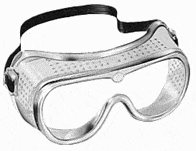
Goggles must be worn when using or working with chemicals

1

False

2

True

28

Lab Equipment/ Separation Activities #2

*I can measure things on an electronic balance.

*I can fold and put paper in a funnel properly.

*I filter sand from salt using water, funnel and filter paper.


media

​​Learning Intentions:

29

Filtering Sand from Salt solution

  • ITEMS NEEDED:

  • Funnel

  • Filter paper

  • Clay Triangle

  • Iron Ring

media

30

Filtering Sand from Salt Solution

  • When water is added to the Sand and Salt remaining sample, the Salt dissolves in water (SOLUTION), but the Sand does NOT dissolve (SUSPENSION)

media

31

media

​Solution vs. Suspension

Solution - particles are dissolved and can no longer be seen
Suspension - particles are temporarily floating in the water and can be seen, they do NOT dissolve

32

Filter Paper folded to fit in the funnel

Fold in HALF

Fold in 1/2 again.

Then open as shown and insert into funnel

media

33

media

34

​The procedure we are doing to filter sand and salt!

media

35

Multiple Choice

Question image

If I pour sand and water onto a filter, what will happen?

1

water and sand will go through the filter

2

sand will get caught in the filter, water will pass through

3

both sand and water will get caught in the filter

36

Multiple Choice

Which one of the following solids is insoluble (won't dissolve) in water?

1

sugar

2

sand

3

kool aid

4

salt

37

Multiple Choice

The separation technique that involves heating a solution until the liquid changes into a gaseous state, leaving behind a solid is known as

1

decanting

2

evaporation

3

filtering

4

chromatography

38

Drag and Drop

When water is added to sand and salt, the salt and water form a​
, but the sand and water form a ​
.

Drag these tiles and drop them in the correct blank above
solution
suspension
colloid
solid

39

Multiple Choice

To separate a mixture of soil and water what separation method is used?

1

Filtering

2

Sifting

3

Using a Magnet

4

Evaporation

40

Multiple Choice

To separate a mixture of salt and water what separation method is used?

1

Filtration

2

Sifting

3

Using a Magnet

4

Evaporation

41

Using the Electronic Balance

*In our lab we measure masses in GRAMS (g)

*NEVER put substances directly on the balance. Use a weigh boat or a paper or container

*The "ZERO" button will allow you to discount the mass of a container so you only get the mass of the material

media

42

Multiple Choice

The electronic balance measures mass of objects in ...

1

grams

2

pounds

3

milliliters

4

degrees

43

Electronic Balance

  • ZERO button is nice and can help you find out how much a sample weighs without having to subtract the mass of the container

  • But in lab you will often have to SHARE the balance and likely will have to record the mass of container, then the mass of sample in the container and then SUBTRACT to get the mass of the sample.

44

USING DATA
FROM A BALANCE

​So....let's practice a few calculations!
(YOU NEED A CALCULATOR!)
(NO PHONES!!!)

45

Multiple Choice

Question image

Iron filing were separated from a sample with a magnet and then transfered to a piece of paper and data was collected:

mass of a weigh boat: 4.24 grams

mass of iron on the weigh boat: 25.28 grams

How much did just the iron weigh?

1

29.52 grams

2

21.04 grams

46

Multiple Choice

Question image

We separated the sand using filter paper and recorded this data:

Mass of filter paper = 1.5 grams

Mass of sand on filter paper = 23.5 grams

How much does just the sand alone weight?

1

25.0 grams

2

22.0 grams

47

Lab Equipment/ Separation Activities #3

Day 3 Boiling/Evaporating the Salt-Water Solution to retrieve the Salt

*I can set up the ring stand, wire gauze and burner to prepare to boil away water.

*I can use evaporating dish and watch glass to boil away the water over a flame to get the salt.

media

48

Separation of Sand, Salt and Iron

  • IRON has been removed with a magnet and weighed (Day 1)

  • SAND has been filtered from the salt solution and is on filter paper. (Day 2)

  • Once the filter paper and sand dry overnight, the sand is weighed.

  • Next....

  • We are ready to retrieve the SALT that is in the water. We would call this our SALT SOLUTION. (Day 3)

49

TYPICAL SET UP FOR BOILING/

EVAPORATING LIQUID

  • Ring Stand

  • Iron Ring

  • Wire Gauze

  • Bunsen Burner

  • Evaporating Dish

  • Watch Glass

media

​NOTE: We had to complete boiling with
hot plates due to not having gas and
bunsen burners!

50

Evaporating Dish

Watch Glass

Evaporating Dish - made of porcelain so it can be heated


Watch Glass - clear concave shaped glass used as a cover. [Looks like a huge contact lens...LOL]

media

51

Boiling Away the Liquid (Evaporation)

Salt solution was added to the evaporating dish.

Flame was used to heat and boiling of the liquid begins.

This should be done slowly as to not boil over or lose any salt in the solution.

Note we haven't put the watch glass on when boiling begins. We will add that toward the end of boiling.

media

52

Boiling Away the Liquid (Evaporation)

Toward the end of boiling the salt will begin to pop out as it gets less liquid.

To keep from losing salt we will add the watch glass over the crucible.

Note he is using crucible tongs to pick up and place the watch glass. That's because the evaporating dish is HOT and it's the best way.

media

53

Boiling Away the Liquid (Evaporation)

Once boiling is finished, this is what the SALT looks like.

Note it looks crusty, but white and it is definitely salt.

media

54

Using balance the weigh the SALT

The evaporating dish and watch glass crusted with white SALT is taken to the electronic balance and the mass is weighed in GRAMS (g).

To get the mass of just the SALT, we have to SUBTRACT the mass of the evaporating dish and watch glass.

media

55

Multiple Choice

Question image

A student weighed their evaporating dish, watch glass crusted with salt and recorded this data:

Mass of evap dish, watch glass & salt: 176.74 g

Mass of evap dish and watch glass: 162.51 g

What is the mass of just the SALT?

(Do you know what to do? Hint: SUBTRACT)

1

15.52 g

2

160.74 g

3

14.23 g

56

Multiple Choice

Question image

Students working on a separation lab like we performed in class boiled away water and obtained the following. What is the residue left behind?

1

sand

2

ash

3

salt

4

iron

57

Multiple Choice

Which of the following would be used to boil away water?

1
2
3
4

58

Multiple Choice

Question image

Identify the equipment shown here:

1

crucible

2

evaporating dish

3

mortar and pestle

4

bowl

59

Multiple Choice

To prevent boiling liquid and materials from popping out you may use which of the following?

1
2
3
4

60

Multiple Choice

This item is used on an iron ring and beakers or dishes can sit on them and safely be heated.

1
2
3
4

61

Multiple Choice

Question image

Identify the equipment shown here:

1

concave glass

2

convex glass

3

watch glass

4

glass plate

62

Multiple Choice

Question image

Identify the equipment shown here:

1

test tube holder

2

iron rod

3

iron ring

4

ring stand

63

TONGS - 2 different types

Beaker Tongs


*Note the wide gap big enough to hold or pick up a beaker

*Beaker Tongs can be coated with black or can be plain metal

media

64

TONGS - 2 different types

Crucible Tongs


*Note the smaller gap at the end and tips that meet


*This is for handing smaller HOT objects.

media

65

Crucible Tongs

See the crucible tongs holding the small porcelain crubible.

media
media

66

Crucible Tongs

Another pic showing small porcelain crucible and crucible tongs

media

67

Multiple Choice

Question image
1

scoopula

2

dropper

3

crucible tongs

4

beaker tongs

68

Multiple Choice

Question image

What is this?

1

thermometer

2

glass stirring rod

3

buret

4

beaker

69

KNOW YOUR FLASKS

Erlenmeyer Flask = triangular shaped


Florence Flask (a.k.a. round bottom flask) = round bottom shaped

media

70

Erlenmeyer Flasks

It is named after the German chemist Emil Erlenmeyer (1825–1909), who created it in 1860. 


Erlenmeyer flasks have wide bases, with sides that taper upward to a short vertical neck

media

71

Florence Flask

Florence flask (also known as a round bottom flask or a boiling flask) is a piece of laboratory glassware. It is a round or flat-bottom flask with a long neck.


The flask is named after Florence, Italy.

media

72

Wrap Up and Complete Calculations from Sand, Salt and Iron Separation Lab

  • Percent by Mass Calculations

  • What % IRON was in the sample? What % SAND was in the sample? What % SALT was in the sample?

  • % Mass = mass of that part/total mass of the mixture x 100

  • If students performed perfect lab techniques and didn't lose any part or make any mistakes, then the 3 percentages would add to = 100%

73

Let's practice doing % Mass IRON

  • Lab data: mass of original mixture of sand, salt & iron = 32.45 g

  • Lab data: mass of iron = 6.75 g

  • % Mass = 6.75 g/32.45 g x 100 =

  • Use calculator DIVIDE first two numbers, then times by 100, then enter

  • Ok...go to next slide. Let's see what you got!!!

74

Multiple Choice

Using a calculator do this calculation:

% Mass IRON = 6.75 / 32.45 x 100 = ??

Use calculator DIVIDE first two numbers, then times by 100, then enter

1

6.75%

2

20.8%

3

28.0%

4

480.7%

75

Let's practice doing % Mass SAND

  • Lab data: mass of original mixture of sand, salt & iron = 32.45 g

  • Lab data: mass of sand= 17.62 g

  • % Mass = 17.62 g/32.45 g x 100 =

  • Use calculator DIVIDE first two numbers, then times by 100, then enter

  • Ok...go to next slide. Let's see what you got!!!

76

Multiple Choice

Using a calculator do this calculation:

% Mass SAND= 17.62 g/32.45 g x 100 =

Use calculator DIVIDE first two numbers, then times by 100, then enter

1

17.62%

2

50.1%

3

54.3%

4

184.2%

77

Let's practice doing % Mass SALT

  • Lab data: mass of original mixture of sand, salt & iron = 32.45 g

  • Lab data: mass of sand= 8.08 g

  • % Mass = 8.08 g/32.45 g x 100 =

  • Use calculator DIVIDE first two numbers, then times by 100, then enter

  • Ok...go to next slide. Let's see what you got!!!

78

Multiple Choice

Using a calculator do this calculation:

% Mass SALT= 8.08 g/32.45 g x 100 =

Use calculator DIVIDE first two numbers, then times by 100, then enter

1

8.08%

2

40.5%

3

54.3%

4

24.9%

79

Multiple Choice

When you add the 3 percentages you just calculated and add them.

20.8% Iron

54.3% Sand

24.9% Salt

What is the total percent when you add?

1

100%

2

95%

80

Multiple Select

Rarely does lab work go perfectly. What possible reasons might account for a student who gets 96.5% total percent instead of 100%? [Mark all that apply.]

1

Spilled some sample on lab table

2

Knocked over their salt solution in flask and lost some salt

3

Some sand wouldn't come out of the beaker and stuck to the side and didn't get filtered

4

While using magnet, some iron filings were small and fell in the floor

81

Multiple Choice

If you spill or break something during an experiment, what is the FIRST thing you should do?

1

Tell the teacher.

2

Clean it up. 

3

Cover it with a paper towel.

4

Leave it for someone else.

82

Multiple Choice

Question image

Name this lab apparatus:

1

buret

2

funnel

3

mortar and pestle

4

clay triangle

83

Multiple Choice

Question image

Identify the equipment shown here:

1

crucible holder

2

wire gauze

3

clay triangle

4

test tube holder

84

Multiple Choice

Question image

This is used to put out a fire

1

fire extinguisher

2

thermometer

3

fire blanket

4

tongs

85

Multiple Choice

Question image

This is used to clean test tubes and other pieces of lab equipment.

1

test tube brush

2

scrub brush

3

bristle brush

4

test tube holder

86

Multiple Choice

Question image

This is used to clean chemicals or debris (stuff) out of your eyes

1

test tube holder

2

eye wash

3

safety goggles

4

lab apron

87

Multiple Choice

Question image

This is called_______________________?

1

Erlenmeyer Flask

2

Test Tube Flask

3

Florence Flask

4

Graduated Cylinder

88

Multiple Choice

Question image

What is this item?

1

Pipette

2

Eye Dropper

3

Buret Clamp

4

Straw

89

Multiple Choice

Question image

This item is used to simply hold or approximately measure a liquid.

1

beaker

2

flask

3

graduated cylinder

4

test tube

90

Multiple Choice

Question image

What is used to protect your eyes from chemicals, broken glass, and fire?

1

Fire blanket

2

Eye wash

3

Saftety Goggles

4

Eyeglasses

91

Multiple Choice

Question image

This device is called a __________________.

1

Ring stand

2

Graduated cylinder

3

Bunsen burner

4

Striker

Lab Equipment/Separation #1

*I can learn names and uses of pieces of lab equipment.

*I can separate iron from a sample of sand, salt & iron in the lab by using physical properties.
*I can measure volume of liquids in a graduated cylinder.
*I can learn about methods of separating mixtures.

media

Learning Intentions:

Show answer

Auto Play

Slide 1 / 91

SLIDE