

10.3B: Political and Economic Life After Slavery

Presentation
•
History
•
9th - 12th Grade
•
Practice Problem
•
Easy

Scott Markowitz
Used 1+ times
FREE Resource
51 Slides • 15 Questions
1

2

3
Fill in the Blanks
During Reconstruction, many African Americans traveled extensively because they wanted to get closer to
Type answer...
4

5
Multiple Choice
What were some of the new rights gained by African Americans during Reconstruction, and what challenges did they continue to face?
African Americans were granted land ownership and wealth accumulation without restrictions, but had to start paying taxes.
They faced no discrimination and had equal opportunities in all aspects of life, but success went to their heads.
They gained voting rights during Reconstruction, but were barred from holding political office.
6

7

8

9

10

11

12

13

14
15

16
Multiple Choice
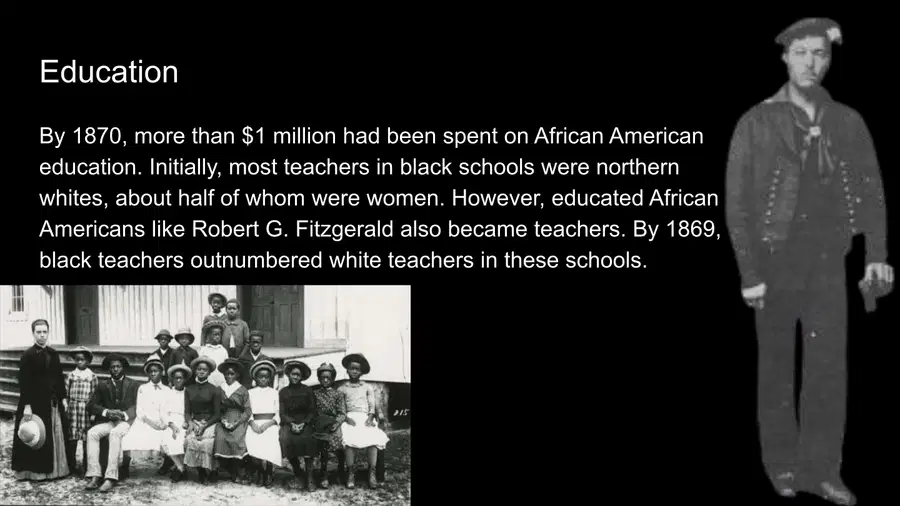
Who was Robert G. Fitzgerald and what was his contribution during Reconstruction?
A Union Army officer who became a teacher for former slaves
A politician who passed education laws
A church leader who built schools
A freed slave who became a principal
17

18

19

20

21

22

23

24

25
Multiple Choice
Which of the following statements about education among former slaves is/are correct?
Younger generations sometimes taught their elders to read
Education was only for children
Elderly African Americans did not participate in learning
Education wasn't seen as important by former slaves
26
Multiple Choice
Why was it significant that African American schools included both children and elderly students after the Civil War?
27

28
Multiple Choice
How did volunteer groups formed by freed African Americans after the Civil War support their communities?
By providing only financial support
By organizing only religious activities
By fostering independence and creating leadership opportunities
By focusing solely on political campaigns
29

30

31

32

33

34

35
Multiple Select
Select all statements that are true about African American political participation during Reconstruction.
P.B.S. Pinchback was the first African American to serve as governor in the United States.
Oscar Dunn served as lieutenant governor and acting governor of Louisiana.
African Americans were not allowed to hold any executive office during Reconstruction.
Both Pinchback and Dunn served as acting governors of Louisiana.
36

37

38

39

40

41

42

43

44
Multiple Choice
Which of the following best describes the primary significance of African American political participation during Reconstruction?
Complete political equality was immediately achieved
African Americans gained limited but meaningful political representation for the first time
No meaningful political changes occurred
Only wealthy African Americans could participate in politics
45
Multiple Choice
What made African American political representation during Reconstruction unique?
It was proportional to population
It was completely accepted by white Southerners
It was limited but historically unprecedented
It immediately transformed Southern politics
46

47

48

49

50

51

52

53

54
55

56

57

58

59

60


61
Multiple Choice
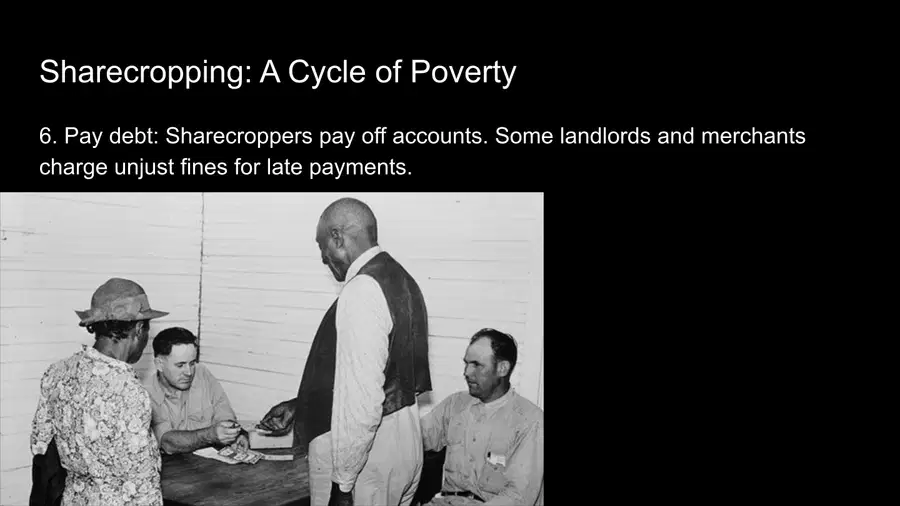
The sharecropping system can best be characterized as
A completely fair economic opportunity for former slaves
A form of economic exploitation that resembled a new type of economic slavery
A temporary agricultural arrangement with no long-term consequences
A system that quickly led to widespread land ownership for African Americans
62
Multiple Choice
What economic challenge most significantly limited African Americans' ability to achieve economic independence after slavery?
Lack of access to education
Absence of capital and land ownership
Racial discrimination in hiring
Limited agricultural knowledge
63
Multiple Choice
How did sharecropping differ fundamentally from slavery?
Sharecroppers could legally leave their employment
Sharecroppers received full compensation for their labor
Sharecroppers had complete economic freedom
There were no significant differences
64
Multiple Choice
The cycle of sharecropping most closely resembled
A fair economic partnership
A system of economic independence
A form of economic entrapment
A temporary agricultural arrangement
65
Multiple Choice
Describe how the opportunity to participate in politics changed the lives of African Americans after the Civil War.
African Americans were only allowed to vote in federal elections, not local ones, since federal laws were the only ones protecting them
African Americans were excluded from all political processes after the Civil War, with the idea that freedom simply meant "the absence of slavery"
African Americans were empowered and had increased representation, advocacy for civil rights, and improvements in their social and economic conditions.
66
Multiple Choice
Which of the following best describes a challenge faced by African Americans during Reconstruction?
They had fewer rights than they'd had under slavery.
They faced discrimination despite gaining new rights.
They were not allowed to participate in political activity.
They lost all social and political rights.
Show answer
Auto Play
Slide 1 / 66
SLIDE
Similar Resources on Wayground

61 questions
Borders and Boundaries
Presentation
•
KG - University
58 questions
Vietnam- Domestic
Presentation
•
9th - 12th Grade
63 questions
The Carrying Capacity of Ecosystems Lesson
Presentation
•
9th - 12th Grade
63 questions
5th Six Weeks Test Review
Presentation
•
9th - 12th Grade
60 questions
Cells and Cell Processes
Presentation
•
10th - 12th Grade
62 questions
2.3 Media Formatting
Presentation
•
9th - 12th Grade
61 questions
Days of the week and Months
Presentation
•
9th - 12th Grade
Popular Resources on Wayground
10 questions
Safety Day 2026 – Student Review

Quiz
•
9th Grade
21 questions
Continents and Oceans
Quiz
•
6th Grade
20 questions
Parts of Speech
Quiz
•
5th Grade
16 questions
Subject & Predicate
Quiz
•
5th Grade
25 questions
Multiplication Facts
Quiz
•
5th Grade
12 questions
Map Skills
Quiz
•
3rd Grade
22 questions
Continents and Oceans
Quiz
•
5th Grade
15 questions
Rounding Decimals
Quiz
•
5th Grade
Discover more resources for History
25 questions
The American Revolution
Quiz
•
7th - 10th Grade
15 questions
The Bill of Rights
Quiz
•
8th - 12th Grade
15 questions
Ancient Rome
Quiz
•
7th - 10th Grade
16 questions
Students of Civics Unit 2: The Constitution
Quiz
•
7th - 11th Grade
10 questions
Exploring the 7 Principles of the Constitution

Interactive video
•
6th - 10th Grade
10 questions
Significance of the Declaration of Independence
Interactive video
•
6th - 10th Grade
22 questions
Beginning of WW2 Quiz
Quiz
•
9th Grade
10 questions
Exploring the Age of Exploration
Interactive video
•
6th - 10th Grade