
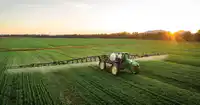
Sustainable Agriculture

Presentation
•
Science
•
9th - 12th Grade
•
Practice Problem
•
Medium
+6
Standards-aligned

Scott Purdy
Used 19+ times
FREE Resource
18 Slides • 18 Questions
1

2
3
Multiple Choice
Which of the following best describes the significance of sustainable agriculture?
It ensures long-term food security while protecting the environment.
It focuses only on increasing crop yields regardless of environmental impact.
It relies solely on traditional farming methods.
It prioritizes profit over ecological balance.
4

5
Open Ended
What was the green revolution?
6

7
Multiple Choice
What problem did Borlaug's team encounter when breeding wheat with large heads, and how was it solved?
The wheat became too short and weak, solved by making it taller.
The wheat fell over (lodging), solved by breeding shorter, sturdier varieties.
The wheat produced less grain, solved by adding more fertilizer.
The wheat became resistant to pests, solved by using pesticides.
8

9

10
Multiple Select
Which of the following are impacts of agriculture on the environment?
Destruction of habitat
Soil erosion
Fertilizer & pesticide runoff
Increased biodiversity
11
Open Ended
How have advances in agriculture both benefited and harmed the environment?
12

13
Multiple Choice
What is one benefit of growing cover crops after harvesting the cash crop?
They increase soil erosion.
They reduce soil health.
They maintain soil health and prevent erosion.
They require more fertilizer.
14

15
Fill in the Blanks
Planting crops in line with the
Type answer...
16

17
Open Ended
Explain how rotating crops and rotating livestock grazing contribute to sustainable agriculture.
18

19
Multiple Choice
Which of the following is a sustainable agricultural practice mentioned in the summary?
Monoculture farming
Cover crops
Heavy pesticide use
Slash-and-burn
20

21
Open Ended
What are the benefits of organic farming techniques?
22

23
Multiple Select
Which of the following are downsides to organic farming techniques?
Less productivity
Requires more land for same yields
Banned use of GMOs
Increased use of synthetic fertilizers
24

25
Fill in the Blanks
Biosolids, or carefully treated
Type answer...
26

27
Multiple Choice
According to the lesson, do organic foods generally have more vitamins and minerals than conventional foods?
Yes, they have more vitamins and minerals.
No, they do not have additional vitamins or minerals.
Yes, but only slightly more.
It depends on the type of crop.
28

29
Open Ended
How might vertical farming help address future challenges in agriculture?
30

31
Multiple Choice
Which of the following is NOT an advantage of vertical farming over traditional farming?
Requires less land
Produces higher yield
Uses more pesticides
Water can be recycled
32

33
Open Ended
Explain how technology can help make traditional farming more environmentally friendly. Provide at least two examples from the lesson.
34

35
Multiple Choice
Which of the following was NOT a goal of Norman Borlaug's selective plant breeding during the green revolution?
Increasing plant yields
Developing disease-resistant wheat varieties
Preventing millions from starving
Reducing the use of fertilizers
36
Fill in the Blanks
Farms of the future may use
Type answer...
Show answer
Auto Play
Slide 1 / 36
SLIDE
Similar Resources on Wayground

30 questions
Phase Changes
Presentation
•
9th - 12th Grade
30 questions
Cell Transportation 1
Presentation
•
9th - 12th Grade
28 questions
Human Population Growth w video
Presentation
•
9th - 12th Grade
32 questions
Body Systems
Presentation
•
10th - 12th Grade
31 questions
Unit 8 - Types of Waves (focus: mechanical waves)
Presentation
•
9th - 12th Grade
26 questions
Cell Organelles
Presentation
•
9th - 12th Grade
32 questions
G11 Unit 6: Lesson 1 - Food Groups (Gen)
Presentation
•
9th - 12th Grade
Popular Resources on Wayground
10 questions
How much do you know about our Portrait of an Eagle?

Quiz
•
10th Grade
10 questions
Fast Food Slogans
Quiz
•
6th - 8th Grade
21 questions
Continents and Oceans
Quiz
•
6th Grade
20 questions
Parts of Speech
Quiz
•
5th Grade
16 questions
Subject & Predicate
Quiz
•
5th Grade
25 questions
Multiplication Facts
Quiz
•
5th Grade
12 questions
Map Skills
Quiz
•
3rd Grade
22 questions
Continents and Oceans
Quiz
•
5th Grade
Discover more resources for Science
10 questions
Exploring Chemical and Physical Changes

Interactive video
•
6th - 10th Grade
20 questions
Atomic Structure
Quiz
•
9th Grade
10 questions
Decoding the Periodic Table of Elements
Interactive video
•
6th - 10th Grade
10 questions
Exploring the Periodic Table
Interactive video
•
6th - 10th Grade
14 questions
Physical and Chemical Changes
Quiz
•
10th Grade
22 questions
Periodic Table Review
Quiz
•
9th - 12th Grade
20 questions
Observation vs. Inference
Quiz
•
7th - 9th Grade
14 questions
Periodic Trends
Interactive video
•
11th Grade