

High vs Low level Code and Translators

Presentation
•
Computers
•
9th - 10th Grade
•
Practice Problem
•
Easy

Ben Dobson
Used 3+ times
FREE Resource
91 Slides • 12 Questions
1
2

3

4
5

6

7

8

9

10

11

12
13
A low level language....
That uses binary instruction that CPU can decode and execute
Different instructions have different binary values
14
Open Ended
What is machine code?
15
A low level language....
That uses binary instruction that CPU can decode and execute
Different instructions have different binary values
16
17
A low level language....
That has simple instructions such as LOAD, each of which corresponds to a single machine code instruction.
It must be translated into machine code (object code) to be understood by CPU.
But this translation process is faster than translating high level language into machine code
18
A low level language....
That has simple instructions such as LOAD, each of which corresponds to a single machine code instruction.
It must be translated into machine code (object code) to be understood by CPU.
But this translation process is faster than translating high level language into machine code
19
Open Ended
What is assembly language?
20
A low level language....
That has simple instructions such as LOAD, each of which corresponds to a single machine code instruction.
It must be translated into machine code (object code) to be understood by CPU.
But this translation process is faster than translating high level language into machine code
21

22
Open Ended
What are the advantages of low level languages?
23

24
25
Open Ended
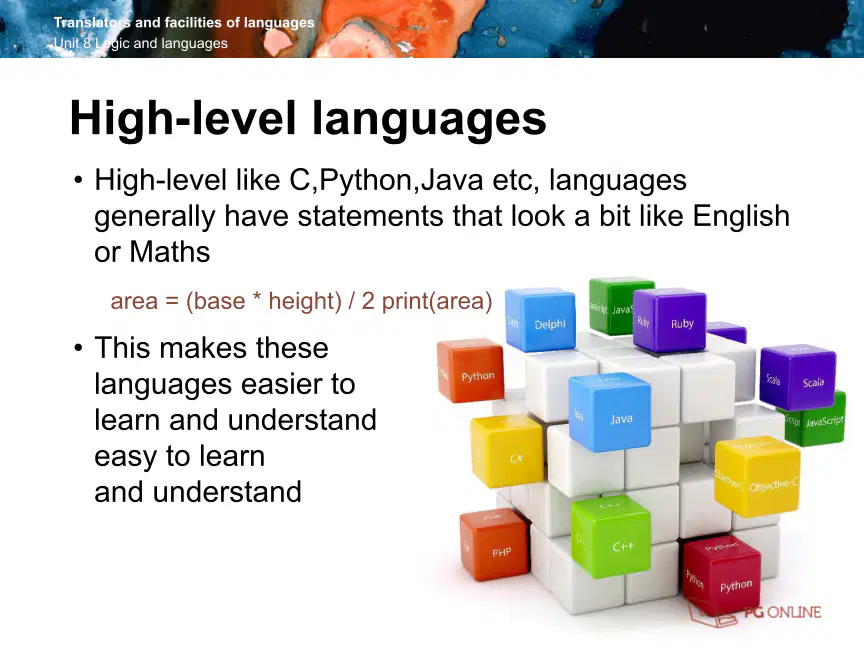
What is a high level language?
26
27

28
Open Ended
What are the advantages of high level languages?
29
•A high-level language is easier to learn
•Programs can be written faster in a high-level language
•It is easier to understand and debug a high-level language
30

31
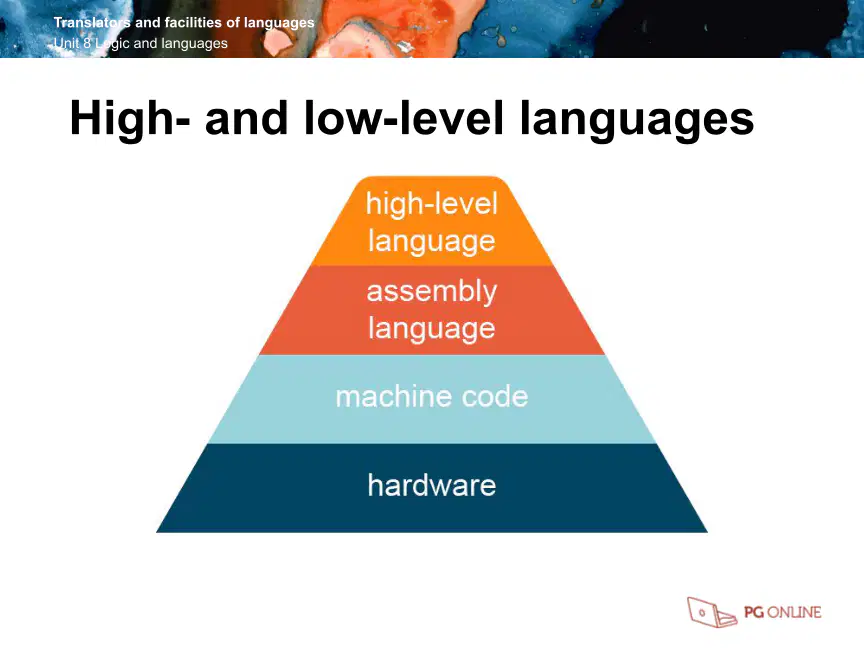
Low level vs High Level Languages.
Explain each and explain some advantages/disadvantages of each
32

33

34

35
36

37

38

39

40

41
Open Ended
Explain what a compiler does.
42
(Unless there is a syntax error....in which case no machine is made)
43
Open Ended
In a compiled language what happens if compilation is attempted if high level code breaks the grammar rules of programming language?
44
45

46
Open Ended
What is an interpreter?
47
48
Open Ended
1) When high level code is compiled does the user need the compiler?
2) When high level code is interpreted does the user need the interpreter installed to run the code?
49
2) When high level code is interpreted does the user need the interpreter installed to run the code? YES
50
Open Ended
1) When high level code is compiled what is given to the user (by the developer) ?
2) When high level code is interpreted what is given the user(by the developer)?
51
Just the machine (object) code
2) When high level code is interpreted what is given the user(by the developer)? The source code (and possibly the interpreter although the developer may assume the user has this already)
52
53

54

55

56

57
Open Ended
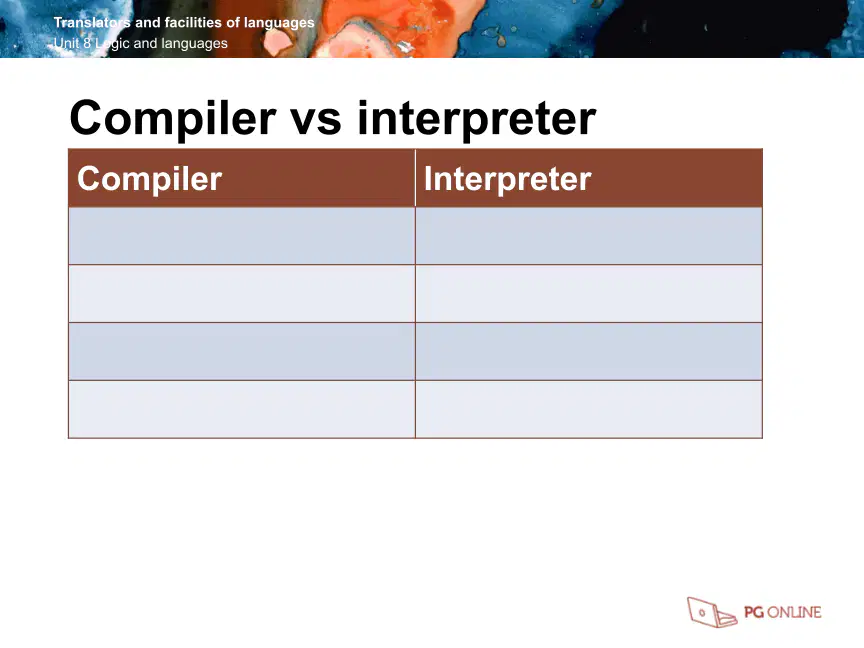
Describe some compiler advantages
58
59

60
Open Ended
Describe some interpreter advantages
61
62
(What they are/do and pros and cons)
63

64

65

66

67

68

69

70

71

72

73
74

75

76

77

78

79

80

81

82

83

84

85

86

87

88

89

90

91

92

93

94

95

96

97

98

99
100
101

102

103

Show answer
Auto Play
Slide 1 / 103
SLIDE
Similar Resources on Wayground

96 questions
Manual Mode: Using the Exposure Triangle
Presentation
•
10th Grade
101 questions
Biology Final Exam Review
Presentation
•
9th Grade
99 questions
Developmental Psych
Presentation
•
10th - 11th Grade
93 questions
WWII (War in the Pacific)
Presentation
•
9th Grade
93 questions
REVISION FOR THE SECOND EXAMINATION - PART 1
Presentation
•
9th Grade
100 questions
Unit 3: Ecosystems
Presentation
•
9th - 12th Grade
98 questions
PA_VA_Unit 2 Review
Presentation
•
8th Grade
93 questions
STAAR Biology Cells
Presentation
•
9th - 12th Grade
Popular Resources on Wayground
10 questions
Safety Day 2026 – Student Review

Quiz
•
9th Grade
21 questions
Continents and Oceans
Quiz
•
6th Grade
20 questions
Parts of Speech
Quiz
•
5th Grade
16 questions
Subject & Predicate
Quiz
•
5th Grade
25 questions
Multiplication Facts
Quiz
•
5th Grade
12 questions
Map Skills
Quiz
•
3rd Grade
22 questions
Continents and Oceans
Quiz
•
5th Grade
15 questions
Rounding Decimals
Quiz
•
5th Grade