Modern Classification Lesson
Presentation
•
Science
•
9th - 12th Grade
•
Hard
Standards-aligned
Kerry Dabbs
FREE Resource
15 Slides • 16 Questions
1
Modern Classification
By Kerry Dabbs
2
Scientists classify living things according to their relatedness based on things like:
*homologous structures - body arrangements that are similar
These vertebrates are all fairly closely related in evolutionary terms.
They share the same basic arrangement and number of limb bones
3
Multiple Choice
Looking at the homologous bone structures, which 2 organisms appear to be most closely related?
dolphin and bat
horse and cat
human and cat
human and horse
4
Scientists classify living things according to their relatedness based on things like:
*embryology - similarities in development of their embryos
These vertebrates are all fairly closely related in evolutionary terms. They show very similar embryological development.
5
Scientists classify living things according to their relatedness based on things like:
*fossil record - layers of earth reveal fossils that are similar but show gradual changes over time
These "horse" fossils organized from top (newest),
to bottom (oldest), show very similar structure but definite changes in size an proportions over millions of years.
6
Multiple Choice
Older fossils from similar species will be found ___________ newer fossils
above
below
7
Scientists classify living things according to their relatedness based on things like:
*DNA sequences - the more closely related a species is, the more similar their DNA sequences will be, and the more similar the resulting proteins they build will be
These vertebrate amino acid/protein sequences show similarities indicating level of relatedness. The more similar the sequence, the more closely related 2 species are.
8
Multiple Choice
According to the protein sequence chart, the most related organisms are
mouse, rat, chicken
human, pig, dog
human, pig, dog, frog
9
All living things fit into one of the 3 DOMAINS of life:
10
Archaea and Eukarya are connected on the same evolutionary line after Bacteria branch off, indicating that they are more closely related to each other
The black vertical line at the bottom represent s a single common ancestor that all of them arose from
11
Domains
Kingdoms
This is another representation of the same information about domains.
This one shows the kingdoms inside each domain
12
Multiple Choice
How many kingdoms are there in Domain Bacteria?
1
2
4
6
13
Multiple Choice
How many kingdoms are there in Domain Eykarya?
1
2
4
6
14
Multiple Select
Which 2 domains have organisms that don't have a nuleus?
Bacteria
Archaea
Eukarya
Animals
15
This graphic shows another way to display the modern classification model.
Time would be moving left to right, with present day being represented as the 6 kingdoms on the right and the oldest common ancestor that they all evolved from, on the left.
16
Multiple Choice
Which 2 domains appear to be the most closely related?
Bacteria, Archaea
Bacteria, Fungi
Bacteria, Eukarya
Eukarya, Archaea
17
Multiple Choice
What is it that indicates a close evolutionary relationship?
a more recent branch, indicating a recent common ancestor
a similar color on the chart
a similar sounding name
18
Phylogenetic Trees and Cladograms
are ways to show evolutionary relationships
can be interpreted in a similar way
19
Phylogenies
Each lineage has a part of its history that is unique to it alone and parts that are shared with other lineages.
Phylogenies trace patterns of shared ancestry between lineages!
Shared lineage = common ancestry!
20
Phylogenies
The process of evolution produces a pattern of relationships between species.
As species evolve and adaptations are inherited, their evolutionary paths split.
21
Phylogenies
When a lineage splits (speciation), it is represented as branching on a phylogeny.
When a speciation event occurs, a single ancestral lineage gives rise to two or more daughter lineages.
22
Multiple Choice
Which group of animals on this tree are most closely related to birds?
Saurischian dinosaurs
Ornithischian dinosaurs
Crocodiles
None of these are related to birds
23
Multiple Choice
According to this tree, which of these animal phyla are most closely related?
Arthropoda & Mollusca
Arthropoda & Chordata
Chordata & Mollusca
24
Multiple Choice
Where is the alligator and T. rex's common ancestor?
Point A
Point B
Point C
Point D
25
Cladograms
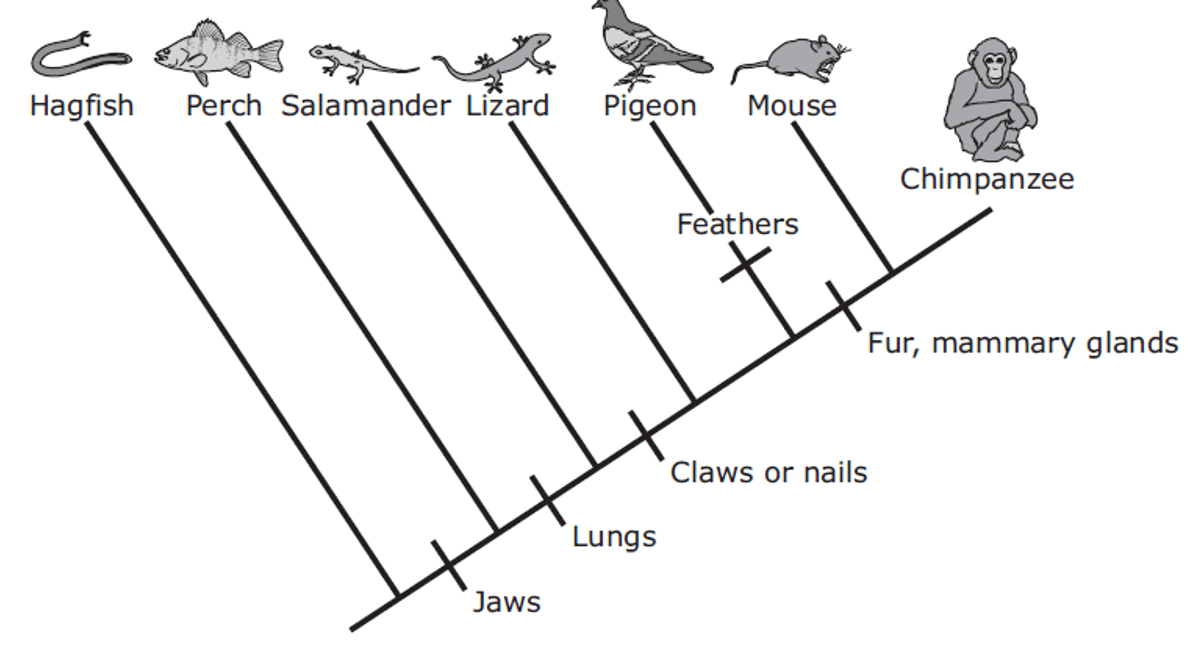
A cladogram is similar, but shows relationships based on shared physical homologies.
The starting point of the branch represents the common ancestor of all the organisms shown.
Characteristics listed are common to all organisms beyond that point on the branch.
For this class, we will treat phylogenies and cladograms as the same.
26
Multiple Choice
Which letter represents the most recent common ancestor of sponges and mushrooms?
A
B
C
D
E
27
Clades
A clade is a grouping that includes a common ancestor and all the descendants (living and extinct) of that ancestor.
Imagine clipping a single branch off the phylogeny — all of the organisms on that clipped branch make up a clade.
28
Multiple Choice
Which trait(s) do conifers have?
vascular tissue only
vascular tissue and seeds
vascular tissue, seeds and flowers
seeds only
29
Multiple Choice
30
Multiple Choice
What do both the squirrel and lion have in common that the other animals do not?
They are both vertebrates
They both have lungs
They are both mammals
They both lose their canine teeth.
31
Multiple Select
What do amphibians, birds, prosimians and humans all have in common? Check all that apply.
Hair
Endothermic
Eukaryotic
Tetrapod
Vertebrate
Modern Classification
By Kerry Dabbs
Show answer
Auto Play
Slide 1 / 31
SLIDE

Similar Resources on Wayground
25 questions
Biome Quiz Review
Presentation
•
9th - 12th Grade
24 questions
Cell Cycle: Checkpoints and Cancer
Presentation
•
9th - 12th Grade
23 questions
Plastic Pollution Awareness
Presentation
•
KG - 12th Grade
23 questions
Forensics: Observation
Presentation
•
9th - 12th Grade
25 questions
Bohr Models
Presentation
•
10th - 12th Grade
21 questions
Climate Part 1: Spheres of the Earth
Presentation
•
9th - 12th Grade
24 questions
Ecology
Presentation
•
10th - 12th Grade
22 questions
The Moon
Presentation
•
8th - 12th Grade
Popular Resources on Wayground
10 questions
5.P.1.3 Distance/Time Graphs
Quiz
•
5th Grade
10 questions
Fire Drill
Quiz
•
2nd - 5th Grade
20 questions
Equivalent Fractions
Quiz
•
3rd Grade
22 questions
School Wide Vocab Group 1 Master
Quiz
•
6th - 8th Grade
20 questions
Main Idea and Details
Quiz
•
5th Grade
20 questions
Context Clues
Quiz
•
6th Grade
20 questions
Inferences
Quiz
•
4th Grade
12 questions
What makes Nebraska's government unique?
Quiz
•
4th - 5th Grade
Discover more resources for Science
10 questions
Exploring the Layers of the Earth
Interactive video
•
6th - 10th Grade
25 questions
Naming Ionic and Covalent Compounds
Quiz
•
9th Grade
20 questions
Balancing Chemical Equations
Quiz
•
9th Grade
15 questions
Protein synthesis
Quiz
•
9th Grade
20 questions
Human Impact on the Environment Review #2
Quiz
•
9th Grade
20 questions
Newton's Laws of Motion
Quiz
•
9th Grade
20 questions
Mendelian Genetics Review
Quiz
•
9th Grade
16 questions
Balancing Chemical Equations and Types of Reactions
Quiz
•
9th - 10th Grade