
2.2.1 Moon Missions

Presentation
•
Other
•
11th Grade
•
Practice Problem
•
Easy

Caitlin Ford
Used 5+ times
FREE Resource
14 Slides • 3 Questions
1
2.2.1
By Caitlin Ford
2
Objectives
- list the different types of Moon missions
- identify different space organizations and their landmark Moon missions
- explain how the Moon missions have led to a better understanding of the Moon
3
How is this
different from these?


4
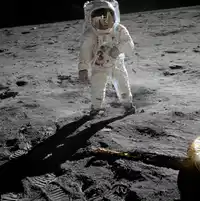
Apollo 11
Launch - July 16, 1969
Landing - July 20, 1969 The Eagle has landed!
Neil Armstrong & Buzz Aldrin do the first moon walk
Capsule landed in the ocean on July 24, 1969

5
Why go to the Moon?
The brightest object in the sky (other than the Sun!) and always attracted interest. Stories and art were created.
It is less expensive to launch missions to the moon than other planets.
Good training for astronauts who want to go on longer missions (like Mars)

6
Drag and Drop
7
The Space Race
1950s-1960s
USA vs The Soviet Union after WWII
Rockets were launched, then rockets with different animals (dogs and monkeys), then rockets with people
8
The Moon Race
Kinds of spacecraft used for the Moon race:
Impactor - hit the surface of the moon
flyby - passed by the moon and took photographs
lander - landed softly on the moon
orbiter - went around the moon
rover - moves on the surface of the Moon, collecting samples and taking photographs
9
10
Disaster
There were deaths during the Space Race.
3 astronauts perished during a launch rehearsal of Apollo 1. A fire broke out.
After this, NASA sent several uncrewed missions to space to test all of its launch equipment.

11
The End of the Space Race
After 1972, NASA stopped sending people to the moon. There was a lack of political backing and it cost too much (25 billion dollars for all Apollo missions)
... until now!
NASA is planning to return to the moon in 2028 with the Artemis III mission.
12
Lunar Missions of the 21st Century

13
Landmark Missions
SMART-1 - European Space Agency: impacted the Moon
SELENE - Japan: mapped the lunar surface and the gravitational field of the Moon's far side
Chang'e - China: multiple missions, brought lunar soil back to Earth
Chandrayaan - India: collected a lunar soil sample, found traces of water in the soil
Artemis 1 - USA: 25-day mission to study lunar surface
14
Multiple Select
Why did the United States stop sending humans to the Moon after Apollo 17? (select two!)
There was a lack of political backing.
The expense became too great.
NASA was not ready to take the risk.
NASA did not have sufficient resources.
15
Match
Match each spacecraft to its definition.
hits the moon
passes by the moon and takes photos
touches down softly on the moon
goes around the moon
moves on the surface of the moon
impactor
flyby
lander
orbiter
rover
impactor
flyby
lander
orbiter
rover
16

Artemis - NASA
You can open this webpage in a new tab.
17
Great job!
Today, you learned:
- the historical developments that led to Moon missions
- some landmark Moon missions and their discoveries
- the importance of Moon missions
2.2.1
By Caitlin Ford
Show answer
Auto Play
Slide 1 / 17
SLIDE
Similar Resources on Wayground

13 questions
Robert Schumann
Presentation
•
KG
11 questions
Halloween
Presentation
•
12th Grade
12 questions
Linear Transformations Review 23-24
Presentation
•
11th Grade
12 questions
Molar Mass
Presentation
•
11th Grade
13 questions
Ilmu Pengetahuan Alam
Presentation
•
KG
14 questions
Solving Rational Equations
Presentation
•
11th Grade
11 questions
Cause and Effect
Presentation
•
11th Grade
10 questions
Algorithm and Flowchart
Presentation
•
11th Grade
Popular Resources on Wayground
10 questions
Safety Day 2026 – Student Review

Quiz
•
9th Grade
21 questions
Continents and Oceans
Quiz
•
6th Grade
20 questions
Parts of Speech
Quiz
•
5th Grade
16 questions
Subject & Predicate
Quiz
•
5th Grade
25 questions
Multiplication Facts
Quiz
•
5th Grade
12 questions
Map Skills
Quiz
•
3rd Grade
22 questions
Continents and Oceans
Quiz
•
5th Grade
15 questions
Rounding Decimals
Quiz
•
5th Grade
Discover more resources for Other
26 questions
SLIME!!!!!
Quiz
•
KG - 12th Grade
20 questions
Cell Transport
Quiz
•
9th - 12th Grade
20 questions
Budgeting
Quiz
•
9th - 12th Grade
20 questions
Investing
Quiz
•
9th - 12th Grade
8 questions
DNA vs. RNA
Presentation
•
9th - 12th Grade
12 questions
Identify Rigid Transformations
Quiz
•
8th - 12th Grade
10 questions
Complementary, Supplementary, Vertical, and Linear Pairs
Quiz
•
9th - 12th Grade
20 questions
Managing Credit
Quiz
•
9th - 12th Grade