

EF2 - 8A Should I Stay or Should I Go?

Presentation
•
English
•
Professional Development
•
Easy

Carolini Simões
Used 2+ times
FREE Resource
16 Slides • 12 Questions
1

2
3
4
Poll

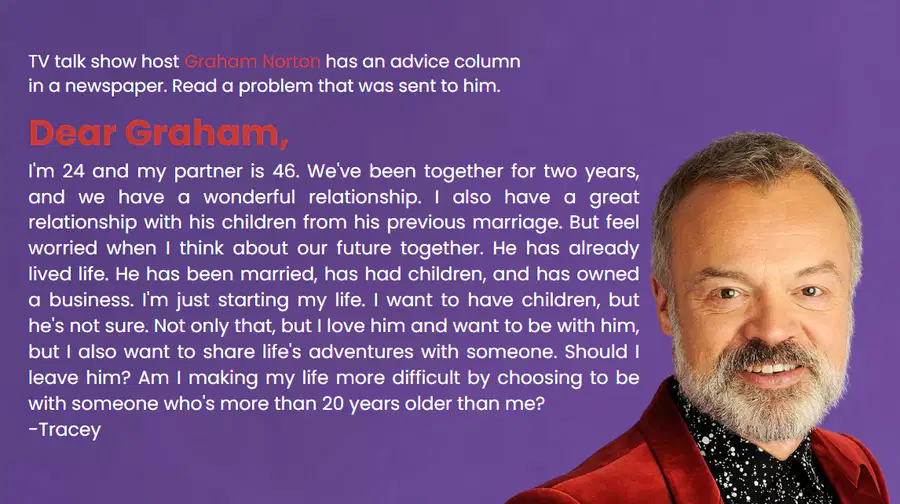
What should Tracey do?
She should leave him and find somebody who is closer to her age and shares her interests.
She should think hard about what kind of man she really wants to be with before making a decision.
She should stay with him if she loves him. Being with an older man has advantages as well as disadvantages.
5
Multiple Choice
Now listen to Tracey reading Graham's advice.
Which of the three options does Graham think is right? Why?
She should leave him and find somebody who is closer to her age and shares her interests.
She should think hard about what kind of man she really wants to be with before making a decision.
She should stay with him if she loves him. Being with an older man has advantages as well as disadvantages.
6

7

Modal verbs
Modal verbs
8
Modal Verbs
are auxiliary verbs that provide additional and specific meaning to the main verb of the sentence.
They not only appear in questions and negatives, but also in affirmatives.

She can swim.
She would swim if she could.
She must swim to lose weight.
She may swim tomorrow.
9
Should

To give advice and make suggestions.
It is also used to tell a situation that is likely in the present.
Advice.
You look awful! You should go to the hospital.
Recommendation.
You should stop taking medication and go to the doctor.
Predicting the present.
There should be a doctor at the hospital.
10

Shouldn't
We use it as advice to not do something,
usually because it is bad or wrong.
Advice.
We shouldn't throw plastic in the ocean.
Recommendation.
We shouldn't think only of ourselves.
11

Ought to
It is used to replace 'should' and give
a more formal meaning.
Formal advice.
You ought to look professional at work.
12

Ought not to
When in a formal conversation, it is used
to substitute 'should not'.
Formal advice.
You oughtn't to say that to our boss.
13
Recommendation/Advice Modals
are used when one wants to recommend or advise another one.
should, shouldn't, ought to, oughtn't to

Should
Ought to
You should organize your room.
You oughtn't (to) be this messy!
P
r
e
s
e
n
t
P
a
s
t
You ought to organize your room.
You shouldn't be this messy!
You should have organized your room.
You shouldn't have made such a mess!
You should organize your room.
You shouldn't be this messy!
You should have organized your room.
You shouldn't have made such a mess!
You ought to organize your room.
You oughtn't (to) be this messy!
You ought to have organized your room.
You ought to have organized your room.
You oughtn't (to) have made such a mess!
You oughtn't (to) have made such a mess!

We use the present perfect tense to make a recommendation in the past.
is mostly used in British English
The negative form of ought is less common, people usually use shouldn't.
'to' can be omitted in the negative form


ought to is used in a more formal meaning
14
Multiple Choice

People ___ attend circuses with animals.
should
shouldn't
15
Multiple Choice

We all ___ help clean the environment.
should
shouldn't
16
Multiple Choice

The city ___ improve public transportation.
haven't
must to
ought to
shouldn't
17
Multiple Choice

We ___ adopt, not buy.
should
shouldn't
18
Word Order
Qw + aux/modal + subj + verb + ... ?
What must he do to help us?
Subj + modal + verb + ... .
He must help us clean his mess!
Ought to is a little different in questions:
Ought he to call someone?
-'to' comes after the subject.
Must, should and ought to ( and their negatives ) are modal verbs. It means that they go where the auxiliary verb is supposed to go and they help the main verb.
On the other hand, have to is not and a modal verb or an auxiliary so e must put do ( or don't ) in questions and negatives.
Qw + do + subj + have to + verb + ... ?
When do we have to go ?
Subj + do ( not ) + have to + verb + ... .
We don't have to go now.

19
Reorder

The president
ought
to
be
responsible.
20
Reorder

You
should
not
drive
so heavy.
21

22
23
Poll

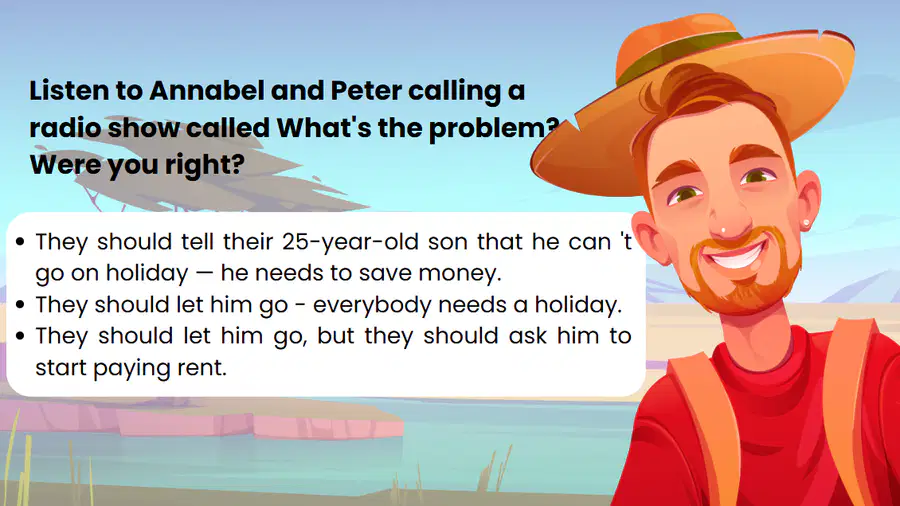
What should Annabel and Peter do?
They should tell their 25-year-old son that he can't go on holiday — he needs to save money.
They should let him go - everybody needs a holiday.
They should let him go, but they should ask him to start paying rent.
24
Multiple Choice
Listen to an expert giving them advice. Is it the advice you chose?
Is it good advice? Why (not)?
They should tell their 25-year-old son that he can't go on holiday — he needs to save money.
They should let him go - everybody needs a holiday.
They should let him go, but they should ask him to start paying rent.
25

PlayPhrase.me: Site for cinema archaeologists.
You can open this webpage in a new tab.
26

27
Categorize
Get angry
Get lost
Get in shape
Get better/worse
Get colder
Get a job
Get a book
Get a ticket
Get home
Get to school
Get to work
Get married
Get ready
Match the verb get with its meaning.
28
Categorize
Get an email/text message
Match the verb get with its meaning.
Show answer
Auto Play
Slide 1 / 28
SLIDE
Similar Resources on Wayground

19 questions
Quantifiers
Presentation
•
Professional Development
20 questions
Enquiries
Presentation
•
Professional Development
19 questions
Past Perfect Tense
Presentation
•
Professional Development
21 questions
Present Simple and Present Continuous
Presentation
•
University
20 questions
Future Tenses
Presentation
•
University
20 questions
Present perfect continuous
Presentation
•
University
21 questions
Employability skills
Presentation
•
Professional Development
26 questions
Articles & prepositions
Presentation
•
Professional Development
Popular Resources on Wayground
11 questions
Hallway & Bathroom Expectations

Quiz
•
6th - 8th Grade
10 questions
HCS SCI 03 Summer School Assessment 2
Quiz
•
3rd Grade
11 questions
Home Scope
Quiz
•
7th - 8th Grade
12 questions
2026 TAP Technology in the Classroom
Presentation
•
Professional Development
15 questions
HCS SCI 05 Summer School Assessment 2 Review
Quiz
•
5th Grade
15 questions
HCS SCI 04 Summer School Review 2
Quiz
•
4th Grade
59 questions
Geometry Unit 3 Review
Quiz
•
9th - 12th Grade
14 questions
FAST ELA READING SMAPLE TEST MATERIALS

Passage
•
3rd Grade