
Acids, Bases and Alkalis

Presentation
•
Chemistry
•
7th Grade
•
Medium

Segun Ogunsunlade
Used 3+ times
FREE Resource
20 Slides • 15 Questions
1
Sec 1
2
1. Recognize the properties of acids and alkalis.
2. Use a pH scale
3. Understand neutralization and some of its application
4. Use indicators to distinguish acid and alkali solutions

3
Can you give an example?
4
Many things contain acid. Some foods also contain acid.
They have sour, sharp and tangy taste
Examples: Lemons and limes, because they contain citric acid (weak acid)
Common acid in the laboratory: hydrochloric acid, sulfuric acid and nitric acid

5
Open Ended
Name a food surround you that contains an acid. Describe the test of it.
6
Strong and corrosive
If strong acid gets on your skin it will dissolve it. You will get a chemical burn.
Acids can be diluted with water, this makes them less dangerous, but they still irritant and harmful.
Thus, if you spill the acid, wash the area with lots of water.
Can you notice something on the figure?

7
Multiple Choice
Acid in our stomach?
Hydrochloric acid
Acetic acid
Sulfuric acid
Carbonic acid
8
Multiple Choice
Acid in soft drink?
Hydrochloric acid
Sulfuric acid
Carbonic acid
Acetic acid
9
Can you give an example?
10
Many cleaning products contain
Taste (often) bitter and feel soapy or slippery
Examples: toothpaste and households cleaning products
Common alkalis found in the laboratory are sodium hydroxide, pottasium hydroxide and calcium hydroxide.

11
Strong alkalis are corrosive
If strong alkalis gets on your skin it will dissolve it. You will get a chemical burn.
Alkalis can be diluted with water, this makes them less dangerous, but they still irritant and harmful.
Always wear eye protection when using alkalis.
Can you notice something on the figure?

12
They can cancel each other out when they are mixed together.
13
Multiple Choice
Which substance is alkali?
Toothpaste
Lemon juice
vinegar
soft drink
14
Open Ended
What does corrosive mean?
15
Can you tell what are the tips?
16
Stand up to work. why?
wear safety glasses. why?
take the top off the bottle and place it upside down. why?
replace the bottle top as soon as you finish using the bottle. why?

17
We can use:
Handmade indicator, and
Litmus paper
Let's see your course book page 92.
Indicators can be made from brightly colored berries, flowers and other parts of plants, ex: red cabbage, blackcurrant and beetroot

Litmus is an indicator that turns red in acids, blue in alkalis and purple in neutral (pure water).
18


19
Multiple Choice

What is the solution tested by litmus paper?
an acid
a base
A pH-neutral substance
a buffer
20
Litmus shows if a substance is an acid or an alkali, while
Universal indicator shows how acidic or alkaline a substance is. This indicator can change to many different color
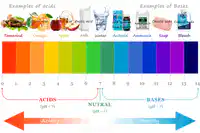
The strength of acids and alkalis is measured on the pH scale.
Universal indicator changes color and shows the pH of a substance

21

22
Multiple Choice
Apart from litmus paper, what other laboratory substance can you use to test if colourless substance is an acid or an alkali?
Catalyst
universal indicator
salt
water
23
Multiple Choice
What is the pH of distilled (pure) water?
12
3
7
8
24
Multiple Choice
Which pH level indicates a weak acid?
1-3
4-6
8-11
12-14
25
Multiple Choice
Which pH levels indicated a strong acid?
1-3
4-6
8-11
12-14
26
Multiple Choice
Which pH level indicates a weak alkali?
1-3
4-6
8-11
12-14
27
Multiple Choice
Which pH level indicates a strong alkali?
1-3
4-6
8-11
12-14
28
Multiple Choice
7 on the pH scale means that it is...
acid
base
neutral
29
Multiple Choice
Soap is a weak base. What is true about the taste of bases?
they taste sour
they taste bitter
Incorrect
they taste sweet
Incorrect
they taste salty
30
Multiple Choice
A common alkali used in the lab is
hydrochloric acid
hydrogen sulphate
sodium chloride
sodium hydroxide
31
32

33
1. Indigestion
when stomach produces too much acid (hydrochloric acid) it can cause indigestion. To heal the pain we can use antacids which is an alkalis that can neutralize the excessive acid in stomach.


34
2. Toothpaste
There are million bacteria in your mouth. This bacteria feed on the food pieces left on your teeth. The bacteria produce acid when they feed and cause them to decay. Toothpaste is alkali and help to neutralize the acid on your teeth.


35
1. Asking questions
2. Planning an investigation
3. Result

Sec 1
Show answer
Auto Play
Slide 1 / 35
SLIDE
Similar Resources on Wayground

25 questions
Electron Configuration, Orbital Notation, & Dot diagrams
Presentation
•
9th - 12th Grade
28 questions
Unit 4 Test Review
Presentation
•
7th Grade
28 questions
Sensory Details: Show Don't Tell! Notes and Practice
Presentation
•
7th Grade
28 questions
Ecological Succession
Presentation
•
7th Grade
29 questions
Color Theory
Presentation
•
7th Grade
27 questions
The Scientific Method
Presentation
•
7th Grade
30 questions
5.2 Purity
Presentation
•
7th Grade
26 questions
Operations with Rational Numbers
Presentation
•
7th Grade
Popular Resources on Wayground
10 questions
How much do you know about our Portrait of an Eagle?

Quiz
•
10th Grade
10 questions
Fast Food Slogans
Quiz
•
6th - 8th Grade
21 questions
Continents and Oceans
Quiz
•
6th Grade
20 questions
Parts of Speech
Quiz
•
5th Grade
16 questions
Subject & Predicate
Quiz
•
5th Grade
25 questions
Multiplication Facts
Quiz
•
5th Grade
12 questions
Map Skills
Quiz
•
3rd Grade
22 questions
Continents and Oceans
Quiz
•
5th Grade
Discover more resources for Chemistry
10 questions
Mastering Significant Figures in Chemistry

Interactive video
•
6th - 10th Grade
14 questions
Physical and Chemical Properties
Quiz
•
6th - 7th Grade
20 questions
Chemical Reactions
Quiz
•
7th - 8th Grade
20 questions
Metals, Nonmetals, and Metalloids
Quiz
•
7th - 9th Grade
10 questions
Mastering Ionic Compound Nomenclature
Interactive video
•
6th - 10th Grade
10 questions
Determining Protons, Neutrons, and Electrons from the Periodic Table
Interactive video
•
6th - 10th Grade
14 questions
Elements, Compounds and Mixtures Review
Quiz
•
7th - 9th Grade
19 questions
Naming Ionic and Covalent Compounds
Quiz
•
7th Grade