

Weather in the Atmosphere

Presentation
•
Science
•
6th Grade
•
Practice Problem
•
Medium
+3
Standards-aligned

Barbara White
Used 50+ times
FREE Resource
18 Slides • 37 Questions
1

Middle School

2
Describe how the sun’s energy drives the water cycle and creates wind.
Explain how interactions of air masses at fronts can cause changes in weather.
Identify how ocean currents, landforms, and latitude influence local weather.
Understand that weather forecasting is based on probabilities and identify severe weather safety procedures.


3
Key Vocabulary

Atmosphere
The layer of gases that surrounds the Earth, which is held in place by gravity.

Air Pressure
The force that is exerted by the weight of the air in the Earth's atmosphere.

Wind
The natural movement of air, especially in the form of a current of air blowing.

Water Cycle
The continuous movement of water on, above, and below the surface of the Earth.

Evaporation
The process by which a liquid substance in a liquid state changes to a gas.

Condensation
The process by which water vapor in the air is changed into liquid water.
4
Key Vocabulary

Crystallization
Crystallization is the process where a gas, like water vapor, changes directly into a solid.

Precipitation
Precipitation is any form of water, such as rain or snow, that falls from clouds.

Air Mass
An air mass is a large body of air with similar temperature and humidity throughout it.

Front
A front is the boundary that forms where two different air masses happen to meet.

Ocean Current
An ocean current is the continuous, directed movement of sea water generated by different forces.

Probabilistic
Probabilistic describes something that is based on the theory of probability or the likelihood of happening.
5
Earth's Atmosphere
Our atmosphere is a mix of gases, mostly nitrogen (78%) and oxygen (21%).
The remaining 1% has argon, carbon dioxide (CO2), water vapor, and dust.
Its four main layers are the troposphere, stratosphere, mesosphere, and thermosphere.
Air pressure decreases as altitude increases because there is less air above you.


6
Multiple Choice
Which statement best describes the Earth's atmosphere?
A mixture of gases, primarily nitrogen and oxygen, organized into four main layers.
A single layer of pure oxygen that surrounds the Earth.
A layer of water vapor and dust that creates weather.
A field of energy generated by the Earth's core.
7
Multiple Choice
What is the relationship between altitude and air pressure?
Because the air gets colder and sinks at higher altitudes.
Because there is less air pushing down from above as altitude increases.
Because nitrogen gas becomes heavier the higher you go.
Because the pull of gravity is stronger at higher altitudes.
8
Multiple Choice
A mountain climber is ascending a tall peak and finds it harder to breathe the higher they go. What is the best explanation for this?
The air provides less oxygen because the air pressure is lower.
The air becomes 100% nitrogen because oxygen is heavier.
The air pressure increases, making it easier to breathe.
The layers of the atmosphere disappear at high altitudes.
9
Energy and Wind in the Atmosphere
The Sun’s energy causes the motion of matter like air and water.
Uneven heating of Earth’s surface makes air move, creating wind.
Heat is transferred through radiation, conduction, and convection.
Wind moves from high-pressure to low-pressure areas.
Local winds cover short distances; global winds cover large areas.
Unequal heating over large areas of Earth leads to large-scale global winds.


10
Multiple Choice
What is the definition of wind?
Air moving from a high-pressure area to a low-pressure area.
The movement of water in the ocean.
Energy that comes directly from the sun.
The transfer of heat through direct contact.
11
Multiple Choice
What is the relationship between the sun's energy and the motion of air?
The sun's energy heats different parts of the Earth unevenly, causing air to move.
The sun's gravity pulls air from one area to another.
Wind is a type of energy that travels from the sun.
Wind is created when air gets trapped in the atmosphere.
12
Multiple Choice
If a large area of the Earth receives significantly more energy from the sun than another large area, what is the most likely outcome?
The creation of large-scale global winds.
The creation of only short-distance local winds.
The immediate stopping of all heat transfer.
The transfer of heat primarily through conduction.
13
The Water Cycle

The sun’s energy turns liquid water into a gas called water vapor.
Water vapor cools in the atmosphere to form clouds through condensation.
When water droplets get heavy, they fall back to Earth as precipitation.
14
Multiple Choice
What provides the energy that turns liquid water into a gas called water vapor?
The sun's energy
The pull of gravity
The rotation of the Earth
The coolness of the atmosphere
15
Multiple Choice
What is the relationship between water vapor and clouds in the water cycle?
Water vapor cools and gathers to form clouds.
Clouds are heated by the sun to create water vapor.
Precipitation evaporates to become clouds.
Water vapor is pushed together by wind.
16
Multiple Choice
Based on the stages of the water cycle, what condition is necessary for precipitation to occur after clouds have formed?
The water droplets that make up the clouds must become heavy.
The sun must heat the clouds to a high temperature.
The clouds must absorb more energy from the sun.
The water vapor in the air must get warmer.
17
Humidity and Precipitation Types

Humidity is the measure of water vapor in the air.
Precipitation can be rain, snow, sleet, or hail.
Snow forms when water vapor turns directly into ice crystals.
18
Multiple Choice
What does humidity measure?
The amount of water vapor in the air
The temperature of the air
The different types of precipitation
The speed of the wind
19
Multiple Choice
What process causes snow to form?
Water vapor turns directly into ice crystals
Liquid water droplets freeze into ice pellets
Raindrops get pushed up into the air to refreeze
Clouds become too heavy with liquid water
20
Multiple Choice
If the air contains a large amount of water vapor and the temperature causes that vapor to transform directly into solid ice crystals, what outcome can be predicted?
Precipitation in the form of snow will occur.
Precipitation in the form of rain will occur.
The humidity in the air will increase.
Hail will form from frozen raindrops.
21
The Ocean's Influence on Weather
The ocean absorbs a huge amount of the sun's energy, releasing it slowly.
This helps regulate temperatures, giving coastal areas milder climates.
Ocean currents move this heat around the globe, influencing weather patterns.
A warm current heats the air above, creating warmer and humid conditions nearby.


22
Multiple Choice
What is the primary way the ocean influences weather and climate?
By creating powerful winds that blow inland.
By reflecting all of the sun's energy back into space.
By absorbing and slowly releasing the sun's energy.
By pushing clouds away from the land.
23
Multiple Choice
How do ocean currents contribute to the weather conditions in coastal areas?
They make the air colder and drier.
They only affect the weather far out at sea.
They move heat around the globe, warming the air above them.
They cause the seasons to change each year.
24
Multiple Choice
A warm ocean current flows past City A, while a cold ocean current flows past City B. What is the most likely difference in their climates?
The coastal city would likely have a warmer and more humid climate.
The coastal city would likely have a cooler and drier climate.
The weather in the coastal city would not be affected by the current.
The coastal city would experience constant rain.
25
Air Masses and Their Movement

An air mass is a large body of air with similar temperature and humidity.
They flow from high-pressure areas to low-pressure areas.
Jet streams and prevailing winds guide the path of air masses.
26
Multiple Choice
What is the definition of an air mass?
A large body of air with similar temperature and humidity
A type of wind that blows only over oceans
A cloud that is about to produce a storm
The boundary between two different weather systems
27
Multiple Choice
What is the primary reason an air mass moves from one place to another?
They move from high-pressure areas to low-pressure areas.
They move from low-pressure areas to high-pressure areas.
They remain stationary until the temperature changes.
They are pushed around by the Earth's rotation only.
28
Multiple Choice
If an air mass is moving away from a high-pressure area, and the prevailing winds are blowing to the east, what is the most likely result?
The air mass will be guided toward the east by the winds.
The air mass will move west, against the prevailing winds.
The air mass will stop moving and stay in one place.
The jet stream will cause the air mass to disappear.
29
Weather Fronts
A front is the boundary formed when two different air masses meet.
A cold front pushes warm air up, causing heavy rain and thunderstorms.
A warm front brings steady rain as warm air slowly slides over cold air.
Stationary fronts are stalled, while occluded fronts trap a warm air mass.

30
Multiple Choice
What is a weather front?
A place where a cold air mass and a warm air mass meet.
A type of cloud that brings thunderstorms.
A period of light, steady rain or snow.
A large body of air with the same temperature.
31
Multiple Choice
What is the main difference in how cold fronts and warm fronts are formed?
Cold fronts create wide, flat clouds, while warm fronts create tall clouds.
In a cold front, cold air slides under warm air, while in a warm front, warm air rises over cold air.
Cold fronts bring light, steady rain, while warm fronts bring thunderstorms.
Cold fronts happen when two warm air masses meet, while warm fronts happen when two cold air masses meet.
32
Multiple Choice
A weather report indicates that tall clouds are forming quickly, leading to thunderstorms. What is the best explanation for this event?
A cold front, because the warm air is pushed up rapidly.
A warm front, because the warm air rises gently.
A cold front, because it creates wide, flat layers of clouds.
A warm front, because it causes abrupt weather changes.
33
Cyclones (Lows)
A cyclone is a swirling center of low air pressure, marked with an 'L' on weather maps.
In the Northern Hemisphere, winds spiral inward in a counterclockwise direction, as shown in the diagram.
The rising air cools at the center, leading to the formation of clouds and rainy weather.

Anticyclones (Highs)

An anticyclone is a center of high-pressure, dry air, marked with an 'H' on weather maps.
Winds spiral outward in a clockwise direction, moving away from the high-pressure center.
The sinking air in the center warms up, which results in clear skies and dry weather conditions.
34
Multiple Choice
What is the defining characteristic of a cyclone?
A swirling center of low air pressure.
A center of high-pressure with sinking air.
Winds that spiral outward in a clockwise direction.
A weather system that only brings clear skies.
35
Multiple Choice
How does the movement of air in an anticyclone lead to specific weather conditions?
Sinking air warms up, leading to clear and dry conditions.
Rising air cools down, causing clouds and rain to form.
Inward-spiraling winds create stormy weather.
Outward-spiraling winds bring in moisture from other areas.
36
Multiple Choice
A weather map of the Northern Hemisphere shows winds spiraling inward in a counterclockwise direction over a region. What conclusion can be drawn about the weather in that region?
The area is experiencing a cyclone, which will likely bring clouds and rain.
The area is experiencing an anticyclone, which will likely bring clear skies.
The air pressure is high, causing winds to spiral outward.
The sinking air in the center is warming up, leading to dry weather.
37
Weather Prediction and Technology
Meteorologists collect data using weather balloons, ground stations, and satellites.
This data is analyzed to monitor atmospheric conditions and make forecasts.
Weather maps use isobars and isotherms to show weather patterns.
Forecasts are probabilistic, predicting the likelihood of an event occurring.

38
Multiple Choice
What is the primary purpose of using technologies like satellites and weather balloons in meteorology?
To change the weather to be more pleasant
To launch rockets into space for exploration
To gather atmospheric data for making forecasts
To create new types of clouds in the sky
39
Multiple Choice
Why are weather forecasts presented as a likelihood, such as a '70% chance of rain,' rather than a definite statement?
Because meteorologists are often unsure about their data
Because weather is complex and cannot be predicted with absolute certainty
To make the forecast sound more scientific and interesting
To account for the time it takes to create the weather map
40
Multiple Choice
A meteorologist uses satellite data and weather maps to predict a 90% chance of rain. What is the most accurate conclusion you can draw from this forecast?
It will rain in exactly 90% of the forecasted area.
It is very likely that it will rain, but it is not guaranteed.
The forecast is incorrect because nothing is ever 90% certain.
It will definitely rain for the entire day.
41
Thunderstorms
A thunderstorm is a storm that produces both lightning and the sound of thunder.
They are formed when warm, humid air rises rapidly, often along a cold front.
Lightning is a powerful electrical discharge, and thunder is the sound it creates.

Tornadoes

A tornado is a violently spinning column of air that extends to the ground.
They form when cold, dry air collides with warm, humid air, causing rotation.
Tornadoes are very brief but can cause an incredible amount of destruction.
42
Multiple Choice
What is the definition of a thunderstorm?
A storm that creates both lightning and thunder.
A column of air that spins violently.
A storm that only happens over the ocean.
A brief shower of rain with light winds.
43
Multiple Choice
What is the key difference in the conditions that cause a tornado to form compared to a thunderstorm?
The collision of cold, dry air with warm, humid air causes rotation.
Warm, humid air rises rapidly along a cold front.
Lightning heats the air, which causes the storm to spin.
The storm forms over a large body of water.
44
Multiple Choice
A weather event occurs that lasts for only ten minutes but causes a huge amount of damage along a narrow path. Which of these statements provides the best conclusion about this event?
A tornado, because they are brief but incredibly destructive spinning storms.
A thunderstorm, because all thunderstorms cause major destruction.
A tornado, because they always form along a cold front.
A thunderstorm, because they are created by spinning columns of air.
45
Hurricanes
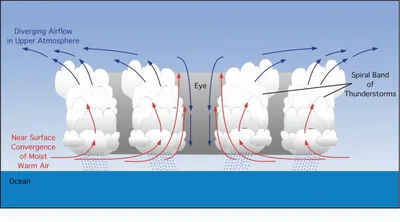
A hurricane is a large storm with winds over 119 km/h that forms over warm ocean water.
The center is a calm eye, which is surrounded by the eyewall where winds are the strongest.
A dangerous rise in sea level, called a storm surge, can cause major flooding along the coast.
Winter Storms

These powerful storms bring heavy snow, ice, and extremely cold temperatures to an area during winter.
Lake-effect snow forms when cold air moves over a large, warmer lake and picks up moisture.
The moisture then falls as heavy snow on the land that is located downwind of the lake.
46
Multiple Choice
What is a hurricane?
A large storm with very high winds that forms over warm ocean water.
A storm that brings heavy snow and ice during the winter.
A calm area in the center of a storm with no wind.
A rise in sea level that causes flooding along the coast.
47
Multiple Choice
How does lake-effect snow form?
When cold air moves over a warmer lake, picks up moisture, and drops it as snow.
When a storm surge from a large lake causes major flooding.
When strong winds from the eyewall of a storm blow over a lake.
When cold temperatures freeze the surface of a large lake completely.
48
Multiple Choice
Based on the characteristics of a hurricane, which area would likely experience the most severe damage?
Along the coast, where the eyewall's strong winds and the storm surge combine.
In the calm eye of the storm, where there is no wind or rain.
On land that is downwind of a large, warm lake.
Far inland, where the storm's winds are weakest.
49
Floods, Droughts, and Storm Safety

A flood is excess water on dry land; a drought is a long time without rain.
A storm watch means be prepared; a warning means take shelter now.
During storms, get indoors. For tornadoes, find a room without windows to stay safe.
50
Multiple Choice
What is the correct definition of a drought?
A long period of time with no rain
Too much water covering dry land
A sign that a storm is coming soon
A safe room that has no windows
51
Multiple Choice
What is the main difference between a storm watch and a storm warning?
A watch means be prepared, while a warning means take shelter now.
A watch means a storm is happening, while a warning means it might happen.
A watch is for tornadoes, while a warning is for floods.
A watch means the storm is over, while a warning means it is starting.
52
Multiple Choice
Imagine a tornado warning is issued for your town. What is the safest immediate action to take?
Find a room in the house that does not have any windows.
Start getting your emergency supplies ready.
Go outside to see where the storm is.
Stay in a room with a window to watch the storm.
53
Misconception | Correction |
|---|---|
Clouds are made of water vapor. | Clouds are made of tiny water droplets or ice crystals. |
Weather forecasts are always 100% certain. | Forecasts state the likelihood of an outcome, not a guarantee. |
A tornado can be outrun in a car. | Tornadoes are fast and unpredictable; seeking shelter is the safest option. |
Lightning never strikes the same place twice. | Lightning often strikes the same place multiple times, especially tall structures. |
54
The sun’s energy and ocean heat drive wind, the water cycle, and weather.
Air masses, fronts, and pressure systems interact to create predictable weather patterns.
Because weather is a complex system, it can only be predicted using probability.
Severe weather, like tornadoes and hurricanes, has unique causes and requires safety measures.
55
Poll
On a scale of 1-4, how confident are you about the concepts covered in today's review?
1
2
3
4
Middle School
Show answer
Auto Play
Slide 1 / 55
SLIDE
Similar Resources on Wayground

50 questions
Minerals and Mohs Hardness Scale
Presentation
•
6th Grade
50 questions
Energy Transformation Lesson
Presentation
•
6th Grade
51 questions
Catastrophic Events
Presentation
•
7th Grade
47 questions
Energy Types Review
Presentation
•
6th Grade
49 questions
10-3 PART 1 Lesson
Presentation
•
6th Grade
50 questions
TEMA 8 IPA KELAS 6C
Presentation
•
6th Grade
47 questions
Energy & waves
Presentation
•
6th Grade
51 questions
Earth's Atmosphere
Presentation
•
6th Grade
Popular Resources on Wayground
10 questions
Safety Day 2026 – Student Review

Quiz
•
9th Grade
21 questions
Continents and Oceans
Quiz
•
6th Grade
20 questions
Parts of Speech
Quiz
•
5th Grade
16 questions
Subject & Predicate
Quiz
•
5th Grade
25 questions
Multiplication Facts
Quiz
•
5th Grade
12 questions
Map Skills
Quiz
•
3rd Grade
22 questions
Continents and Oceans
Quiz
•
5th Grade
15 questions
Rounding Decimals
Quiz
•
5th Grade
Discover more resources for Science
20 questions
Elements, compounds, and mixtures
Quiz
•
6th Grade
10 questions
6.6D - Relative Density Review
Quiz
•
6th Grade
10 questions
Exploring Chemical and Physical Changes

Interactive video
•
6th - 10th Grade
20 questions
CONDUCTION,CONVECTION AND RADIATION
Quiz
•
6th Grade
20 questions
Rocks and The Rock Cycle
Quiz
•
6th Grade
19 questions
Describing and Classifying Matter
Presentation
•
6th Grade
21 questions
Waves and Wave Properties
Quiz
•
6th - 8th Grade
20 questions
Phases of the Moon
Quiz
•
6th Grade