

Resources in Ecosystems

Presentation
•
Science
•
7th Grade
•
Medium
+3
Standards-aligned

Barbara White
Used 47+ times
FREE Resource
12 Slides • 19 Questions
1

Middle School

2
Analyze how the availability of resources affects organisms and populations.
Explain how limiting factors and competition determine an ecosystem's carrying capacity.
Differentiate between biotic potential and carrying capacity.
Argue how human population and resource use impact Earth's systems.


3
Key Vocabulary
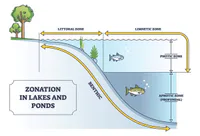
Ecosystem
All living and nonliving things that interact with each other in a specific area.
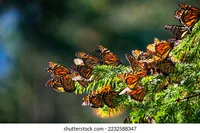
Population
A group of organisms of the same species that live together in the same area.
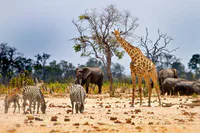
Community
All the different populations of various species that live and interact in the same area.
Limiting Factor
Any factor or condition that restricts the size or growth of a population in an ecosystem.
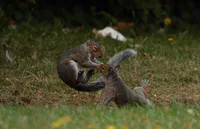
Competition
The struggle between organisms to get the same limited resources like food, water, and shelter.
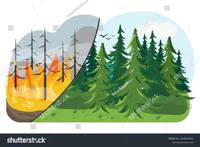
Resource Availability
The available supply of essential materials like food, water, and sunlight that organisms need to survive.
4
Key Vocabulary
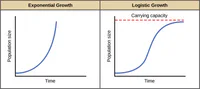
Carrying Capacity
The maximum population that an ecosystem can support with the resources that are available.
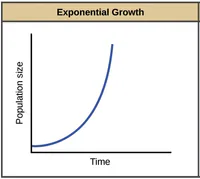
Biotic Potential
The highest possible growth rate for a population when it has unlimited resources and ideal conditions.

Per-Capita Consumption
The average amount of a resource, such as energy or food, used by each person.
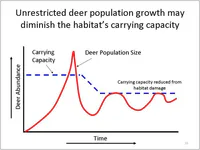
Overpopulation
This occurs when a population becomes too large to be supported by its environment or resources.
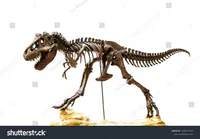
Extinct Species
An animal or plant species that no longer has any living members left in the world.
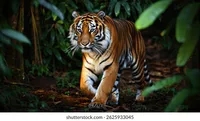
Endangered Species
A species of an animal or a plant that is at a very high risk of becoming extinct.
5
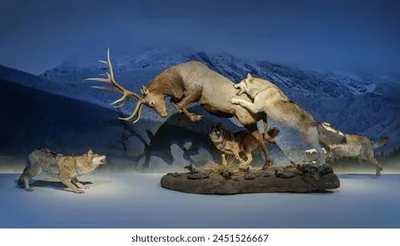
Levels of Environmental Organization
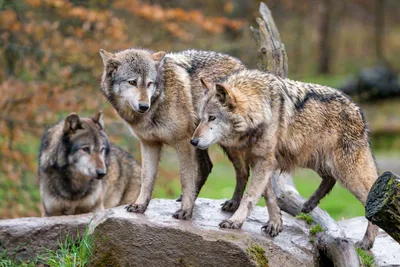
An individual is a single member of a species, like one wolf.
A population is a group of the same species, like a wolf pack.
A community includes all populations in an area, like wolves and deer.
An ecosystem adds nonliving factors; the biosphere is all ecosystems on Earth.
6
Multiple Choice
Which statement best defines a population?
A single member of a species.
A group of the same species living in the same area.
All the different populations of species in an area.
All living and nonliving things in an environment.
7
Multiple Choice
What is the primary difference between a community and an ecosystem?
A community includes only living things, while an ecosystem includes both living and nonliving factors.
An ecosystem is a group of one species, while a community is a group of many species.
A community is larger than an ecosystem and includes the entire Earth.
An ecosystem describes a single animal, while a community describes a group of animals.
8
Multiple Choice
A scientist studies how a pack of wolves, the deer they hunt, and the local river interact. Which level of environmental organization is the scientist investigating?
A population
A community
An ecosystem
The biosphere
9
What Are Limiting Factors?
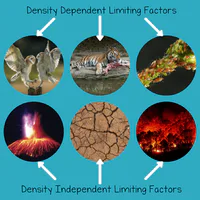
A limiting factor is anything that restricts a population's growth and size.
Limited resources like food, water, and space can lead to competition.
Competition happens when organisms need the same limited resource to survive.
10
Multiple Choice
What is the role of a limiting factor in an ecosystem?
It restricts a population's growth and size.
It helps a population grow without any limits.
It provides unlimited resources to all organisms.
It only affects plants and not animals.
11
Multiple Choice
What is the direct result of organisms needing the same limited resources, such as food and water?
Competition between the organisms.
An increase in the population's size.
The creation of more resources.
A decrease in the number of predators.
12
Multiple Choice
Imagine a small, isolated island where a new species of rabbit is introduced. The island has a limited supply of fresh water. What will most likely happen to the rabbit population over time?
The population will grow until the lack of water restricts its size.
The population will grow indefinitely without any limits.
The rabbits will learn to create their own water source.
The amount of fresh water on the island will increase.
13
Resource Availability and Populations
Resource availability directly impacts the organisms that live in an ecosystem.
When resources are abundant, populations can grow and reproduce more successfully.
Scarce resources lead to competition and a decrease in population size.
14
Multiple Choice
What is the main factor that directly impacts the size of a population in an ecosystem?
The availability of resources in their habitat
The number of sunny days during the year
The average age of the organisms
The presence of mountains or oceans nearby
15
Multiple Choice
What happens to a population when the resources in its ecosystem become abundant?
The population is likely to grow and reproduce more.
The population will immediately shrink and disappear.
The organisms will stop needing resources to survive.
The amount of resources will have no effect on the population.
16
Multiple Choice
If a new population of birds that eats the same seeds as a native bird population is introduced to an ecosystem with limited seeds, what is the most likely outcome?
The two bird populations will compete, and one or both may decrease.
Both bird populations will grow larger and reproduce more successfully.
The birds will learn to share the limited seeds without any conflict.
The amount of seeds will magically increase to feed all the birds.
17
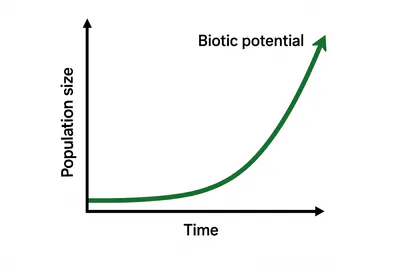
Biotic Potential
Biotic potential is the maximum, unrestricted growth of a population in a perfect environment.
This occurs when there are no limiting factors like predators or resource shortages.
This is a theoretical maximum that populations rarely, if ever, actually reach.
Carrying Capacity
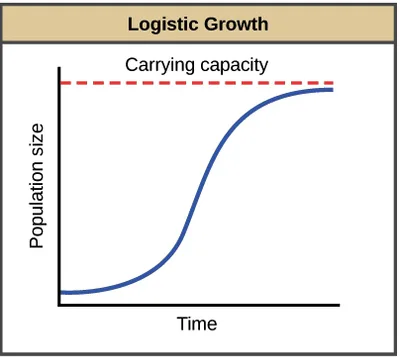
Carrying capacity is the largest population size an ecosystem can realistically support long-term.
It is determined by the availability of resources like food, water, and space.
Limiting factors in the environment determine the specific carrying capacity for a species.
18
Multiple Choice
Which of the following best defines an ecosystem's carrying capacity?
The maximum population size that an environment can support over time.
The fastest rate at which a population can possibly grow.
The total number of predators found in a specific ecosystem.
The amount of space a single organism needs to survive.
19
Multiple Choice
What is the primary difference between biotic potential and carrying capacity?
Biotic potential describes theoretical growth, while carrying capacity describes realistic growth.
Biotic potential is determined by predators, while carrying capacity is determined by food.
Biotic potential applies to plants, while carrying capacity applies to animals.
Biotic potential is a population's maximum size, while carrying capacity is its minimum size.
20
Multiple Choice
A fish population in a lake grows quickly at first, then its size stays about the same for many years. What is the best explanation for this pattern?
The population has reached the carrying capacity determined by limiting factors.
The population is showing its biotic potential because there are no predators.
The individual fish have stopped reproducing entirely.
The fish have used up all of the water in the lake.
21
Human Impact on Earth Systems
A growing human population requires more natural resources like water and food.
People using more resources increases our impact on Earth's systems.
This can lead to resource depletion, pollution, and environmental changes.
22
Multiple Choice
What is the main reason for the increasing demand for natural resources like water and food?
A growing human population requires more of them.
They are becoming less expensive to find and use.
Natural disasters are making them more available.
Earth's systems are naturally producing more of them.
23
Multiple Choice
What is the relationship between increased resource use and Earth's systems?
It helps to stabilize Earth's natural cycles.
It has no significant effect on the environment.
It can cause harmful changes like pollution and resource depletion.
It reduces the overall number of people on Earth.
24
Multiple Choice
If a large number of people move into an area with limited water and food, what is the most likely prediction for the future of that area?
The environment will remain unchanged by the population growth.
The area will likely experience resource depletion and increased pollution.
The natural resources in the area will automatically increase.
The impact on the local environment will decrease over time.
25
Population Changes and Status
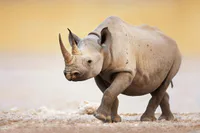
Endangered Species
An endangered species has a very high risk of becoming extinct soon.
Their population size has become extremely low, threatening their survival.
The black rhino is an example of an endangered species.
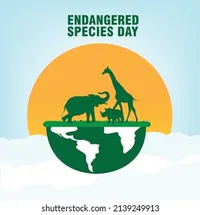
Threatened Species
A threatened species is at risk of becoming endangered in the future.
Their population is declining due to various limiting factors.
They require protection to prevent them from becoming endangered.
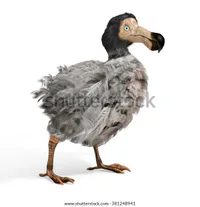
Extinct Species
An extinct species is one that no longer has any living individuals.
Overpopulation can lead to the depletion of necessary resources for survival.
The dodo bird is a famous example of an extinct species.
26
Multiple Choice
Which statement best describes an endangered species?
A species with a very high risk of becoming extinct soon.
A species that is at risk of becoming endangered in the future.
A species that no longer has any living individuals.
A species that has a large and stable population.
27
Multiple Choice
What is the key difference between a threatened species and an endangered species?
A threatened species is at risk of becoming endangered, while an endangered species is at high risk of becoming extinct.
An endangered species is declining, while a threatened species is already extinct.
A threatened species has a very low population, while an endangered species' population is still large.
An endangered species needs protection, while a threatened species does not.
28
Multiple Choice
If a species' population grows too large for its environment and depletes its necessary resources, what is the most likely outcome for that species?
The species could become threatened or endangered due to the depletion of its food source.
The species will immediately become extinct.
The food source will automatically increase to support the population.
The species will evolve to require fewer resources.
29
Misconception | Correction |
|---|---|
Populations can grow without limits. | Limiting factors set an ecosystem's carrying capacity. |
An ecosystem is only animals and plants. | Ecosystems include biotic and abiotic components. |
Human actions barely affect Earth. | Population and consumption cause global environmental changes. |
Endangered and threatened are identical terms. | Endangered species face higher, immediate extinction risk. |
30
Resource availability directly affects the growth and size of a population.
Limiting factors and competition determine an ecosystem's carrying capacity.
A population's size is a balance between its biotic potential and carrying capacity.
A sharp decline in population can lead to a species becoming endangered or extinct.
31
Poll
On a scale of 1-4, how confident are you about explaining how resources affect populations in an ecosystem?
1
2
3
4
Middle School
Show answer
Auto Play
Slide 1 / 31
SLIDE
Similar Resources on Wayground

21 questions
Muscular System Lesson
Presentation
•
7th Grade
24 questions
Body Systems: Circulatory System
Presentation
•
7th Grade
25 questions
Unit 3 Test Review Tides/phases of moon/eclipses
Presentation
•
7th Grade
26 questions
Location of Genetic Material
Presentation
•
7th Grade
23 questions
Apex 3.2 - Atomic Models
Presentation
•
7th Grade
22 questions
Human Dependence on Oceans
Presentation
•
7th Grade
21 questions
Heredity and Probability
Presentation
•
7th Grade
21 questions
Animal Behavior
Presentation
•
7th Grade
Popular Resources on Wayground
10 questions
Safety Day 2026 – Student Review

Quiz
•
9th Grade
21 questions
Continents and Oceans
Quiz
•
6th Grade
20 questions
Parts of Speech
Quiz
•
5th Grade
16 questions
Subject & Predicate
Quiz
•
5th Grade
25 questions
Multiplication Facts
Quiz
•
5th Grade
12 questions
Map Skills
Quiz
•
3rd Grade
22 questions
Continents and Oceans
Quiz
•
5th Grade
15 questions
Rounding Decimals
Quiz
•
5th Grade
Discover more resources for Science
10 questions
Exploring Chemical and Physical Changes

Interactive video
•
6th - 10th Grade
14 questions
Week 1 Falcon Flex Fast and Curious
Quiz
•
7th Grade
42 questions
Explore Plate Tectonics and Boundaries
Quiz
•
7th Grade
21 questions
Waves and Wave Properties
Quiz
•
6th - 8th Grade
16 questions
Photosynthesis and Cellular Respiration Review
Quiz
•
7th Grade
20 questions
Food Webs + Energy Pyramids
Quiz
•
7th Grade
9 questions
Biology: Cell Structure
Interactive video
•
7th Grade
8 questions
Diffusion and Osmosis Review
Presentation
•
6th - 8th Grade