

Copy of Chapter 1: Introduction to Communication Studies

Presentation
•
Professional Development
•
University
•
Practice Problem
•
Hard

Ivan Silva
Used 1+ times
FREE Resource
28 Slides • 29 Questions
1

2

3
Open Ended
Why is effective communication important in our daily lives?
4

5
Multiple Choice
Which of the following is NOT a reason to study communication as mentioned in the slides?
To enhance understanding of communication theories
To improve practical communication skills
To memorize historical dates
To communicate more effectively in different contexts
6

7
Open Ended
Describe how ancient roots and modern developments have shaped the field of communication studies.
8

9
Multiple Select
Which of the following are highlighted as the significance of studying communication?
It is a fundamental human activity
It is only relevant for business professionals
It has interdisciplinary applications
It helps build relationships
10

11

12
Fill in the Blanks
The art of persuasion, often used in public speaking and writing, is known as
13
Multiple Select
A CEO uses ethos, pathos, and logos to motivate employees. Match each rhetorical component to its corresponding example from the scenario described.
Ethos: Highlighting experience and credibility
Pathos: Sharing a compelling story about values
Logos: Presenting data for logical appeal
Ethos: Presenting data for logical appeal
14

15
Open Ended
Why is it important to study the historical development of communication?
16

17
Multiple Choice
Which of the following best describes the difference between public communication and mass communication?
Public communication involves one person speaking to an audience, while mass communication uses media channels to reach a larger audience.
Public communication is always informal, while mass communication is always formal.
Mass communication is only used for entertainment, while public communication is used for education.
Public communication requires technology, while mass communication does not.
18

19
Fill in the Blanks
Fill in the blank: In the communication process, the person or group that receives and interprets the message is called the
20
Open Ended
List and briefly explain any three basic components of the communication process.
21

22
Multiple Select
Which of the following are types of feedback in communication?
Verbal feedback
Written feedback
Nonverbal feedback
Visual feedback
23

24

25
Open Ended
Why is context important in the process of communication?
26

27
Multiple Select
Which of the following strategies can help overcome barriers to effective communication?
Active listening
Ignoring cultural differences
Clarification
Cultural awareness
28

29
Multiple Choice
Which of the following is NOT a key aspect of effective interpersonal communication at work?
Clear Expectations
Active Listening
Constructive Feedback
Ignoring Feedback
30

31
Open Ended
Explain how interpersonal communication differs from mass communication, providing examples for each.
32

33
Multiple Select
Which of the following statements highlight the importance of communication in all parts of our lives?
Communication is only important in professional settings.
Integrative learning connects communication across various spheres of life.
Communication is essential in academic, professional, personal, and civic life.
Theoretical knowledge of communication is more important than practical application.
34

35
Multiple Choice
In the civic sphere, communication is crucial for:
Achieving personal goals
Civic engagement and community involvement
Maintaining academic records
Improving physical health
36

37
Fill in the Blanks
Communication is key to academic success and linking different
38

39
Multiple Choice
Which need is addressed when communication helps us present ourselves in different roles, such as professional versus personal settings?
Relational Needs
Identity Needs
Physical Needs
Safety Needs
40

41
Multiple Choice
Which of the following best describes an instrumental need met by communication?
Expressing hunger or distress
Seeking shelter
Asking for help
Reducing stress
42

43
Open Ended
Explain the importance of ethical and practical responsibilities in communication. How do they contribute to effective communication?
44

45
Fill in the Blanks
The ability to adapt communication based on social and cultural context is known as
Type answer...
46
Multiple Select
Which of the following are key aspects of communication competence?
Knowledge of effective communication patterns
Ability to use communication appropriately
Developing mindful communication
All of the above
47

48
Open Ended
Compare the interactive and transactional models of communication. What is a key difference between them?
49

50
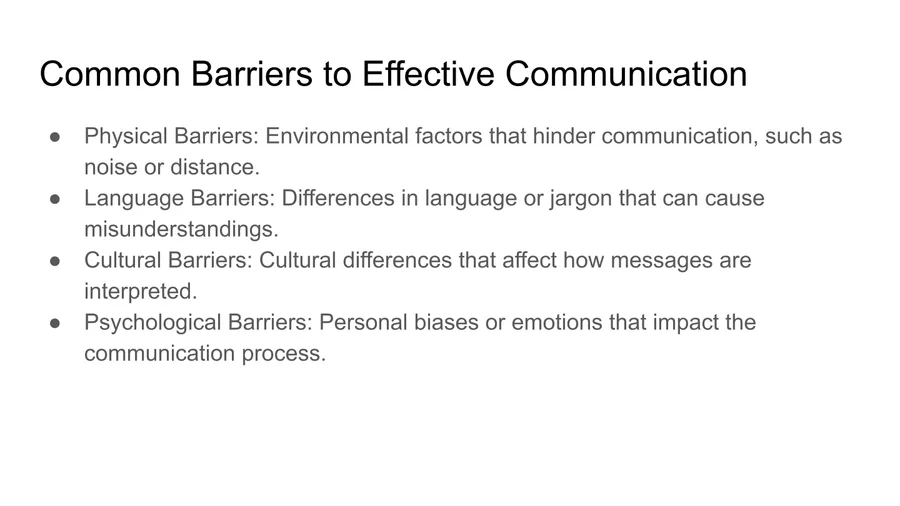
51
Multiple Choice
Which of the following is NOT a common barrier to effective communication?
Physical barriers
Language barriers
Technological barriers
Cultural barriers
52

53
Multiple Choice
Which of the following is an example of psychological noise in communication?
A loud construction site making it hard to hear
A poor phone connection causing static
Feeling stressed and unable to focus on the conversation
A television playing in the background
54

55
Multiple Choice
Which of the following is NOT a component of communication?
Sender
Message
Receiver
Interpreter
56
Open Ended
Summarize the main components of communication discussed in this lesson. Why do you think each component is important for effective communication?
57
Open Ended
Why is a commitment to ethical communication important in both personal and professional settings?
Show answer
Auto Play
Slide 1 / 57
SLIDE
Similar Resources on Wayground

52 questions
Poverty & Inequality
Presentation
•
University
51 questions
Will- might
Presentation
•
University
53 questions
Classroom management - Online training
Presentation
•
KG - University
51 questions
hugo test
Presentation
•
University
53 questions
January 6th Staff Meeting
Presentation
•
University - Professi...
53 questions
Language and Communication
Presentation
•
Professional Development
51 questions
Validity and Reliability & Survey Research
Presentation
•
Professional Development
50 questions
Társadalombiztosítási járulék
Presentation
•
12th Grade
Popular Resources on Wayground
10 questions
Safety Day 2026 – Student Review

Quiz
•
9th Grade
21 questions
Continents and Oceans
Quiz
•
6th Grade
20 questions
Parts of Speech
Quiz
•
5th Grade
16 questions
Subject & Predicate
Quiz
•
5th Grade
25 questions
Multiplication Facts
Quiz
•
5th Grade
12 questions
Map Skills
Quiz
•
3rd Grade
22 questions
Continents and Oceans
Quiz
•
5th Grade
15 questions
Rounding Decimals
Quiz
•
5th Grade
Discover more resources for Professional Development
20 questions
Disney Trivia
Quiz
•
University
10 questions
Spanish Greetings and Goodbyes!
Presentation
•
6th Grade - University
20 questions
Physical or Chemical Change/Phases
Quiz
•
8th Grade - University
39 questions
Unit 7 Key Terms
Quiz
•
11th Grade - University
25 questions
SER and Subject Pronouns
Quiz
•
8th Grade - University
38 questions
Unit 6 Key Terms
Quiz
•
11th Grade - University
19 questions
Key Concepts in Buddhism
Quiz
•
University
0 questions
Cell Domain Basic Review (Biology)
Quiz
•
University