GED Soc. Studies 2025 - The United States Becomes a Global Power
Presentation
•
Social Studies
•
University
•
Practice Problem
•
Easy
Adesti Komalasari
Used 4+ times
FREE Resource
13 Slides • 33 Questions
1
The US History |
The United States Becomes a Global Power
By Adesti Komalasari
2
Read the article “The United States Becomes a Global Power.”
Find one or two sentences that show how the U.S. became a global power.
3
Open Ended
Type one or two sentences from the article (you can rephrase/paraphrase it) that show how the US became a global power
4
Read the article again and choose whether the following statements are either FACT or FICTION
5
Poll
The U.S. was immediately eager to join World War I.
FACT
FICTION
6
Poll
President Woodrow Wilson played a major role in negotiating peace after World War I.
FACT
FICTION
7
Poll
The Emergency Quota Act of 1921 encouraged immigration from all parts of the world.
FACT
FICTION
8
Poll
The Harlem Renaissance was a cultural movement that celebrated African American contributions.
FACT
FICTION
9
Poll
The Great Depression was caused only by the stock market crash.
FACT
FICTION
10
Poll
Franklin D. Roosevelt’s “New Deal” focused on relief, recovery, and reform.
FACT
FICTION
11
Poll
The U.S. dropped atomic bombs on Germany to end World War II.
FACT
FICTION
12
Poll
The Marshall Plan aimed to rebuild and support Western European countries after WWII.
FACT
FICTION
13
Poll
The Cold War involved direct military battles between the U.S. and the Soviet Union.
FACT
FICTION
14
Poll
The Bretton Woods system helped create the IMF and the World Bank.
FACT
FICTION
15
Now, read two texts related to US and the Global Power and answer the questions
16
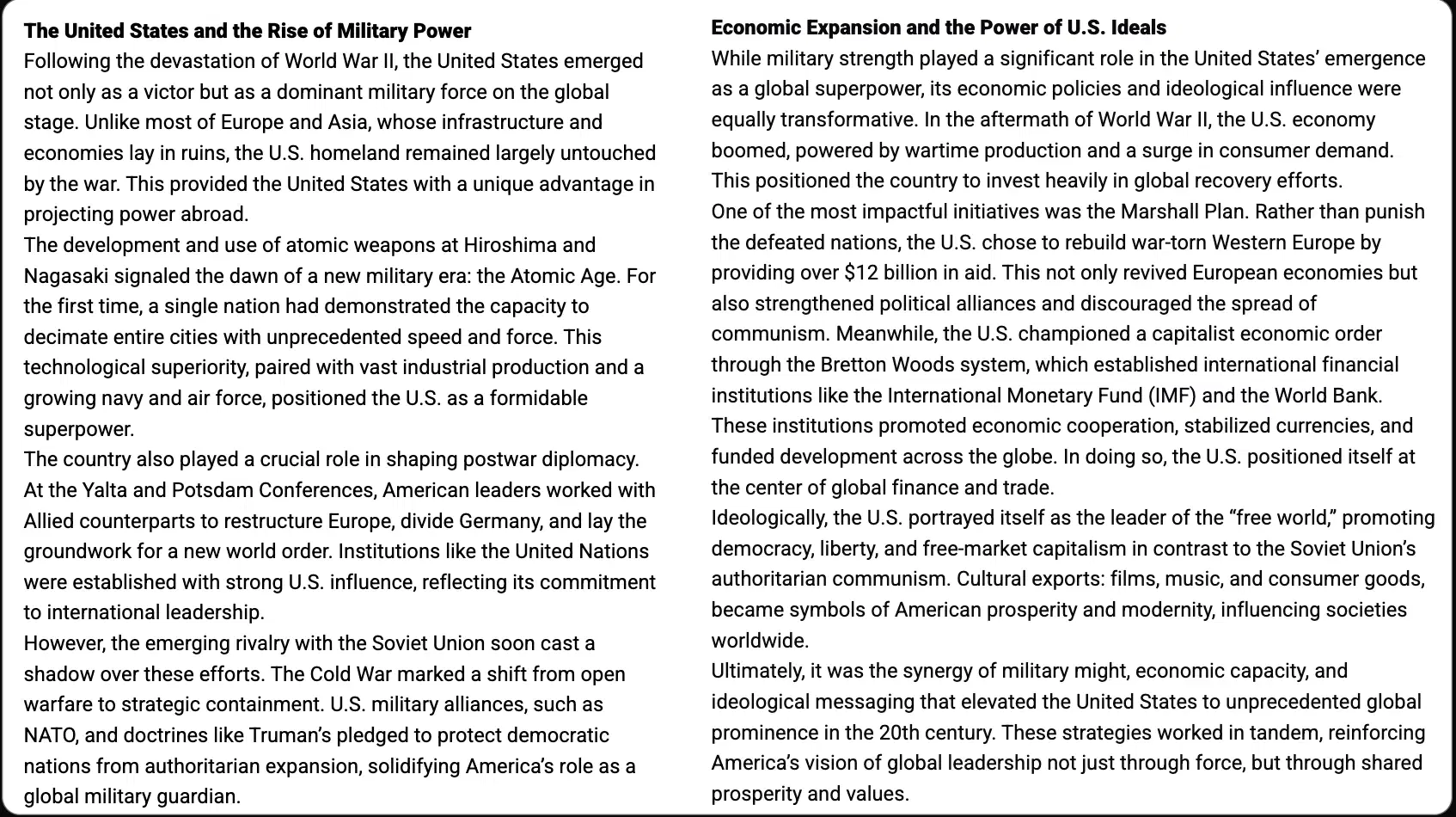
The United States and the Rise of Military Power
Following the devastation of World War II, the United States emerged not only as a victor but as a dominant military force on the global stage. Unlike most of Europe and Asia, whose infrastructure and economies lay in ruins, the U.S. homeland remained largely untouched by the war. This provided the United States with a unique advantage in projecting power abroad.
The development and use of atomic weapons at Hiroshima and Nagasaki signaled the dawn of a new military era: the Atomic Age. For the first time, a single nation had demonstrated the capacity to decimate entire cities with unprecedented speed and force. This technological superiority, paired with vast industrial production and a growing navy and air force, positioned the U.S. as a formidable superpower.
The country also played a crucial role in shaping postwar diplomacy. At the Yalta and Potsdam Conferences, American leaders worked with Allied counterparts to restructure Europe, divide Germany, and lay the groundwork for a new world order. Institutions like the United Nations were established with strong U.S. influence, reflecting its commitment to international leadership.
However, the emerging rivalry with the Soviet Union soon cast a shadow over these efforts. The Cold War marked a shift from open warfare to strategic containment. U.S. military alliances, such as NATO, and doctrines like Truman’s pledged to protect democratic nations from authoritarian expansion, solidifying America’s role as a global military guardian.
Economic Expansion and the Power of U.S. Ideals
While military strength played a significant role in the United States’ emergence as a global superpower, its economic policies and ideological influence were equally transformative. In the aftermath of World War II, the U.S. economy boomed, powered by wartime production and a surge in consumer demand. This positioned the country to invest heavily in global recovery efforts.
One of the most impactful initiatives was the Marshall Plan. Rather than punish the defeated nations, the U.S. chose to rebuild war-torn Western Europe by providing over $12 billion in aid. This not only revived European economies but also strengthened political alliances and discouraged the spread of communism. Meanwhile, the U.S. championed a capitalist economic order through the Bretton Woods system, which established international financial institutions like the International Monetary Fund (IMF) and the World Bank. These institutions promoted economic cooperation, stabilized currencies, and funded development across the globe. In doing so, the U.S. positioned itself at the center of global finance and trade.
Ideologically, the U.S. portrayed itself as the leader of the “free world,” promoting democracy, liberty, and free-market capitalism in contrast to the Soviet Union’s authoritarian communism. Cultural exports: films, music, and consumer goods, became symbols of American prosperity and modernity, influencing societies worldwide.
Ultimately, it was the synergy of military might, economic capacity, and ideological messaging that elevated the United States to unprecedented global prominence in the 20th century. These strategies worked in tandem, reinforcing America’s vision of global leadership not just through force, but through shared prosperity and values.
17
Let's answer the questions
18
Multiple Choice
Which sentence best explains the U.S. motivation for creating institutions like NATO, according to the first text?
To demonstrate the superiority of atomic weapons
To prevent another world war
To contain the influence of the Soviet Union
To compete with Britain for control of Europe
19
Multiple Choice
Why is the use of atomic bombs presented as a turning point in the first text?
It introduced air power as a new warfare strategy
It marked the end of international diplomacy
It showcased a destructive power never seen before
It ended the Cold War
20
Multiple Choice
What evidence does the second text give to support the idea that the U.S. influenced global finance?
It built roads and schools abroad
It funded the reconstruction of Japan
It created the IMF and World Bank
It signed treaties with the USSR
21
Multiple Choice
How does the Marshall Plan demonstrate a blend of economic and political reasoning?
It was purely humanitarian
It aimed only to boost the U.S. economy
It sought to revive Europe and prevent communism
It replaced all European governments with U.S. allies
22
Multiple Choice
Which statement from either text offers direct support for the idea that U.S. leadership was strategic, not accidental?
“U.S. leaders worked to divide Germany.”
“The Cold War was a direct result of the atomic bomb.”
“Military alliances and global finance positioned the U.S. at the center of a new world order.”
“War caused destruction in both hemispheres.”
23
Multiple Choice
In context, what does “projecting power abroad” most likely mean?
Building factories in rural America
Avoiding foreign involvement to keep the American power
Extending military and political influence overseas
Estimating future global trends
24
Multiple Choice
What is the meaning of “ideological influence” as used in the second text?
The use of religious institutions in-country and abroad
The spread of U.S. political and economic values
The military occupation of foreign nations
The transfer of nuclear technology
25
Multiple Choice
What does the shift from warfare to containment in the first text signify about U.S. strategy?
The U.S. was no longer interested in conflict
The military had grown too weak for war
The U.S. adapted its methods to indirect conflict
The Cold War was short-lived and unimportant
26
Multiple Choice
Why is the Marshall Plan described as both economic and ideological?
It provided food only to communist leaders and countries
It was funded by the USSR
It aimed to rebuild economies and spread U.S. values
It sought to form a European empire
27
Multiple Choice
What is the central idea of Text 1?
The U.S. ended WWII by itself
Military victories had no lasting impact, especially in third world countries
U.S. military and diplomatic actions positioned it as a world leader
The U.S. lost power after WWII
28
Multiple Choice
What is the central message of Text 2?
The U.S. economy collapsed after WWII
Ideals and economic investment helped solidify U.S. power
Communism spread faster than capitalism
U.S. foreign policy was anti-European and anti-communist
29
Multiple Choice
Together, the two texts suggest which broader conclusion?
U.S. power rested only on atomic weapons
American influence was accidental
Military, economic, and ideological tools shape U.S. leadership
The Cold War made U.S. leadership irrelevant
30
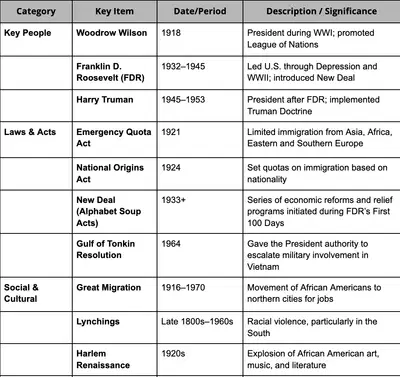
Let's see the matrix for highlighted information
31
32
Let's answer the questions
33
Multiple Choice
The significance of Woodrow Wilson in the table can best be described as:
A leader who initiated widespread economic reforms and policies
The president who restricted immigration from Europe
A figure who championed global cooperation after WWI
The originator of Cold War anti-communist policy
34
Multiple Choice
Which of the following conclusions is best supported by the timing of the Emergency Quota Act and National Origins Act?
Both acts reflected a temporary wartime immigration policy.
They were responses to a broader postwar fear of foreign influence.
These acts encouraged skilled labor migration during industrial growth.
They were aimed at integrating immigrants into U.S. political systems.
35
Multiple Choice
Which law institutionalized a quota system that discriminated based on national origin?
Gulf of Tonkin Resolution
National Origins Act
New Deal Acts
Truman Doctrine
36
Multiple Choice
Which idea is reinforced by both the Emergency Quota Act and the National Origins Act?
The U.S. consistently welcomed diversity in the early 20th century.
Legislative decisions were influenced by prevailing social fears.
Immigration policy was mostly shaped by economic needs alone.
The U.S. avoided restricting immigration until after WWII.
37
Multiple Choice
What can be inferred about the role of the Harlem Renaissance in shaping U.S. culture?
It was primarily a southern movement promoting agricultural values.
It undermined the legitimacy of African American contributions to society including immigrants.
It signified a shift in how African American identity was expressed and recognized.
It was a short-lived artistic trend limited to rural communities.
38
Multiple Choice
Which of the following people is directly associated with implementing sweeping domestic economic reform?
Woodrow Wilson
Franklin D. Roosevelt
Harry Truman
Lyndon B. Johnson
39
Let's watch a documentary video on Ku Klux Klan
40
41
Let's challenge our understanding by answering the questions
42
Multiple Choice
What does the phrase “membership…ignited and multiplied three separate times” suggest about the KKK’s history?
It indicates continuous operation without interruption three times consecutively.
It shows that the Klan experienced three major periods of resurgence.
It suggests membership numbers remained static over time.
It implies that only three people ever joined.
43
Multiple Choice
Which of the following best reflects the Klan’s recurring nature over time?
One-time event with long-term consequences.
A static organization with stable membership.
Multiple revivals linked to social tensions.
Always a federal political body.
44
Multiple Choice
What inference can you draw about societal values during each KKK revival?
Each revival addressed economic prosperity.
They reflected rising racial hostilities and fear of change.
The Klan was revived due to secularism.
Each resurgence focused on environmental issues.
45
Multiple Choice
What hypothesis is suggested by the statement that KKK membership “multiplied” multiple times?
Resurgences were accidental and trivial.
There was organized recruitment aligned with broader social concerns.
The increases were due to foreign influence.
Membership grew via random chance, especially in religious states.
46
The US History |
The United States Becomes a Global Power
By Adesti Komalasari
Show answer
Auto Play
Slide 1 / 46
SLIDE

Similar Resources on Wayground
40 questions
Unit 1: Parts of Speech
Presentation
•
University
43 questions
EPF: Module 3
Presentation
•
12th Grade
41 questions
WW II and Isolationism 7.1
Presentation
•
12th Grade
41 questions
Scientific Method Lesson and Practice
Presentation
•
KG - University
38 questions
Business English - Workplace Materials
Presentation
•
University
38 questions
CLE1243(2) CORE COMPETENCIES
Presentation
•
University
40 questions
ESB Domain 3
Presentation
•
12th Grade
40 questions
Unit-4-Business Plan-Done
Presentation
•
University
Popular Resources on Wayground
16 questions
Grade 3 Simulation Assessment 2
Quiz
•
3rd Grade
19 questions
HCS Grade 5 Simulation Assessment_1 2526sy
Quiz
•
5th Grade
10 questions
Cinco de Mayo Trivia Questions
Interactive video
•
3rd - 5th Grade
17 questions
HCS Grade 4 Simulation Assessment_2 2526sy
Quiz
•
4th Grade
24 questions
HCS Grade 5 Simulation Assessment_2 2526sy
Quiz
•
5th Grade
13 questions
Cinco de mayo
Interactive video
•
6th - 8th Grade
20 questions
Math Review
Quiz
•
3rd Grade
30 questions
GVMS House Trivia 2026
Quiz
•
6th - 8th Grade
Discover more resources for Social Studies
55 questions
Post Malone Addtion (Tres)
Quiz
•
12th Grade - University
20 questions
Disney Trivia
Quiz
•
University
50 questions
AP Biology Exam Review 2017
Quiz
•
11th Grade - University
24 questions
5th Grade Math EOG Review
Quiz
•
KG - University
12 questions
Star Wars Trivia - Easy
Quiz
•
KG - University
215 questions
8th Physical Science GA Milestones Review
Quiz
•
KG - University
40 questions
Famous Logos
Quiz
•
7th Grade - University
14 questions
(5-3) 710 Mean, Median, Mode & Range Quick Check
Quiz
•
6th Grade - University