

Grammar Les. 10: Sentences

Presentation
•
English
•
8th Grade
•
Practice Problem
•
Medium
+17
Standards-aligned

Melissa Powell
Used 4+ times
FREE Resource
9 Slides • 12 Questions
1

2

3
Multiple Choice
Which of the following is most likely to happen if your message does not make sense?
People may misunderstand you.
Your message will be clearer.
You will always get the response you want.
It will improve your grammar skills.
4
Open Ended
Why is it important for your sentences to make sense when communicating with others?
5

6

7
Fill in the Blanks
A sentence that asks a question and ends with a question mark is called an
Type answer...
8

9
Multiple Select
Which of the following sentences are imperative?
Cut the chatter!
Where is your ticket?
Don’t drop that suitcase!
Our visit to Hawaii will last five days.
10
Multiple Choice
Which type of sentence gives a command or makes a request?
Imperative sentence
Declarative sentence
Interrogative sentence
Exclamatory sentence
11
Multiple Choice
Which sentence is exclamatory or declarative?
A matador is a man who fights a bull in a special contest.
Would you want to have a matador’s job?
I definitely would not!
Don’t get too close to the bull.
12

13
Multiple Choice
What are the two main parts of every sentence?
Subject and predicate
Noun and verb
Clause and phrase
Adjective and adverb
14
15
Open Ended
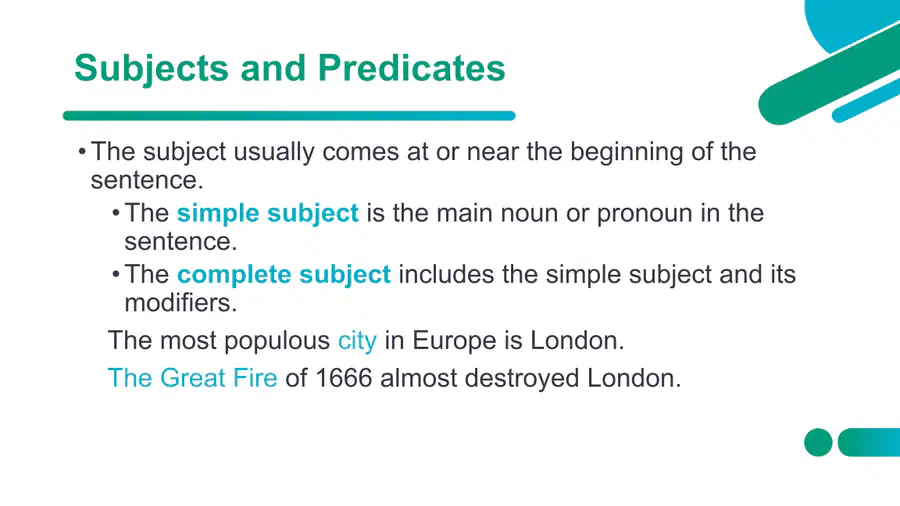
Explain the difference between a simple subject and a complete subject.
16
17
Multiple Choice
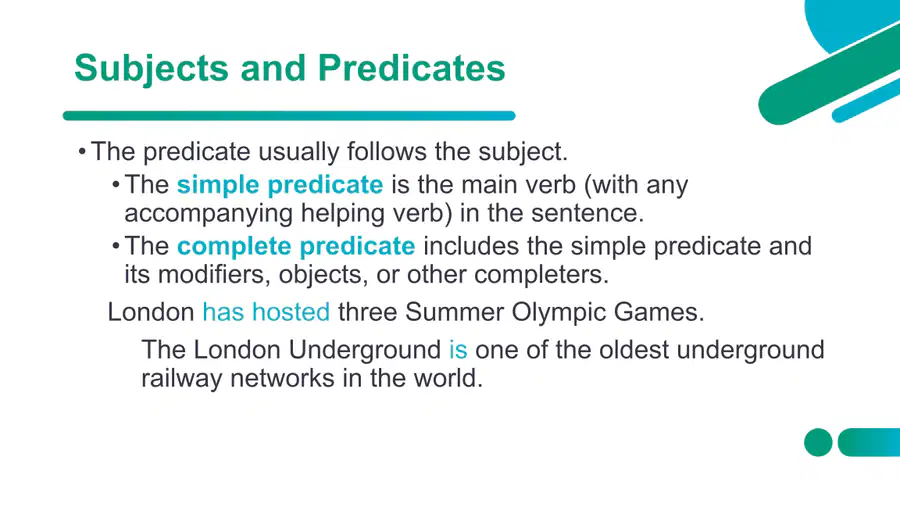
What is the difference between a simple predicate and a complete predicate in a sentence?
A simple predicate is just the main verb, while a complete predicate includes the verb and all its modifiers, objects, or completers.
A simple predicate is the subject, while a complete predicate is the object.
A simple predicate is always at the beginning of a sentence, while a complete predicate is always at the end.
A simple predicate includes adjectives, while a complete predicate does not.
18

19
Multiple Select
Which of the following statements about imperative sentences are correct?
The subject is usually understood to be 'you'.
Imperative sentences often have only a predicate.
Only imperative sentences can have an understood subject.
Imperative sentences always have an explicit subject.
20
Fill in the Blanks
In the sentence 'The Alcazar in Segovia, Spain, appears as a lofty and noble bulwark,' the simple predicate is
Type answer...
21
Open Ended
Identify the complete subject and predicate in the sentence 'The Alhambra was built by the Moors between 1248 and 1354.'
Show answer
Auto Play
Slide 1 / 21
SLIDE
Similar Resources on Wayground

19 questions
Context Clues
Presentation
•
8th Grade
16 questions
Poetry vs. Prose
Presentation
•
7th - 8th Grade
19 questions
Possesive pronouns and adjectives
Presentation
•
8th Grade
15 questions
Linear & Nonlinear Plot Development
Presentation
•
7th - 8th Grade
16 questions
Dramatic Irony Mini Lesson
Presentation
•
8th Grade
15 questions
Simple Past Tense
Presentation
•
8th Grade
18 questions
Compare and Contrast
Presentation
•
8th Grade
14 questions
House on Mango Street 1-4
Presentation
•
8th Grade
Popular Resources on Wayground
10 questions
How much do you know about our Portrait of an Eagle?

Quiz
•
10th Grade
10 questions
Fast Food Slogans
Quiz
•
6th - 8th Grade
21 questions
Continents and Oceans
Quiz
•
6th Grade
20 questions
Parts of Speech
Quiz
•
5th Grade
16 questions
Subject & Predicate
Quiz
•
5th Grade
25 questions
Multiplication Facts
Quiz
•
5th Grade
12 questions
Map Skills
Quiz
•
3rd Grade
22 questions
Continents and Oceans
Quiz
•
5th Grade
Discover more resources for English
25 questions
Making Inferences
Quiz
•
6th - 8th Grade
20 questions
Figurative Language Review
Quiz
•
8th Grade
30 questions
Central Idea practice Grade 7-8
Quiz
•
6th - 8th Grade
12 questions
Final Figurative Language Review
Presentation
•
6th - 8th Grade
20 questions
Sentences, Fragments, and Run-ons
Quiz
•
8th Grade
20 questions
TEXTUAL EVIDENCE & INFERENCES
Quiz
•
6th - 8th Grade
11 questions
Objective Summary Review
Quiz
•
6th - 8th Grade
17 questions
Plot
Quiz
•
8th Grade