

Using Bunsen Burners

Presentation
•
Science
•
7th Grade
•
Easy

Mandy Mills
Used 2+ times
FREE Resource
9 Slides • 16 Questions
1

Using Bunsen Burners
2
Poll
Which one would you want to be able to control?
Earth
Air
Water
Fire
3
Why might you use a Bunsen burner?
4
The Bunsen burner was invented by Robert Bunsen in 1854 in order to have a hotter and smokeless flame that could be used inside laboratories.
It is now the most common way of heating things up in the lab. For example, you might need it to boil a solution, burn a piece of metal, start a chemical reaction, sterilize a test tube.
5
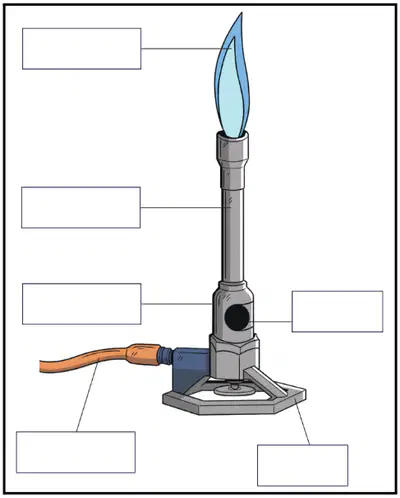
Let's label the parts of a Bunsen burner!
Parts of a Bunsen
Word Bank
Airhole
Base
Flame
Chimney / Barrel
Collar
Rubber Tube
6
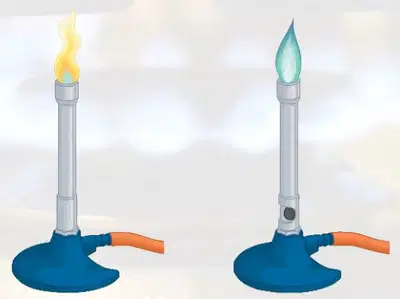
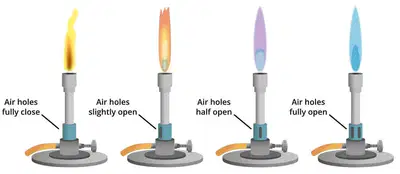
Fire needs oxygen to burn, and the air hole on the Bunsen burner controls how much oxygen gets in.
Turning the collar changes the air hole size, which makes the flame change colour from yellow (less oxygen) to blue (more oxygen).
The Air Hole and Collar
7
When the air hole is closed, the flame is yellow, cooler, and makes soot. This yellow flame is called the safety flame and is used when the burner is on but not heating, because it is easy to see.
When the air hole is open, more oxygen mixes in, making a blue flame, which is hotter, cleaner, and better for heating during experiments.
8

Before we light a Bunsen, we have to think about SAFETY!
9
Word Cloud
Can you think of a way we can stay safe around Bunsen burners?
(only one or two words)
10
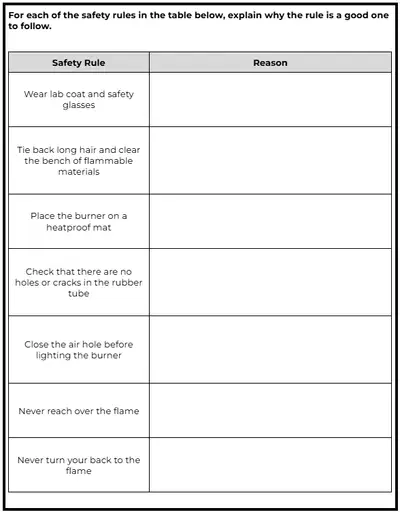
Glue the sheet into your books
Write a reason for why you need to follow each safety rule
There may be more than one reason for a safety rule. Can you find someone who has a different reason for a rule than you?
Safety
Rules and Reasons
11
What are 3 things you didn't know before watching a Bunsen burner be lit?
Demonstration
Get a whiteboard and write down the steps you notice.
12
Multiple Choice
What does the air hole on a Bunsen burner do?
Controls the gas flow
Controls the oxygen flow to the flame
Connects to the gas supply
Holds the flame in place
13
Multiple Choice
What colour is the flame when the air hole is closed?
Blue
Yellow
Red
Green
14
Multiple Choice
Why is the yellow flame called the safety flame?
Because it is the hottest flame
Because it is easier to see when the burner is not heating
Because it burns the cleanest
Because it produces no soot
15
Multiple Choice
What safety equipment should you always wear when using a Bunsen burner?
Sunglasses
Safety goggles
Gloves only
No safety equipment needed
16
Multiple Select
What should you do before lighting a Bunsen burner?
Hint: there are two correct answers
Make sure the air hole is open
Make sure the air hole is closed
Turn on the gas fully immediately
Light the match before turning on the gas
17
Multiple Choice
What part of the Bunsen burner connects it to the gas supply?
Collar
Chimney / Barrel
Rubber Tubing
Base
18
Multiple Select
When should you turn off the gas on the Bunsen burner?
Hint: there are two correct answers
Immediately after use
While the flame is still burning
Only when you change the flame colour
Never
19
Multiple Choice
What happens if the flame produces soot?
It is burning completely
It is burning incompletely and creating dirty deposits
The flame is blue and hot
The burner is off
20
Multiple Choice
What should you do if the Bunsen burner flame goes out?
Turn off the gas immediately
Keep trying to light it without turning the gas off
Leave the gas on and walk away
Increase the gas flow without caution
21
Multiple Choice
In case of a fire emergency in the lab, what is the first thing you should do?
Try to put the fire out yourself without telling anyone
Turn off the gas, alert the teacher, and follow emergency procedures
Run away shouting
Ignore it and continue working
22
Multiple Choice
When lighting a match to light the Bunsen burner, you should:
Light the match close to your fingers
Light the match away from your body and the burner
Light the match under the burner
Light the match and immediately put it on the burner
23
Multiple Choice
Why should you never cross your hands over the flame or tubing when lighting or adjusting the burner?
It looks untidy
To avoid burning or accidentally knocking the burner
It makes the flame go out
It is faster not to cross hands
24
Multiple Choice
What should you do if you smell gas but don’t see a flame?
Turn off the gas immediately and tell the teacher
Turn up the gas to try and light it
Ignore it and start your experiment
Open the windows and continue
25
Multiple Select
What safety step should you always do before using a Bunsen burner?
Hint: there are two correct answers
Tie back long hair and secure loose clothing
Wear sandals and shorts
Pour water on the burner
Have the hole closed and the safety flame on whenever you are not doing the actual task
Using Bunsen Burners
Show answer
Auto Play
Slide 1 / 25
SLIDE
Similar Resources on Wayground

19 questions
Apex 3.3 - Periodic Table Mini-Lesson
Presentation
•
7th Grade
21 questions
Heredity and Probability
Presentation
•
7th Grade
21 questions
Animal Behavior
Presentation
•
7th Grade
21 questions
Organization of Multicellular Organisms
Presentation
•
7th Grade
21 questions
Severe Weather- Hurricanes and Blizzards
Presentation
•
7th Grade
21 questions
Nervous System
Presentation
•
7th Grade
20 questions
States of Matter Review
Presentation
•
3rd Grade
19 questions
The Distribution of Earth's Resources
Presentation
•
7th Grade
Popular Resources on Wayground
28 questions
US History Regents Review

Quiz
•
11th Grade
36 questions
Biology Regents Review
Quiz
•
9th - 10th Grade
20 questions
Math Review
Quiz
•
3rd Grade
38 questions
Regents Life Science General Review
Quiz
•
9th Grade
20 questions
Math Review
Quiz
•
6th Grade
21 questions
EOY Grade 6 Benchmark Assessment - Content Skills
Quiz
•
6th Grade
20 questions
Inferences
Quiz
•
4th Grade
20 questions
Figurative Language Review
Quiz
•
6th Grade