

AP World SAQ Introduction

Presentation
•
Social Studies
•
9th - 12th Grade
•
Easy

Allison Bair
Used 2+ times
FREE Resource
24 Slides • 15 Questions
1
Open Ended
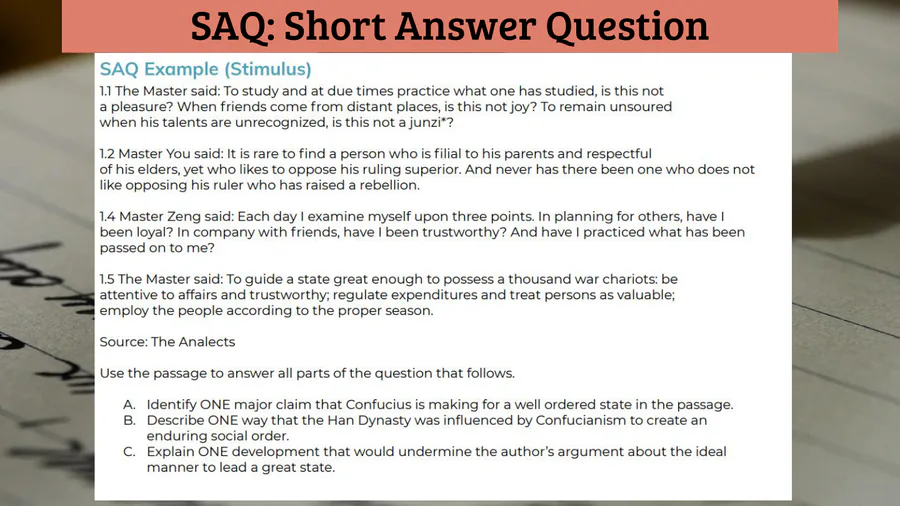
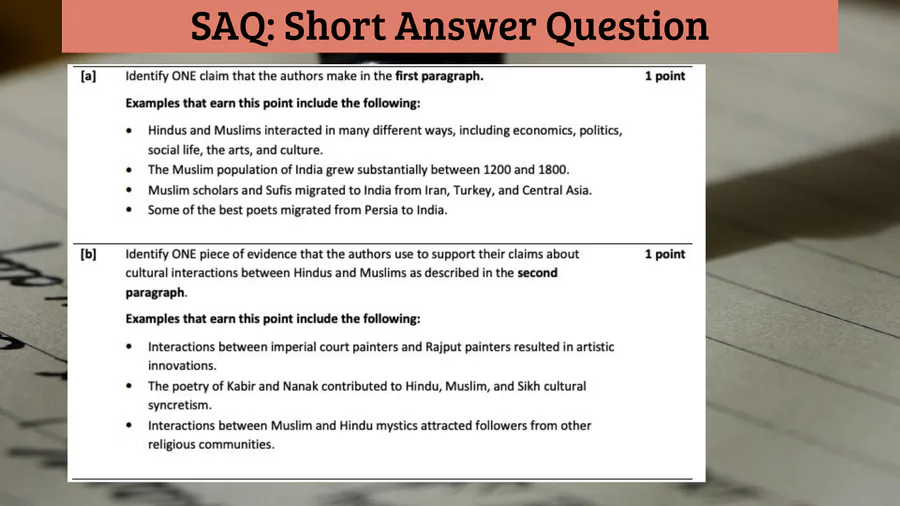
What is the claim that the author is making in the secondary source below?
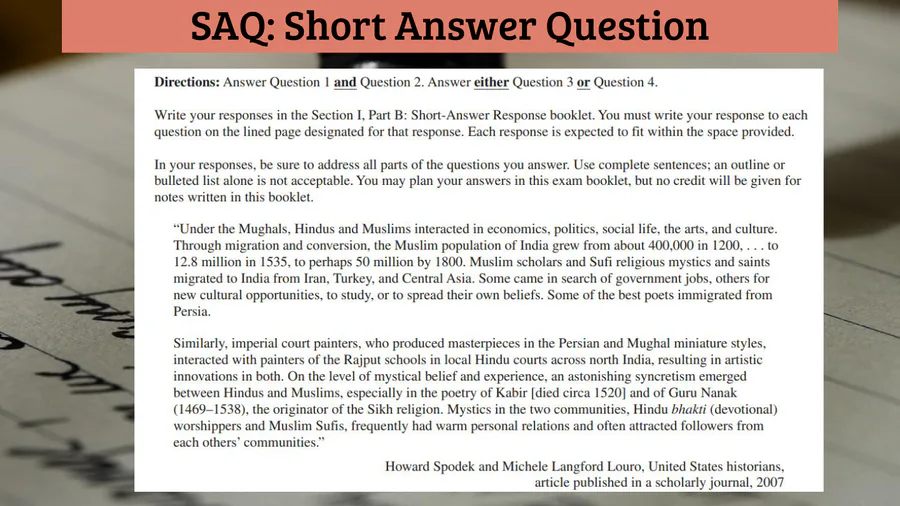
“Under the Mughals, Hindus and Muslims interacted in economics, politics, social life, the arts, and culture. Through migration and conversion, the Muslim population of India grew from about 400,000 in 1200, . . . to 12.8 million in 1535, to perhaps 50 million by 1800. Muslim scholars and Sufi religious mystics and saints migrated to India from Iran, Turkey, and Central Asia. Some came in search of government jobs, others for new cultural opportunities, to study, or to spread their own beliefs. Some of the best poets immigrated from Persia.
Similarly, imperial court painters, who produced masterpieces in the Persian and Mughal miniature styles, interacted with painters of the Rajput schools in local Hindu courts across north India, resulting in artistic innovations in both. On the level of mystical belief and experience, an astonishing syncretism emerged between Hindus and Muslims, especially in the poetry of Kabir [died circa 1520] and of Guru Nanak (1469–1538), the originator of the Sikh religion. Mystics in the two communities, Hindu bhakti (devotional) worshippers and Muslim Sufis, frequently had warm personal relations and often attracted followers from each others’ communities.”
Howard Spodek and Michele Langford Louro, United States historians,
article published in a scholarly journal, 2007
2

3
4
Multiple Choice
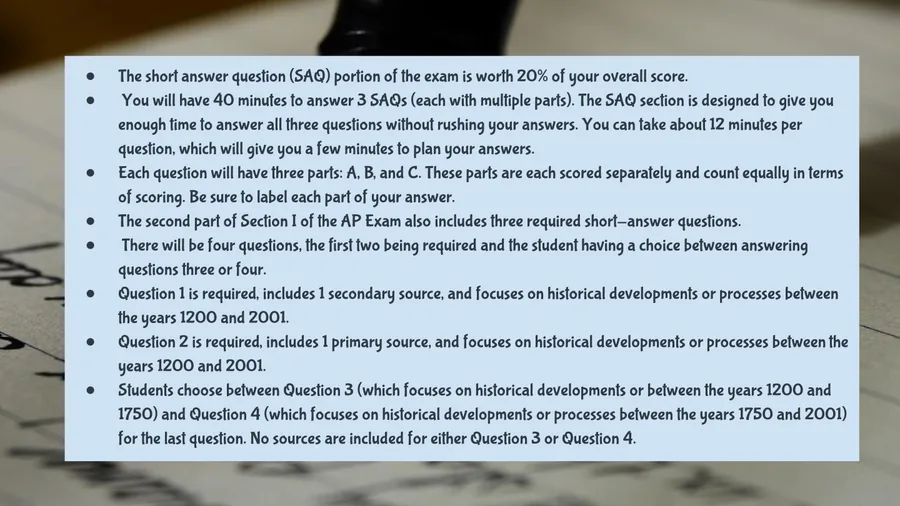
Which of the following statements about the SAQ section of the AP Exam is correct?
You have to answer all four SAQs in the exam.
Each SAQ has only one part to answer.
You can choose between Question 1 and Question 2.
You will have about 40 minutes to answer three SAQs, each with multiple parts.
5
6
Multiple Choice
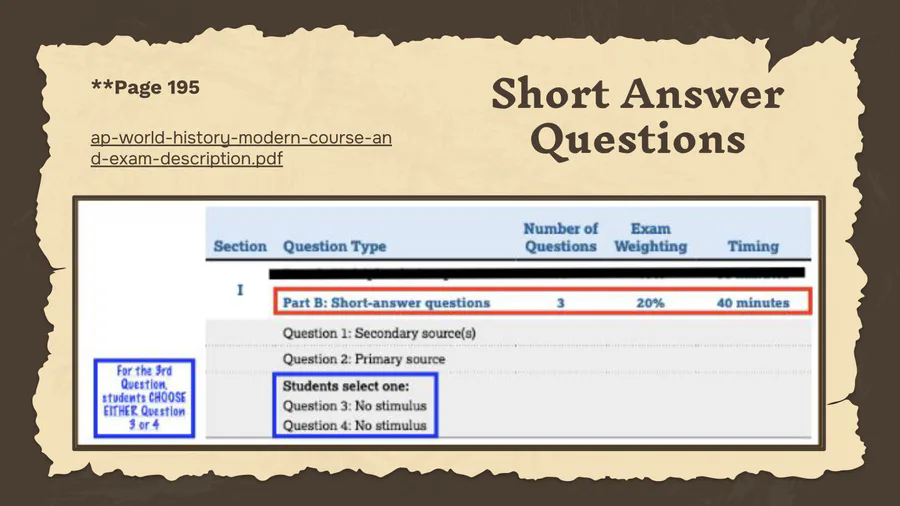
Which section of the AP World History exam contains short-answer questions, and how many questions are included in this section?
Section I, 2 questions
Section II, 4 questions
Part B, 3 questions
Part C, 1 question
7
8
Open Ended
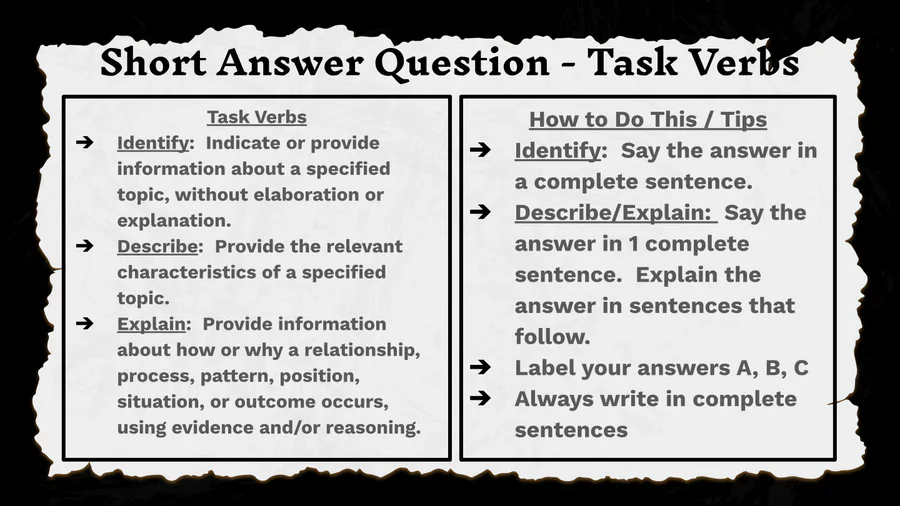
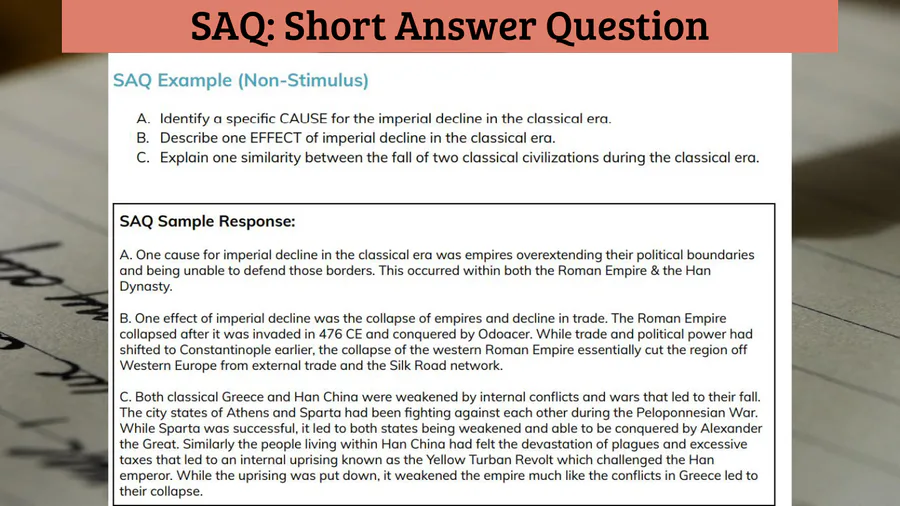
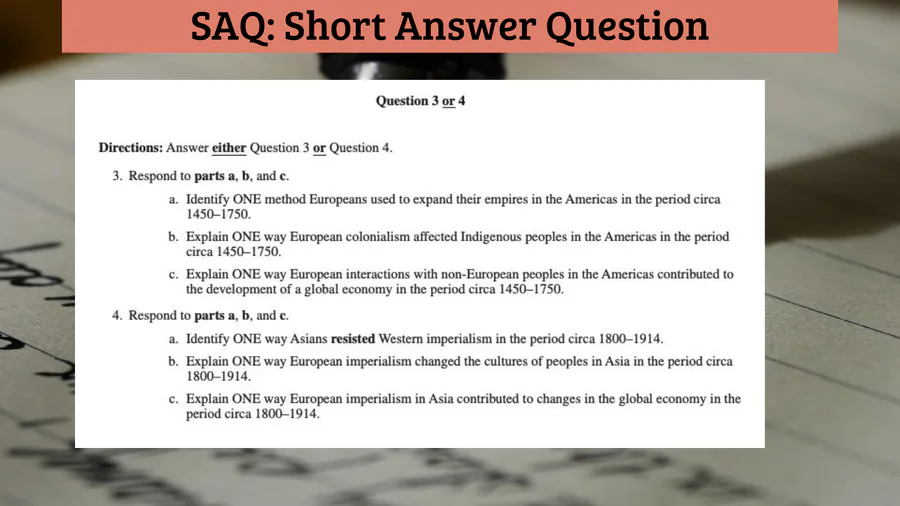
What are the three main task verbs used in short answer questions, and what does each require you to do?
9
10
Fill in the Blanks
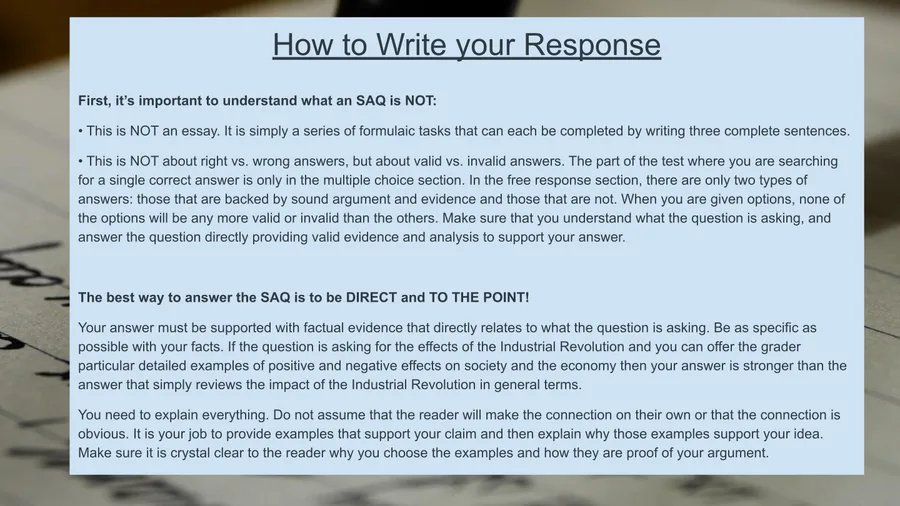
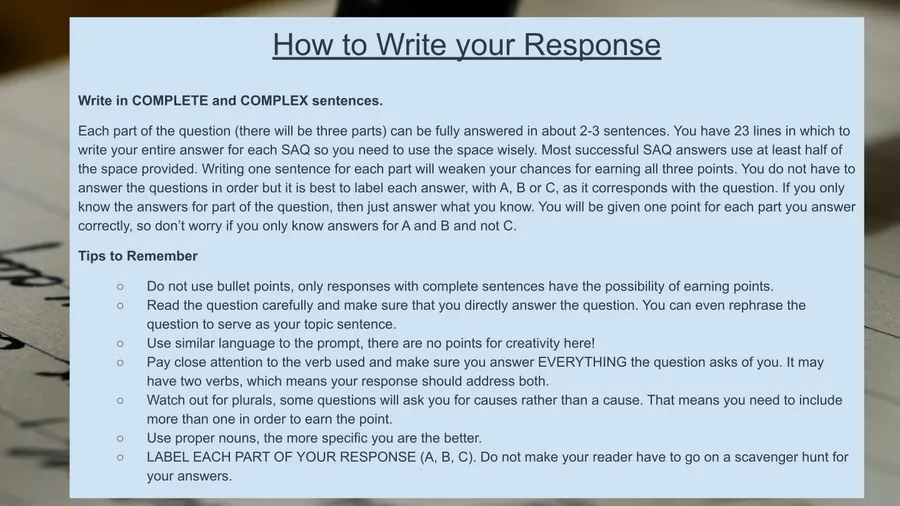
Fill in the blank: The best way to answer the SAQ is to be
11
12
Multiple Select
According to the guidance on writing responses, which of the following are important tips to remember when answering SAQs?
Use bullet points for clarity
Read the question carefully and answer directly
Use proper nouns and be specific
Label each part of your response (A, B, C)
13

14
15
Fill in the Blanks
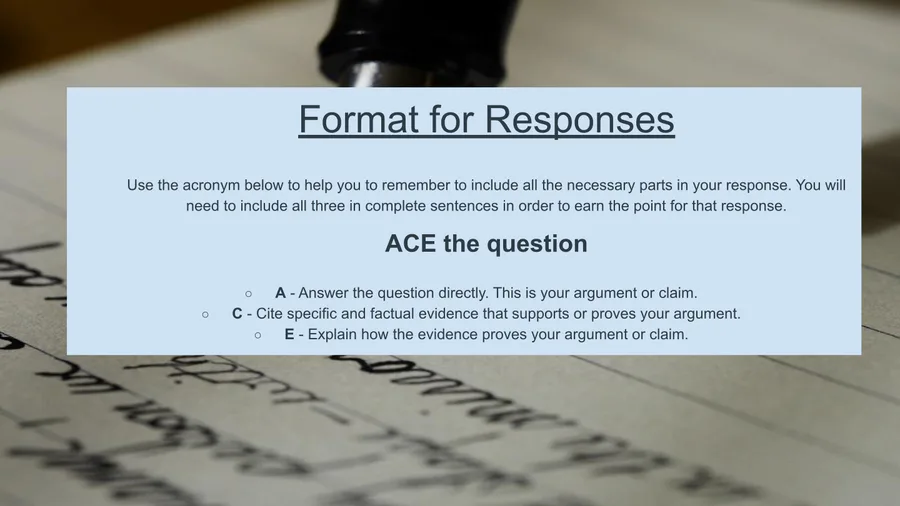
Fill in the blank: The acronym used to remember the format for responses is
Type answer...
16
Multiple Choice
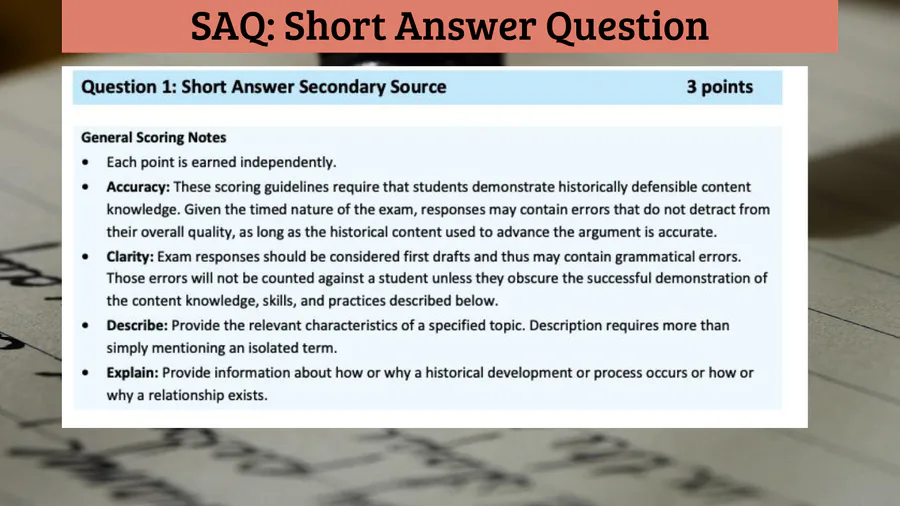
Which of the following is NOT a requirement for a high-scoring Short Answer Question (SAQ) response?
Accuracy in historical content
Clarity in writing
Providing a personal opinion
Describing and explaining relevant characteristics
17
18
19
20
21
22
23
24
25
26
Multiple Choice
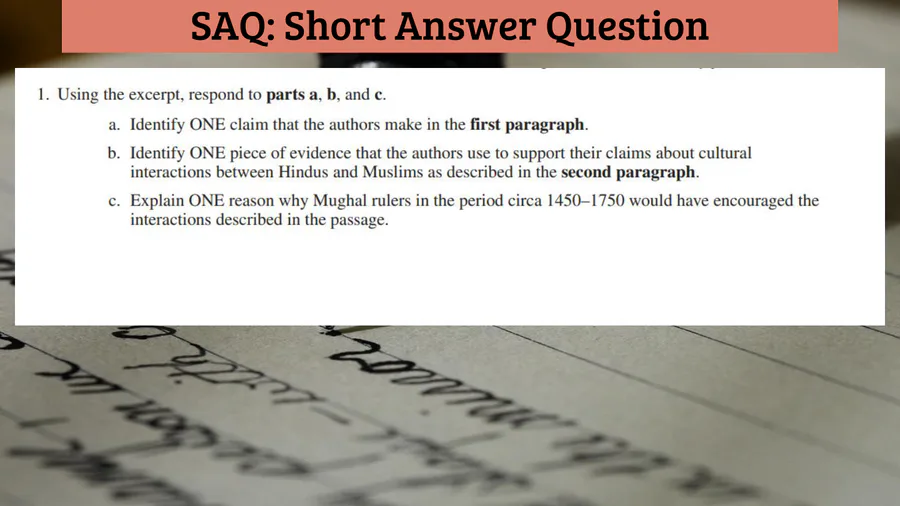
Based on the examples provided, which of the following would be considered valid evidence to support claims about cultural interactions between Hindus and Muslims?
Interactions between imperial court painters and Rajput painters
The use of military force to suppress religious groups
The migration of European traders to India
The construction of Hindu temples by Muslim rulers
27
28
29
30
Multiple Choice
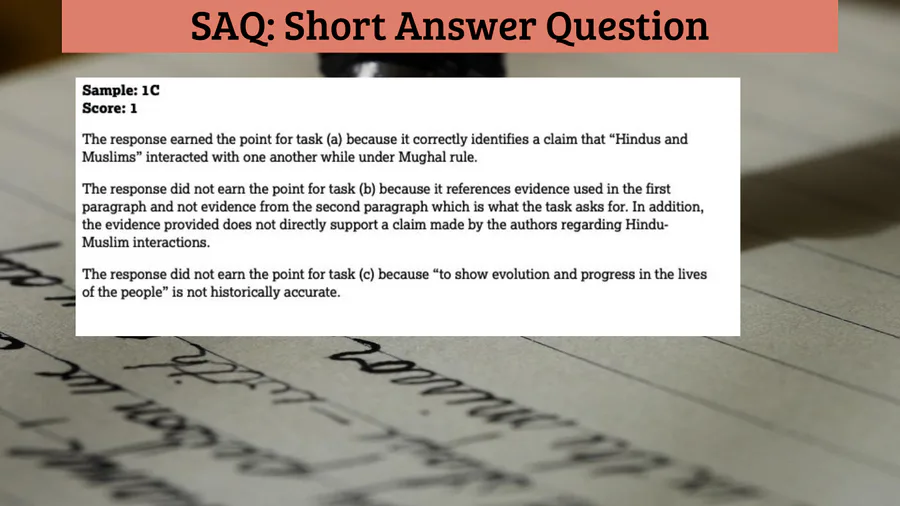
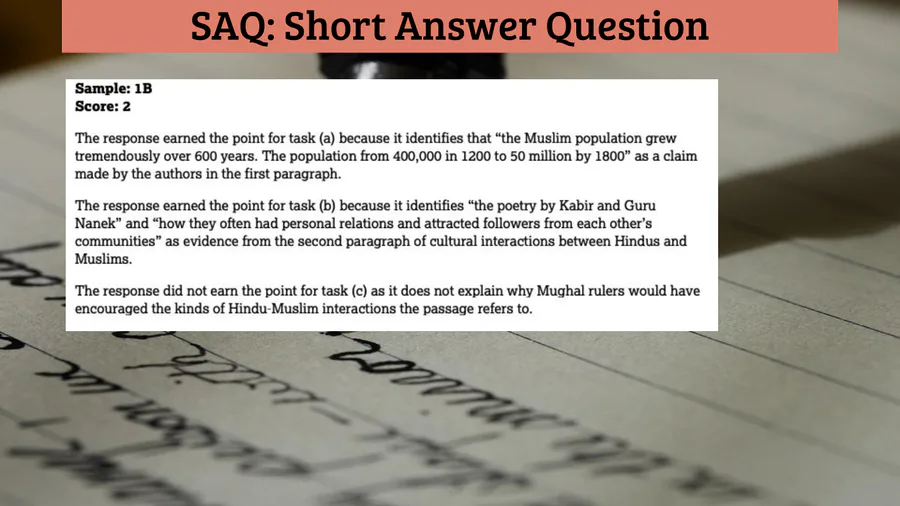
According to the scoring explanation, why did the response not earn the point for task (b)?
It referenced evidence from the wrong paragraph
It was too brief
It was not legible
It included too many grammatical errors
31
32
Multiple Choice
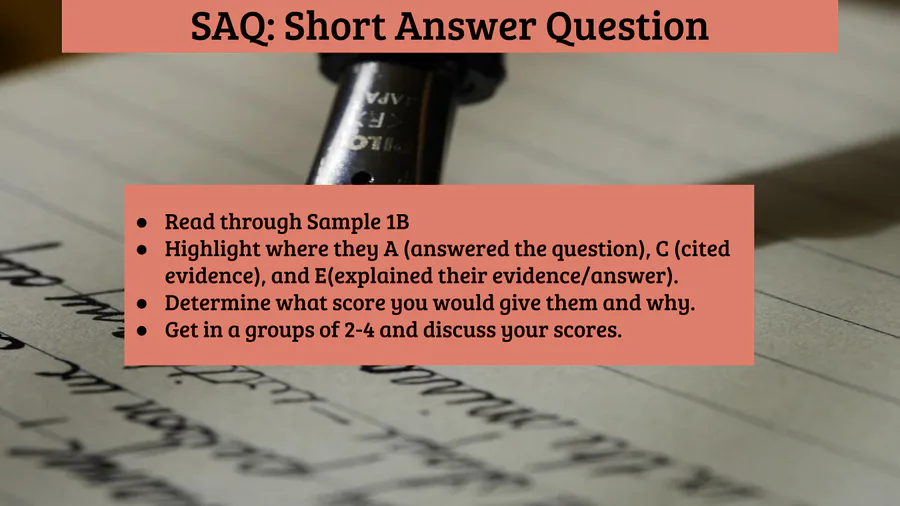
What are the three components you should look for when evaluating a short answer question (SAQ) response, according to the instructions?
Answered the question, cited evidence, explained evidence/answer
Restated the question, provided an opinion, summarized the passage
Listed facts, used quotations, wrote a conclusion
Identified the author, described the setting, gave a personal reflection
33
34
Fill in the Blanks
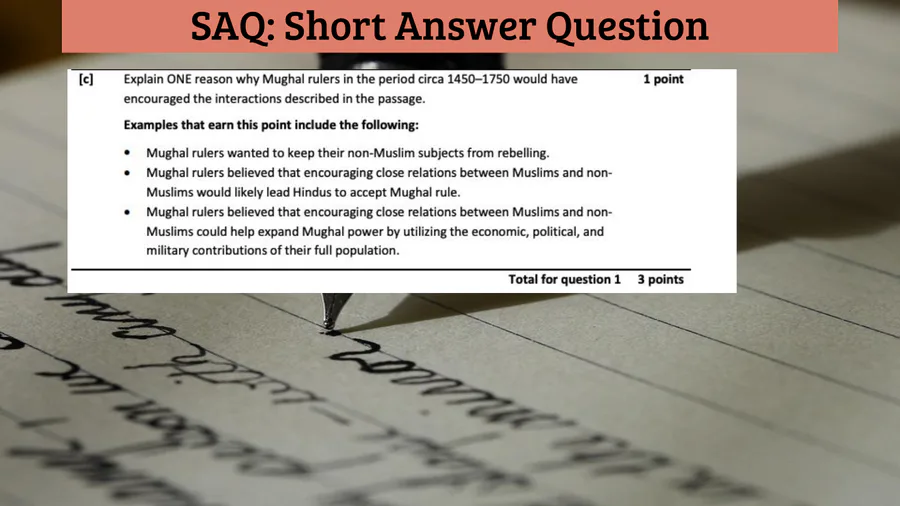
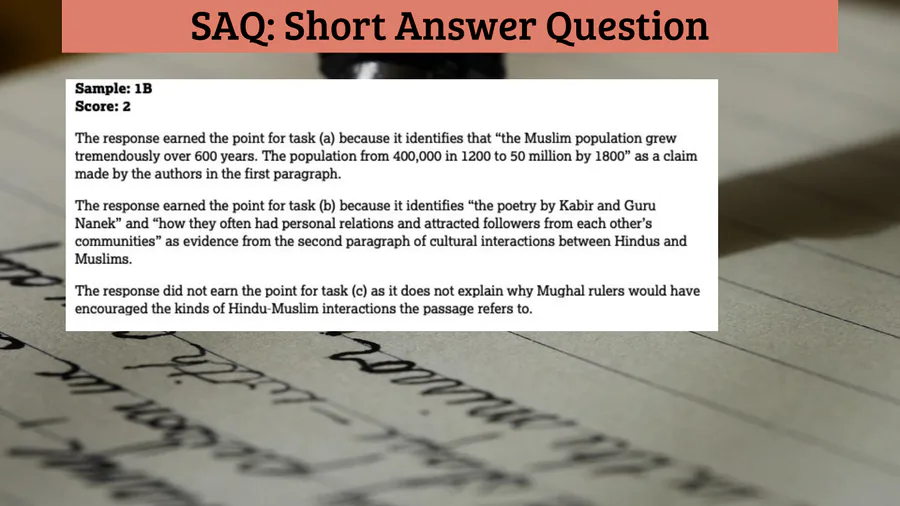
Why did the response not earn the point for task (c) in Sample 1B?
Type answer...
35
Multiple Choice
Based on the sample response in the images, what evidence was used to support the answer for task (b)?
The poetry by Kabir and Guru Nanek and their personal relations with followers from each other's communities
The Muslim population grew tremendously over 600 years
The Mughal rulers encouraged Hindu-Muslim interactions
The response did not earn the point for task (c)
36
37
38
Open Ended
What questions do you still have about the SAQ portion of the AP Exam, or is there anything you would like to know more about?
39
Open Ended
Summarize the structure and requirements of the SAQ section in the AP Exam. What are the key points students should remember?
What is the claim that the author is making in the secondary source below?
“Under the Mughals, Hindus and Muslims interacted in economics, politics, social life, the arts, and culture. Through migration and conversion, the Muslim population of India grew from about 400,000 in 1200, . . . to 12.8 million in 1535, to perhaps 50 million by 1800. Muslim scholars and Sufi religious mystics and saints migrated to India from Iran, Turkey, and Central Asia. Some came in search of government jobs, others for new cultural opportunities, to study, or to spread their own beliefs. Some of the best poets immigrated from Persia.
Similarly, imperial court painters, who produced masterpieces in the Persian and Mughal miniature styles, interacted with painters of the Rajput schools in local Hindu courts across north India, resulting in artistic innovations in both. On the level of mystical belief and experience, an astonishing syncretism emerged between Hindus and Muslims, especially in the poetry of Kabir [died circa 1520] and of Guru Nanak (1469–1538), the originator of the Sikh religion. Mystics in the two communities, Hindu bhakti (devotional) worshippers and Muslim Sufis, frequently had warm personal relations and often attracted followers from each others’ communities.”
Howard Spodek and Michele Langford Louro, United States historians,
article published in a scholarly journal, 2007
Show answer
Auto Play
Slide 1 / 39
OPEN ENDED
Similar Resources on Wayground

31 questions
The Holocaust
Presentation
•
9th - 12th Grade
35 questions
Q2. Assessment 1 Practice: Quiz
Presentation
•
KG
34 questions
2017 DBQ Amazing Race
Presentation
•
9th - 12th Grade
35 questions
Electron Configuration
Presentation
•
9th - 12th Grade
35 questions
Gilded Age
Presentation
•
9th - 12th Grade
35 questions
Stock Market: Ticker Symbols, Brands and Companies
Presentation
•
9th - 12th Grade
35 questions
3.5 Types of Market Structures: Labor Market Trends and Global Influences
Presentation
•
9th - 12th Grade
33 questions
Sectionalism
Presentation
•
9th - 12th Grade
Popular Resources on Wayground
6 questions
PRIDE Always and Everywhere
Presentation
•
12th Grade
20 questions
Lab Safety Quiz

Quiz
•
6th Grade
26 questions
KOR Review Kahoot Questions
Quiz
•
8th Grade
21 questions
Continents and Oceans
Quiz
•
6th Grade
12 questions
Unit Zero lesson 2 cafeteria
Presentation
•
9th - 12th Grade
20 questions
Parts of Speech
Quiz
•
5th Grade
10 questions
Riddles Riddles fun Riddles
Quiz
•
6th - 12th Grade
16 questions
Subject & Predicate
Quiz
•
5th Grade
Discover more resources for Social Studies
6 questions
PRIDE Always and Everywhere
Presentation
•
12th Grade
6 questions
PRIDE in the Hallways and Bathrooms
Presentation
•
12th Grade
10 questions
Exploring the Age of Exploration: Key Events and Figures

Interactive video
•
6th - 10th Grade
8 questions
Pre Civil Formative
Quiz
•
11th Grade
30 questions
AP Human Geography Unit 1
Quiz
•
9th - 12th Grade
42 questions
Unit 3 Key Terms
Quiz
•
11th Grade
8 questions
Source Analysis Formative
Quiz
•
10th Grade
64 questions
USHC 4 Key Terms 22-23
Quiz
•
11th Grade - University