

Physical Science Module 4-1 Work and Energy

Presentation
•
Science
•
12th Grade
•
Medium
+8
Standards-aligned
Used 2+ times
FREE Resource
30 Slides • 24 Questions
1
2
3
Multiple Choice
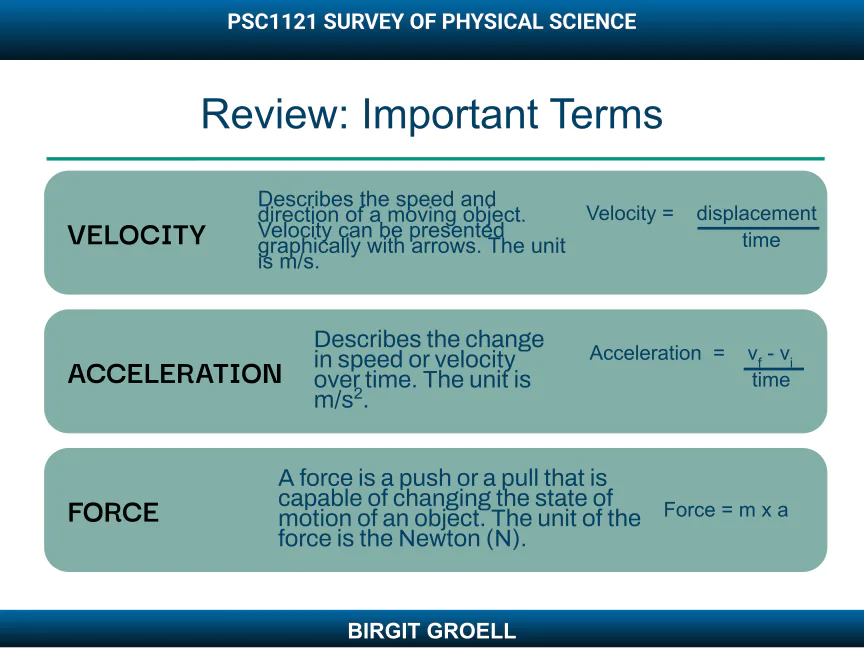
Which of the following best describes acceleration?
The speed and direction of a moving object.
The change in speed or velocity over time.
A push or pull that changes the state of motion of an object.
The distance traveled per unit time.
4
Multiple Choice
Which of the following best describes the difference between velocity and acceleration?
Velocity is the speed and direction of a moving object, while acceleration is the change in speed or velocity over time.
Velocity is the force applied to an object, while acceleration is the distance traveled.
Velocity is measured in Newtons, while acceleration is measured in meters per second.
Velocity is the change in time, while acceleration is the change in displacement.
5
Open Ended
How do the concepts of velocity, acceleration, and force relate to each other in understanding the motion of objects?
6
7
Multiple Choice
Which of the following best defines 'work' in physical science?
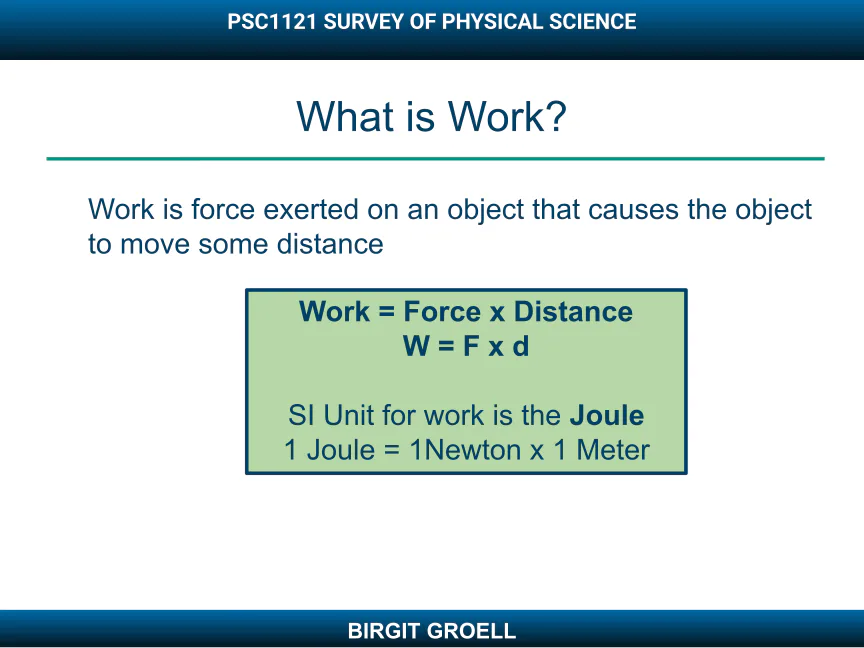
Work is the force exerted on an object that causes it to move some distance.
Work is the amount of energy stored in an object.
Work is the speed at which an object moves.
Work is the mass of an object multiplied by its acceleration.
8
9
Multiple Choice
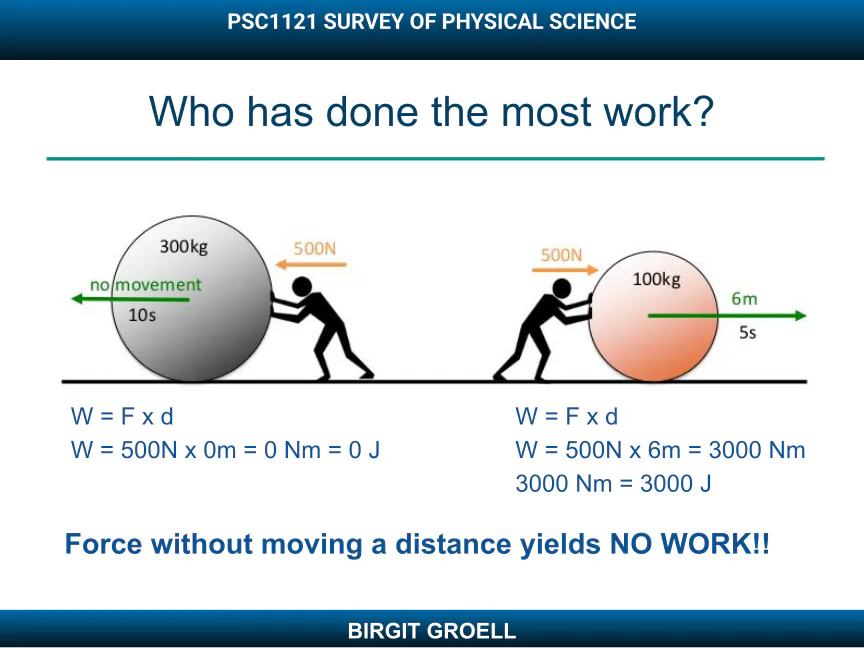
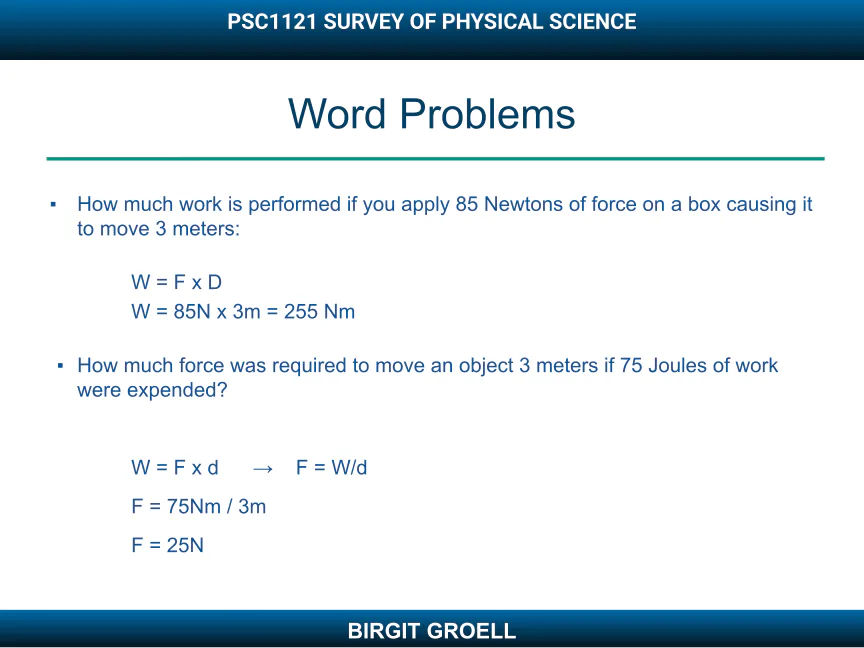
Why does the person pushing the 300kg ball for 10 seconds do no work, while the person pushing the 100kg ball for 5 seconds does work?
Because work requires movement over a distance, and the 300kg ball did not move.
Because the force applied was not enough for the 300kg ball.
Because the time spent pushing determines the work done.
Because the mass of the ball is more important than the distance moved.
10
11
12
Open Ended
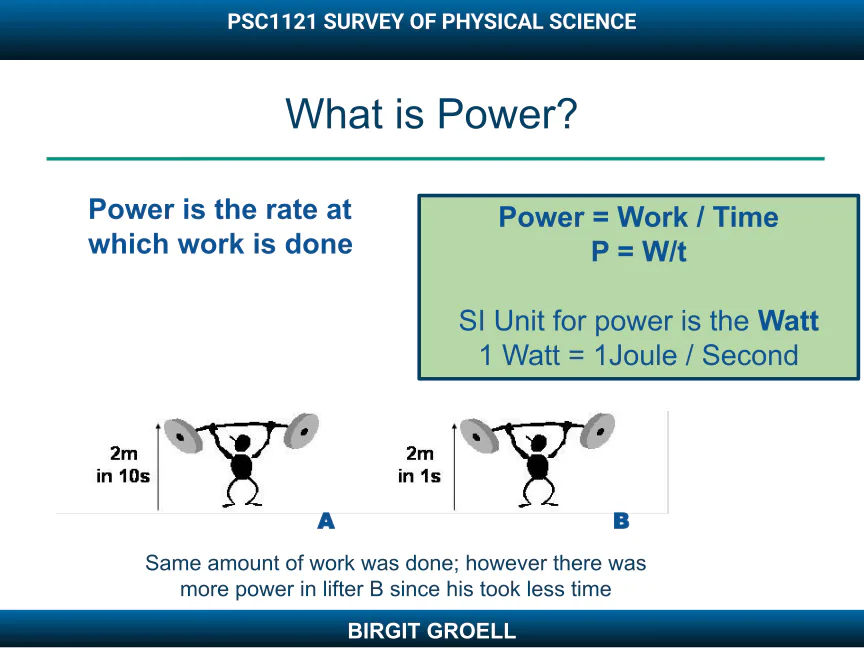
Explain the difference between work and power using examples from the images provided.
13
14
Multiple Choice
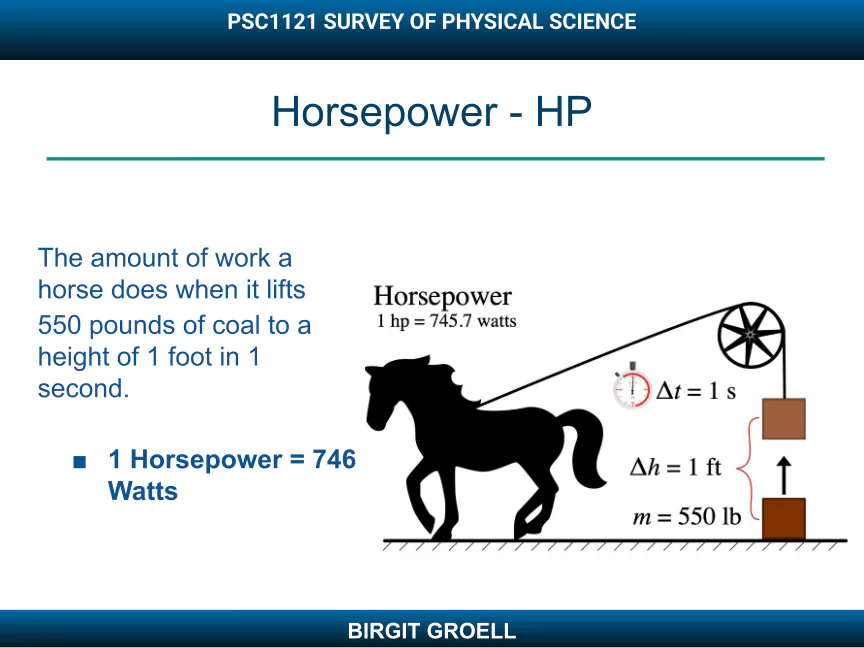
Which of the following statements about horsepower is correct?
1 horsepower is equal to 746 watts.
1 horsepower is equal to 550 watts.
1 horsepower is equal to 1000 watts.
1 horsepower is equal to 1 watt.
15
16
17
18
19
Multiple Choice
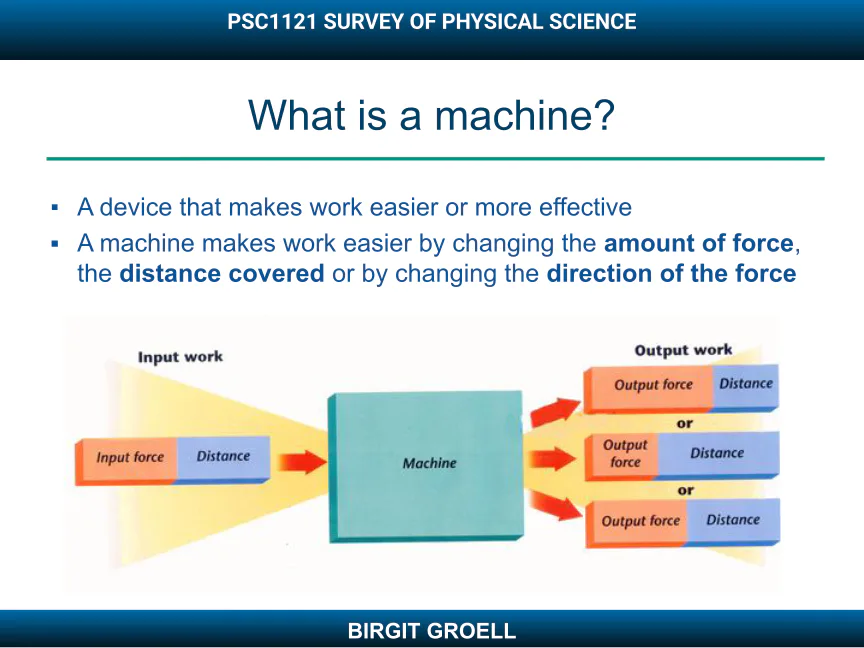
Which of the following is NOT a way a machine makes work easier?
By changing the amount of force
By changing the distance covered
By changing the direction of the force
By increasing the speed of work
20
21
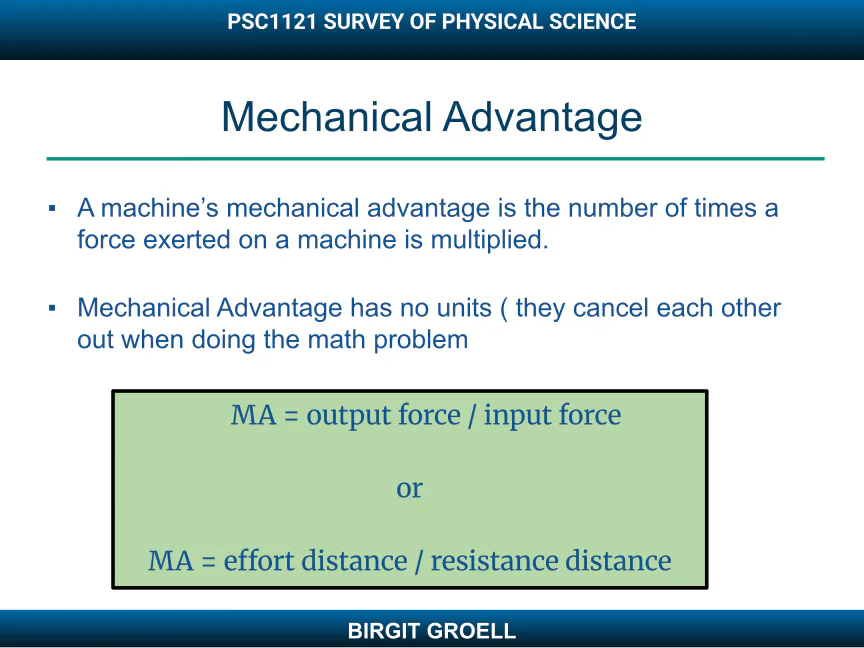
Fill in the Blanks
MA =
Type answer...
22
23
Multiple Select
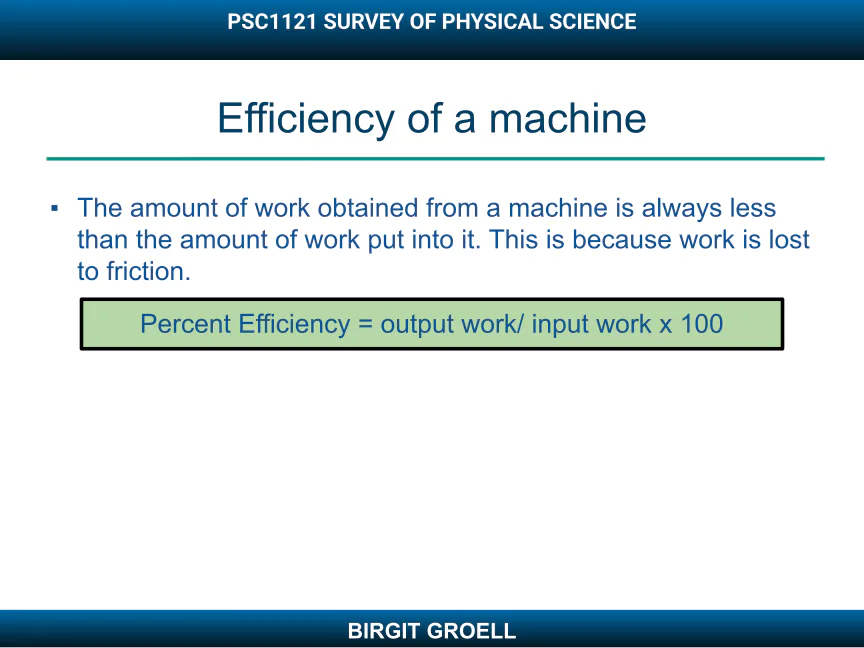
Select all statements that are true about the efficiency of a machine:
Efficiency is always less than 100% due to friction.
Efficiency is calculated as output work divided by input work times 100.
Efficiency has no units.
Efficiency is always equal to mechanical advantage.
24
25
Open Ended
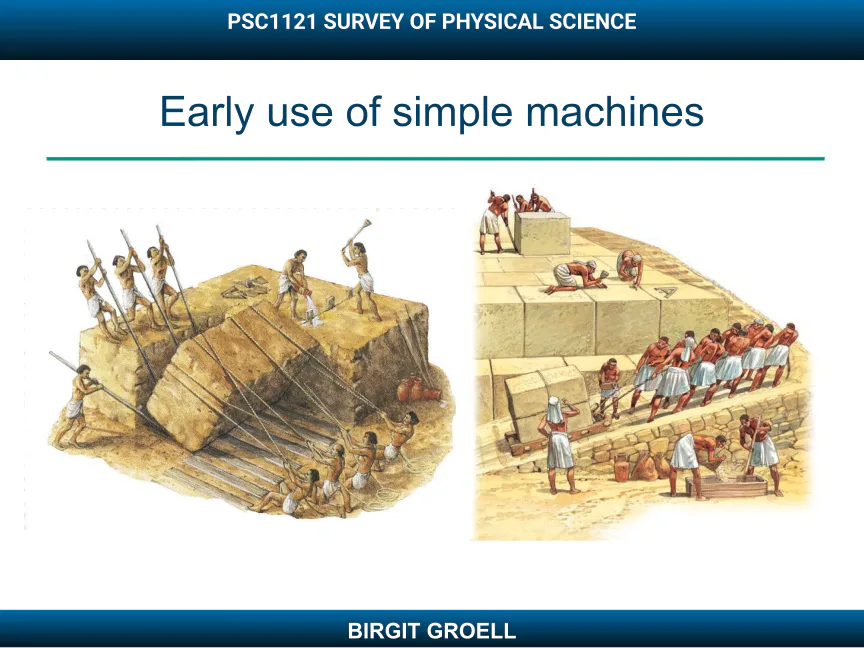
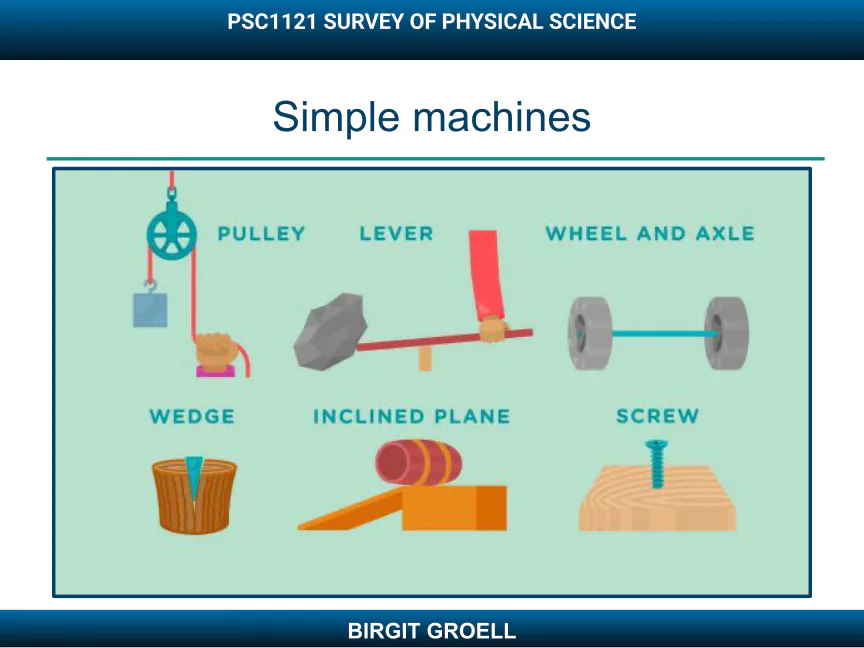
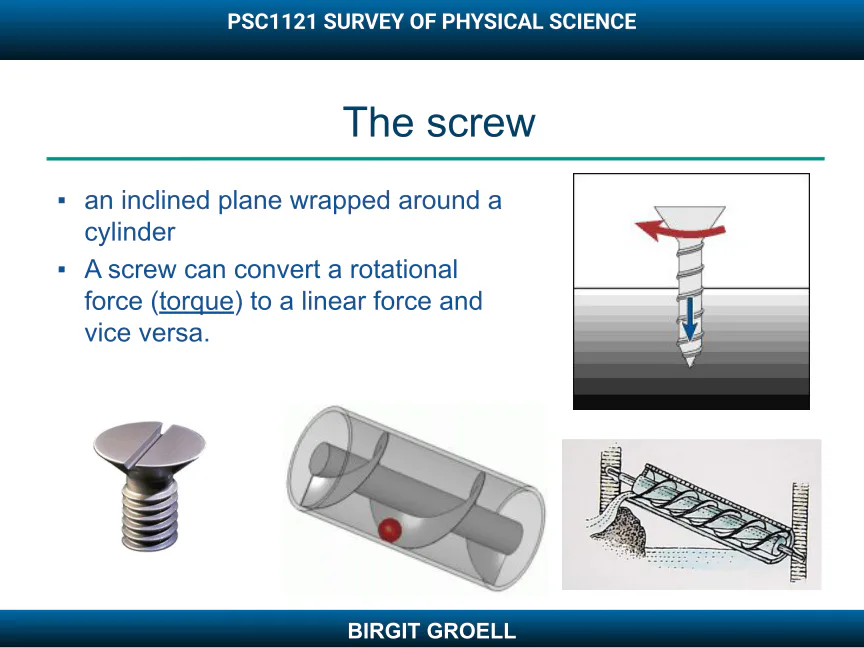
Explain the differences between a wedge, a screw, and an inclined plane as types of simple machines.
26
27
Multiple Choice
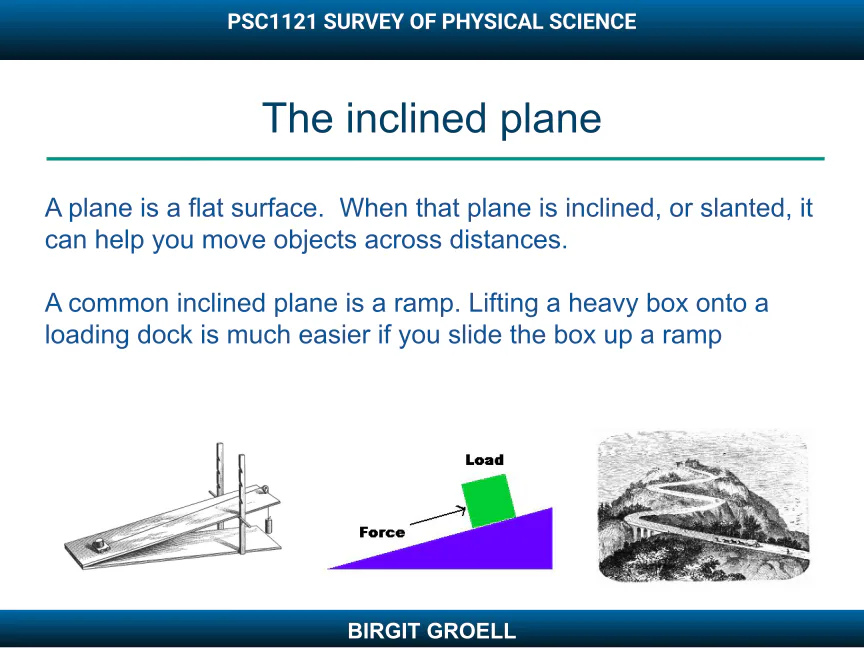
Which of the following is an example of an inclined plane?
A ramp used to move boxes
A pulley lifting a weight
A wheel and axle system
A lever used to pry open a lid
28
29
Open Ended
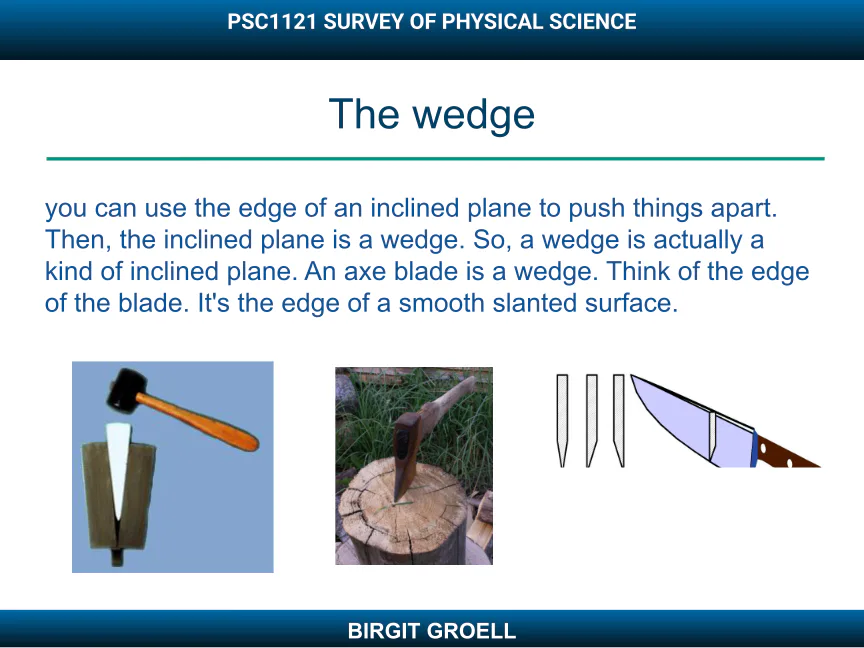
Explain how a wedge is related to an inclined plane and provide an example from everyday life.
30
31
Fill in the Blanks
A screw is an inclined plane wrapped around a
Type answer...
32
33
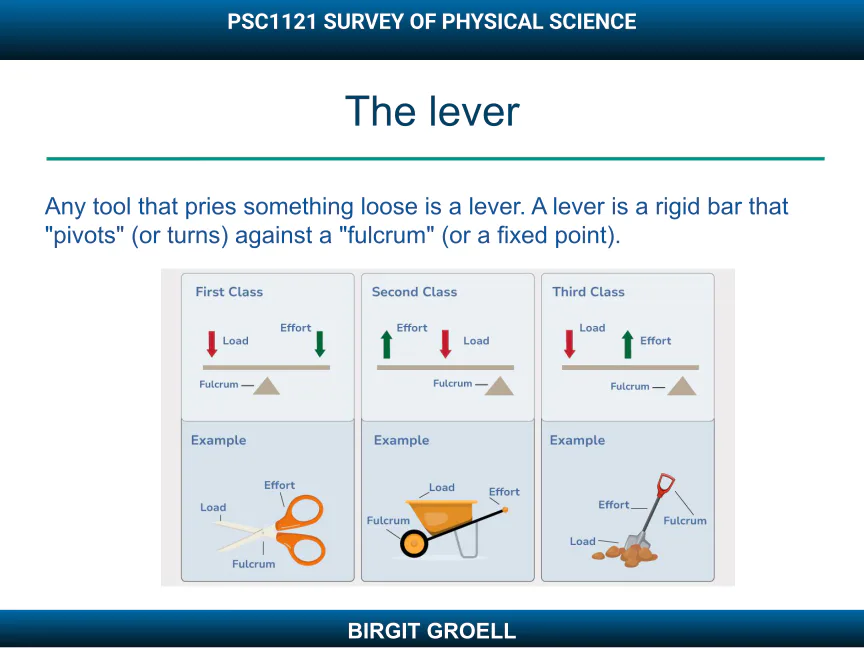
Multiple Select
Which of the following are examples of levers?
Scissors
Ramp
Crowbar
Pulley
34
35
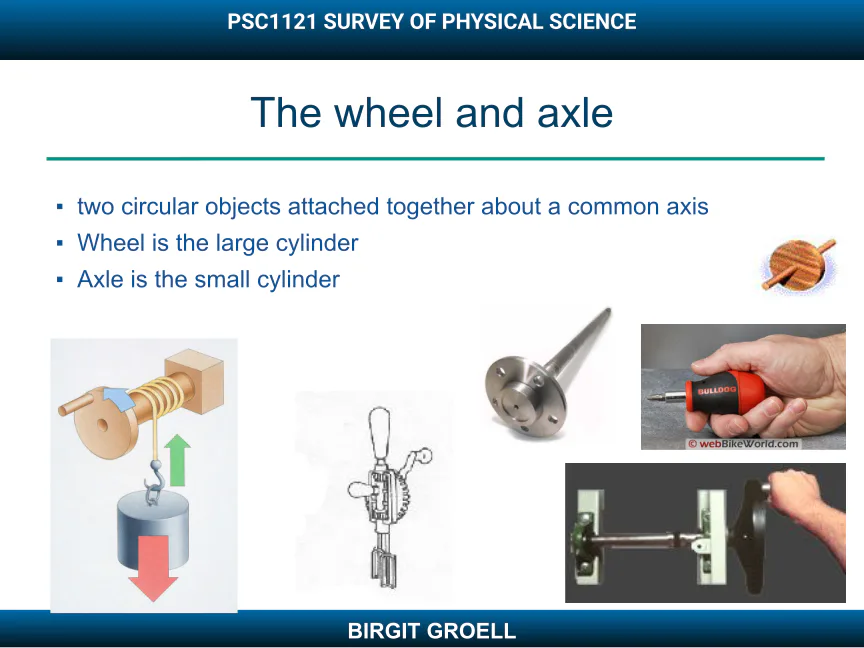
Multiple Choice
What is the main function of the wheel and axle in simple machines?
To increase rotational force
To convert rotational force to linear force
To lift heavy objects vertically
To attach two objects together
36
37
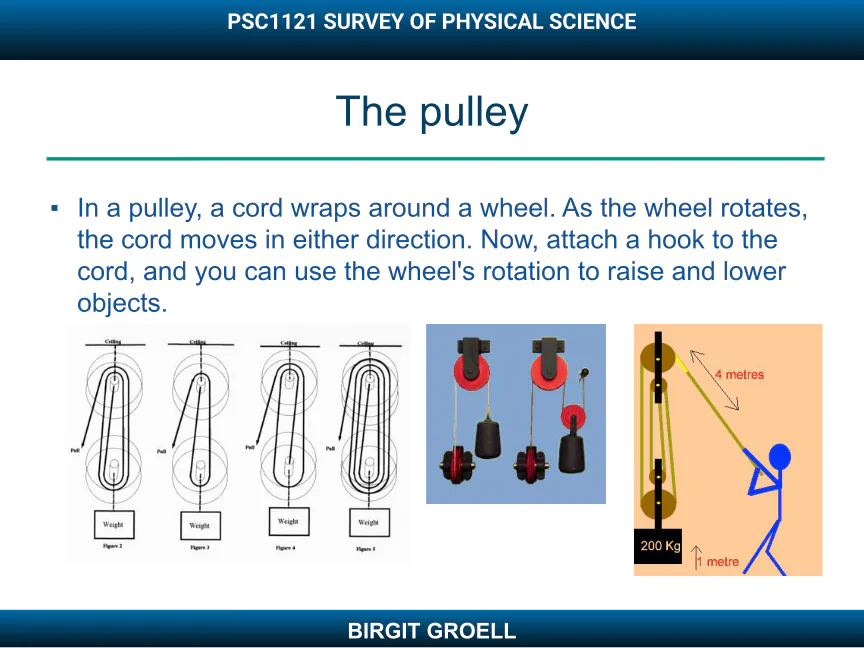
Open Ended
Describe how a pulley system makes lifting heavy objects easier. Use examples from the image to support your answer.
38
39
Multiple Choice
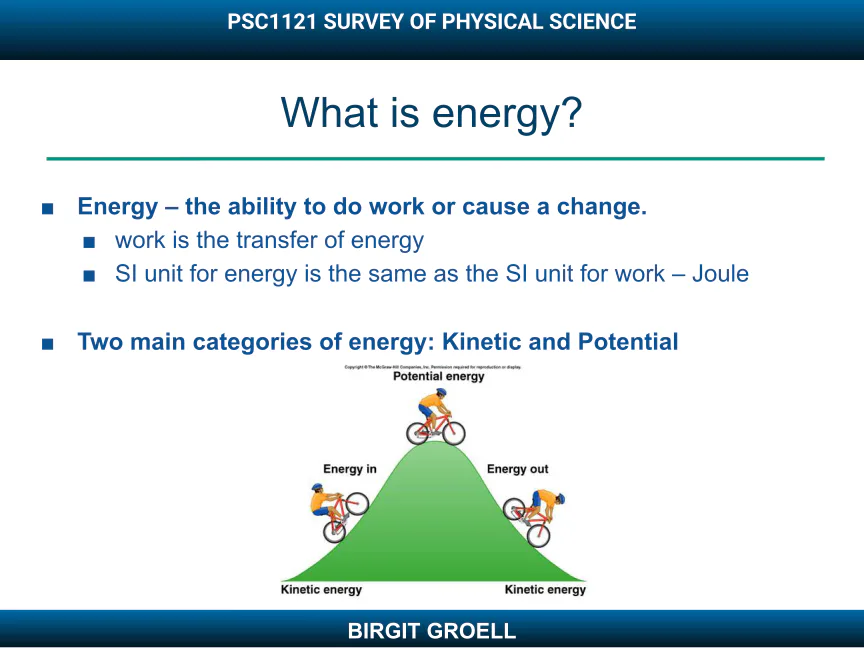
Which of the following best describes the difference between kinetic energy and potential energy?
Kinetic energy is the energy of motion, while potential energy is stored energy due to position.
Kinetic energy is stored energy, while potential energy is the energy of motion.
Kinetic energy and potential energy are both forms of chemical energy.
Kinetic energy only exists in living things, while potential energy exists in non-living things.
40
41
Open Ended
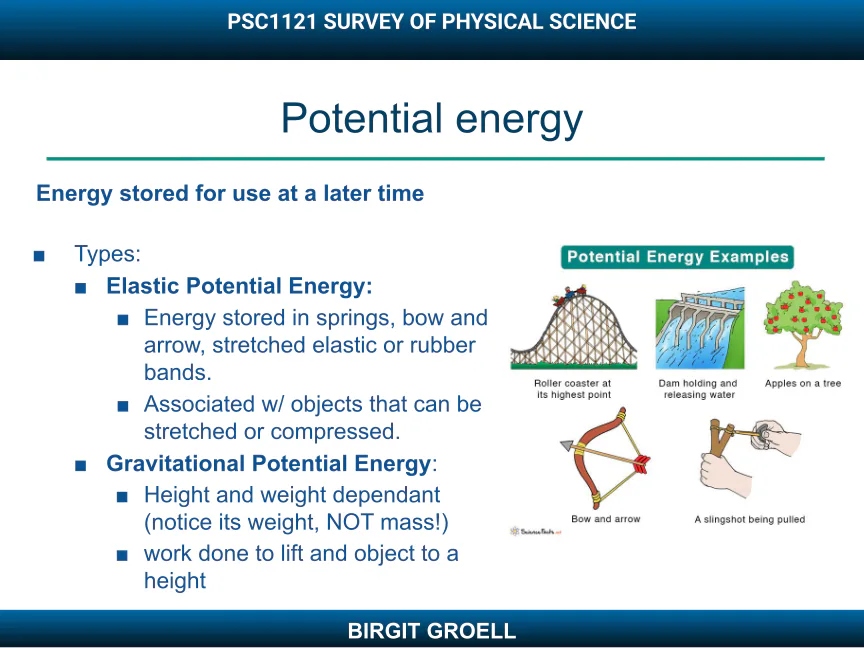
Explain how elastic potential energy and gravitational potential energy differ in terms of how they are stored and what factors affect them.
42
43
Multiple Choice
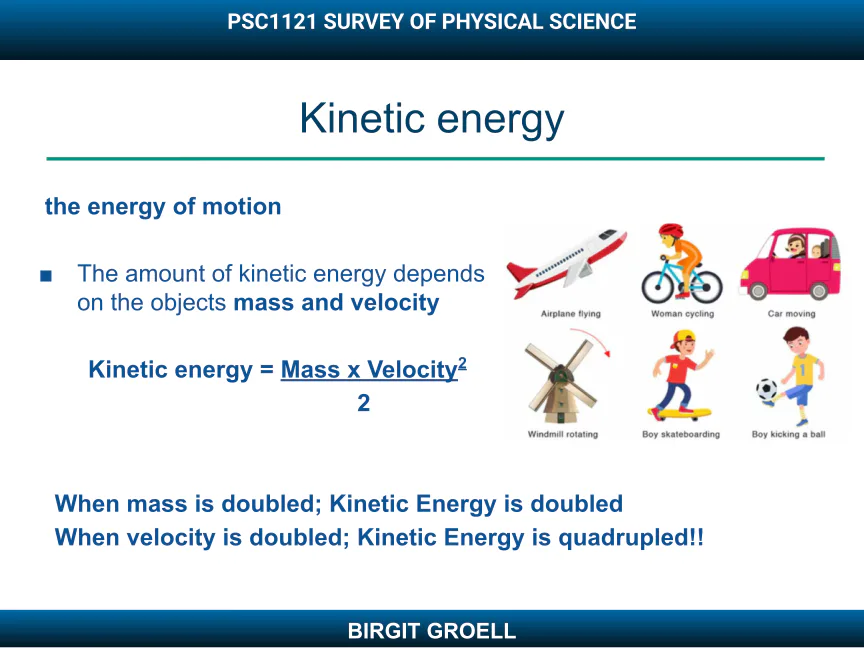
Which of the following factors will cause the greatest increase in an object's kinetic energy?
Doubling the object's mass
Doubling the object's velocity
Halving the object's mass
Halving the object's velocity
44
45
Multiple Select
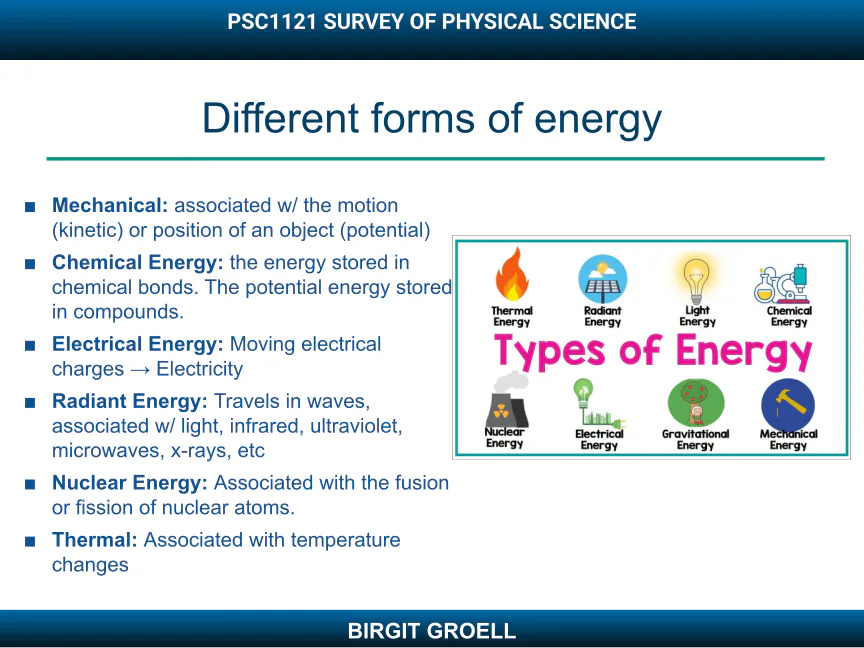
Select all forms of energy that are associated with the movement of particles or waves.
Thermal Energy
Radiant Energy
Chemical Energy
Mechanical Energy
46
47
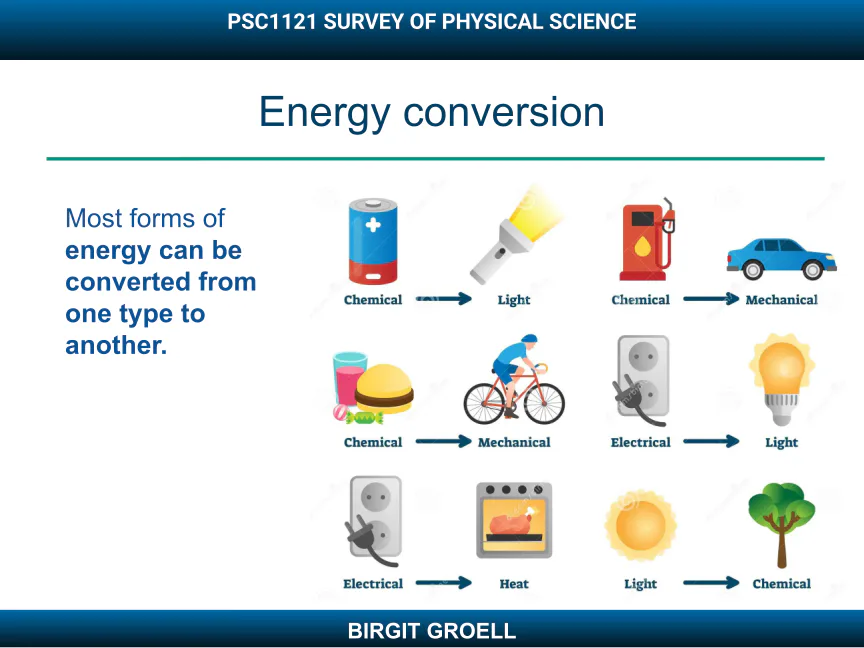
Open Ended
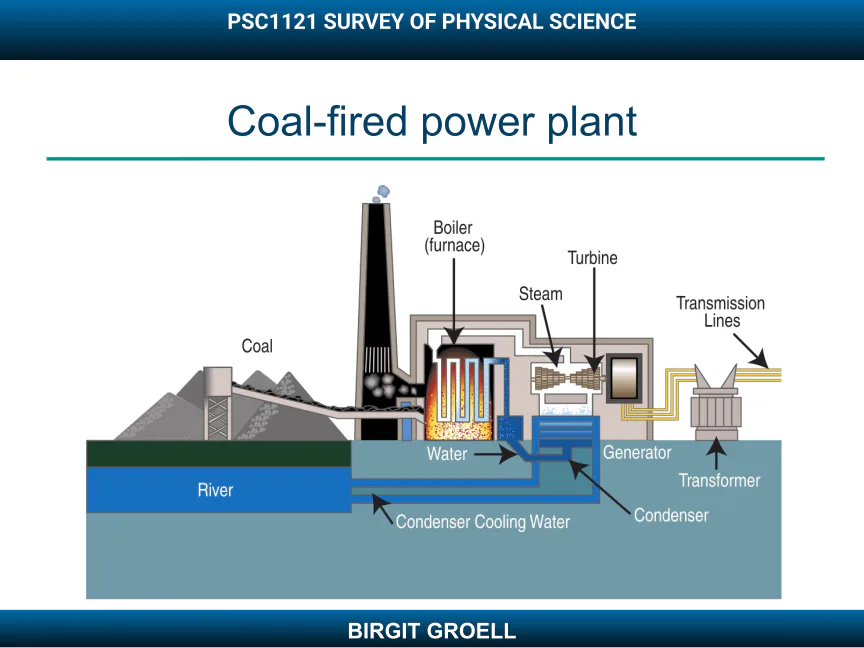
Describe a real-life example where energy is converted from one form to another, and explain the forms of energy involved in the process.
48
49
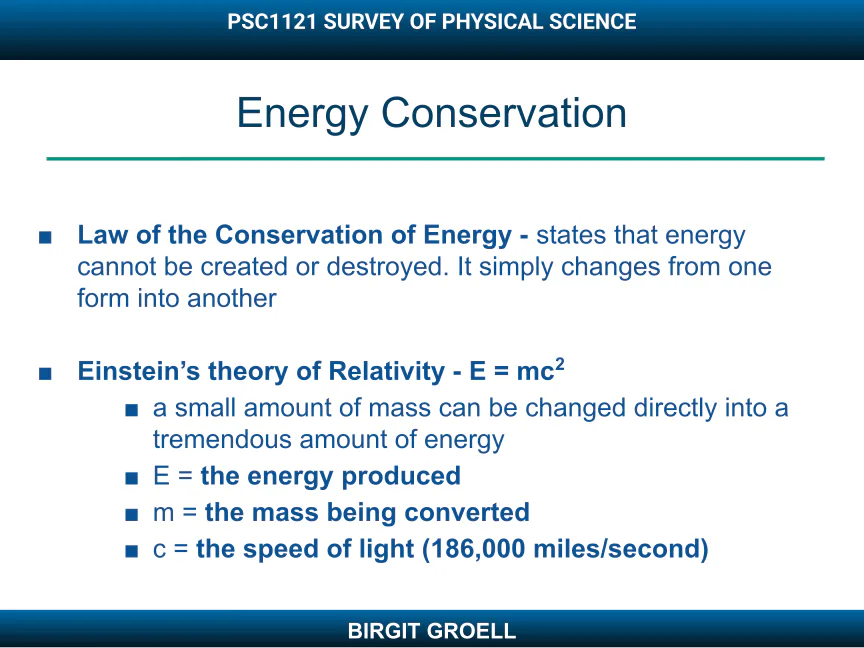
Fill in the Blanks
Fill in the blank: The law of conservation of energy states that energy cannot be created or
Type answer...
50
51
52
53
54
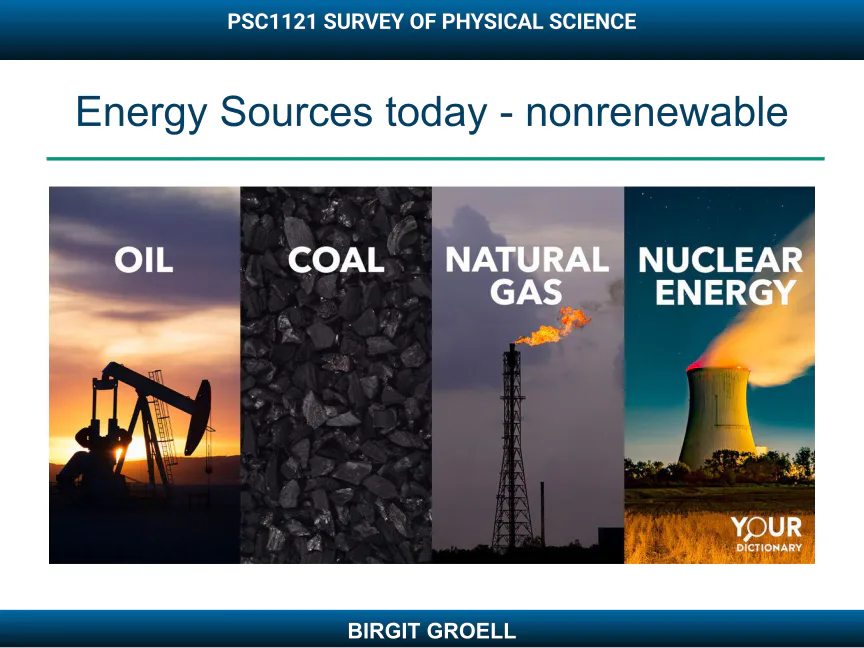
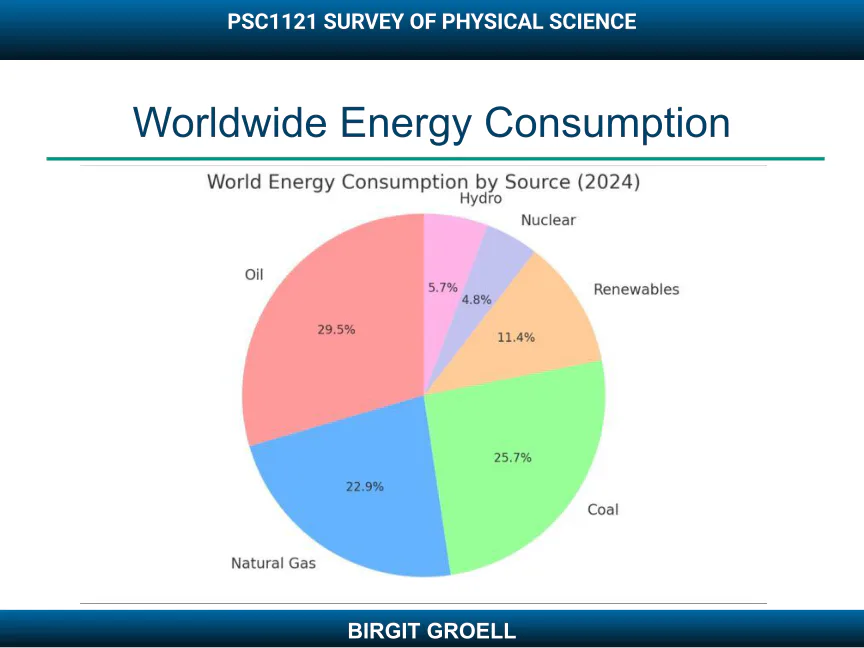
Open Ended
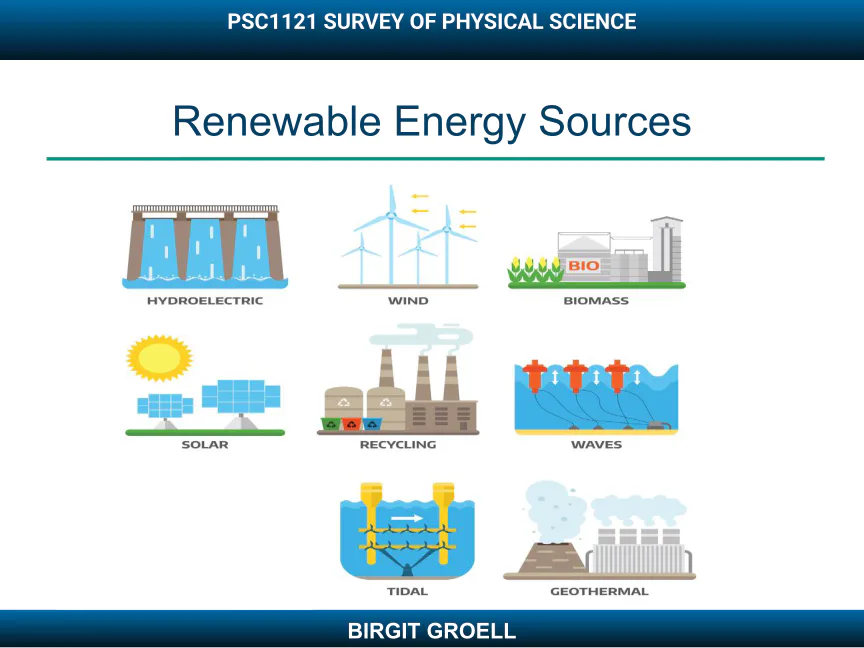
Name 3 renewable and 3 non-renewable energy sources.
Show answer
Auto Play
Slide 1 / 54
SLIDE
Similar Resources on Wayground

51 questions
Grade 7: Review for Mid-term (Intermediate class)
Presentation
•
12th Grade
53 questions
Cardiovascular System: Heart Anatomy
Presentation
•
11th Grade - University
48 questions
SEV4b land pollution prevention Lesson
Presentation
•
KG - University
47 questions
Earth Subsystem
Presentation
•
11th Grade
50 questions
Agroecology
Presentation
•
11th - 12th Grade
49 questions
Big Bang Theory
Presentation
•
11th - 12th Grade
48 questions
Functional Physical Science FINAL REVIEW
Presentation
•
KG - 12th Grade
48 questions
Genes to proteins
Presentation
•
12th Grade
Popular Resources on Wayground
10 questions
How much do you know about our Portrait of an Eagle?

Quiz
•
10th Grade
10 questions
Fast Food Slogans
Quiz
•
6th - 8th Grade
21 questions
Continents and Oceans
Quiz
•
6th Grade
20 questions
Parts of Speech
Quiz
•
5th Grade
16 questions
Subject & Predicate
Quiz
•
5th Grade
25 questions
Multiplication Facts
Quiz
•
5th Grade
12 questions
Map Skills
Quiz
•
3rd Grade
22 questions
Continents and Oceans
Quiz
•
5th Grade
Discover more resources for Science
22 questions
Periodic Table Review
Quiz
•
9th - 12th Grade
7 questions
Newton's Laws Video Quiz

Interactive video
•
9th - 12th Grade
17 questions
Unit 3A: Cells Vocab
Quiz
•
9th - 12th Grade
89 questions
Unit 1 (Ch 2 & 3) Test Review - Water/Ocean Currents
Quiz
•
9th - 12th Grade
58 questions
Biomolecule Test Corrections
Quiz
•
9th - 12th Grade
20 questions
Unit 2: Cell Energy Review
Quiz
•
9th - 12th Grade
17 questions
Explore Newton's Laws of Motion
Quiz
•
8th - 12th Grade
35 questions
Directional Terms, Body Cavities, Body Planes
Quiz
•
11th - 12th Grade