

Module 6 Lesson 3

Presentation
•
History
•
9th - 12th Grade
•
Medium

Amanda Tumacder
Used 2+ times
FREE Resource
22 Slides • 23 Questions
1

2

3
4

5

6

7

8

9

10

11

12

13

14

15

16

17

18

19

20

21

22
Multiple Choice
23
Multiple Choice
24
Multiple Choice
25
Multiple Choice
26
Multiple Choice
27
Multiple Choice
28
Multiple Choice
29
Multiple Choice
30

31
Multiple Choice

Resentment toward foreign influence in China led to the rise of secret societies, including the 'Righteous and Harmonious Fists,' known to Westerners as the Boxers. They sought to expel 'foreign devils' and Chinese Christians. In 1900, the Boxers launched a rebellion, killing hundreds of foreigners and surrounding the European section of Beijing.
--
What was the main goal of the Boxers during their rebellion in 1900?
32
Multiple Choice

Cuban nationalists, led by figures like José Martí, had fought for decades for 'Cuba Libre' (a free Cuba). While the Platt Amendment allowed the U.S. military to withdraw, many Cubans felt the amendment's terms were an insult to their sovereignty. The U.S. maintained that the amendment was necessary to protect Cuban independence from European powers.
--
What term best describes the relationship between the U.S. and Cuba after the Platt Amendment?
33
Multiple Choice

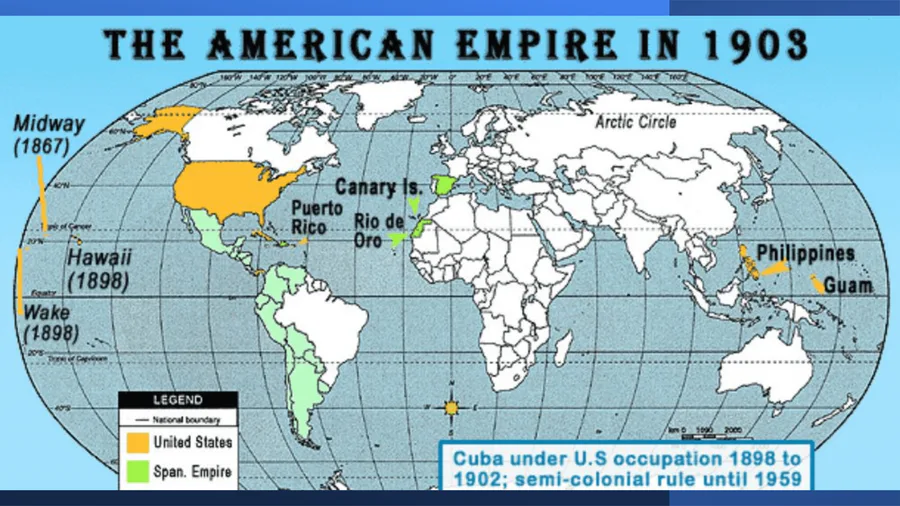
Following the Spanish-American War in 1898, the United States acquired several territories, including Puerto Rico. The transition from military rule to a civil government was established by the Foraker Act in 1900. This act gave the President of the United States the power to appoint Puerto Rico's governor and the members of the upper house of its legislature. Only the members of the lower house were elected by Puerto Rican voters. In 1901, the Supreme Court's 'Insular Cases' ruled that the Constitution did not automatically apply to people in acquired territories.
--
What was the primary purpose of the Foraker Act of 1900?
34
Multiple Choice

The Foraker Act of 1900 was a significant step in defining the relationship between the United States and its new Caribbean territory. While it allowed for a degree of local representation, it maintained strong federal control. The U.S. President held the authority to select the island's executive leadership. It wasn't until the Jones-Shafroth Act of 1917 that Puerto Ricans were granted U.S. citizenship and a more elective form of government.
--
Under the Foraker Act, which part of the Puerto Rican government was elected by the Puerto Rican people?
35
Multiple Choice

The Open Door Policy reflected three deeply held American beliefs about the industrial economy:
(1) that the growth of the U.S. economy depended on exports; (2) that the U.S. had a right to intervene abroad to keep foreign markets open; and (3) that the closing of an area to American products, citizens, or ideas threatened U.S. survival.
---
What were the 'spheres of influence' in China?ddd
36
Multiple Choice

The war ended in 1902, and the U.S. set up a government in the Philippines similar to the one in Puerto Rico. The Philippines would not achieve full independence until July 4, 1946. During the colonial period, the U.S. focused on internal improvements like education and infrastructure, but the suppression of the independence movement left a complex legacy.
--
When did the Philippines finally achieve full independence from the United States?
37
Multiple Choice

Although the United States had passed the Teller Amendment promising not to annex Cuba, it maintained significant influence over the island after the war. In 1901, the U.S. insisted that Cuba add the Platt Amendment to its new constitution. This amendment became a focal point of Cuban-American relations for decades.
--
Which of the following was a requirement of the Platt Amendment?
38
Multiple Choice

The Platt Amendment effectively turned Cuba into a U.S. protectorate—a country whose affairs are partially controlled by a stronger power. One of the most lasting impacts of the amendment was the provision allowing the United States to buy or lease land on the island for naval and refueling stations. This led to the establishment of a permanent base that remains today.
--
Which permanent U.S. military installation was established in Cuba as a result of the Platt Amendment?
39
Multiple Choice

John Hay's policy was not initially accepted by all powers, but none rejected it outright either. By 1900, the U.S. declared the policy in effect. This marked a significant shift in U.S. foreign policy, moving away from isolationism toward active intervention in global affairs to protect economic interests.
--
Who was the U.S. Secretary of State responsible for the Open Door notes?
40
Multiple Choice

After the Boxer Rebellion was crushed, the United States feared that European powers would use the event as an excuse to seize even more Chinese territory. Consequently, John Hay issued a second series of Open Door notes. This second set of notes emphasized that the U.S. would 'safeguard for the world the principle of equal and impartial trade with all parts of the Chinese Empire.'
--
Why did the U.S. issue a second set of Open Door notes after the Boxer Rebellion?
41
Multiple Choice

To put down the Boxer Rebellion, an international coalition was formed. Forces from Britain, France, Germany, Japan, and the United States marched on Beijing. Within two months, the international force put down the rebellion. Thousands of Chinese people died during the fighting.
--
How did the international community respond to the Boxer Rebellion?
42
Multiple Choice

The legal status of residents in the new American territories was complex. In the 'Insular Cases' of 1901, the Supreme Court addressed whether the 'Constitution follows the flag.' The court determined that rights were not automatically extended to all territorial subjects. This allowed the U.S. to govern Puerto Rico without providing all the constitutional protections enjoyed by citizens in the states.
--
According to the Supreme Court's ruling in the 'Insular Cases,' how did the U.S. Constitution apply to newly acquired territories?
43
Multiple Choice

By the late 19th century, China was weakened by internal conflict. European powers like France, Germany, Britain, and Russia, along with Japan, established 'spheres of influence'—areas where each nation claimed special rights and economic privileges. Fearing that American traders would be shut out, U.S. Secretary of State John Hay issued the Open Door notes in 1899.
--
What was the primary goal of the Open Door Policy proposed by John Hay?
44
Multiple Choice

n the Treaty of Paris, the U.S. purchased the Philippines from Spain for $20,000,000. Filipinos, led by Emilio Aguinaldo, were outraged as they expected independence. They rose in revolt in 1899, leading to the Philippine-American War. The conflict was much more costly and lethal than the Spanish-American War itself.
--
Why did Emilio Aguinaldo lead a rebellion against the United States forces in the Philippines?
45
Multiple Choice

The Philippine-American War lasted nearly three years and saw the U.S. employ controversial tactics, including the use of reconcentration camps similar to those the Spanish had used in Cuba. The war claimed the lives of approximately 4,000 Americans and over 20,000 Filipino combatants. Estimates of civilian deaths due to disease and famine during the conflict range as high as 200,000.
--
Which of the following is true regarding the Philippine-American War?
Show answer
Auto Play
Slide 1 / 45
SLIDE


