

Ch 2 Earth's Minerals

Presentation
•
Science
•
11th Grade
•
Hard

Leslie Staley
FREE Resource
37 Slides • 24 Questions
1

2
Multiple Choice
Why are minerals considered valuable resources in our daily lives?
Because they are rare and expensive
Because they are used in jewelry only
Because they are valuable resources for almost every aspect of our lives, including telling the history of Earth
Because they are only found in rocks
3

4
Open Ended
How does understanding the basic chemistry concepts of atoms, elements, ions, and molecules help us learn about minerals and their properties?
5

6
Multiple Choice
Which subatomic particle determines what element an atom is?
Proton
Neutron
Electron
Photon
7

8
Open Ended
Explain the difference between ionic, covalent, and hydrogen bonds, and provide an example of each type from everyday life.
9

10
Fill in the Blanks
Fill in the blank: An atom that has gained or lost one or more electrons is called an
Type answer...
11

12

13
14
Open Ended
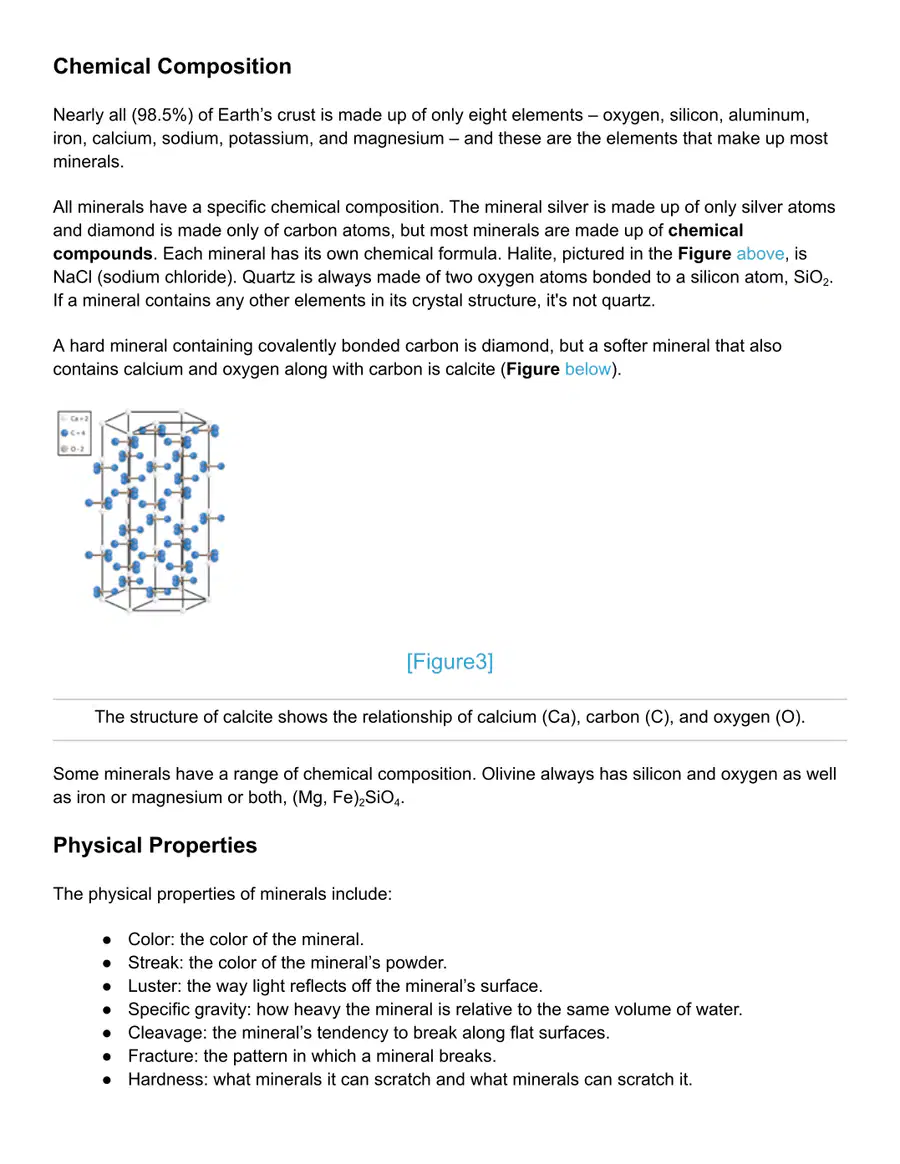
Why is glass not considered a mineral, even though it is made from minerals?
15
Multiple Select
Which of the following are characteristics that all minerals share?
They are inorganic
They have a crystalline structure
They are made by natural processes
All of the above
16

17
Multiple Choice
Which of the following is the basic building block for all silicate minerals?
Silica tetrahedron
Carbonate ion
Phosphate tetrahedron
Halide ion
18

19
Multiple Select
Which of the following statements about silicate minerals are correct?
They make up over 90% of Earth's crust.
Their basic building block is the silica tetrahedron.
They are the only minerals that contain oxygen.
Feldspar and quartz are common examples.
20
Fill in the Blanks
The most common carbonate mineral is
Type answer...
21
Multiple Select
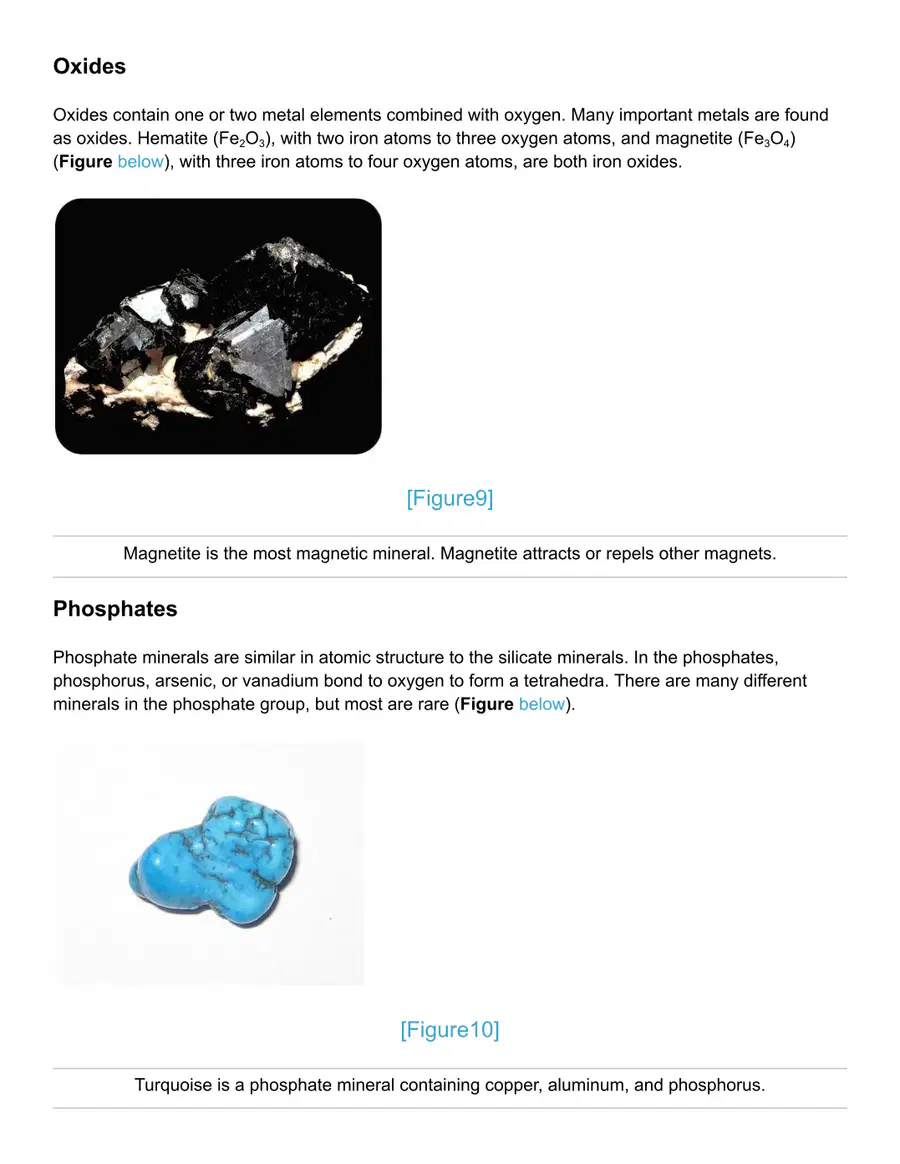
Which of the following minerals are examples of native elements?
Gold
Diamond
Calcite
Sulfur
22

23
24

25
Multiple Choice
Which mineral group contains sulfur atoms bonded to oxygen atoms and forms when salt water evaporates?
Sulfates
Sulfides
Oxides
Halides
26
27
28
Multiple Choice
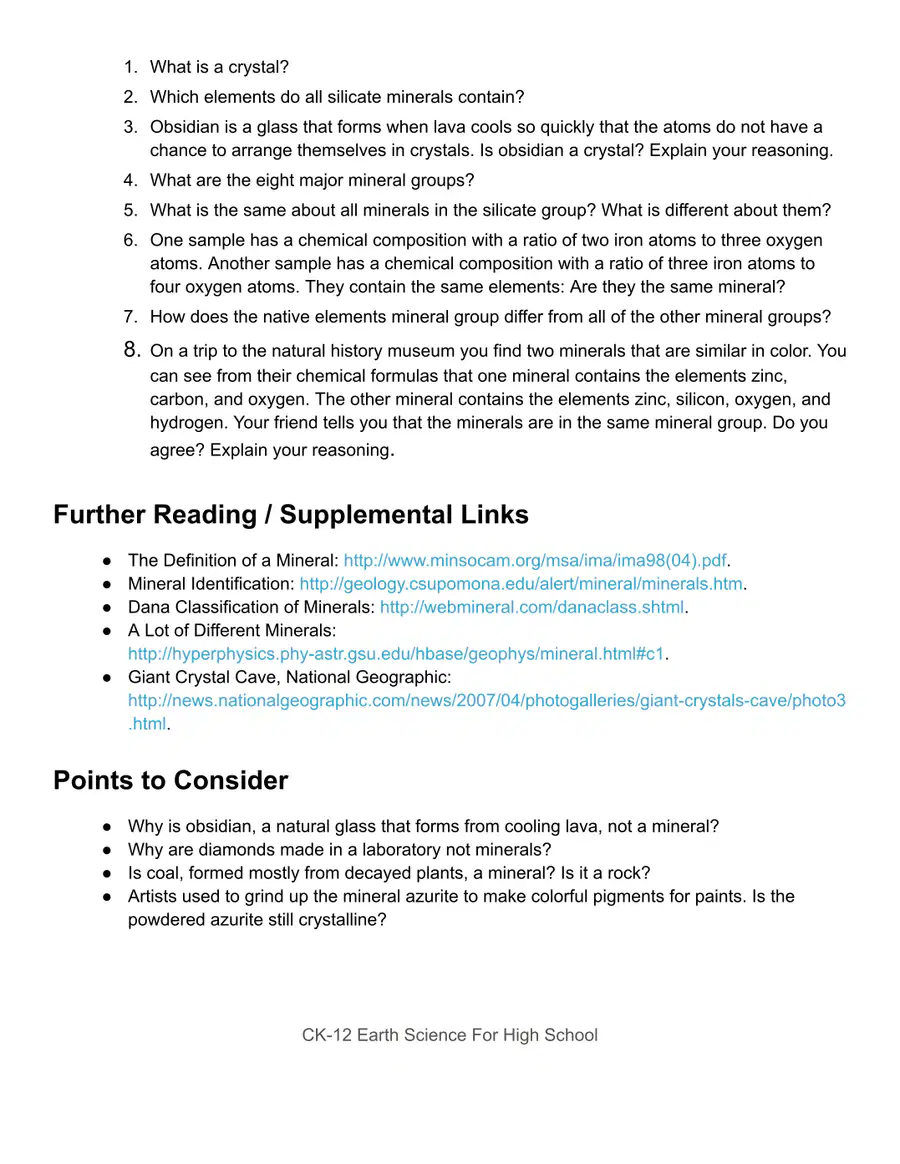
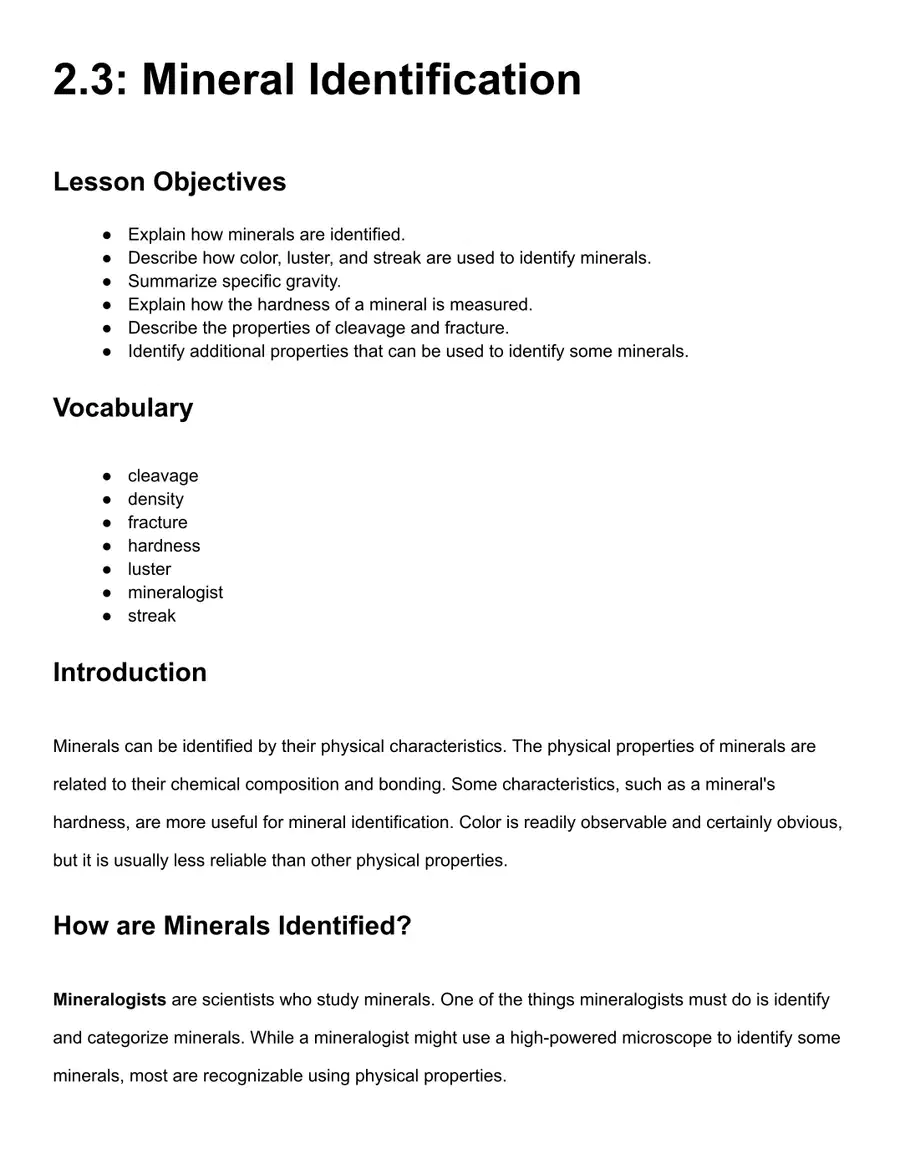
Which of the following physical properties is usually less reliable for mineral identification than others?
Color
Hardness
Luster
Streak
29
30

31
Open Ended
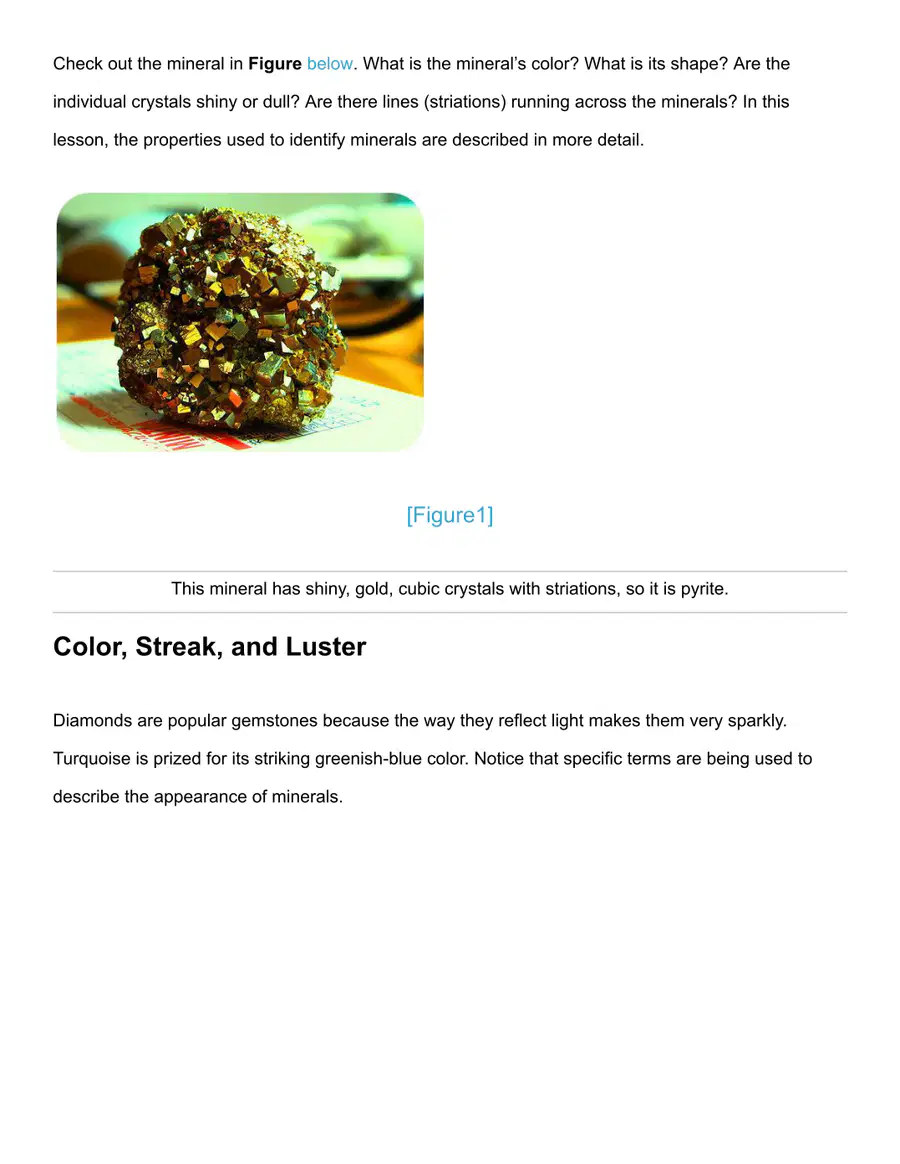
Explain why color alone is not a reliable property for identifying minerals, using examples from the images provided.
32

33
Multiple Choice
Which of the following statements about streak is correct?
Streak is the color of a mineral’s powder and is more reliable than color.
Streak is the same as the mineral's surface color.
All minerals have a streak.
Streak varies depending on the mineral's size.
34
Fill in the Blanks
Fill in the blank: The color of a mineral’s powder is called its
Type answer...
35
36

37
Multiple Select
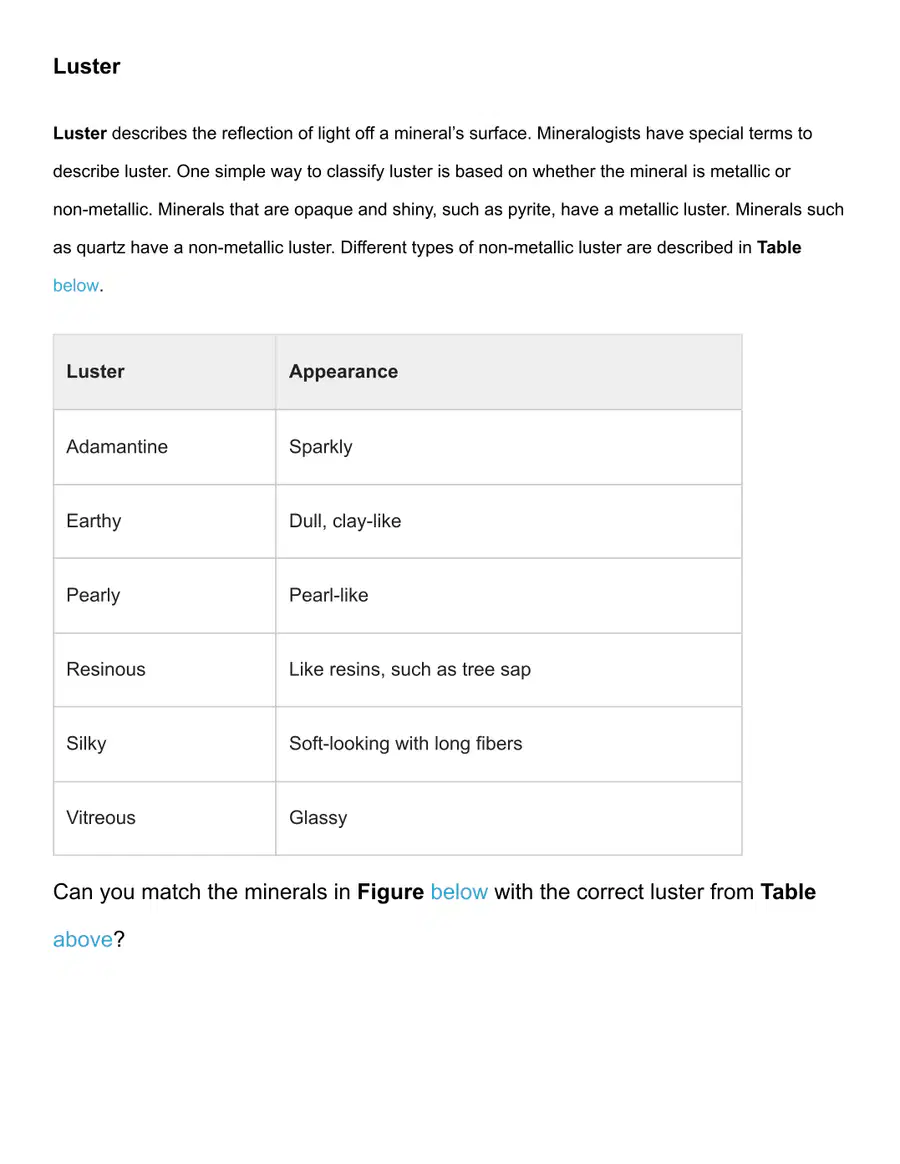
Select all the correct statements about specific gravity and density.
Density is mass divided by volume.
Gold is denser than pyrite.
Quartz has a higher density than gold.
Specific gravity compares a substance's density to that of water.
38

39
Multiple Select
Which of the following minerals have a hardness less than 5 on the Mohs Hardness Scale?
Gypsum
Calcite
Apatite
Quartz
40
Multiple Choice
Which mineral is the hardest according to the Mohs Hardness Scale?
Quartz
Diamond
Corundum
Topaz
41

42
Fill in the Blanks
Cleavage is the tendency of a mineral to break along certain planes to make
Type answer...
43

44

45
Open Ended
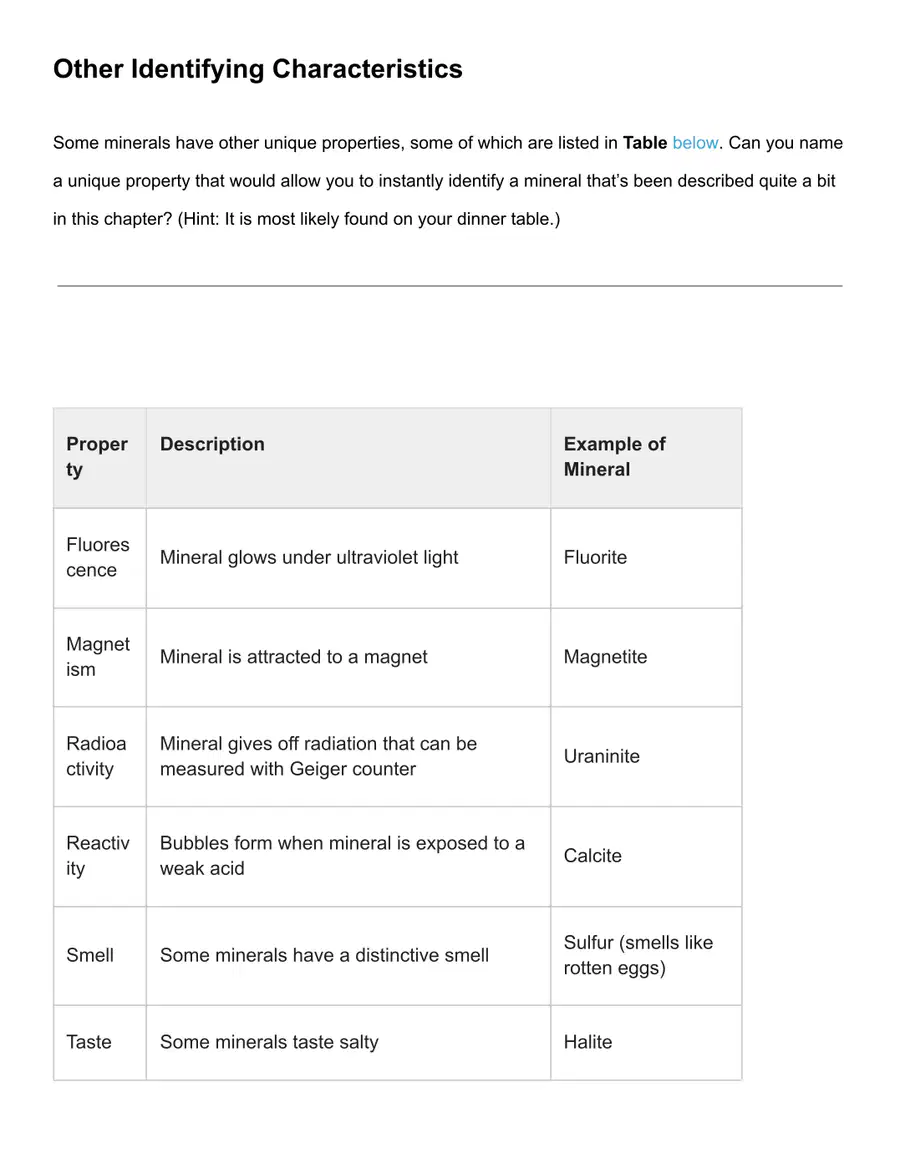
Describe the difference between cleavage and fracture in minerals, and give an example of each from the images.
46
47
Multiple Choice
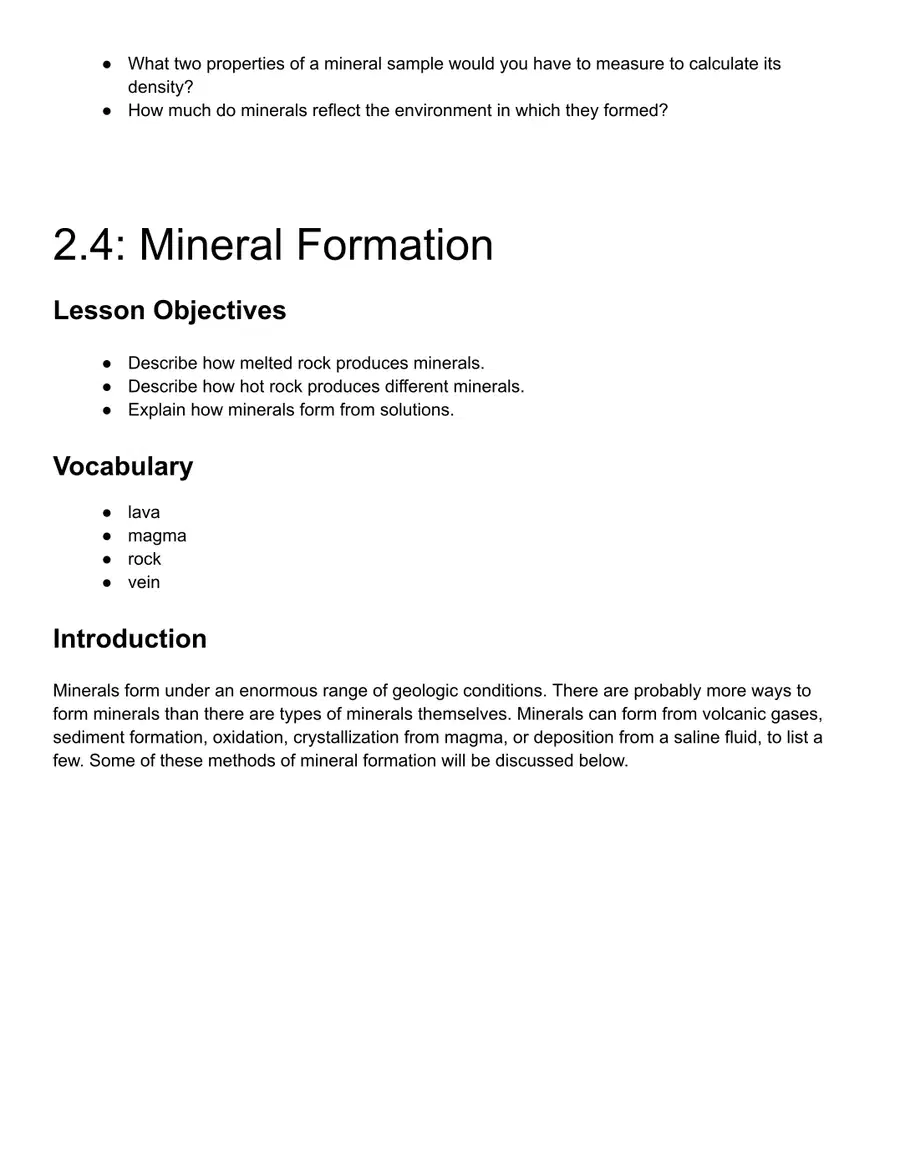
Which property would allow you to instantly identify halite among other minerals?
Fluorescence
Magnetism
Taste
Smell
48

49
50

51

52

53

54

55
56

57

58
59

60
Open Ended
After learning about Earth's minerals and the basics of matter, what questions do you still have about how minerals form or their properties?
61
Multiple Choice
What is the smallest unit of a chemical element that retains all the properties of that element?
Molecule
Atom
Ion
Nucleus
Show answer
Auto Play
Slide 1 / 61
SLIDE
Similar Resources on Wayground

50 questions
Endogenic Processes II - Earthquakes and Volcanoes
Presentation
•
11th Grade
54 questions
Sponges
Presentation
•
11th - 12th Grade
60 questions
How Hertz produced Radiowaves
Presentation
•
11th Grade
57 questions
1/3 Intro to Forensics FBISD Austin HS Forensics
Presentation
•
9th - 12th Grade
56 questions
GEOLOGIC TIME SCALE
Presentation
•
11th Grade
57 questions
บทเรียนเรื่องคาร์โบไฮเดรต
Presentation
•
11th Grade
56 questions
Microscope and Microscopy
Presentation
•
11th - 12th Grade
54 questions
Simple Harmonic Motion
Presentation
•
11th Grade
Popular Resources on Wayground
10 questions
Safety Day 2026 – Student Review

Quiz
•
9th Grade
21 questions
Continents and Oceans
Quiz
•
6th Grade
20 questions
Parts of Speech
Quiz
•
5th Grade
16 questions
Subject & Predicate
Quiz
•
5th Grade
25 questions
Multiplication Facts
Quiz
•
5th Grade
12 questions
Map Skills
Quiz
•
3rd Grade
22 questions
Continents and Oceans
Quiz
•
5th Grade
15 questions
Rounding Decimals
Quiz
•
5th Grade
Discover more resources for Science
14 questions
Periodic Trends

Interactive video
•
11th Grade
7 questions
Newton's Laws Video Quiz
Interactive video
•
9th - 12th Grade
35 questions
Cell Transport/Enzyme/Cell/Macro Review
Quiz
•
9th - 12th Grade
13 questions
Explore Enzyme Functions and Interactions
Quiz
•
9th - 12th Grade
10 questions
Fact or Fiction: Microbes
Quiz
•
9th - 12th Grade
10 questions
Understand Cell Functions and Organelles
Quiz
•
9th - 12th Grade
20 questions
BIOGEOCHEMICAL CYCLES
Quiz
•
10th - 11th Grade
19 questions
Explore Macromolecules in Living Organisms
Quiz
•
9th - 12th Grade