Search Header Logo
7.PS1-3-Topic 1-Particle Motin &  States of Matter

7.PS1-3-Topic 1-Particle Motin & States of Matter

Assessment

Presentation

•

Science

•

6th - 8th Grade

•

Hard

•
NGSS
MS-PS1-4, MS-PS1-1, 5-PS1-1

+4

Standards-aligned

Created by

Jessica Freeman

FREE Resource

29 Slides • 39 Questions

1

​7.PS1-3-Topic 1
Particle Motion in States of Matter

By Jessica Freeman

2

media

Explain how the motion and arrangement of particels differ in solids, liquids, and gases.

​

​Objective:

3

Multiple Choice

Which particle arrangement represents a gaseous state?

1
2
3

4

media
media
media
media

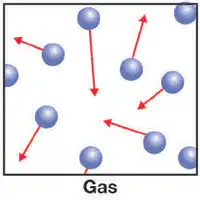
What Makes Gas … Gas?

• Has no fixed shape

• Has no fixed volume
• Made of particles that move rapidly

• The particles also have large spaces between them

in comparison to solids and liquids

5

media
media
media

Examples of Gases are

Steam


Oxygen

Carbon dioxide
Smog

Tear Gas

Helium

6

Draw

Draw an example of gas using particle arrangement.

7

media
media
media
media

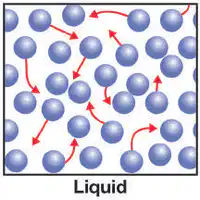
• Has no fixed shape


•Has a fixed volume

• Particles move past one another easily
• Particles are fairly close, but not in a neat

even arrangement as the particles in a solid
are

8

media

9

Draw

Draw an example of liquid using particle arrangement.

10

media
media
media
media

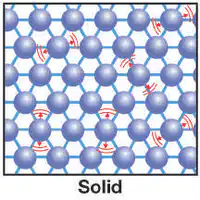
Solids

• Has a fixed shape

• Has a fixed volume

• Particles are arranged in a tight, regular pattern
• Particles move very little

11

Draw

Draw an example of solid using particle arrangement.

12

media

13

media

14

Particle motion in a solid

media

15

media

16

Multiple Choice

Question image

What type of solid contains particles that are jumbled and form no particular pattern?

1

Crystalline

2

Amorphous

3

High-density

4

Low-volume

17

media

18

Particle motion in a liquid

media

19

media

20

Particle motion in a gas.

media

21

media

22

Multiple Choice

What is the best way to describe particles in a gas?

1

Very energetic

2

Vibrating in place

3

Completely still

4

Closely packed

23

media

24

Multiple Choice

Which of the following depicts particles in a solid?

1
2
3

25

Multiple Choice

What is the three types of states of matter?

1

rocks, water, lava

2

Solids, Liquids, Gases

26

media

27

media

28

Multiple Select

When heat is added to the matter what happens to it?

1

They move slowly

2

They move faster

29

media

30

media

31

media

32

Open Ended

Give one example of a Solid, Liquid and a Gas.

33

Thermal Energy

Thermal energy (also called heat energy) is produced when a rise in temperature causes atoms and molecules to move faster and collide with each other.

The energy that comes from the temperature of the heated substance is called thermal energy.

34

media

35

media

36

media

37

Multiple Choice

Rank the states of matter from the least amount of energy to most amount of energy.

1

Liquid, gas, solid

2

Solid, liquid, gas

3

Solid, gas, liquid

4

Gas, liquid, solid

38

Multiple Choice

Question image

If you removed enough heat from the sample below, what would it change into?

1

Solid

2

Liquid

3

Gas

4

It would stay the same

39

Multiple Choice

What enables liquid water to take the shape of its container?

1

The molecules of liquid water are moving but still have enough attraction to one another.

2

The molecules of liquid water are held tightly together by intermolecular forces.

3

The molecules of liquid water are smaller than in any other phase.

4

The molecules of water move very fast and stay far away from each other.

40

media

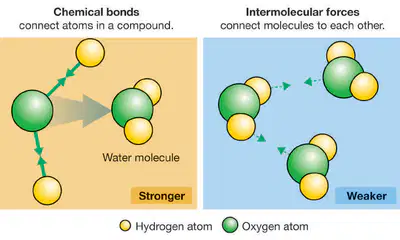
When they are close together, molecules are attracted through

intermolecular forces.
These forces are not as strong as the chemical bonds between atoms, but are strong enough to attach neighboring molecules to each other.

Intermolecular Forces

​They hold everything together

41

media
media
media
  • Hold their shape

  • Do not flow

  • Particles vibrate in place; don't move far

Solids

  • Hold their volume

  • Does flow

  • Particles are close together but have enough energy to move around freely

Liquids

  • Does not hold it's volume (can compress or expand)

  • Does flow

  • Particles have lots of energy and move around freely

Gases

42

Multiple Select

Which statements correctly describe the behavior of particles in liquids?

1

Particles in liquids can move more freely past each other.

2

Attractive forces in liquids are stronger than in solids.

3

Liquids take the shape of their container due to particle motion.

4

Particles in liquids are stuck in place.

43

Multiple Choice

Which of the following best describes the movement of particles in a solid?

1

Particles are stuck in place with very little to no movement.

2

Particles move freely and rapidly in all directions.

3

Particles can move past each other but are still attracted to one another.

4

Particles are widely spread and have no attractive forces.

44

Multiple Select

Question image

Select all that apply for Solids

1

Strongest Intermolecular Forces

2

Weakest Intermolecular Forces

3

Smallest Amount of Particle Movement

4

Most Amount of Particle Movement

45

Multiple Select

Question image

Select all that apply for Gases

1

Strongest Intermolecular Forces

2

Weakest Intermolecular Forces

3

Smallest Amount of Particle Movement

4

Most Amount of Particle Movement

46

Multiple Choice

What happens to molecules as you increase the temperature of a substance?

1

The molecules move Slower

2

The molecules undergo pentatonix

3

The molecules move faster

4

The atoms undergo transmutation

47

Multiple Choice

Question image

At higher temperatures

1

particles in an object have less kinetic energy

2

particles in an object move faster

3

a gas contracts

48

Multiple Choice

Thermal energy is...

1

heat energy

2

the energy of motion

3

energy of nuclear processes.

4

an indication of physical change.

49

Multiple Choice

Question image

Which state of matter has particles that are somewhat close together and have enouch kinetic energy to slide past each other?

1

solid

2

liquid

3

gas

50

Multiple Choice

______ is the amount of space an object takes up.
1
mass
2
volume

51

Multiple Choice

Which of the following states of matter has the LOWEST level of kinetic energy?

1

Solid

2

Liquid

3

Gas

4

Plasma

52

Multiple Choice

Which of the following is TRUE when particles GAIN Thermal Energy?
1
Particles move more slowly
2
Particles move further apart
3
Particles stop moving
4
Particles move closer together

53

Multiple Choice

Which of the following states of matter can easily be compressed?

1

Solid

2

Liquid

3

Gas

54

Multiple Choice

Which state of matter have the weakest intermolecular forces?

1

solid

2

liquid

3

gas

55

Multiple Choice

The state of matter with definite volume but no definite shape.
1
solid
2
liquid 
3
gas

56

Multiple Choice

"Kinetic" refers to

1

motion

2

heat

3

density

4

forces

57

Multiple Choice

The kinetic theory of matter states that all particles are constantly

1

growing

2

contracting

3

reacting

4

moving

58

Multiple Choice

When the temperature of matter increases the particles...
1
speed up and move closer
2
speed up and move farther apart
3
slow down and move closer together
4
slow down and move farther apart

59

Multiple Choice

Question image
What does this picture represent? 
1
solid
2
liquid
3
gas
4
plasma

60

Multiple Choice

Question image
If the tops were removed from the cylinders, the following would happen:
1
The solid would fly out of the container
2
The liquid would fly out of the container.
3
The gas would fly out of the container.
4
They ALL would fly out of the container.

61

Multiple Choice

Question image
The molecules in the picture are tightly held together with little movement. They have shape and energy.  Therefore, the picture represents _________.
1
solid
2
liquid
3
gas
4
plasma

62

Multiple Choice

What happens to the particles when I add heat?
1
The particles get bigger
2
The particles get smaller
3
The particles get slower
4
The particles get faster

63

Multiple Choice

Which of the following statements describes a gas?
1
It has a fixed volume
2
It becomes the volume of it's container

64

Multiple Choice

Which of the following statements describes a liquid?
1
It has a fixed volume
2
It becomes the volume of it's container

65

Multiple Choice

Which state of matter has the highest kinetic energy? 
1
solid
2
liquid 
3
gas
4
matter

66

Multiple Choice

All changes in the state of matter of a substance requires
1
vibration
2
water
3
permission
4
energy

67

Multiple Choice

Question image
At higher temperatures
1
particles in an object have less energy
2
particles in an object move faster
3
a gas contracts

68

Go to Mastery Connect: Complete Quiz 7.PS1-3_Particle Motion & States of Matter


pattern-tertiary
​7.PS1-3-Topic 1
Particle Motion in States of Matter

By Jessica Freeman

Show answer

Auto Play

Slide 1 / 68

SLIDE