

Solar System and Universe

Presentation
•
Science
•
6th - 8th Grade
•
Practice Problem
•
Medium
+1
Standards-aligned

Barbara White
Used 192+ times
FREE Resource
11 Slides • 13 Questions
1

Middle School
2
Define the parts of our solar system and the role of the Sun's gravity.
Differentiate between planets, moons, and smaller objects like asteroids and comets.
Compare the key features of the inner and outer planets.
Explain how the solar system formed about 4.6 billion years ago.


3
Key Vocabulary
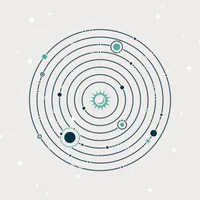
Solar System
The solar system includes the sun, planets, their moons, and other smaller objects orbiting the sun.
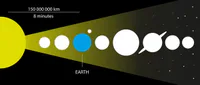
Astronomical Unit (AU)
An astronomical unit is the average distance from the center of our Earth to the sun.
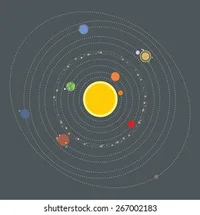
Planet
A planet is a large, round body that orbits the sun and has cleared its orbital path.
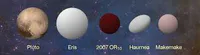
Dwarf Planet
A dwarf planet orbits the sun and is spherical, but has not cleared its orbital path.
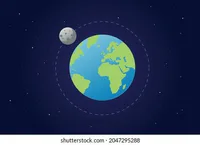
Natural Satellite
A natural satellite, also known as a moon, is a celestial body in a stable orbit around a planet.
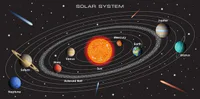
Asteroids
Asteroids are small, rocky bodies that orbit the sun, often in a belt between Mars and Jupiter.
4
Key Vocabulary
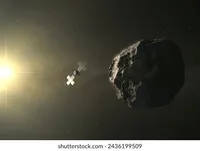
Meteoroid
A chunk of rock or dust in space that is smaller than an asteroid and orbits the sun.
Meteorite
A meteoroid that survives its journey through the atmosphere and successfully lands on the Earth's surface.
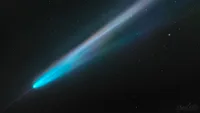
Comet
A loose ball of ice and rock that has a very long, narrow orbit around the sun.
5
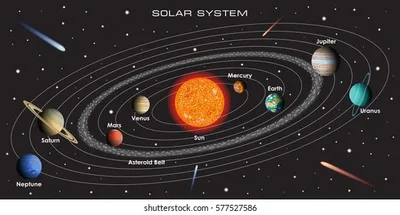
Our Solar System
The solar system includes the Sun, planets, moons, asteroids, and comets.
The Sun is at the center, and its gravity keeps everything in orbit.
Gravitational pull is stronger with more mass and weaker with more distance.
An astronomical unit (AU) is used to measure vast distances in space.
6
Multiple Choice
What is the primary force responsible for keeping planets, moons, and asteroids in orbit around the Sun?
The planets' speed
The Sun's light
The vacuum of space
The Sun's gravity
7
Multiple Choice
Which of the following changes would cause the Sun's gravitational pull on a planet to become stronger?
The planet begins to spin faster.
The planet moves farther away from the Sun.
The planet's mass increases.
The planet develops more moons.
8
Multiple Choice
Why is it important to use both astronomical units (AU) and include objects like comets and asteroids when describing the solar system?
To make the solar system seem smaller and simpler.
To focus only on the objects that have moons.
To accurately represent the system's vast scale and all its components.
To show that only planets are affected by gravity.
9
The Sun and the Planets
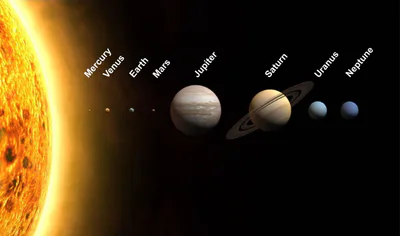
The Sun is a star containing 99.85% of our solar system’s total mass.
A planet is a round object that orbits the Sun in a clear path.
The four inner planets are small and are made mostly of rock and metal.
The four outer planets are very large and made mostly of gas and liquid.
10
Multiple Choice
What is the main characteristic used to classify planets as either inner or outer planets?
The color of their surface
The materials they are made of
Their size and mass
Their distance from the Sun
11
Multiple Choice
Which statement accurately compares the general characteristics of inner and outer planets?
Both inner and outer planets are small and rocky.
Inner planets are large and gaseous, while outer planets are small and rocky.
Inner planets are small and rocky, while outer planets are large and gaseous.
Both inner and outer planets are large and gaseous.
12
Multiple Choice
A scientist discovers a new planet that is very large and composed mostly of hydrogen gas. Where is this planet most likely to be located?
It could be anywhere, as size and composition do not relate to location.
In a region far from the Sun, with the other gas giants.
In a position closest to the Sun, with the other rocky planets.
In an orbit between Earth and the Sun.
13
Dwarf Planets and Moons
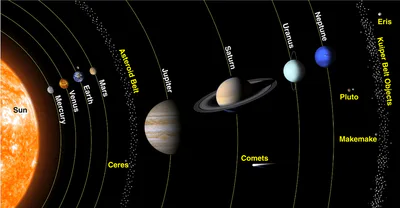
A dwarf planet orbits the Sun and is spherical, but has not cleared its orbit.
There are five known dwarf planets: Pluto, Eris, Ceres, Makemake, and Haumea.
A moon is a natural satellite that orbits a planet, held by the planet's gravity.
Asteroids and Comets
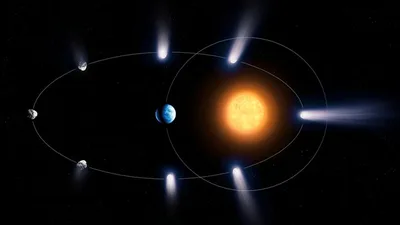
Asteroids are small, rocky bodies found in the asteroid belt between Mars and Jupiter.
Comets are loose balls of ice and rock with very long, narrow orbits.
They develop tails of gas and dust when they get closer to the Sun.
14
Multiple Choice
What is the key characteristic that defines a dwarf planet?
It is a natural satellite that orbits a planet.
It is a small, rocky body found between Mars and Jupiter.
It is a loose ball of ice and rock with a long orbit.
It has not cleared other objects from its orbit.
15
Multiple Choice
What is the primary difference between a moon and an asteroid as described in the text?
A moon is made of rock, while an asteroid is made of ice.
A moon is always spherical, while an asteroid has a long, narrow orbit.
A moon orbits a planet, while an asteroid is found in a belt between planets.
A moon develops a tail near the Sun, while an asteroid does not.
16
Multiple Choice
A celestial body made of ice and rock is tracked moving from the outer solar system. What would you predict will happen as it gets closer to the Sun?
It will become spherical and be classified as a dwarf planet.
It will be pulled into orbit around the nearest planet.
It will begin to develop a tail of gas and dust.
It will break apart into many smaller asteroids.
17
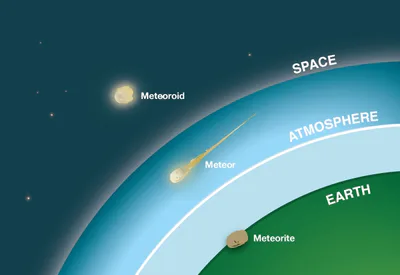
Meteoroids are small chunks of rock or dust traveling through space, often smaller than asteroids.
When a meteoroid enters Earth's atmosphere, it burns up, creating a streak of light called a meteor.
If a piece of the meteoroid survives and lands on the ground, it is then called a meteorite.
18
1. The solar system formed about 4.6 billion years ago from a cloud of gas, dust, rock, and ice.
2. Gravity pulled this material into a spinning disk, and the hot, dense center eventually formed the Sun.
3. The remaining particles of rock and ice slowly clumped together over time to form the planets.
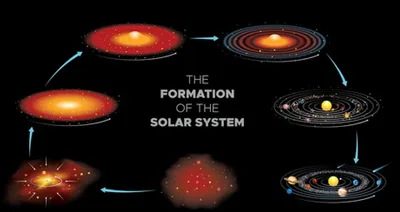
Solar System Formation
19
Multiple Choice
If a small chunk of rock from space survives its journey through the atmosphere and lands on Earth's surface, what is it called?
An asteroid
A meteor
A meteoroid
A meteorite
20
Multiple Choice
According to the description of how the solar system formed, what caused the initial cloud of gas, dust, and rock to form a spinning disk?
The pull of gravity
The heat from the newly formed Sun
The speed of the moving particles
The clumping of rocks and ice
21
Multiple Choice
What does the existence of meteoroids, which are small chunks of rock and dust, suggest about the formation of the solar system?
That they are leftover materials from when the planets formed
That the solar system is still expanding outward
That planets are slowly breaking apart into dust
That they are pieces that have broken off from the Sun
22
Misconception | Correction |
|---|---|
The Sun is a solid, burning ball of fire. | The Sun is hot gas that makes energy through nuclear fusion. |
Pluto was 'demoted' because it is too small. | Pluto is a dwarf planet because it has not cleared its orbital path. |
Meteors are 'shooting stars'. | Meteors are space rocks burning up in Earth’s atmosphere. |
23
Our solar system is a sun-centered system held together by gravity.
Inner planets are rocky and small, while outer planets are large and gaseous.
Planets are defined by being spherical and having a clear orbital path.
Dwarf planets, asteroids, comets, and meteoroids are other objects orbiting the Sun.
24
Poll
On a scale of 1-4, how confident are you about the concepts covered in today's review?
1
2
3
4
Middle School
Show answer
Auto Play
Slide 1 / 24
SLIDE
Similar Resources on Wayground

19 questions
Scientific Method
Presentation
•
6th - 8th Grade
18 questions
Photosynthesis and Cellular Respiration
Presentation
•
6th - 8th Grade
18 questions
Energy
Presentation
•
6th - 8th Grade
20 questions
Waves and Wave Properties
Presentation
•
6th - 8th Grade
18 questions
Energy and Its Transformations
Presentation
•
6th - 8th Grade
18 questions
Conduction, Convection, and Radiation
Presentation
•
6th - 8th Grade
18 questions
Gravity and the solar system
Presentation
•
6th - 8th Grade
19 questions
Gravity In Our Solar System 2: Orbital Speeds
Presentation
•
6th - 8th Grade
Popular Resources on Wayground
10 questions
Safety Day 2026 – Student Review

Quiz
•
9th Grade
21 questions
Continents and Oceans
Quiz
•
6th Grade
20 questions
Parts of Speech
Quiz
•
5th Grade
16 questions
Subject & Predicate
Quiz
•
5th Grade
25 questions
Multiplication Facts
Quiz
•
5th Grade
12 questions
Map Skills
Quiz
•
3rd Grade
22 questions
Continents and Oceans
Quiz
•
5th Grade
15 questions
Rounding Decimals
Quiz
•
5th Grade
Discover more resources for Science
20 questions
Newton's Laws of Motion
Quiz
•
8th Grade
20 questions
Elements, compounds, and mixtures
Quiz
•
6th Grade
10 questions
6.6D - Relative Density Review
Quiz
•
6th Grade
15 questions
potential and kinetic energy
Quiz
•
8th Grade
21 questions
Newton's Laws of Motion
Quiz
•
8th Grade
20 questions
Elements, Compounds and Mixtures
Quiz
•
8th Grade
10 questions
Exploring Chemical and Physical Changes

Interactive video
•
6th - 10th Grade
20 questions
CONDUCTION,CONVECTION AND RADIATION
Quiz
•
6th Grade