

SSUSH11 and SSUSH12

Presentation
•
Social Studies
•
9th - 12th Grade
•
Easy

Kimberly Bryant
Used 1+ times
FREE Resource
53 Slides • 28 Questions
1
By Kimberly Bryant
2
Open Ended

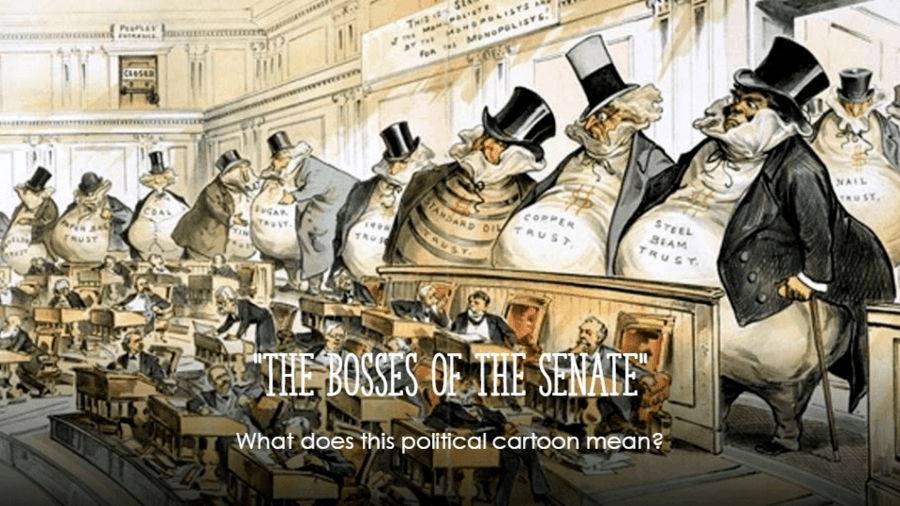
Big business cartoons from the late 19th and early 20th centuries use symbolism to critique corporate power. What does this cartoon suggest about Big Business? Use complete sentences.
3
Multiple Choice
What is a corporation?
the freedom to run a business
policies that allow businesses to operate under minimal government regulation
the freedom to run a business for profit with minimal regulation beyond what's necessary
a number of people share ownership of a business
4


5

6
Multiple Choice

John D. Rockefeller was a(n)
railroad tycoon
steel tycoon
oil tycoon
politician
7

8
Multiple Choice

Andrew Carnegie was a(n)
railroad tycoon
steel tycoon
oil tycoon
politician
9

10
Multiple Choice

What is a monopoly?
businesses making the same product agree to limit their production to keep their prices high
complete control of a product or service
a company either bought its competitors or drove them out of business
companies assigned their stock to a board of trustees who combined them into a new organization
11

12
Multiple Choice

What is a trust?
businesses making the same product agree to limit their production to keep their prices high
complete control of a product or service
a company either bought its competitors or drove them out of business
companies assigned their stock to a board of trustees who combined them into a new organization
13
Multiple Choice

Who were key entrepreneurs that built vast corporations changing the business landscape in the early 20th century?
Andrew Carnegie and J.D. Rockefeller
Henry Ford and Thomas Edison
Nikola Tesla and George Westinghouse
Alexander Graham Bell and Samuel Morse
14
Multiple Choice

What allowed big businesses to control production and prices in the market?
Globalization
Forming trusts and monopolies
Social media marketing
E-commerce
15

16
Multiple Choice

17
Alexander Graham Bell was born on March 3, 1847 and died on August 2, 1922 in Scotland. He became an American citizen in 1882. He was also a Canadian citizen.
He worked with the Deaf and Hard of Hearing population.
Invents the telephone in 1876

18
Multiple Choice

What did he invent?
the telephone
the television
the typewriter
19
Multiple Choice

THINK: What technological advancements supported twenty-four hour factory operation?
Renewable energy sources
Internet and digital platforms
New technologies for instant communication
Artificial intelligence
20
Thomas Edison invents the incandescent light bulb (1879)
Edison did NOT invent the light bulb
His version was the first that was ready for home use

21
Multiple Choice

22
Multiple Choice
Which of the following is NOT an important technological development of the 19th century?
telegraph
telephone
motion picture camera
television
23
24

While push factors push people from their homes, pull factors pull people to new locations.
Pull factors are the reasons that attract people to a new place, almost like they "pull" them in. Some examples include:
Job Opportunities: A place with lots of jobs can attract people looking for work.
Safety and Stability: Areas that are peaceful and safe often draw people in.
Better Education: Good schools and universities can pull families to a new area.
Family and Friends: If someone has relatives or friends in a place, they might move there to be closer to them.
Why do People Move?
25

Lesson: Immigrating to the US
10/46
26
Categorize
Lack of (No) jobs
Religious Freedom
Better Schools
War
Poverty (No Money)
Job Opportunities
Better Medical Care
Famine (No Food)
Natural Disaster
Better Environment
Drag the push and pull factors into the appropriate columns.
27

From 1880 to 1920 over 20 million people immigrated to the US. These people emigrated from many countries, including Italy, Greece, Poland and Russia.
They arrived on large, fast, steam-powered ships.
European Immigrants
28

Once in the United States, new arrivals were processed through government-run immigration centers.
The busiest center on the East Coast was Ellis Island, which opened in New York Harbor in 1892. Over the next 40 years, millions of European immigrants came through Ellis Island. It’s estimated that 40% of all current US citizens have an ancestor who passed through Ellis Island in New York Harbor. Many immigrants at this time came from Russia and eastern Europe, escaping war, drought, famine and religious persecution. Many families left Russia due to violent attacks against the Jews known as pogroms.
European Immigrants

29
30

Immigrants traveled to the U.S. by ship, often taking long and difficult journeys. Once they arrived, they saw the Statue of Liberty, which symbolized hope and new beginnings.
When they arrived at Ellis Island, immigrants stepped off the ship and into a large hall called the "Great Hall." This is where the processing began.
First, everyone went through a quick medical inspection. Doctors looked for any signs of illness. If someone was sick, they might be sent to the hospital or, in some cases, sent back home.
Ellis Island Experience
31

After the physical examination came the Legal examination. Immigration inspectors would ask each immigrant’s name. If the official wasn’t sure how to spell a name, he would give the immigrant a simpler, more English sounding name. For example, the name Wallenchinsky might be written down as “Wallace.”
There were other questions, too: Where are you from? Any relatives in America? Why are you coming? Where will you live? Do you have a
job waiting for you?
Ellis Island Experience
32
33
Multiple Choice
What was Ellis Island primarily used for?
34
Fill in the Blanks
Ellis Island, in New York Harbor, mostly served immigrants from
35
Multiple Choice
What symbol did many immigrants see as they arrived in New York Harbor?
36
Multiple Select
What were TWO common reasons for immigrants to be denied entry at Ellis Island?
Illness
Criminal Records
37
38
39
At the same time that European were arriving on the East Coast, thousands of Asians were arriving on the West Coast of the United States.
The majority of these Asian immigrants were Chinese.
Other countries in Asia, primarily Japan and the Philippines, also sent immigrants to America
Chinese Immigrants

40

Most came to escape problems similar to those facing European emigrants-famine, overpopulation, civil warfare. (Push Factors)
They were also lured by fantastic tales of the “mountain of Gold” that had been discovered in California. (Pull Factor)
Push/Pull Factors
41

After traveling for three weeks aboard crowded ships, Chinese immigrants wanted nothing more than to start their new lives in America.
Unfortunately, one thing stood in their way - Immigration officers.
Often immigrants would be detained for months at Angel Island, waiting to see if they would be admitted or sent back to China.
Asian Experience
42

While waiting, some immigrants expressed their feelings through poetry. They carved poems into the walls of their barracks, sharing their hopes, fears, and experiences. These poems are important historical artifacts that tell the story of their struggles.
Today, Angel Island is a state park and a historical site. It honors the stories of those who passed through, helping us understand the experiences of immigrants in America.
43
Multiple Choice
What was the primary purpose of Angel Island?
44

45
Multiple Choice
“Be it enacted by the Senate and House of Representatives of the United States of America in Congress assembled, That from and after the expiration of ninety days next after the passage of this act, and until the expiration of ten years next after the passage of this act, the coming of Chinese laborers to the United States be… suspended; and during such suspension it shall not be lawful for any Chinese laborer to come, or having so come after the expiration of said ninety days to remain within the United States.
SEC. 2. That the master of any vessel who shall knowingly bring within the United States on such vessel, and land or permit to be landed, any Chinese laborer, from any foreign port or place, shall be deemed guilty of a misdemeanor, and on conviction thereof shall be punished by a fine of not more than five hundred dollars for each and every such Chinese laborer so brought, and maybe also imprisoned for a term not exceeding one year….
SEC. 14. That hereafter no State court or court of the United States shall admit Chinese to citizenship; and all laws in conflict with this act are hereby repealed.
SEC.15. That the words "Chinese laborers", wherever used in this act shall be construed to mean both skilled and unskilled laborers and Chinese employed in mining.”
―Forty-Seventh U.S. Congress, Chinese Exclusion Act, 1882
The above legislation was a direct development of which of the following?
A desire to balance the numbers of ethnicities immigrating into the US
The end of an era of railroad construction leading large numbers of unemployed Chinese workers to spread across the nation
A rapid growth in Chinese immigrant population
Political pressure arising from strong anti-Chinese nativist sentiments in the West
46

47

48
49
Multiple Choice

What's the main idea of this political cartoon?
Big business was not powerful enough.
Big business had too much control over elected leaders.
Big business can better serve the American people than the Senate.
50

51

52
Multiple Choice
“Of every thousand dollars spent in so-called charity today, it is probable that nine hundred and fifty dollars is unwisely spent.…The best means of benefiting the community is to place within its reach the ladders upon which the aspiring can rise—free libraries, parks, and means of recreation, by which men are helped in body and mind.…The laws of accumulation will be left free, the laws of distribution free. Individualism will continue, but the millionaire will be but a trustee for the poor.…The best minds will thus have reached a stage in the development of the race in which it is clearly seen there is no mode of disposing of surplus wealth creditable to thoughtful and earnest men into whose hands it flows, save by using it year by year for the general good.”
―Andrew Carnegie, “The Gospel of Wealth,” 1889
The view of the poor in the quote above is most consistent with the ideology of
Social Gospel
Populist Party
Social Darwinism
Utopianism
53

54

55

56

57

58

59

60

61

62

63
Multiple Choice
What was the main reason labor unions emerged in the United States?
To promote global trade
To address the nation's growing labor concerns
To support technological innovation
To increase worker salaries to match CEOs
64
Multiple Choice
Which of the following is an important tactic used by labor unions?
strike
suppressing protest
ending collective bargaining
65

66

67

68

69

70

71
Multiple Choice
Who did NOT build the railroads?
Irish Immigrants
Chinese Immigrants
Ellis Island Immigrants
72

73

74

75

76

77

78
Multiple Choice
What was the effect of the Wounded Knee Massacre?
fueled more armed resistance from Native Americans
end of armed Native American resistance
additional battles with Plains Indians in the west
Native groups were enthusiastic to assimilate and abandon aspect of culture
79

80
Multiple Choice
What made the expansion of railroads possible?
The mass production of steel rails
The development of electric trains
The discovery of coal mines
The invention of the steam engine
81
Multiple Choice
What was the biggest customer of the steel industry?
Railroad companies
Shipbuilding industries
Construction companies
Automobile manufacturers
By Kimberly Bryant
Show answer
Auto Play
Slide 1 / 81
SLIDE
Similar Resources on Wayground

75 questions
grading TSI essays
Presentation
•
9th - 12th Grade
75 questions
TGAT ENG GUIDELINE
Presentation
•
9th - 12th Grade
79 questions
The Civil War
Presentation
•
11th Grade
74 questions
MATERI HARI AKHIR
Presentation
•
9th - 12th Grade
74 questions
EOC Review: Exponentials
Presentation
•
9th - 12th Grade
76 questions
Bio EOC - Cell Review (Pro-vs-Euk & Organelles) w/review Q's
Presentation
•
9th - 12th Grade
75 questions
Impact did Neo-Confucianism have on Ming and Qing China
Presentation
•
9th - 12th Grade
75 questions
Unit 1 Test Review - Piecewise Functions
Presentation
•
KG
Popular Resources on Wayground
10 questions
Safety Day 2026 – Student Review

Quiz
•
9th Grade
21 questions
Continents and Oceans
Quiz
•
6th Grade
20 questions
Parts of Speech
Quiz
•
5th Grade
16 questions
Subject & Predicate
Quiz
•
5th Grade
25 questions
Multiplication Facts
Quiz
•
5th Grade
12 questions
Map Skills
Quiz
•
3rd Grade
22 questions
Continents and Oceans
Quiz
•
5th Grade
15 questions
Rounding Decimals
Quiz
•
5th Grade
Discover more resources for Social Studies
10 questions
Exploring the Age of Exploration: Key Events and Figures

Interactive video
•
6th - 10th Grade
9 questions
Exploring Ancient Mesopotamia and Its Civilizations
Interactive video
•
10th Grade
20 questions
Chapter 8 Test "Types of Business Organizations"
Quiz
•
12th Grade
39 questions
Unit 7 Key Terms
Quiz
•
11th Grade - University
10 questions
Debating the Legacy of Christopher Columbus
Interactive video
•
6th - 10th Grade
38 questions
Unit 6 Key Terms
Quiz
•
11th Grade - University
27 questions
World Geography - Q1 9week Test
Quiz
•
9th Grade
22 questions
U3T2 Vocab FAC: Domestic Policy
Quiz
•
10th Grade