

B13 Variation

Presentation
•
Chemistry
•
7th - 10th Grade
•
Easy

Samantha Argent
Used 1+ times
FREE Resource
13 Slides • 20 Questions
1
B13 Variation
By Samantha Argent
Please log in and use your actual names:
Top most accurate = 3 HP (and a lil treat bought in next week)
2nd = 2 HP
3rd = HP
2
Variation
Children generally look a little like their mother and their father, but are not identical to either. They inherit their features from each parent's DNA.
Examples of genetic variation in humans include blood group, skin colour and natural eye colour.
Whether you have lobed or lobeless ears is due to genetic causes.

3
Multiple Choice

The genetic difference between individuals in the same species is
Interesting
Harmful
Variation
Genetics
4
Environmental Variation
Characteristics of animal and plant species can be affected by factors such as climate, diet, accidents, culture and lifestyle. For example, if you eat too much you will become heavier, and if you eat too little you will become lighter. A plant in the shade of a big tree will grow taller to reach more light.
Other examples of features that show environmental variation include:
scars
language and accent
flower colour in hydrangeas as these plants produce blue flowers in acidic soil and pink flowers in alkaline soil
5
Genetic and environmental causes together
Some features vary because of a combination of genetic and environmental causes. For example, tall parents will pass genes to their children for height. Their children have the genetic potential to also be tall. However, if their diet is poor then they will not grow very well: their environment also has an impact on their height.
6
Multiple Choice
What is a mutation?
Change that helps a living thing survive in its environment
Change in DNA structure
Natural differences in traits (like color)
7
Multiple Choice
What is an adaptation?
Change that helps a living thing survive in its environment
Change in DNA structure
Natural differences in traits (like color)
8
Multiple Choice

What is this?
Variation
Adaptation
Mutation
9
Mutation and variation
Extensive genetic variation is contained within any species. This is clearly visible in the domestic dog species.
Variation within genes leads to different genotypes, and this can be seen by a different phenotype. Genetic and environmental variation combine together to produce these different phenotypes. All variants arise from mutations and most have no effect on the phenotype.
A mutation is a change in a gene or chromosome. Mutations arise spontaneously and happen continually.
10
Multiple Choice
Homozygous is defined as....
Two of the same alleles
Two of the same genes
Two different alleles
The characteristic shown by the gene
11
Multiple Choice
12
Natural Selection
Natural selection is a process where organisms that are better adapted to an environment will survive and have more offspring. This means their genes are passed on to the future generations.
This is associated with the term 'survival of the fittest'. A famous example is the peppered moth.
13
Multiple Choice
14
Multiple Choice
15
Multiple Choice
16
Peppered Moths

During the nineteenth century, pollution killed off some of the lichens and soot deposits caused the bark on trees to appear darker. Light coloured moths were no longer camouflaged and were eaten by birds. The dark moths had a better camouflage. As a result, dark moths had a greater chance of reproducing and passing on the phenotypes, and through this the alleles that made them dark. This led to a gradual increase in the proportion of dark moths until light moths became very rare in industrial areas. Note that this change was not due to pollution making the moths darker. The dark variety had always existed, but had an advantage when the environment changed.
17
Multiple Choice

18
Multiple Choice
What does evolution mean?
changes to a species over time
changes to one living thing in a life time
changes in traits colors
19
Selective Breeding
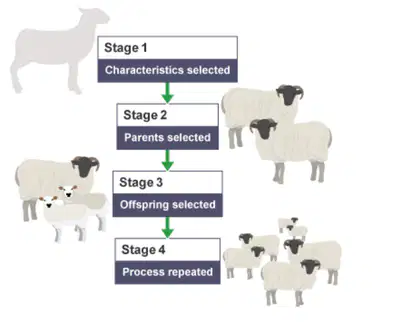
Selective breeding or artificial selection is when humans breed plants and animals for particular genetic characteristics.
1. Decide which characteristics are important enough to select.
2. Choose parents that show these characteristics from a mixed population. They are bred together.
3. Choose the best offspring with the desired characteristics to produce the next generation.
4. Repeat the process continuously over many generations, until all offspring show the desired characteristics.
20
Selective Breeding
Characteristics can be chosen for usefulness or appearance:
Desired characteristics in plants:
disease resistance in food crops
wheat plants that produce lots of grain
large or unusual flowers
Desired characteristics in animals:
animals that produce lots of milk or meat
chickens that lay large eggs
domestic dogs that have a gentle nature
The new varieties may be economically important. For example, they may provide more or better quality food, or allow farmers to feed more people.
21
Multiple Choice
Selective breeding is...
a process to create an organism with desired traits from parents with those desired traits
natural method of producing offspring with desired traits
creating a new species
making organisms reproduce during times of stress
22
Multiple Choice
An example of selective breeding is
a dog breeder mating 2 dogs to make more dogs
a farmer grows bees to pollinate the plants on his farm
a person pollinates 2 white rose plants to only create white roses
23
Multiple Choice
One problem with selective breeding is
creating a new species
gene variety is lost
new food sources
24
reduced genetic variation can lead to attack by specific insects or disease, which could be extremely destructive
rare disease genes can be unknowingly selected as part of a positive trait, leading to problems with specific organisms, eg a high percentage of Dalmatian dogs are deaf
can create physical problems in specific organisms, eg large dogs can have faulty hips due to not being formed correctly
new varieties may be economically important, by producing more or better quality food
animals can be selected that cannot cause harm, for example cattle without horns
Risks and Benefits of SB
25
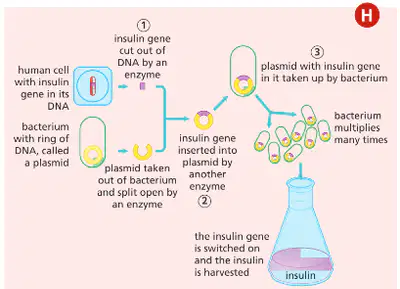
Genetic Engineering
selection of the desired characteristic
the gene responsible for the characteristic is 'cut out' of the chromosome with enzymes
the gene is transferred and inserted into another organism (vector) using more enzymes
replication of the modified organism. or vector is used to transfer the gene into required cells
26
Multiple Choice
27
Multiple Choice
28
Multiple Choice
29
Multiple Choice
Rice modified to have more Vitamin A is an example of
Genetic engineering
Cloning
Gene mutation
Artificial selection
30
Multiple Choice

31
Uses
diabetes
GMO crops (to be herbicide resistant, increased yields, to contain more vitamins)
to treat inherited disorders - CF (in the future)
32
Transfer of the selected gene into other species. What benefits one plant may harm another.
Some people believe it is not ethical to interfere with nature in this way. Also, GM crop seeds are often more expensive and so people in developing countries cannot afford them.
GM crops could be harmful, for example toxins from the crops have been detected in some people’s blood.
GM crops could cause allergic reactions in people.
Pollen produced by the plants could be toxic and harm insects that transfer it between plants.
Genetic modification is a faster and more efficient way of getting the same results as selective breeding.
Improve crop yields or crop quality, which is important in developing countries. This may help reduce hunger around the world.
Introduce herbicide resistance, which results in less herbicides being used, as weeds are quickly and selectively killed.
Insect and pest resistance can be developed and inserted into the plants. The plant produces toxins, which would discourage insects from eating the crop.
Sterile insects could be created such as a mosquito. They would breed, which would lead to infertile offspring. This may help with spread of diseases, such as malaria, dengue fever and the Zika virus.
Risks vs Benefits
33
Open Ended
Evaluate the use of genetic engineering to treat cystic fibrosis.
B13 Variation
By Samantha Argent
Please log in and use your actual names:
Top most accurate = 3 HP (and a lil treat bought in next week)
2nd = 2 HP
3rd = HP
Show answer
Auto Play
Slide 1 / 33
SLIDE
Similar Resources on Wayground

28 questions
Classification of Matter
Presentation
•
7th - 10th Grade
23 questions
Reported Speech
Presentation
•
7th - 10th Grade
24 questions
Fundamental Counting Principles
Presentation
•
8th - 10th Grade
24 questions
What Caused the French Revolution Video Lesson
Presentation
•
7th - 9th Grade
24 questions
Spanish -ar verbs in present tense
Presentation
•
8th - 10th Grade
22 questions
Linking & Helping Verbs
Presentation
•
7th - 10th Grade
26 questions
Space Missions
Presentation
•
8th - 9th Grade
26 questions
Volume of Prisms and Cylinders
Presentation
•
7th - 10th Grade
Popular Resources on Wayground
19 questions
Naming Polygons

Quiz
•
3rd Grade
10 questions
Prime Factorization
Quiz
•
6th Grade
20 questions
Math Review
Quiz
•
3rd Grade
15 questions
Fast food
Quiz
•
7th Grade
20 questions
Main Idea and Details
Quiz
•
5th Grade
20 questions
Context Clues
Quiz
•
6th Grade
20 questions
Inferences
Quiz
•
4th Grade
19 questions
Classifying Quadrilaterals
Quiz
•
3rd Grade
Discover more resources for Chemistry
34 questions
Unit 11 Acids and Bases Test Review
Quiz
•
10th Grade
20 questions
Types of Chemical Reactions
Quiz
•
9th - 12th Grade
25 questions
Unit 12 Thermochemistry Review
Quiz
•
10th Grade
22 questions
Solubility Curve Practice
Quiz
•
10th Grade
25 questions
Solutions Test Review
Quiz
•
10th Grade
12 questions
IP PreAP: Fission and Fusion Reactions
Quiz
•
10th - 12th Grade
22 questions
Unit 8- Chemical Reactions
Quiz
•
10th Grade
34 questions
Nuclear Chemistry Review
Quiz
•
9th - 12th Grade