

WHII Review 1

Presentation
•
History
•
10th - 12th Grade
•
Medium

Cheyanne Banks
Used 1+ times
FREE Resource
37 Slides • 64 Questions
1
Ottoman Empire -Europe, Asia, Africa
Persia -Asia
China -Asia
Mughal India -Asia
Songhai Empire - Africa
England -Europe
France- Europe
Spain -Europe
Portugal -Europe
Russia -Eurasia
Eastern Hemisphere
2
Aztec -NorthAmerica
Inca -South America
WesternHemisphere
3

4


Holy Roman Empire
Japan
5
Multiple Choice

What major state/empire is identified as G?
England
Aztec
France
Incan
6
Multiple Choice

What major state/empire is identified as J?
England
Aztec
France
Incan
7
Multiple Choice

What major state/empire is identified as B?
England
France
Spain
Songhai
8
Multiple Choice

What major state/empire is identified as C?
England
France
Spain
Songhai
9
Multiple Choice

What major state/empire is identified as E?
Ottoman
Holy Roman
Russia
China
10
Multiple Choice

What major state/empire is identified as H?
Ottoman
Persia
Russia
China
11
Multiple Choice

What major state/empire is identified as K?
Songhai
Persia
Mughal India
Ottoman
12
Multiple Choice
What is the correct location of the Ottoman Empire
13
Multiple Select
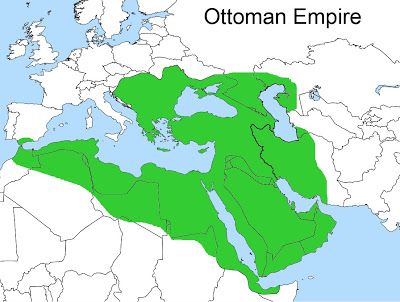
Which continents did the Ottoman Empire have some control over? Click all that apply.
Europe
Asia
Africa
North America
South America
14
Multiple Choice
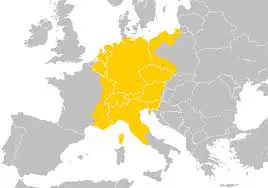
Which location is shaded in the picture?
Portugal
Ottoman Empire
Holy Roman Empire
France
15
Location of world religions in 1500 a.d. (c.e.)
Judaism: Concentrated in Europe and the Middle East
Christianity: Concentrated in Europe and the Middle East
Islam: Parts of Asia, Africa, and southern Europe
Hinduism: India and part of Southeast Asia
Buddhism: East and Southeast Asia
Sikhism : India
16

17
Exchange of products and ideas
Paper, compass, silk, porcelain (China)
Textiles, numeral system (India and Middle East)
Scientific knowledge—medicine, astronomy, mathematics
Trade Goods
Silk Routes across Asia to the Mediterranean basin
Maritime routes across the Indian Ocean
Trans-Saharan routes across North Africa
Northern European links with the Black Sea
Western European sea and river trade
South China Sea and lands of Southeast Asia
Trade Routes
18
Multiple Choice

Analyze the map. Which country on the map is the origin of Hinduism?
China
Nepal
India
Pakistan
19
Multiple Choice

Which religion's spread does this map represent
Hinduism
Buddhism
Christianity
Islam
20
Multiple Choice

Which represents the order of the spread of Buddhism?
India --> Afghanistan --> Japan
India --> China --> Japan
Japan --> China --> India
India ---> China --> Tibet
21
Multiple Choice

Which religion dominated this region circa 1500?
Islam
Judaism
Buddhism
Christianity
22
Multiple Choice

Which religion dominated this region in 1500?
Islam
Christianity
Hinduism
Judaism
23

24
Multiple Choice

What is the name of the trade route outlined in yellow?
Trans-Saharan Trade Route
Silk Road
Indian Ocean Maritime Trade
South China Sea Trade
25
Multiple Choice
As a result of trans-Saharan trade, the areas of West Africa converted to —
Christianity
Islam
Judaism
Buddhism
26
Multiple Choice
Originally, the technology of paper was brought to the Muslims
from –
India
China
West Africa
Southeast Asia
27
Monotheism
Jesus as Son of God
Life after death
New Testament—Life and teachings of Jesus
Establishment of Christian doctrine by early church councils
Christianity
Monotheistic belief centered on one God, Yahweh.
Abraham is considered the founder
Moses was known for receiving the Ten Commandments, the moral and religious rules, and leading the Hebrews out of slavery (Exodus).
Sacred texts include the Torah
Traditions include observing the Sabbath , Passover, Kosher diete
Influenced Christianity and Islam
Judaism

28
Multiple Choice
Who saved the enslaved Israelites from Egypt and lead them all to Canaan?
Abraham
Jesus
Moses
Buddha
29
Multiple Choice
This religion follows sacraments including baptism and communion
Judaism
Sikhism
Christianity
Islam
30
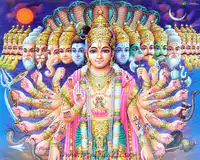
Many forms of one god (Brahman)
Vedas and Upanishads books
Caste system social class system
Reincarnation
Karma—Future reincarnation based on present behavior
Hinduism
Monotheism - Allah (Arabic for God)
Muhammad the prophet as founder
Quran / Koran = sacred text
Five Pillars of Islam - faith, prayer, charity, fasting, and pilgrimage to Mecca.
Arabian peninsula - Mecca and Medina as holy cities
Islam


31
Match

Match the following
Hinduism
Judaism
Christianity
Islam
Sikhism
Vedas
Torah
Bible
Quran
Guru Granth Sahib
Vedas
Torah
Bible
Quran
Guru Granth Sahib
32
Multiple Choice
Christianity and Islam have what in common?
Both started by Muhammad
Both started by Jesus
Both came from Judaism
Both came from Hinduism
33
Multiple Choice
Which of the following religions believes in the concept of reincarnation?
Hinduism
Islam
Christianity
Judaism
34
Multiple Choice
35
Began in Punjab area of India by Guru Nanak Dev Ji.
Monotheistic
Focus on social reform
Wearing the 5 Ks
Sikhism
Founder—Siddhartha Gautama (Buddha)
Four Noble Truths
Eightfold Path to Enlightenment
Spread of Buddhism from India to China and other parts of Asia, resulting from Asoka’s missionaries and their writings
Buddhism

36
Multiple Choice
Which of the following definitions most accurately fits with term "karma?"
The belief in no Gods or spirituality
The constant rebirth of one's soul over and over again
The code of morals that formed the basis of Jewish laws
The accumulation of one's good and bad deeds
37
Multiple Choice

These ideas are most closely associated with what religion?
Christianity
Hinduism
Judaism
Islam
38
Multiple Choice
Buddhists believe that life is suffering. How does a Buddhist relieve their soul from suffering?
Buddhist's try to end all worldly desires through the Eightfold Path
Buddhists do their best to follow the Ten Commandments
Buddhists pray at least 5 times a day to their God
Buddhists read the Torah in search for Enlightenment
39
Multiple Choice

The beliefs of this religion consist of being Monotheistic (Allah)
and the Five Pillars
Judaism
Christianity
Islam
Buddhism
40
Multiple Choice
To attain enlightenment one must follow the Four Noble Truths and the Eight-fold Path
Christianity
Judaism
Islam
Buddhism
41
• Accomplishments in the visual arts— Michelangelo, Leonardo da Vinci
• Accomplishments in literature (sonnets, plays, essays)—Shakespeare
• Accomplishments in intellectual ideas (humanism)—Erasmus (Praise of Folly)
• “Rebirth” of classical knowledge, “birth” of the modern world
• Spread from the Italian city states to northern Europe
•Humanism - focus on individuals, reason, human achievement
•Secular - non religious

42
Last Supper, Mona Lisa, Vitruvian Man
Da Vinci


43
Multiple Choice

Which person is most associated with this time period?
Voltaire
Henry Bessemer
Michelangelo
John Huss
44
David, Creation of Adam and Sistine Chapel, Pieta
Michelangelo


45
Causes
For centuries, the Roman Catholic Church had little competition in religious thought and action. The resistance of the church to change led to the Protestant Reformation, which resulted in the birth of new Protestant Churches who challenged Catholicism
-Black Death - distrust in Church
-Renaissance ideas on human achievement and focus on individual
-Humanism and Secularism

46
Multiple Choice
What was the Protestant Reformation?
A movement to reform the Catholic Church
A war between France and England
A period of artistic development
A scientific revolution
47
Causes
• Merchant wealth challenged the Church’s view of usury.
• German and English nobility disliked Italian domination of the Church.
• The Church’s great political power and wealth caused conflict.
• Church corruption and the sale of indulgences were widespread and caused conflict.
-Disagreement over other Church practices (reading Bible, good works, use of Latin)
-The Printing Press, by Johannes Gutenberg, lead to growth of literacy and spread Renaissance and Reformation ideas

48
Multiple Choice
What did the Catholic Church sell to forgive sins for money?
Excommunication
Printing Press
Indulgences
Corruption
49
Multiple Choice
The ideas of the Protestant Reformation were spread by what new invention?
Compass
Biblical press
Printing press
University system
50
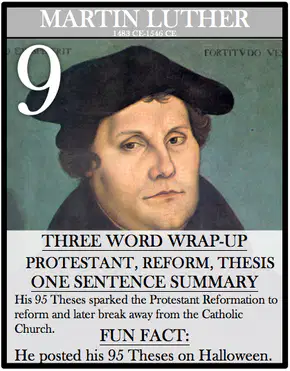
German
Views—Salvation by faith alone, Bible as the ultimate authority, all humans equal before God
• 1517 - nailed 95 theses to door of Church, birth of the Protestant Church, translated Bible into German
--> Begins Reformation

51
Multiple Choice

52

53
Multiple Choice
Which idea is most associated with John Calvin?
Ultimate authority comes from the Bible.
People are equal before God.
Salvation depends on faith alone.
Fate is determined by predestination.
54
Multiple Select
Identify two central beliefs of Martin Luther's 95 Theses.
The Bible is the central religious authority.
Humans may reach salvation through faith and indulgences paid to the Catholic Church.
Humans may reach salvation only by faith, not through indulgences.
The Pope is the central religious authority.
55
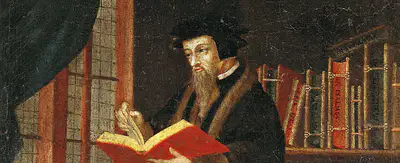
France
Views - predestination - god already decided who will go to Heaven (the elect vs. the damned)
Faith revealed by righteous life, hard work
Expanded Protestant Reformation (Calvinism)
56

57
Multiple Choice
Elizabeth I supported Protestantism in England by--
returning land belonging to the Catholic Church
making the Anglican Church the official national church
persecuting people who used Latin in the Catholic Church
removing the leader of the Anglican Church
58
Daughter of Henry VIII
Expanded Protestant Anglican Church (39 Articles)
More tolerant of religious dissenters
American colonies
Defeated Spanish Armada
Elizabeth I
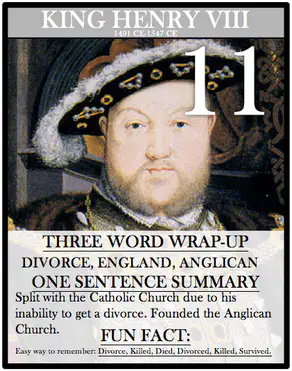
Wanted to divorce his wife for male heir
Tried to get divorce from Pope, Pope refused and excommunicated him
Broke away from Catholic Church, became head of Church of England/Anglican Church
Seized church lands and wealth
Henry VIII
59
Multiple Choice

What was one effect of this act?
The influence of the Catholic Church declined.
The practice of Protestantism was prohibited in England.
The Pope granted greater authority to the king.
The colonies were subjected to the authority of the Church.
60
Catholic monarchy (Henry IV) granted Protestant Huguenots freedom of worship by the Edict of Nantes (later revoked)
. • Cardinal Richelieu changed the focus of the Thirty Years’ War from a religious to a political conflict.
France
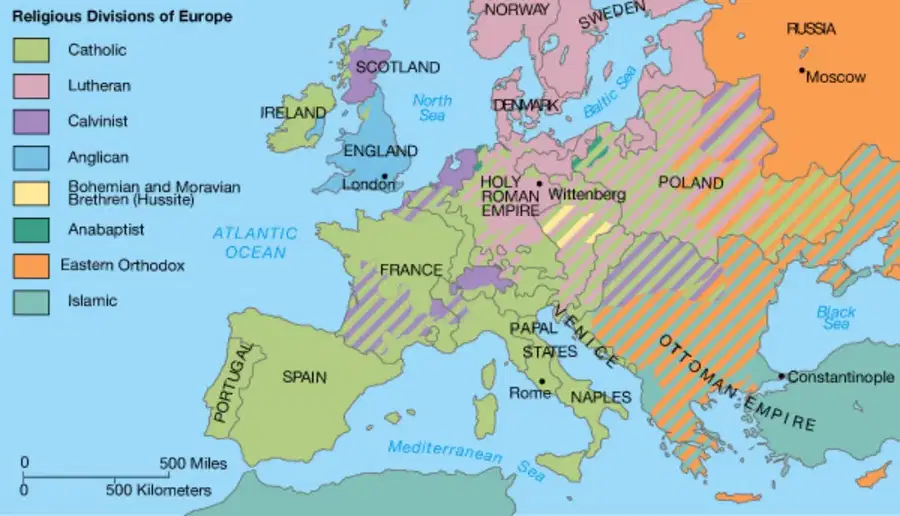
Princes in Northern Germany converted to Protestantism
• The Hapsburg family and the Holy Roman Empire continued to support the Roman Catholic Church.
• Conflict between Protestants and Catholics resulted in wars (e.g., Thirty Years’ War).
Germany

61

62
Multiple Choice

Which statement completes this diagram?
Priests gave up positions of leadership in their community.
Nobles decided to abandon the beliefs of Christianity.
Beliefs encouraging religious toleration became widely accepted.
New religions that rejected the authority of the Pope were established.
63
Multiple Choice
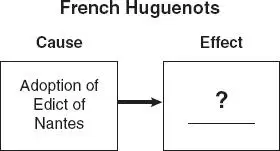
Which of the following best completes this diagram?
A. Freedom of religion
B. Freedom of speech
C. Freedom of petition
D. Freedom of press
64
Multiple Choice
The Thirty Years' War was between which religious sects?
Martin Luther and John Calvin
Muslims and Catholics
Protestants and Catholics
Muslims and Protestants
65

66

67

68
Counter- Reformation
Church attempt to combat Protestantism
The Council of Trent (1545-1563) reaffirmed most Church doctrine and practice.
• The Society of Jesus (The Jesuits) was founded to spread Catholic doctrine and convert colonies to Catholicism
• The Inquisition was used to reinforce Catholic doctrine. (torture), ex. Jan Hus being burned at stake
69
Multiple Choice
Identify a negative effect that was caused by the Protestant and Catholic Reformations.
Persecution of different groups of people became more common.
New religions developed and collaborated for political reasons.
The Catholic Church no longer existed because Protestant churches took over.
The Protestant churches did not survive because the Catholic Church took over.
70
Multiple Choice
The Society of Jesus was created to spread Catholic teachings, primarily in response to the-
Inquisition
Renaissance
Scientific Revolution
Protestant Reformation
71
Multiple Choice
Why did the Catholic Church start the Inquisition?
To reinforce Catholic doctrine
To convert the Native Americans to Catholicism
To punish priests for selling indulgences
To praise Protestant reformers
72
Multiple Choice
Read the list. 1. Council of Trent 2. Society of Jesus 3. Inquisition The list describes characteristics that were part of the —
Counter-Reformation
Enlightenment
Edict of Nantes
Protestant Reformation
73
Ended 30 Years War
-Established more religious tolerance in Europe between Catholics and Protestants
-Redrew national boundaries (ex. Holy Roman Empire

74
75
Growth of secularism • Growth of individualism
Eventual growth of religious tolerance
Creation of new nations and boundaries (ex. weakening of Holy Roman Empire, creation of Dutch Republic)
• Growth of literacy was stimulated by the Gutenberg printing press. • The Bible was printed in English, French, and German.
76
Multiple Choice

Which would best replace the question mark in the last box?
A. Papal Authority
B. Religious Tolerance
C. Literary Ideas
D. Scientific Thought
77
Multiple Choice
How did the Reformation fuel European exploration in the New World?
Created a desire to spread religious beliefs
Increased desire to bring glory to one's nation
Pushed to open new markets for raw materials
Saw potential for new learning and technology
78

79
Ottoman Empire
Islamic culture and art - ex. mosques
millet system, allowing religious minorities self-governance under their own leaders
devshirme, aka “child levy” or “blood tax” took Christian boys to serve the Ottoman government, created a system of loyalty to the sultan.
80
Multiple Choice
One reason that the Ottoman Turks were successful in creating a large empire was that they —
conquered the lands of the Mughal Empire
taxed visitors who traveled in their empire
used the Islamic religion as a unifying force
relied on foreign navies to protect their coast
81

82
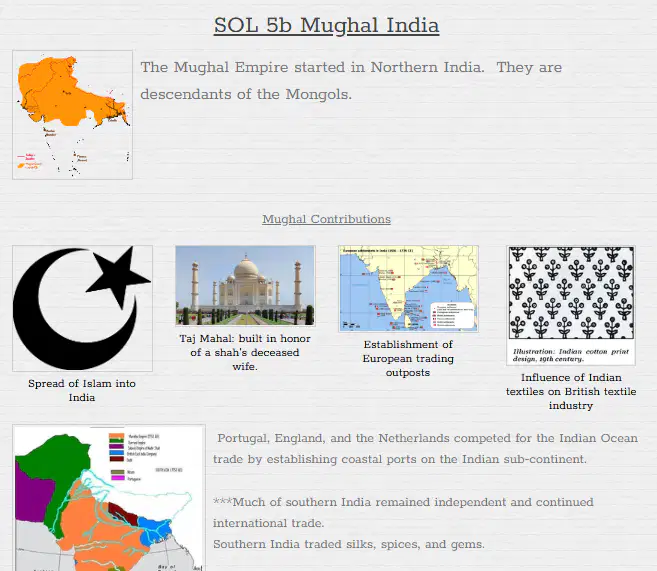
Mughal India
Islamic rulers ruling over Hindu populace
Growth of Sikhism (reform based religion) --> Conflict with Mughal rulers
Weakening of Mughal rulers --> India colonized by European countries (England, Portugal, Netherlands)
83
Multiple Choice

This building is associated with the Mughal Empire, it is known as the-
Hagia Sophia
Taj Mahal
Burj Khalifa
84
Multiple Choice
Millet system and blood tax
mosques and religious complexes
Developments in architecture, calligraphy, manuscript painting, textiles, and ceramics
Mughal Empire
Ottoman Empire
Japan
85
Multiple Choice

Which modern-day country includes the area once ruled by the Mughals?
1
2
3
4
86
Multiple Choice
- Spread Islam into India
- Art and architecture: Taj Mahal
- Establishment of European trading outposts
- Influence of Indian textiles on the British textile industry
Ottoman Empire
China
Mughal Empire
87
Multiple Select
Trade items the Mughal Empire grew wealthy trading (2) --
spices
textiles
poultry
art
88
China
Confucian culture - education, ancestor worship, filial piety/respect for elders
Buddhist
Control of Silk Road trade
Ming Dynasty (1368–1644)
Forbidden City, Great Wall, capital at Beijing porcelain
Qing Dynasty (1644–1912)
China's last imperial dynasty
Known for expansion into Taiwan, Tibet, Mongolia, and Central Asia
89

90

Japan
-Tokugawa Ieyasu - shogun who unified Japan after warring states (Sengoku) period, began Edo period
-Implemented closed door policy
-Supported Japanese culture and art (Shintoism, Buddhism, woodblock prints, kabuki theater)
-Isolation led to technological, scientific, military growth
91
Multiple Choice
How did China attempt to limit the influence of European merchants during the Commercial Revolution?
Adopting a strict policy of isolationism
Using Islam as a unifying force
Creating foreign enclaves
Promoting a capitalist market economy
92
Multiple Choice
During the 16th century, Europe gained access to knowledge about
astronomy, medicine, and mathematics because of the —
exploration of Africa
spread of the manorial system
expansion of religion
growth of trade with Asia
93
Multiple Choice
"When we arrived at Kyoto, we waited for some days that we
might obtain leave to approach the king. . . . But we found all
ways of access to him altogether closed. And as we discovered
that the edicts of the king were generally thought little of . . ."
— Letter from St. Francis Xavier to the
Society of Jesus at Goa, 1551
Which aspect of Japanese society is best described by this letter?
Weakness of the emperor
Power of the people
Decline of the class structures
Importance of religious institutions
94
Multiple Choice
WHII.5c
Which adopted a policy of isolation to limit the influence of European merchants?
Japan
Africa
India
Ottoman Empire
95
Multiple Choice
- tried to control trade by creating specific areas for trade within its borders (foreign enclaves)
- emperor's (imperial) policy of controlling foreign influences
- Europeans demanded it goods including tea and porcelain
Mughal Empire
China
Ottoman Empire
96
Multiple Choice
- emperor was powerless, true leader was the shogun
- tried to isolate itself from outside trade and influences
China
Japan
Ottoman Empire
97
Multiple Choice
Which correctly describes Tokugawa Ieyasu
Built the Taj Mahal
Shogun who unified Japan
Last emperor of China
Created the millet system
98
Multiple Choice
Military leader of Japan who had control of the empire --
shogun
boshido
samurai
shah
99
Multiple Select
Two primary religions found in the Mughal Empire --
Islam
Hinduism
Christianity
Judaism
100
Multiple Choice

Mimar Sinan was famous designing and building the Suleiman ________.
Mosque
Church
Plaza
Taj Mahal
101
Multiple Choice
Istanbul was known as ______ before the Ottoman Empire.
Constantinople
Rome
London
Saudi Arabia
Ottoman Empire -Europe, Asia, Africa
Persia -Asia
China -Asia
Mughal India -Asia
Songhai Empire - Africa
England -Europe
France- Europe
Spain -Europe
Portugal -Europe
Russia -Eurasia
Eastern Hemisphere
Show answer
Auto Play
Slide 1 / 101
SLIDE
Similar Resources on Wayground

96 questions
Biology Keystone Review B
Presentation
•
10th - 12th Grade
98 questions
ICP Fall Finals Review
Presentation
•
10th - 12th Grade
96 questions
Unit 4 Balancing and Types of Chemical Reactions
Presentation
•
9th - 12th Grade
95 questions
Advanced Livestock Nutrition
Presentation
•
9th - 12th Grade
95 questions
Imperialism Review
Presentation
•
KG - University
94 questions
Male Reproductive System
Presentation
•
11th - 12th Grade
97 questions
PASSIVE INFINITIVE AND GERUND
Presentation
•
9th Grade - University
Popular Resources on Wayground
10 questions
Safety Day 2026 – Student Review

Quiz
•
9th Grade
21 questions
Continents and Oceans
Quiz
•
6th Grade
20 questions
Parts of Speech
Quiz
•
5th Grade
16 questions
Subject & Predicate
Quiz
•
5th Grade
25 questions
Multiplication Facts
Quiz
•
5th Grade
12 questions
Map Skills
Quiz
•
3rd Grade
22 questions
Continents and Oceans
Quiz
•
5th Grade
15 questions
Rounding Decimals
Quiz
•
5th Grade
Discover more resources for History
25 questions
The American Revolution
Quiz
•
7th - 10th Grade
15 questions
The Bill of Rights
Quiz
•
8th - 12th Grade
15 questions
Ancient Rome
Quiz
•
7th - 10th Grade
16 questions
Students of Civics Unit 2: The Constitution
Quiz
•
7th - 11th Grade
10 questions
Exploring the 7 Principles of the Constitution

Interactive video
•
6th - 10th Grade
10 questions
Significance of the Declaration of Independence
Interactive video
•
6th - 10th Grade
10 questions
Exploring the Age of Exploration
Interactive video
•
6th - 10th Grade
10 questions
French and Indian War
Interactive video
•
9th - 10th Grade