Search Header Logo
ICP Fall Finals Review

ICP Fall Finals Review

Assessment

Presentation

Science

10th - 12th Grade

Medium

Created by

Mihir Paranjape

Used 4+ times

FREE Resource

25 Slides • 73 Questions

1

ICP Fall Finals Review

by Mihir Paranjape

2

Unit 1: Science Skills​

Scientific Method:

​1. Question.

​2. Hypothesis

​3. Experiment

​4. Data

​5. Conclusion

​6. Test

Manipulated Variable: X axis Independent Variable

​Responding Variable: Y axis Dependent Variable

Measurement Units: SI Units

​Length: meters (m). Tape Measure, meter stick

​Mass: kilograms (kg). Triple Beam Balance

​Volume: liters (l). Graduated Cylinder

3

Multiple Choice

Question image

What is the purpose of this tool?

1

to measure liquids, not exact

2

used to stir

3

to measure exact amounts of liquid

4

used to find mass

4

Multiple Choice

Which tool would be used for measuring distance?

1

meter stick

2

yard

3

graduated cylinder

4

beaker

5

Unit 1: Triple Beam Balance

media

200 g

20 g

1.3 g

200 g + 20 g + 1.3 g = 221.3 g

6

Multiple Choice

Question image

What is the mass of this object?

1

459.4 g

2

594.4 g

3

549.4 g

4

954.4 g

7

Unit 1: Graduated Cylinder

media

Check Bottom of Meniscus

​Start with lower number and count towards the higher number.

​The meniscus is between 36 and 37 mL

​Estimate the number in between

​e.g. 36.5 mL

8

Multiple Choice

Question image
What is the volume of the water in this graduated cylinder?
1
53 mL
2
54 mL
3
66 mL
4
56 mL

9

Unit 1: Volume Displacement Method

Volume after: 22.1 mL

​Volume before: 13.2 mL

​Difference: (22.1 - 13.2) = 8.9 mL

media

10

Unit 1: Accuracy and Precision

media

11

Multiple Choice

Question image

What is the volume of the ring?

1

64 ml

2

68 ml

3

8 ml

4

4 ml

12

Multiple Choice

Question image
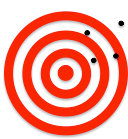
Describe the accuracy and precision of the image
1
Accurate and Precise
2
Accurate and not precise
3
Not Accurate and Precise
4
not accurate and not precise

13

Unit 2: Velocity and Acceleration

Distance: Path travelled between two points.

​Displacement: Straight line distance between two points.

​Speed: Ratio of distance moved to time taken. Scalar

​Velocity: Ratio of displacement to the time taken. Vector

​Velocity is Speed with a Direction.

media
media

14

Unit 2: Speed

media

​Distance D = m

​Speed S = m/s

​Time T = s

15

Multiple Choice

Bill jogs 400 meters to Andy's house, turns around, and runs 400 meters back home.  He does so in 267 seconds.  What is Bill's average speed?
1
about 3 m/s
2
about 1.5 m/s
3
0
4
about 4 m/s

16

Multiple Choice

Dave runs a 400 m race with a speed of 4 m/s. What time will it take him to finish the race?
1
400 minutes
2
100 minutes
3
100 seconds 
4
.25 seconds 

17

Multiple Choice

A boat travels at 22 km/hr for 10 hrs, what distance will it travel?
1
220 miles
2
2.2 km
3
220 km
4
22 km

18

Unit 2: Acceleration

Acceleration: Ability of an object to Gain or Lose Speed.

​Positive Acceleration: Increasing Speed

​Negative Acceleration: Decreasing Speed

​Zero Acceleration: Constant Speed

media
media

19

Multiple Choice

If you are test-driving a Bugatti Veyron and you go from 0 km/s to 124 km/s in 3.7 seconds, what was your acceleration?
1
33.5 m/s2
2
0.03 m/s2
3
-33.5 m/s2
4
-0.03 m/s2

20

Multiple Choice

A dog runs with an initial speed of 7.5 m/s on a waxed floor. It slides to a stop in 15 seconds. What is the acceleration?

1

-7.5 m/s

2

-7.5 m/s2

3

-0.5 m/s2

4

7.5 mi//hr

21

Unit 3: Force

Force is a Push or Pull that causes an object to

​Speed Up

​Slow Down

​Change Direction

​Change Shape

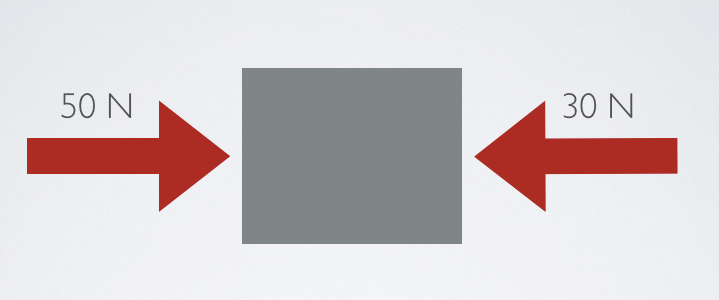
​Balanced Forces are equal forces in opposite directions. They cancel out and object does not move.

​Unbalanced forces cause object to move. Calculate the Net Force.

media

22

Multiple Choice

Question image
How will this object move? 
1
It won't move. 
2
It will move to the right. 
3
It will move to the left. 
4
It will move up. 

23

Multiple Choice

Question image

These forces are...

1

Balanced

2

Unbalanced

24

Multiple Choice

Question image

What is the net force pulling on the cart and in which direction?

1

3 N Right

2

5 N Right

3

5 N Left

4

8 N Left

25

Unit 3: Newtons First Law

Motion stays the same unless there is an UNBALANCED force.

​Object at rest stays at rest.

​Object in motion, stays in motion.

​This property is called INERTIA.

26

Multiple Choice

What is Newton's First Law known as? The Law of
1
Friction
2
Mass
3
Inertia
4
Gravity

27

Multiple Choice

The tendency of an object to resist a change in its motion
1
acceleration
2
inertia
3
mass
4
frame of reference

28

Unit 3: Newtons Second Law

More Force causes more acceleration.

​More Mass causes more acceleration.

​F = M x A

​F = Force in Newtons (N)

​M = Mass in kgs

​A = Acceleration in m/s2

media

29

Multiple Choice

Question image

use the triangle to solve the question.

Find the acceleration of a box having mass 10Kg when a force of 20N is applied on it.

1

1m/s2

2

2m/s2

3

10m/s2

4

5m/s2

30

Multiple Choice

Jenny applies a 60 N force to a 20 Kg cart, what is the acceleration of the cart if friction can be neglected?

1

1200 m/s2

2

0.33 m/s2

3

20 m/s2

4

3 m/s2

31

Multiple Choice

An object accelerates 5 m/s2 when a force of 20 newtons is applied to it. What is the mass of the object?
1
4 Kg
2
20 Kg
3
0.5 Kg
4
2 Kg

32

Multiple Choice

Friction is a force that acts in an ___________ direction of movement.
1
similar
2
opposite
3
parallel
4
west

33

Unit 3: Newtons Third Law

When you push an object, the object pushes back at you with equal strength in the opposite direction.

media

34

Multiple Choice

A baseball player hits a ball with 400 N of force. How much force does the ball exert on the bat?

1

300

2

400

3

500

4

Not enough info to tell

35

Multiple Choice

For every action, there is an equal and opposite reaction.
1
Newton's
1st
Law of Motion
2
Newton's
2nd
Law of Motion
3
Newton's
3rd
Law of Motion

36

Multiple Choice

Question image
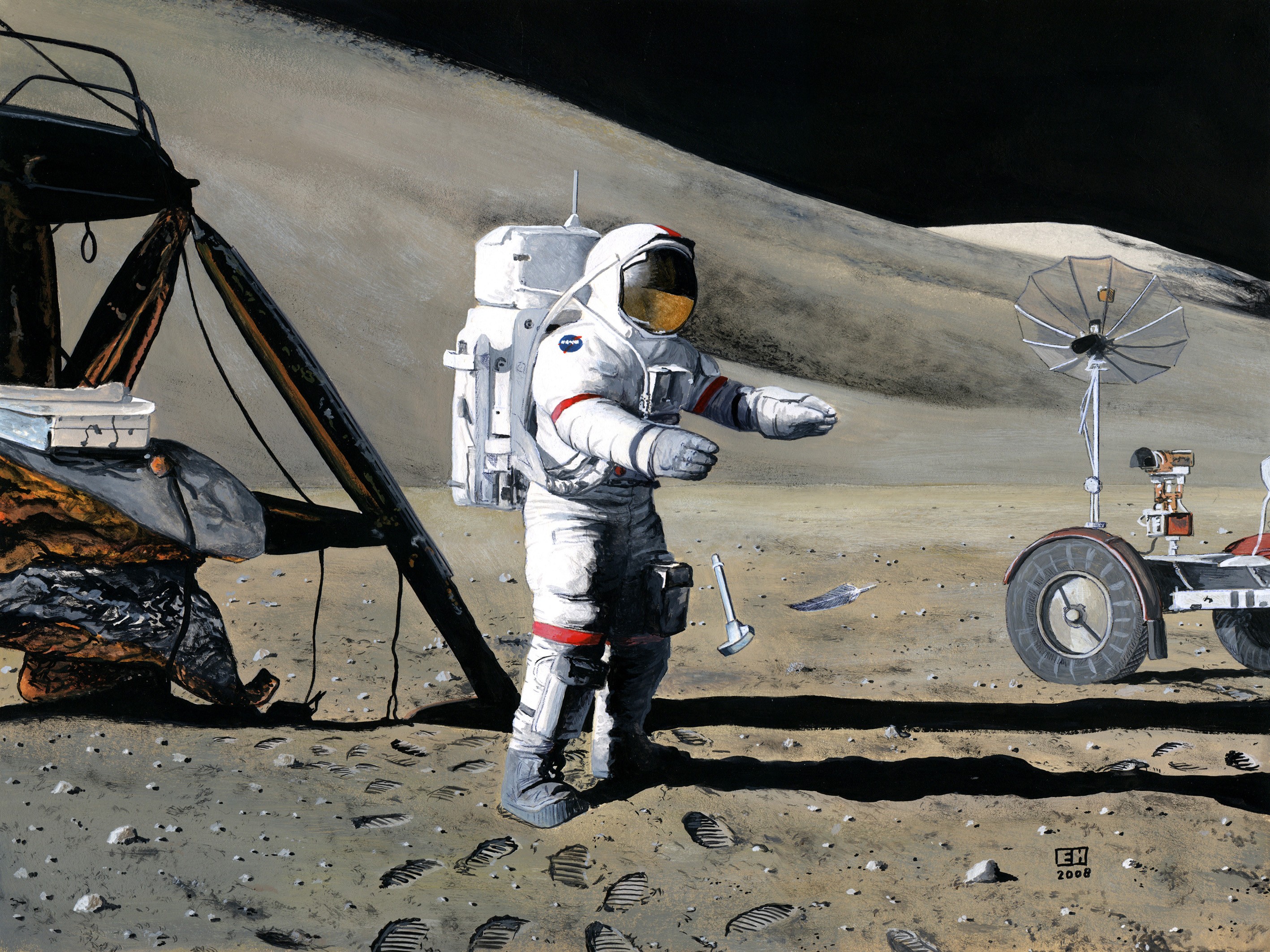
If a feather and a hammer are dropped at the same time on the moon, where there is no atmosphere, which one will hit the ground first?
1
Neither, there is no gravity on the moon.
2
hammer because it has more mass
3
feather because it has less mass
4
both will hit at the same time

37

Unit 4: Work

Work is the product of a Force and the Distance the object moves in the direction of the Force.

​If the Object does not move in the direction of the Force, no work is done.

media
media

38

Multiple Choice

Bob pushes against a wall with a force of 500-N for 20 seconds. Obviously, he cannot move the wall, but he is a bit tired afterwards. How much work did bob do pushing against the wall?

1

0 J

2

1000 J

3

10,000 J

4

500 J

39

Multiple Choice

If 150 Joules of work is needed to move a box 10 meters, what force was used?

1

1500 N

2

15 N

3

150 N

40

Multiple Choice

How far does a car that weighs 5,000 N go if 18,000 J of work is done on it?

1

3.8 m

2

3.7 m

3

3.6 m

41

Unit 4: Power

Power is the rate of doing work.

​Unit of Power is Watt

​Work = J

​t (time) = s

media

42

Multiple Choice

A 100 N force is applied to move an object a horizontal distance of 5 meters in 10 seconds. How much power is done?

1

50J

2

50W

3

500J

4

500W

43

Multiple Choice

Question image

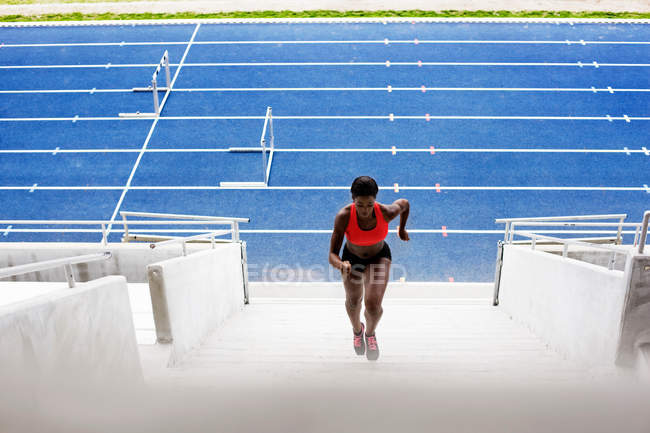
How much power is generated by Ashley (50 kg) running up a 6 m flight of stairs in 5 seconds? Assume that acceleration due to gravity is 10 m/s2

1

60 W

2

62 W

3

600 W

4

1500 W

44

Unit 4: Energy

Energy is the ability to do work. Unit of Energy is same as Work i.e Joules.

There are many types of Energy and Energy is constantly changing from one form to another.

media

45

Multiple Choice

Question image

When a car burns gasoline it creates hot air to move the pistons in the engine, which causes the car to move. What energy transformation occur from the fuel to the movement of a car?

1

thermal energy to mechanical energy

2

thermal energy to chemical energy to mechanical energy

3

chemical energy to thermal energy to mechanical energy

4

chemical energy to electrical energy

46

Multiple Choice

Which of the following energy transformations occur when a lamp that is plugged into a wall socket is functioning correctly?
1
Chemical to light
2
Electrical to chemical
3
Electrical to light
4
Chemical to electrical

47

Multiple Choice

According to the Law of Conservation of Energy, energy cannot be _________ or ____________. 
1
destroyed, destroyed
2
created, saved
3
created, destroyed
4
lost, found

48

Multiple Choice

Gravitational potential energy depends on the ________ and ________ of the object. 
1
Height and mass
2
Friction and movement
3
Mass and Movement
4
Height and Friction 

49

Multiple Choice

Question image
Solar Energy is transferred to _____ Energy.
1
Mechanical
2
Solar
3
Sound
4
Electrical

50

Unit 4: Energy

Potential Energy: Stored Energy in a body that has the potential to be transformed into other forms of Energy.

​Mechanical Potential Energy = mass x gravity x height.

​Kinetic Energy: Energy of an object due to its motion.

​Kinetic Energy = (1/2) x mass x (velocity)2

51

Multiple Choice

Question image

The roller coaster cart has the most kinetic energy at position-

1

W

2

X

3

Y

4

Z

52

Multiple Choice

Question image

Where is the kinetic energy the greatest?

1

A

2

B

3

C

4

D

53

Multiple Choice

Question image

The roller coaster cart has the most gravitational potential energy at position-

1

W

2

X

3

Y

4

Z

54

Multiple Choice

Question image
Where is the potential energy the greatest?
1
A
2
B
3
C
4
D

55

Multiple Choice

A 5 kg ball is lifted 12 m above the ground. It's gravitational potential energy is

(assume that g = 10 m/s2

1
60 J
2
600 J
3
17 J
4
2.4 J

56

Multiple Choice

What is the KE of a football which has a mass of 0.8 kg and is kicked at a velocity of 10m/s.
1
80 J
2
3.2 J
3
160 J
4
40 J

57

Unit 4: Energy in a Pendulum

​Energy is being constantly converted from Potential Energy(PE) to Kinetic Energy(KE) in a Pendulum.

​At the highest Positions, Start and 4, PE is highest

​At the lowest Position 2, PE is lowest.

​​At the highest Positions, Start and 4, KE is lowest

​At the lowest Position 2, KE is highest.

​Start -2: PE converts to KE

​2-4: KE converts to PE.

media

58

Multiple Choice

Question image

On the pendulum shown, where is the potential energy the greatest?

1

A and D (highest positions)

2

B

3

C (lowest position)

4

The potential energy is the same at all positions

59

Multiple Choice

Question image

On the pendulum shown, where is the kinetic energy the greatest?

1

A and D (highest positions)

2

B

3

C (lowest position)

4

The kinetic energy is the same at all positions

60

Multiple Choice

What types of energy does a pendulum have at the bottom of its swing?

1

Only potential energy

2

Only kinetic energy

3

A mix of kinetic and potential energy

4

No energy

61

Unit 5: Wave Types

Waves are the transfer of Energy. Only Energy moves from one place to the other, particles of the medium do not move.

There are broadly two wave types

​Longitudinal Waves: Particles move parallel to the wave direction. e.g. Sound

Transverse Waves: Particles move perpendicular to wave direction. e.g. Light

media

62

Multiple Choice

How would you describe the movement of matter in a longitudinal wave?

1

perpendicular to direction of energy

2

parallel to the direction of energy

3

In zigzags

4

Linear

63

Multiple Choice

A wave transfers:
1
matter
2
water
3
energy
4
particles

64

Multiple Choice

How would you describe the movement of matter in a transverse wave?

1

perpendicular to direction of energy

2

parallel to the direction of energy

3

In zigzags

4

Linear

65

Unit 5: Parts of a Wave

Crest: Highest or Densest Part of a wave.

​Trough: Lowest or Rarest Party of a Wave.

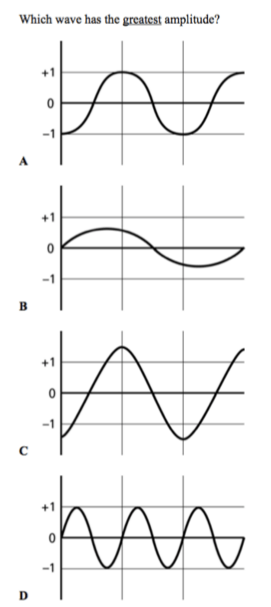
​Amplitude: Half the height of a wave

Wavelength: Distance between two crests, two troughs or two neutral points where motion is in the same direction.​

​Frequency: The number of crests or troughs through a point in one second.

media

66

Multiple Choice

Question image
1
Amplitude
2
Crest
3
Trough
4
Wavelength

67

Multiple Choice

Question image
1
Frequency
2
Amplitude
3
Wavelength
4
Trough

68

Multiple Choice

Question image
1
Trough
2
Crest
3
Amplitude
4
Wavelength

69

Multiple Choice

Question image
1
Crest
2
Trough
3
Height
4
Frequency

70

Multiple Choice

The number of waves that pass somewhere in a second is:

1

amplitude

2

frequency

3

wavelength

71

Multiple Choice

Question image

Which wave has the greatest wavelength?

1

Red Wave

2

Orange Wave

3

Green Wave

4

Purple Wave

72

Multiple Choice

Question image
Which wave has the greatest amplitude?
1
A
2
B
3
C
4
D

73

Multiple Choice

Question image

_________________________ is the distance between a point on one wave and the identical point of the next wave.

1

Amplitude

2

Frequency

3

Crest

4

Wavelength

74

Unit 5: Wave Behavior

When a Wave hits an Obejct, following can happen.

Reflection: Waves bounce off an object.

Refraction: Bending of waves when they pass from one material to another due to the difference in velocity of a wave.

Diffraction: Bending of waves around a corner.

​Absorbtion: Waves lose energy as they move in the material.

75

Multiple Choice

Rainbows are made by...

1

water

2

rain

3

Water droplets act as prisms to separate white light into the ROYGBIV spectrum

76

Multiple Choice

Question image
Which of the figures represents reflection?
1
A
2
B
3
C
4
D

77

Multiple Choice

Question image
What type of wave behavior is pictured above?
1
Refraction
2
Reflection
3
Absorption
4
Diffraction

78

Multiple Choice

When standing in the sun this behavior allows you to warm up as light and other waves hit your clothes. 
1
Reflection
2
Refraction
3
Absorption
4
Transmission

79

Multiple Choice

Question image
The orca uses this behavior of waves to locate food.
1
Refraction
2
Reflection
3
Absorption
4
Transmission

80

Unit 5: Wave Behavior

When a Wave hits another wave it is called interference.

Constructive Interference: Waves ADD together.

Destructive Interference: Waves CANCEL each other.

​Waves that bounce back can create Standing Waves. These waves look like bubbles.

​Node: Narrow portion of the bubble.

Anti-node: Broad portion of the bubble.

media
media

81

Multiple Choice

Question image
What type of wave behavior is pictured above?
1
Refraction
2
Reflection
3
Absorption
4
Diffraction

82

Multiple Choice

Question image

What type of interference is represented in this diagram?

1

Constructive

2

Destructive

83

Multiple Choice

Question image

In the diagram which letters represent the nodes

1

A B C

2

A C E

3

B D

4

B D E

5

A C D

84

Multiple Choice

Question image
Which harmonic is shown?
1
1st
2
2nd
3
3rd
4
4th

85

Multiple Choice

Question image

What type of interference is represented in the diagram?

1

Constructive

2

Destructive

86

Unit 5: Wave Speed

media

87

Multiple Choice

One end of the rope is vibrated to produce a wave with a wavelength of .25 m.  The Frequency of the wave is 3.0 Hz.  What is the speed of the wave?
1
3.00 m/s
2
2.50 m/s
3
.75 m/s
4
1.25 m/s

88

Multiple Choice

 A wave has frequency of 50 Hz and a wavelength of 10 m. What is the speed of the wave?
1
500 m/s
2
50 m/s
3
5 m/s
4
0.5 m/s

89

Multiple Choice

 A wave has frequency of 5 Hz and a speed of 25 m/s. What is the wavelength of the wave?
1
25 m
2
125 m
3
5 m
4
25 m/s

90

Unit 6: Electricity

Batteries change Chemical Energy into Electrical Energy.

​Voltage is the amount of Energy supplied to each electron. Unit is Volts V.

Current is the flow of electrons. Unit is Ampere (A)

​Voltage is the Energy supplied which causes the electrons to flow. Electrons flow from higher Voltage to lower Voltage. Hence a Voltage difference causes Current to Flow.

​Materials are either:

​Conductors: Allow flow of electrons. e.g. Metals

Insulators: Do not Allow flow of electrons. e.g. plastic, glass, ceramic, paper

91

Multiple Choice

A material in which electrons are able to move easily
1
Circuit
2
Insulator 
3
Resistance 
4
Conductor 

92

Multiple Choice

A material in which electrons are not able to move easily 
1
Circuit 
2
Insulator 
3
Resistance 
4
Conductor

93

Multiple Choice

The flow/movement of electric charges 
1
Voltage
2
Resistance 
3
Current 
4
Circuit 

94

Multiple Choice

The tendency for a material to oppose the flow of electrons, changing electrical energy into thermal energy and light.
1
Voltage
2
Current
3
Resistance
4
Circuit 

95

Unit 6: Electricity

Resistance is how difficult it is to move current through a material. Unit is Ohms.

​Conductors have lower resistance

​Insulators have higher resistance.

​Ohms Law provides the relationship between Voltage (V), Current (I) and Resistance (R).

media

96

Multiple Choice

What size resistor would produce a 3 Amp current flow with a 12 Volt battery
1
1 Ohm
2
3 Ohms
3
4 Ohms
4
12 Ohms

97

Multiple Choice

What is the Voltage of a circuit that has a resistance of 5 Ω and a current of 2 A?
1
25 V
2
10 V
3
2.5 V
4
0.4 V

98

Multiple Choice

Question image
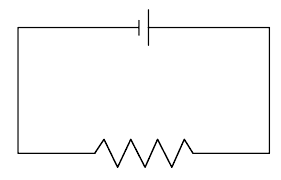
This circuit has a 24 volt battery and the resistor is 8 ohms. How many amps are running through the circuit?
1
3 Amps
2
192 Amps
3
2 Amps
4
4 Amps

ICP Fall Finals Review

by Mihir Paranjape

Show answer

Auto Play

Slide 1 / 98

SLIDE