Forms of Energy
Presentation
•
Science
•
6th - 8th Grade
•
Medium
+8
Standards-aligned
Stephanie Serna
Used 7+ times
FREE Resource
32 Slides • 29 Questions
1
2
Open Ended
Which one does not belong? Why?
3
4
Open Ended
What is energy? Give an example from your daily life where you use energy to cause change.
5
6
Multiple Choice
Which of the following best describes kinetic energy?
Energy caused by the motion of objects or particles within a system
Energy that is stored due to the position or shape of an object
Energy from food
Energy used to travel from one place to another
7
8
Multiple Choice
What is kinetic energy?
The energy of motion
The energy of heat
The energy of sound
The energy of light
9
10
Multiple Select
Which of the following factors increase the kinetic energy of an object?
Greater mass
Greater velocity
Smaller mass
Lower velocity
11
12
Multiple Choice
If three cars are moving at the same speed, which car will have the greatest kinetic energy?
The car with the greatest mass
The car with the least mass
All cars have the same kinetic energy
The car with the smallest wheels
13
14
Multiple Choice
If three cars have the same mass, which car will have the greatest kinetic energy?
The car moving at the highest speed
The car moving at the lowest speed
All cars have the same kinetic energy
The car with the brightest color
15
Multiple Choice
When a roller coaster is at the top of a hill it has
high potential energy
high kinetic energy
low potential energy
equal amounts of kinetic and potential energy
16
17
18
19
20
Multiple Select
Which of the following factors determine the gravitational potential energy of an object?
Mass of the object
Height above Earth's surface
Speed of the object
Color of the object
21
22
23
24
25
26
Multiple Choice
When does an object have the greatest gravitational potential energy on a roller coaster?
At the highest point
At the lowest point
When moving fastest
When stopped at the bottom
27
Fill in the Blank
28
Open Ended
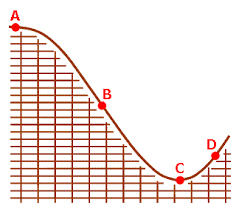
Explain how the energy of the roller coaster changes as it moves from point A to point C.
29
Multiple Choice
30
31
32
33
34
35
36
37
38
39
40
41
42
43
44
45
46
Open Ended
Explain how potential energy and kinetic energy are connected using the example of a tug-of-war game.
47
Hotspot
Select the points in this photo that show POTENTIAL energy.
48
Labelling
Which has the greatest potential energy?
Least potential
Most potential
49
Hotspot
Select the bowling ball that has LESS kinetic energy
50
Multiple Choice
51
Match
Match the following
Lifting an object away from the Earth's surface
Stretching a rubber band
Applying a voltage to a conductor
Energy of molecules
Gravitational PE
Elastic PE
Electrical PE
Chemical PE
Gravitational PE
Elastic PE
Electrical PE
Chemical PE
52
Multiple Choice
Kinetic energy depends on _____________ & _____________.
mass, speed
mass, position
mass, weight
speed, distance
53
Fill in the Blank
54
Fill in the Blank
55
Hotspot
Click the dot that has the greatest kinetic energy.
56
Hotspot
Click the dot that has the greatest gravitational potential energy.
57
Labelling
match
Lowest potential energy
Highest potential energy
58
Multiple Choice
Which of the following statements are true about the relationship between potential and kinetic energy as the car moves down the ramp?
Potential energy decreases while kinetic energy increases.
Kinetic energy decreases while potential energy increases.
Both potential and kinetic energy increase.
Potential energy remains the same while kinetic energy increases.
59
Multiple Select
Select all statements that correctly describe potential energy.
It is energy that is stored.
It is energy due to the position or shape of an object.
It is energy caused by motion.
It is energy that cannot be converted to kinetic energy.
60
Multiple Choice
What happens when you stretch a rubber band and then release it?
It stays in place
It moves quickly in the opposite direction
It melts
It changes color
61
Drag and Drop
Kinetic energy is
Show answer
Auto Play
Slide 1 / 61
SLIDE

Similar Resources on Wayground
58 questions
Weathering Erosion Deposition
Presentation
•
6th - 8th Grade
55 questions
Big Idea 17: Interdependence (CS1)
Presentation
•
6th - 8th Grade
56 questions
Plate Tectonics
Presentation
•
6th - 8th Grade
55 questions
Planet Motion/Seasons/Eclipses Review
Presentation
•
6th - 8th Grade
57 questions
Types of Heterotrophs
Presentation
•
6th - 8th Grade
57 questions
Decomposers
Presentation
•
6th - 8th Grade
60 questions
Physical and Chemical Changes Examples - day 2
Presentation
•
6th - 8th Grade
55 questions
Geologic Change over Time
Presentation
•
6th - 8th Grade
Popular Resources on Wayground
10 questions
5.P.1.3 Distance/Time Graphs
Quiz
•
5th Grade
10 questions
Fire Drill
Quiz
•
2nd - 5th Grade
20 questions
Equivalent Fractions
Quiz
•
3rd Grade
22 questions
School Wide Vocab Group 1 Master
Quiz
•
6th - 8th Grade
20 questions
Main Idea and Details
Quiz
•
5th Grade
20 questions
Context Clues
Quiz
•
6th Grade
20 questions
Inferences
Quiz
•
4th Grade
12 questions
What makes Nebraska's government unique?
Quiz
•
4th - 5th Grade
Discover more resources for Science
8 questions
Amoeba Sister Asexual vs Sexual Reproduction
Interactive video
•
8th Grade
19 questions
Introduction to Properties of Waves
Presentation
•
6th - 8th Grade
16 questions
Interactions within Ecosystems
Presentation
•
6th - 8th Grade
10 questions
Exploring the Layers of the Earth
Interactive video
•
6th - 10th Grade
16 questions
Photosynthesis and Cellular Respiration Review
Quiz
•
7th Grade
20 questions
Abiotic & Biotic Factors
Quiz
•
7th Grade
15 questions
Punnett Squares
Quiz
•
6th Grade
10 questions
Exploring the Evolution of Cell Theory
Interactive video
•
7th Grade