
Rest. Mgmt. Lesson 1.1

Presentation
•
Business
•
9th Grade
•
Hard

Julie Pittas
Used 1+ times
FREE Resource
22 Slides • 8 Questions
1

Please fill out this form so I can get to know you!
https://forms.office.com/r/XJBHUWNQwt?origin=lprLink
Welcome to Restaurant Management

2
3
4

5
6
7
8
The History of Restaurants

Lesson 1.1
9
Inn
popina
table d'hote
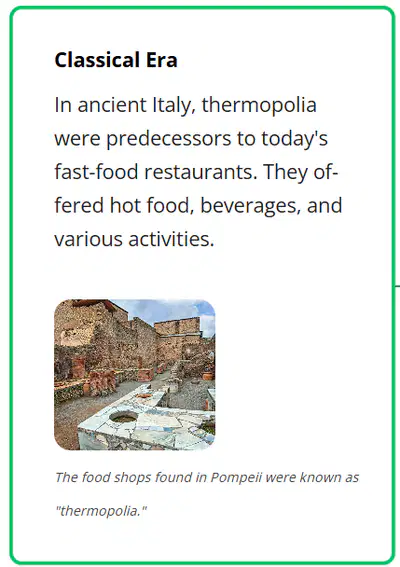
thermopolium
Vocabulary
identify the major events in the history of restaurants
explain the impact of different cultures on restaurants and their significance within a community
Learners can:
Lesson Overview
10
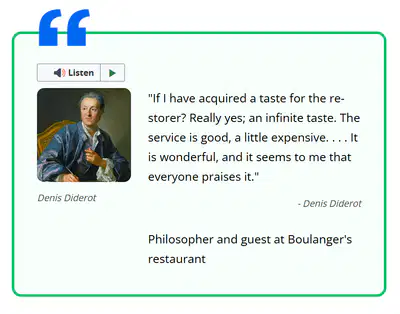
The word restaurant comes from the French word restaurer--to restore or refresh
What do you think "the restorer" is?
11
Multiple Choice
What does Denis Diderot mean by "the restorer" in his quote?
A type of restaurant
A type of broth
A cooking technique
A historical figure
12
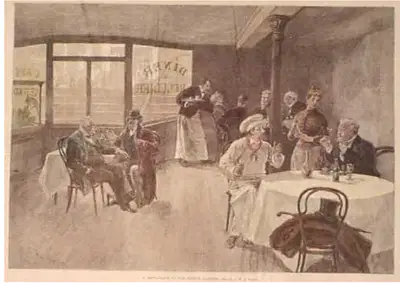
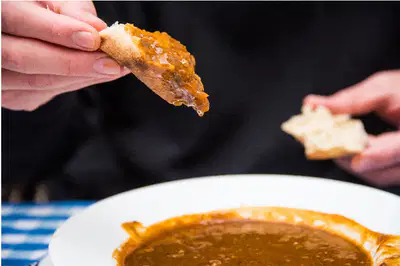
In 1765, a man named M. Boulanger hung a sign on a building that read in French, "Come to me, those whose stomachs ache, and I will restore you."
He focused on a good location: near the Louvre
First Restaurant
Had a limited menu
chicken & sauce (like stew or soup)
Was well-received
Same concerns as now
taste, service, price, other's opinions
Boulanger's Restaurant
13
Multiple Select
Which of the following characteristics of Boulanger's restaurant did Denis Diderot mention in the quote? (2)
its service
the length of its menu
other people's opinions
its location
14
Evolution of Restaurants
Many people eat at restaurants today
eat in, take out, delivery
Inns
were not a restaurant because they did not have a menu
cooked what they had
15
16
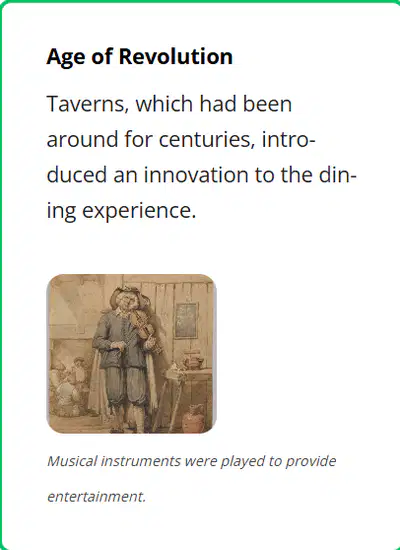
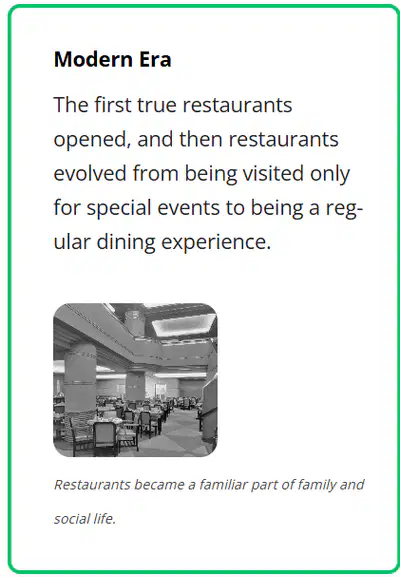
1775-1848 CE
1750 CE-Present
Timeline of Restaurants
17
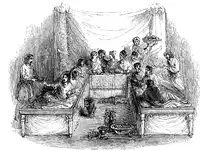
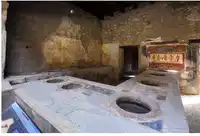

A structure that offers guests public lodging, occasional meals, and entertainment. Inns served as communal meeting spaces. Many of the inns were located near temples with a lot of traffic and areas where people would frequently congregate to celebrate holidays.
Inn
a place where something hot is sold," was a shop where guests could buy prepared meals in the Greco-Roman era, more than 2,000 years ago. People without their own kitchens tended to frequent these locations. Resembled 'quick service food'
Thermopolium
"
a style of wine bar typically frequented by slaves and members of the lower classes, was outfitted simply with stools and tables. In the main space, there was an L-shaped service counter where staff would offer guests food and beverages.
Popina
Classical Era, 600 BCE-476 CE
18
Multiple Choice
Which of the following was most likely to have been placed near an ancient temple?
a restaurant
a popina
a thermopolium
an inn
19
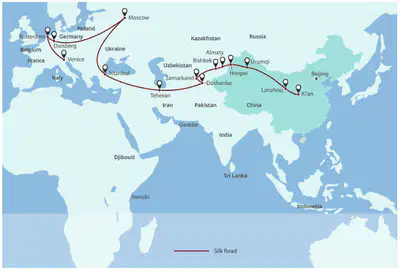
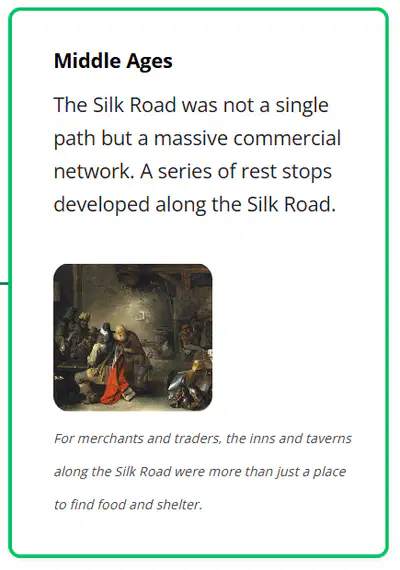
Traders, nomads, missionaries, warriors, and diplomats used the Silk Road.
It connected China with the Middle East, Europe, and Asia.
Major trade route for centuries transporting: fruits, veggetables, grains, spices
Middle Ages, 476-1450 CE
20
Multiple Choice
Which trade route was significantly important for exchanging region-specific spices and foods in Europe and Asia during the Middle Ages?
Silk Road
Amber Road
Persian Royal Road
Incense Route
21
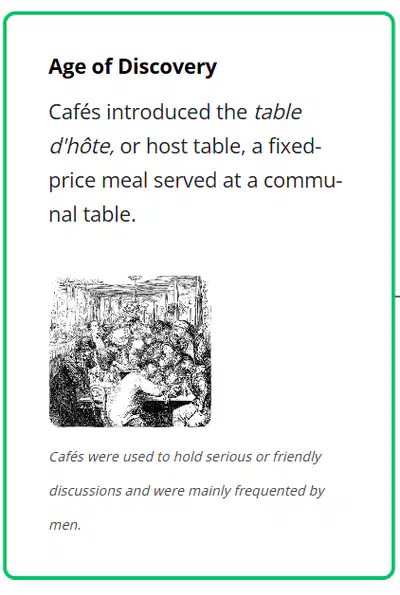
The table d'hôte, or "host table," a meal with a fixed price served at a communal table, emerged in the West. At the same time, Japanese chefs were developing fully immersive dining experiences. This kind of meal was consumed in public while friends and strangers mingled around a family-style spread.
Age of Discovery, 1400-1600 CE
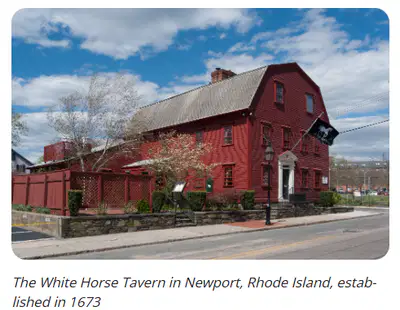
Street vendors, inns, taverns, pubs, and cafés served as gathering places for people from all social classes. For example, the White Horse Tavern in Newport, Rhode Island, offered food and, over time, evolved into a full restaurant. It is considered the oldest restaurant in the United States and a National Historic Landmark. In the early 1700s, it started offering drinks and became famous for its "businessman's lunch" menu. It is still open.
22
Multiple Choice
What is considered the oldest restaurant in the United States?
the Brown Rooster
O'Neil's Pub
Ye Olde Union Oyster House
thte White Horse Tavern
23
Age of Revolution, 1775-1848 CE
First Restauranteur-M. Boulanger
First Fine Dining Restaurant-Antoine Beauvilliers
La Grande Tavern de Londres
one of the 1st to target affluent patrons
24
Age of Revolution, 1775-1848 CE
After French Revolution, many eateries sprang up in Paris
had a printed menu
eateries offered more choices
25
Multiple Choice
Which of the following is officially recognized as the earliest fine-dining restaurant?
La Grande Taverne de Londres
the Silk Road
the White Horse Tavern
the Blue Anchor
26
Modern Era, 1750 CE-Present
America
first eateries were inns and bars
developed in frontier towns to serve businessmen & frequently included lodging
27
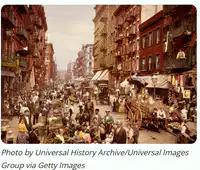

Aristocrats from England and France introduced elegant dining, which included the use of china and white tablecloths, late in the nineteenth century. Waitstaff dressed in tuxedos. Diners ordered from a full menu while seated at individual tables. The first fine-dining establishment in America, Delmonicos 1827, was established in New York City in the nineteenth century.
Nineteenth Century
The United States saw a flavor explosion due to a surge in migrant workers and immigrants.
Diners first encountered:
Chinese-American, Mexican, Italian restaurants.Chain restaurants & casual family dining-1960's
Twentieth Century
Started in the 1950's
1950-1970--restaurants grew quickly
staffing was fairly easy in fast food
asssmebly line
Fast Food/Chains
Modern Era
28
Multiple Choice
Where was the first restaurant opened?
France
United States
China
Italy
29
Multiple Choice
Which term originated in inns where guests sat at a common table and paid a fixed price for a meal?
cabaret
table d'hôte
smorgasbord
a la carte
30
In this lesson, you learned about:
the evolution of restaurants
the impact of different cultures on restaurants and their significance within a community.
Summary

Don't forget to turn in
Lesson 1.1
Please fill out this form so I can get to know you!
https://forms.office.com/r/XJBHUWNQwt?origin=lprLink
Welcome to Restaurant Management
Show answer
Auto Play
Slide 1 / 30
SLIDE
Similar Resources on Wayground

22 questions
Functional Areas of a Business
Presentation
•
9th - 10th Grade
23 questions
Algebra 1: Algebraic Properties
Presentation
•
9th Grade
24 questions
Age of Exploration
Presentation
•
9th Grade
21 questions
Climate Change
Presentation
•
9th Grade
22 questions
Oceania
Presentation
•
9th Grade
22 questions
Introduction to Relations and Functions
Presentation
•
9th Grade
24 questions
10-3 Analyzing Functions Graphically
Presentation
•
9th Grade
21 questions
Transcription
Presentation
•
9th Grade
Popular Resources on Wayground
16 questions
Grade 3 Simulation Assessment 2

Quiz
•
3rd Grade
19 questions
HCS Grade 5 Simulation Assessment_1 2526sy
Quiz
•
5th Grade
10 questions
Cinco de Mayo Trivia Questions

Interactive video
•
3rd - 5th Grade
17 questions
HCS Grade 4 Simulation Assessment_2 2526sy
Quiz
•
4th Grade
24 questions
HCS Grade 5 Simulation Assessment_2 2526sy
Quiz
•
5th Grade
13 questions
Cinco de mayo
Interactive video
•
6th - 8th Grade
20 questions
Math Review
Quiz
•
3rd Grade
30 questions
GVMS House Trivia 2026
Quiz
•
6th - 8th Grade
Discover more resources for Business
20 questions
Mastering Job Interview Skills
Quiz
•
9th Grade
25 questions
Job Interview Skills
Quiz
•
9th - 12th Grade
10 questions
Understanding Stock Market Investing
Interactive video
•
9th - 12th Grade
20 questions
Reading a Pay Stub Practice
Quiz
•
9th - 12th Grade
5 questions
Banking Basics
Presentation
•
6th - 12th Grade
10 questions
BizInnovator Startup - Firm Up Your Value Proposition
Quiz
•
9th - 12th Grade
27 questions
ESB Certification Domain 3: Production & Distribution
Presentation
•
6th - 12th Grade