Search Header Logo
  1. Resource Library
  2. Science
  3. Physical Science
  4. 8th Grade Physical Science U1 & U2
8th Grade Physical Science U1 & U2

8th Grade Physical Science U1 & U2

Assessment

Presentation

•

Science

•

8th Grade

•

Practice Problem

•

Easy

•
NGSS
MS-PS1-2, MS-PS1-5, MS-PS1-1

+5

Standards-aligned

Created by

Roy Calderon

Used 2+ times

FREE Resource

35 Slides • 24 Questions

1

media

2

media

3

Multiple Choice

Michael and Rohan are starting a science project. What is the first thing they do when beginning the scientific method?

1

test their hypothesis

2

make observations to decide a question to investigate

3

conduct an experiment

4

write down their results

4

media

5

media

6

Multiple Choice

Question image
Newton’s third law of motion states that for every action there is an equal and opposite reaction. How does this law differ from a theory?
1
A theory explains a set of well tested observations; a law describes a pattern in nature.
2
Laws can be changed with the addition of new evidence but theories cannot.
3
A law explains a pattern in nature in more detail than a theory. 
4
Theories are based on more evidence than laws.

7

media

8

Multiple Choice

What are the differences between hypothesis, theory and law?

1

Hypothesis is an educated guess, theory is a well-tested explanation, and law describes a universal truth.

2

Hypothesis, theory, and law are all scientific terms for the same concept.

3

Law is an educated guess, hypothesis is a well-tested explanation, and theory describes a universal truth.

4

There are no significant differences; they are interchangeable in scientific contexts.

9

media

10

Multiple Choice

What are the key aspects of how scientific knowledge evolves?

1

It is static and unchanging

2

It is always open to change with new evidence

3

It is based solely on personal beliefs

4

It does not adapt to new observations

11

media

12

media

13

Multiple Choice

What are the steps to take if the hypothesis is found to be wrong?

1

Study data to check if the hypothesis was right.

2

Make a new hypothesis and test again.

3

Share and explain results to others.

4

Repeat the experiment without changes.

14

media

15

media

16

Open Ended

What are two limitations of scientific models?

17

media

18

Multiple Choice

Question image

Particles of a liquid

1

are tightly packed together and stay in a fixed position.

2

are free to move around one another but still touch.

19

media

20

Fill in the Blanks

media image

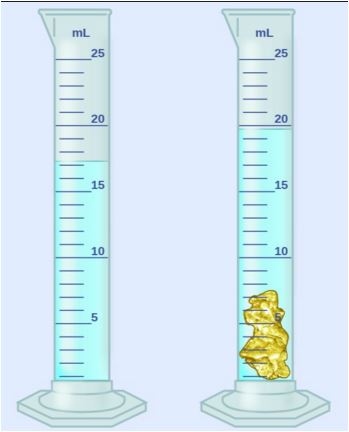
An irregularly shaped piece of gold was lowered into a graduated cylinder holding a volume of water equal to 17 ml. The height of the water rose to 20 ml. If the mass of the gold was 27 g, what was its density?

Type answer...

21

media

22

Multiple Choice

What is the difference between mass and weight?

1

Mass is constant, weight changes with location

2

Weight is constant, mass changes with location

3

Mass is measured with a spring scale

4

Weight is measured with a triple-beam balance

23

media

24

Multiple Choice

Question image
What is the volume of the regular solid in this diagram?
1
24 cm3
2
20 cm3
3
30 cm3
4
26 cm3

25

media

26

Multiple Choice

What is the method used to determine the volume of oddly shaped objects?

1

Water displacement

2

Mass measurement

3

Volume calculation

4

Density measurement

27

media

28

Multiple Choice

Question image

A rock has a mass of 200 grams and displaces 50 mL of water. What is its density?

1

4 g/mL

2

0.25 g/mL

3

2 g/mL

4

5 g/mL

29

media

30

Drag and Drop

The definition of density is how much ​ ​
is in the ​
that matter has.
Drag these tiles and drop them in the correct blank above
mass
volume
height
width
melting point
atoms
molecules

31

Open Ended

Question image

Which liquids have a density greater than 1 g/mL? Explain how you know.

32

media

33

Multiple Choice

What happens during a chemical change in matter?

1

Matter changes.

2

The substance changes forming something new.

3

The form and size changes.

4

The state of matter changes.

34

media

35

media

36

Multiple Choice

Question image

During an investigation, a student combined the two clear, colorless solutions shown above.

The student observed that the temperature changed from 25°C to 23°C when the solutions were combined and that a white substance rapidly formed and settled to the bottom of the container. What most likely happened to produce these results?

1

One of the original compounds came out of solution.

2

The solutions reacted chemically.

3

Some of the water froze into ice crystals.

4

Rapid evaporation of water occurred, leaving a solid.

37

media

38

media

39

Open Ended

A chemist heats a white solid.  When the temperature reaches 52º C, the white solid melts and turns into a liquid. 

Hypothesize what will happen when the liquid cools below 52ºC.

40

media

41

Categorize

Options (10)

Boron (B)

Calcium (Ca)

Magnesium (Mg)

Baking soda (NaCHO3)

Sweet tea

Vinegar (CH3OOH)

Air

Pepperoni Pizza

Chicken noodle soup

Oil & water

Categorize the examples in the correct category

Element
Compound
Homogeneous Mixture (Solution)
Heterogeneous Solution

42

media

43

media

44

Multiple Choice

Question image

Students were asked to identify the location of elements in the periodic table based on clues printed on game cards. Based on the data, which periodic table shows the correct location of the four elements?

1
2
3
4

45

Fill in the Blanks

media image

State whether the following is true or correct the false part with the correct term.

More than three-fourths of the elements in the periodic table are nonmetals.

Type answer...

46

media

47

Multiple Choice

Question image

According to the diagram, which of the following best describes bleach?

1

Strong acid

2

Weak acid

3

Strong base

4

Weak base

48

media

49

media

50

Drag and Drop

Question image
What type of mixture is displayed in the picture above?
Drag these tiles and drop them in the correct blank above
Solution
Heterogenous Mixture
Homogenous Mixture
Solvent

51

media

52

media

53

media

54

Labeling

What do each of these pictures represent?

Drag labels to their correct position on the image

Compound

Element(s)

Mixture

Mixture

55

media

56

media

57

media

58

Hotspot

Which arrow points to the electrons?

59

media
pattern-tertiary
media

Show answer

Auto Play

Slide 1 / 59

SLIDE