Search Header Logo
Review Module 2: Stars, the Universe and the Solar System

Review Module 2: Stars, the Universe and the Solar System

Assessment

Presentation

Chemistry

9th - 12th Grade

Practice Problem

Easy

NGSS
1-ESS1-1, HS-ESS1-1, 5-ESS1-1

+7

Standards-aligned

Used 1+ times

FREE Resource

48 Slides • 43 Questions

1

media

2

media

3

media

4

Multiple Choice

Which of the following planets can be seen in the night sky as shown in the image?

1

Mars

2

Earth

3

Neptune

4

Pluto

5

media

6

Multiple Choice

What are the main parts of a comet?

1

Nucleus

2

Coma

3

Tail

4

Core

7

media

8

Multiple Choice

What is the difference between a meteoroid, meteor, and meteorite?

1

Meteoroid is a rock in space, meteor is a shooting star, meteorite is a rock that lands on Earth

2

Meteoroid is a shooting star, meteor is a rock in space, meteorite is a comet

3

Meteoroid is a rock that lands on Earth, meteor is a rock in space, meteorite is a shooting star

4

Meteoroid is a comet, meteor is a rock that lands on Earth, meteorite is a shooting star

9

media

10

Multiple Choice

Question image

What letter represents the location of the south celestial pole?

1

A

2

B

3

D

4

G

11

media

12

media

13

Open Ended

Question image

What is the energy transformation in a star?

14

media

15

Multiple Choice

Which of the following is a real-world application of measuring distances in light years?

1

Measuring the distance between cities

2

Calculating the distance to the Moon

3

Determining the distance to distant stars and galaxies

4

Measuring the height of a building

16

media

17

Multiple Choice

What phenomenon is used to measure the scale of the universe and distances of far-off galaxies?

1

Gravitational lensing

2

Supernovae Type Ia as standard candles

3

The Doppler Effect

4

Parallax measurements

18

media

19

Open Ended

Will our sun become a black hole? Explain why or why not.

20

media

21

Multiple Choice

What is a nebula and how does it contribute to the formation of a protostar?

1

A large gas cloud that forms stars

2

A type of star

3

A planet formation process

4

A black hole

22

media

23

Multiple Choice

When does a protostar become a true star?

1

when the star is 1 million years old

2

when the central temperature reaches 1 million Kelvin

3

when nuclear fusion begins in the core

4

when the thermal energy becomes trapped in the center

24

media

25

Multiple Choice

What triggers a star's transition from the main sequence phase to the red giant stage?

1

Loss of all hydrogen fuel

2

Increase in magnetic activity

3

Hydrogen fuel exhaustion in the core, leading to helium fusion

4

Collision with another star

26

media

27

Open Ended

What happens to the temperature in the outer layers of a star after the Red Giant stage?

28

media

29

Multiple Choice

What is the ultimate fate of a low to medium mass star after the red giant phase?

1

It becomes a black hole

2

It turns into a neutron star

3

It explodes as a supernova

4

It sheds its outer layers and leaves behind a white dwarf

30

media

31

Multiple Choice

Why do stars much more massive than the Sun not form into white dwarfs after their nuclear fuel is exhausted?

1

Their cores are too hot for a white dwarf to form

2

They lose too much mass in the red giant phase

3

Their gravitational pull is too strong, leading to further collapse

4

They turn directly into black holes without collapsing

32

media

33

Multiple Choice

What can the remains of the core after a supernova form depending on their mass?

1

Neutron star

2

Black hole

3

Both neutron star and black hole

4

None of the above

34

media

35

Multiple Choice

What happens to a star with a core mass of more than 3 solar masses?

1

It becomes a neutron star

2

It explodes as a supernova

3

It forms a black hole

4

It remains stable

36

media

37

Multiple Choice

What are the three characteristics used to classify stars?

1

Size, temperature, and brightness

2

Color, size, and distance

3

Brightness, distance, and temperature

4

Color, temperature, and mass

38

media

39

Reorder

Reorder the types of electromagnetic radiation from highest energy to lowest energy.

Radio WAves

Infrared

Visisble

Ultraviolet

Gamma

1
2
3
4
5

40

media

41

Multiple Choice

What is the difference between Apparent Magnitude and Absolute Magnitude of a star?

1

Apparent Magnitude is the brightness as seen from Earth, while Absolute Magnitude is the brightness at a standard distance.

2

Apparent Magnitude is the brightness at a standard distance, while Absolute Magnitude is the brightness as seen from Earth.

3

Both Apparent and Absolute Magnitude refer to the brightness as seen from Earth.

4

Apparent Magnitude is always greater than Absolute Magnitude.

42

Multiple Choice

Which measurements allows astronomers to compare the brightness of stars?

1

parallax

2

red shift

3

absolute magnitude

4

apparent magnitude

43

Multiple Choice

Which measurements allows astronomers to compare the brightness of stars?
1
parallax
2
red shift
3
absolute magnitude
4
apparent magnitude

44

media

45

Multiple Choice

What does the Hertzsprung-Russell Diagram compare?

1

Color, surface temperature, and brightness of stars

2

Distance and size of stars

3

Color and age of stars

4

Brightness and temperature of planets

46

media

47

media

48

Multiple Choice

Question image
This is a picture of The Milky Way, where would our sun be located?
1
Directly in the middle
2
Towards the outside but NOT at the edge
3
All the way on the outside
4
Somewhere near the top

49

media

50

Multiple Choice

What are the three basic shapes of galaxies?

1

Spiral, Elliptical, Irregular

2

Circular, Oval, Linear

3

Flat, Round, Irregular

4

Spherical, Disk, Irregular

51

Multiple Choice

What is the term for the point in an elliptical orbit closest to the Sun?

1

Aphelion

2

Perihelion

3

Perigee

4

Apogee

52

media

53

media

54

media

55

media

56

media

57

media

58

media

59

media

60

media

61

Multiple Choice

What is the longest day of the year?
1
winter solstice
2
summer solstice
3
fall equinox
4
spring equinox

62

Multiple Choice

What does the rotation of the earth cause us to experience?
1
seasons
2
year
3
day & night
4
eclipse

63

Multiple Choice

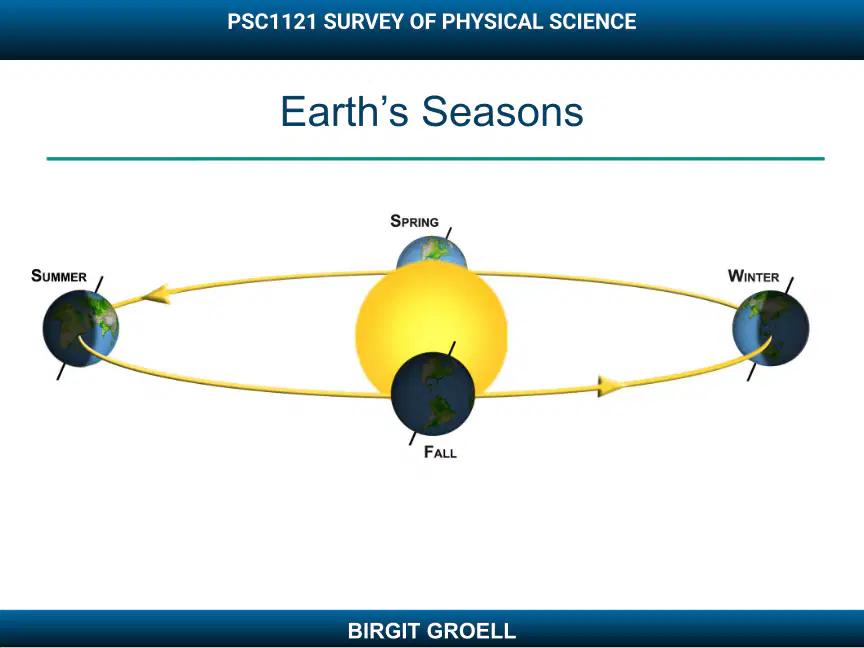
Why do we experience the changing of the season on the earth?
1
distance from the sun
2
rotation of the earth
3
change in solar output
4
tilt of the earth's axix

64

media

65

Multiple Choice

Question image

What are the inner planets called?

1

Gas Giants

2

Dwarf Planets

3

Terrestrial Planets

4

Terrestrial Giants

66

media

67

media

68

media

69

Multiple Choice

The surface of the two gas giants is mainly made of

1

ammonia

2

Carbon dioxide

3

Hydrogen

4

Helium

70

media

71

Open Ended

What is special about Uranus?

72

media

73

Multiple Choice

Where is the Asteroid Belt located in the Solar System?

1

near Neptune

2

between Mercury and Venus

3

between Mars and Jupiter

4

around the Sun

74

Fill in the Blanks

media image

75

Multiple Choice

Question image

Why is Pluto no longer considered a planet?

1

It is too small

2

It does not orbit the Sun

3

It's too far away

4

It doesn't dominate it's orbit

76

Labelling

Label the planets in our solar system

Drag labels to their correct position on the image

Mercury

Neptune

Venus

Saturn

Mars

Jupiter

Earth

Uranus

77

media

78

media

79

Reorder

Reorder the following from inside to surface of the sun

Core

Radiation Zone

Convection Zone

Photosphere

Corona

1
2
3
4
5

80

media

81

Open Ended

What causes the Northern and Southern Lights?

82

media

83

media

84

Multiple Choice

Question image
Name the moon phase
1
waning crescent
2
waxing crescent
3
waning gibbous
4
waxing gibbous

85

Multiple Choice

Question image
Name the moon phase
1
Waning Crescent
2
Waxing Crescent
3
Waning Gibbous
4
Waxing Gibbous

86

Multiple Choice

Question image
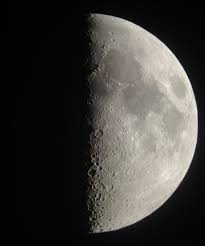
Name the moon phase
1
First Quarter
2
Last Quarter
3
New Moon
4
Full Moon

87

media

88

media

89

Multiple Choice

Since some light will still illuminate the moon, it will appear

1

red

2

green

3

yellow

4

blue

90

Multiple Choice

Question image
In a Lunar Eclipse what is in the middle of the lineup?
1
Sun
2
Moon 
3
Earth
4
Jupiter

91

Multiple Choice

Question image
For a solar eclipse to occur, what has to happen?
1
The sun must be directly between Earth and the moon.
2
The moon must be directly between Earth and the Sun.
media

Show answer

Auto Play

Slide 1 / 91

SLIDE