

Review Gov't Final

Presentation
•
Social Studies
•
12th Grade
•
Practice Problem
•
Easy

Abram Gonzalez
Used 1+ times
FREE Resource
19 Slides • 40 Questions
1
Government Review
By Abram Gonzalez
2
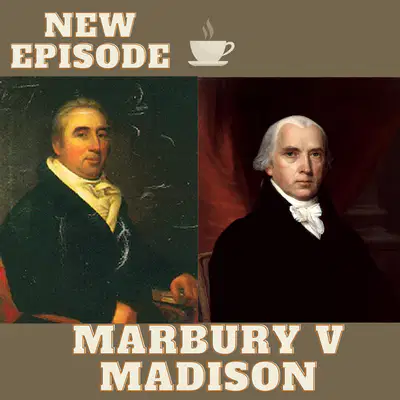
Background
In 1800, President John Adams lost re-election to Thomas Jefferson.
Before leaving office, Adams appointed several justices of the peace, including William Marbury.
The commissions were signed and sealed but not delivered before Jefferson took office.
Jefferson instructed James Madison, his Secretary of State, not to deliver the commissions.
Marbury v. Madison
3
Multiple Choice
Who was denied his commission as a justice of the peace?
Thomas Jefferson
James Madison
William Marbury
John Adams
4
Multiple Choice
Who was the Secretary of State involved in the case?
John Adams
William Marbury
Thomas Jefferson
James Madison
5
Legal Conflict
Marbury petitioned the Supreme Court for a writ of mandamus to force Madison to deliver his commission.
A writ of mandamus is a court order requiring a government official to carry out their official duties.
Marbury v. Madison
6
Multiple Choice
What legal document did Marbury request from the Supreme Court?
Judicial review
Writ of mandamus
Bill of rights
Executive order
7

Key Legal Questions
Did Marbury have a right to his commission?
Did the Supreme Court have the authority to issue the writ?
Was the Judiciary Act of 1789 constitutional?
Marbury v. Madison
8
Decision
The Court ruled that Marbury had a right to his commission.
However, the Supreme Court did not have the constitutional authority to issue the writ.
The Judiciary Act of 1789 was declared unconstitutional because it gave the Court powers not granted by the Constitution.
Marbury v. Madison
9
Multiple Choice
Why didn’t Marbury receive his commission?
Congress repealed the law
The Supreme Court lacked authority
Jefferson refused to sign it
Madison lost the document
10
Multiple Choice
Which law was declared unconstitutional in this case?
The Constitution
The Bill of Rights
The Judiciary Act of 1789
The Voting Rights Act
11
Impact
This case established the principle of judicial review—the power of the Supreme Court to declare laws unconstitutional.
It affirmed the role of the judiciary as an equal branch of government.
Marbury v. Madison
12
Multiple Choice
What power did Marbury v. Madison establish for the Supreme Court?
Executive privilege
Judicial review
Legislative veto
Presidential pardon
13
Multiple Choice
Why is Marbury v. Madison considered a landmark case?
It ended slavery
It created the Supreme Court
It established judicial review
It allowed presidential vetoes
14
Multiple Choice
What does judicial review allow the Supreme Court to do?
Appoint judges
Pass laws
Enforce laws
Declare laws unconstitutional
15
Multiple Choice
Which branch of government gained power from this decision?
Judicial
Executive
Legislative
Military
16
Multiple Choice
What was the result for William Marbury?
He became a judge
He received compensation
He never got his commission
He was elected to Congress
17

Background
In 1816, Congress created the Bank of the United States to help manage federal finances.
The bank operated in Maryland, where state banks felt threatened by its presence.
Maryland passed a law requiring any bank not chartered by the state to pay a special tax.
The Bank of the U.S. refused to pay, and Maryland sued.
McCulloch v. Maryland
18
Multiple Choice
What institution did Congress create in 1816 that led to the case?
Federal Reserve
Bank of the United States
Internal Revenue Service
Department of Treasury
19
Multiple Choice
Why did Maryland sue the Bank of the United States?
It refused to pay a state tax
It printed counterfeit money
It closed local banks
It violated state banking laws
20
Multiple Choice
Which state was involved in the lawsuit against the federal bank?
Virginia
Pennsylvania
New York
Maryland
21
Legal Questions
Did Congress have the constitutional authority to create a national bank?
Could a state (Maryland) tax a federal institution?
McCulloch v. Maryland
22
Key Constitutional Clauses
Necessary and Proper Clause: Allows Congress to make laws needed to carry out its powers.
Supremacy Clause: Establishes that federal laws override state laws.
McCulloch v. Maryland
23
Multiple Choice
Which clause allows Congress to make laws needed to carry out its powers?
Commerce Clause
Supremacy Clause
Necessary and Proper Clause
Equal Protection Clause
24
Multiple Choice
Which clause establishes that federal laws override state laws?
Supremacy Clause
Establishment Clause
Due Process Clause
Full Faith and Credit Clause
25
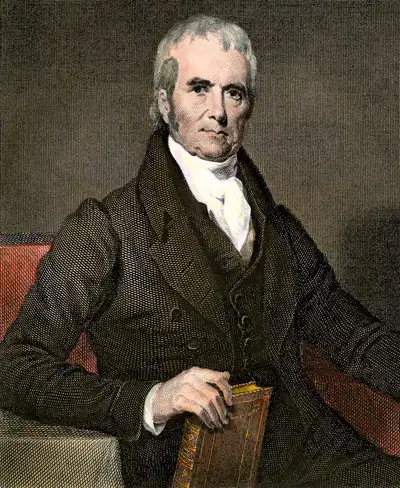
Supreme Court Decision
The Court ruled in favor of the federal government.
It upheld Congress’s power to create a national bank under the Necessary and Proper Clause.
It declared that states cannot tax federal institutions, reinforcing the Supremacy Clause.
McCulloch v. Maryland
Chief Justice John Marshall
26
Multiple Choice
What was the Supreme Court’s ruling regarding Maryland’s tax on the federal bank?
Maryland could tax the bank
The tax was unconstitutional
The bank had to pay the tax
Congress had to repeal the tax
27
Multiple Choice
Who was the Chief Justice during McCulloch v. Maryland?
John Jay
Roger Taney
John Marshall
William Rehnquist
28
Multiple Choice
What did the Court say about Congress’s ability to create a bank?
It was unconstitutional
It was not mentioned in the Constitution
It was a proper use of implied powers
It required state approval
29
Impact
Strengthened the power of the national government.
Clarified the relationship between state and federal authority.
Set a precedent for broad interpretation of federal powers.
McCulloch v. Maryland
30
Multiple Choice
What effect did the ruling have on federal power?
It limited federal power
It expanded federal power
It gave states more control
It abolished state banks
31
Multiple Choice
What principle did the case reinforce about federal institutions?
They must follow state laws
They are immune from state interference
They are subject to state taxation
They must be approved by state legislatures
32
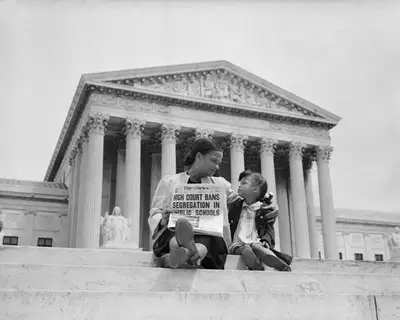
Background
In the early 1950s, Black families across several states challenged laws requiring racial segregation in public schools (schools were run-down and lacked facilities)
These cases were combined into one and brought before the Supreme Court (with the help of the NAACP) under the name Brown v. Board of Education.
The case directly challenged the precedent set by Plessy v. Ferguson (1896), which allowed segregation under the “separate but equal” doctrine.
Brown v. Board of Education
33
Multiple Choice
What was one reason Black families challenged school segregation?
Schools were too expensive
Schools were run-down and lacked facilities
Schools were overcrowded
Schools were too far from home
34
Multiple Choice
Which organization helped challenge segregation in schools?
NAACP
FBI
ACLU
EPA
35
Legal Issue
Is it constitutional to require children of color to attend separate schools from white children, even if the facilities are equal?
Brown v. Board of Education
36
Supreme Court Decision (1954)
The Court ruled that segregation in public schools is unconstitutional.
It found that separating children by race created a sense of inferiority and violated the Equal Protection Clause of the 14th Amendment.
The decision overturned Plessy v. Ferguson and declared that “separate but equal” has no place in public education.
Brown v. Board of Education
37
Multiple Choice
What did the Supreme Court rule in Brown v. Board of Education?
Segregation in schools is constitutional
Segregation in schools is unconstitutional
38
Multiple Choice
Which amendment was used to support the ruling in Brown v. Board of Education?
4th Amendment
5th Amendment
13th Amendment
14th Amendment
39
Multiple Choice
What message did segregation send to children of color, according to the Court?
They were equal
They were inferior
They were privileged
They were protected
40
Multiple Choice
What clause of the 14th Amendment was central to the Court’s decision?
Due Process Clause
Equal Protection Clause
Commerce Clause
Commerce Clause
41
Multiple Choice
Which earlier Supreme Court case did Brown v. Board of Education overturn?
Roe v. Wade
Plessy v. Ferguson
Marbury v. Madison
McCulloch v. Maryland
42
Impact
The ruling was a major victory for the Civil Rights Movement.
It led to the desegregation of schools and was later applied to colleges and universities.
Resistance followed in some states, such as Alabama, where Governor George Wallace tried to block Black students from enrolling.
Brown v. Board of Education
43
Multiple Choice
What did Governor George Wallace do in response to the Brown decision?
Supported integration
Blocked Black students from registering
Closed public schools
Filed a lawsuit against the federal government
44
Multiple Choice
True or False: The Brown decision also applied to public colleges and universities.
True
False
45
Multiple Choice
What was the long-term impact of Brown v. Board of Education?
It legalized segregation
It ended school funding
It led to school desegregation
It created private schools
46
Background
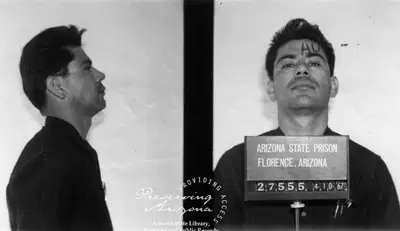
Ernesto Miranda was arrested in Phoenix, Arizona, and interrogated for two hours without being informed of his rights.
He signed a confession (for a violent crime) that was used against him in court, leading to his conviction.
Miranda v. Arizona
47
Multiple Choice
What crime was Ernesto Miranda accused of?
Theft
A violent crime
Tax evasion
Drug trafficking
48
Legal Issue
Was Miranda’s confession valid if he wasn’t informed of his 5th Amendment right to remain silent and his 6th Amendment right to legal counsel?
Miranda v. Arizona
49
Multiple Choice
Which amendment protects against self-incrimination?
1st Amendment
4th Amendment
5th Amendment
6th Amendment
50
Multiple Choice
Which amendment guarantees the right to legal counsel?
1st Amendment
5th Amendment
6th Amendment
8th Amendment
51
Supreme Court Decision (1966)
The Court ruled that suspects must be informed of their rights before interrogation.
These rights include:
The right to remain silent
The right to an attorney
The right to have an attorney provided if they cannot afford one
The Court emphasized that confessions must be truly voluntary and not coerced.
Miranda v. Arizona
52
Multiple Choice
Why did Miranda argue his confession was invalid?
He was underage
He was coerced
He wasn’t informed of his rights
He didn’t understand English
53
Multiple Choice
What did the Supreme Court decide in Miranda v. Arizona?
Miranda’s confession was valid
Police must inform suspects of their rights
Suspects must have a lawyer present at trial
Police can use any confession
54
Impact
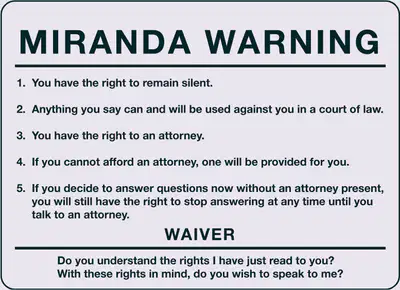
The decision led to the creation of the Miranda Warning, which police must read to suspects before questioning.
If rights are not read, any statements made during interrogation cannot be used in court.
Miranda was retried and convicted without the confession.
Miranda v. Arizona
55
Multiple Choice
What is the Miranda Warning?
A law passed by Congress
A statement read to suspects before questioning
A Supreme Court justice’s opinion
A police training manual
56
Multiple Choice
Which of the following is part of the Miranda Warning?
You must answer all questions
You have the right to remain silent
You will be released after questioning
You must hire your own lawyer
57
Multiple Choice
What happens if police fail to read the Miranda Warning?
The suspect is released
The case is dismissed
Statements made cannot be used in court
The suspect is fined
58
Multiple Choice
Why is a lawyer important during interrogation?
To record the session
To protect the suspect’s rights
To negotiate bail
To speak for the police
59
Multiple Choice
What was the outcome for Miranda after the Supreme Court decision?
He was released permanently
He was retried and convicted without the confession
He became a lawyer
He sued the police department
Government Review
By Abram Gonzalez
Show answer
Auto Play
Slide 1 / 59
SLIDE
Similar Resources on Wayground

52 questions
Chem A Unit 3
Presentation
•
12th Grade
54 questions
In Norway, Global Seed Vault guards genetic resources
Presentation
•
12th Grade
54 questions
Unit 2 Anatomy: Skeletal Muscle
Presentation
•
12th Grade
51 questions
CH 4 - Motivation
Presentation
•
University
53 questions
AMH1 (AB Tech), Ch. 19: American Empire
Presentation
•
12th Grade
55 questions
Ch 1 Observation Skills
Presentation
•
12th Grade
52 questions
Structura socială
Presentation
•
11th - 12th Grade
54 questions
Digital & Communication Systems
Presentation
•
12th Grade
Popular Resources on Wayground
25 questions
The Ultimate College Knowledge Quiz

Quiz
•
8th Grade
20 questions
Math Review
Quiz
•
3rd Grade
15 questions
Fast food
Quiz
•
7th Grade
20 questions
Math Review
Quiz
•
6th Grade
20 questions
Context Clues
Quiz
•
6th Grade
20 questions
Inferences
Quiz
•
4th Grade
19 questions
Classifying Quadrilaterals
Quiz
•
3rd Grade
20 questions
Figurative Language Review
Quiz
•
6th Grade