
Poetry & Poe

Presentation
•
English
•
6th - 8th Grade
•
Practice Problem
•
Hard
+3
Standards-aligned

Amy Shaw
FREE Resource
21 Slides • 23 Questions
1
By Amy Shaw
2
What does silence look like?
Today, you'll read two poems about silence. Then, you'll write your own poem about something silent.

3
What was the writer trying to make me see?
Making a clear picture of the specific things the writer is describing is the key step to understanding.
4
Be very quiet...
Think of something very quiet.
Now, turn to your shoulder partner (A) and try to describe the sound of the VERY quiet object.
Now, have the secondary partner (B)describe what the quiet object is.
5
Be very quiet...
Close your eyes.
Listen to the poem and make a mental image of what is being described.
When you have your mental image, write down two details from your "mental movie."
In the second poem, "The Silence," how does Lorca try to answer our question: What does silence look like?
6
D. H. Lawrence
The youth walks up to the white horse, to put its halter on
and the horse looks at him in silence.
They are so silent, they are in another world.
halter: straps or ropes that fit around the hear of a horse
Note - a halter is used for walking - not riding - a horse.
7
Federico Garcia Lorca
Listen, my son, to the silence.
It's a sinuous silence,
A silence,
where valleys and echoes slip,
and foreheads bend
toward the ground.
sinuous: having curves; flexible
8
Open Ended
How does Lorca try to answer our question: What does silence look like?
9
10

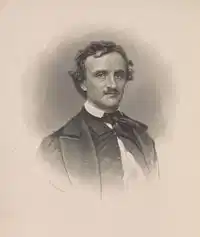
-Best known for horror stories, but he was also a poet.
-Wrote some of the first detective stories.
Edgar Allan Poe
11
Different genres of literature have different characteristics or features that we use to identify them.
In "The Tell-Tale Heart," the story is told from a first person perspective and we get to see the thoughts of the narrator.
12

13

14

15

16
17
Edgar Allan Poe
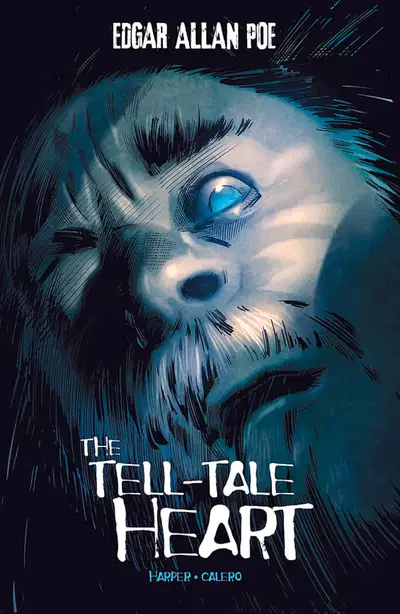
Vocabulary
Pages 416-417
18
Match
Match the following vocabulary words.
mad
observe
dreadful
furious
hideous
insane
watch
terrifying
frantic
horrible
insane
watch
terrifying
frantic
horrible
19
Match
Match the following vocabulary words.
bosom
fury
ceased
hastily
dreadfully
chest
rage
stopped
quickly
terribly
chest
rage
stopped
quickly
terribly
20
Match
Match the following vocabulary words.
hearty
marrow
dulled
cautious
precisely
cheerful
core
slowed
careful
exactly
cheerful
core
slowed
careful
exactly
21
Match
Match the following vocabulary words.
acute
extent
over-acuteness
conceived
scarcely
sharp
amount
extra sharpness
thought up
barely
sharp
amount
extra sharpness
thought up
barely
22
Match
Match the following vocabulary words.
vex
object
triumph
corpse
degrees
worry
goal
victory
dead body
stages
worry
goal
victory
dead body
stages
23
Match
Match the following vocabulary words.
proceeded
caution
latch
cautiously
boldly
moved forward
carefulness
lock
carefully
confidently
moved forward
carefulness
lock
carefully
confidently
24
Match
Match the following vocabulary words.
courageously
deeds
pitch
hearkening
presently
bravely
actions
tar
listening
at the moment
bravely
actions
tar
listening
at the moment
25
Match
Match the following vocabulary words.
in vain
enveloped
dull
pulsation
precautions
useless
surrounded
dim
beat
steps taken to prevent a bad outcome
useless
surrounded
dim
beat
steps taken to prevent a bad outcome
26
Match
Match the following vocabulary words.
concealment
foul play
lodged
dissimulation
foresight
hiding
wrongdoing
presented
deception
planning
hiding
wrongdoing
presented
deception
planning
27
28
Edgar Allan Poe
Pages 410-415
29
Open Ended
Define silence in four words.
30
Multiple Choice
What is the main idea of the story?
The story is about a dog, an eye and a curse.
The story is about police officers who arrest a criminal.
The story is about a man who commits a crime and is driven to confession.
The story is about a man who has a heart problem.
31
Multiple Choice
What is the setting of the story?
The old man's living room at his vacation house in the country.
The old man's basement at midnight.
The old man's attic at midnight.
The old man's house, in his bedroom at midnight.
32
Multiple Choice
What does the title mean?
The old man is telling a tale.
The old man's beating heart doesn't stop even after he kills him.
The narrator blames the old man's heart for giving him away.
The old man's eye causes the narrator to tell a tale.
33
Multiple Choice
Why does the narrator confess his crime?
The narrator confesses because he thinks the police are the real murderers.
The narrator confesses because he knows the old man is not really dead.
The narrator confesses because he thinks the police are mocking him and can hear the heartbeat.
The narrator confesses because the officers knew the crime that had been committed.
34
Multiple Choice
How long did it take the narrator to accomplish his goal?
6 nights
7 nights
8 nights
9 nights
35
Multiple Choice
How does the narrator feel about the old man?
He loves him
He hates him
He wants to spend more time with him
He has forgotten him
36
Multiple Choice
What is the narrator most likely hearing when he thinks he hears the old man's heartbeat?
The old man's heart
The police arriving
His own heartbeat
His blood drops
37
Multiple Choice
How is the narrator feeling when the police FIRST enter his home?
Terrified
Confident
Guilty
Scared
38
Multiple Choice
Where did the narrator tell the police that the old man was?
At his mother's house
Taking a walk
Asleep in his bed
Out in the country
39
Multiple Choice
“It was the beating of the old man’s heart. It increased my fury, as the beating of a drum stimulates the soldier into courage” is an example of...
Metaphor
Simile
Hyperbole
Personification
40
Open Ended
Paraphrase/Explain the following sentence: "TRUE!-nervous-very, very dreadfully nervous I had been and am; but why will you say that I am mad?
41
42
from Queen v. M'Naghten (1843)
"...the jurors out to be told in all cases that every man is presumed to be sane, and to possess a sufficient degree of reason to be responsible for his crimes, until the contrary be proved to their satisfaction; and that to establish a defense on the ground of insanity, it must be clearly proved that, at the time of the committing of the act, the party accused was laboring under such a defect of reason, from disease of the mind, as not to know the nature and quality of the act he was doing; or, if he did know it, that he did not know he was doing what was wrong."
43
The two conditions needed to judge a person legally sane, therefore, are:
1. The accused understood what he was doing.
AND
2. The accused knew that what he was doing was wrong.
Sane
According to the M'Naghten Rule, a person can be considered legally insane if he meets one of these two conditions:
1. The accused did not understand what he was doing-he did not understand reality.
OR
2. The accused did not understand that what he was doing was wrong.
Insane
44
Open Ended

Review paragraphs 12 and 13 on page 413 of your text. Determine the narrator's sanity, find 3-5 pieces of evidence that you can cite to show that the narrator is insane or sane. Make your decision, and share your findings.
By Amy Shaw
Show answer
Auto Play
Slide 1 / 44
SLIDE
Similar Resources on Wayground

35 questions
PSSA 6th Grade ELA Review
Presentation
•
6th - 8th Grade
40 questions
MINTS
Presentation
•
6th - 8th Grade
40 questions
Word Relationships Review
Presentation
•
6th - 8th Grade
38 questions
Setting's Influence
Presentation
•
6th - 8th Grade
38 questions
Homophones
Presentation
•
6th - 8th Grade
38 questions
(E8) Unit 3- Write
Presentation
•
6th - 8th Grade
39 questions
Zero & First Conditional (Explanation+Quiz)
Presentation
•
6th - 8th Grade
41 questions
Informational Review
Presentation
•
7th - 8th Grade
Popular Resources on Wayground
10 questions
How much do you know about our Portrait of an Eagle?

Quiz
•
10th Grade
10 questions
Fast Food Slogans
Quiz
•
6th - 8th Grade
21 questions
Continents and Oceans
Quiz
•
6th Grade
20 questions
Parts of Speech
Quiz
•
5th Grade
16 questions
Subject & Predicate
Quiz
•
5th Grade
25 questions
Multiplication Facts
Quiz
•
5th Grade
12 questions
Map Skills
Quiz
•
3rd Grade
22 questions
Continents and Oceans
Quiz
•
5th Grade
Discover more resources for English
20 questions
Context Clues
Quiz
•
6th Grade
20 questions
Types of sentences
Quiz
•
6th Grade
25 questions
Making Inferences
Quiz
•
6th - 8th Grade
20 questions
Figurative Language Review
Quiz
•
6th Grade
15 questions
Plot Elements
Quiz
•
6th Grade
20 questions
Figurative Language Review
Quiz
•
8th Grade
12 questions
Chemical Reactions

Interactive video
•
7th Grade
18 questions
Main Idea
Quiz
•
4th - 6th Grade