
Livestock Digestive Systems

Presentation
•
Science
•
9th - 12th Grade
•
Hard
Standards-aligned

Caleigh Robinson
FREE Resource
7 Slides • 21 Questions
1

2

3
Multiple Choice
What are the main functions of the digestive system?
Converts feed into energy and nutrients
Determines feed efficiency
Identifies nutritional disorders
Guides feed formulation
4

5
Multiple Choice
Which of the following species have a monogastric digestive tract?
Pigs
6
Multiple Choice
In pigs, which part of the digestive system is primarily responsible for nutrient absorption?
Stomach
Small intestine
Large intestine
Cecum
7
Multiple Choice
What is the main function of the stomach in the digestive system?
Storing excess water in the body
Breaking down food and mixing it with digestive juices
Regulating body temperature
Producing red blood cells
8
Multiple Choice
What is the main function of the large intestine?
To absorb water and form feces.
9
Multiple Choice
What feed type do animals with monogastric digestive systems predominantly eat?
Forages
Roughages
Concentrates and easily digested grain
10

11
Multiple Choice
Ruminants have ___ complex stomach stuctures
1
2
3
4
12
Multiple Choice
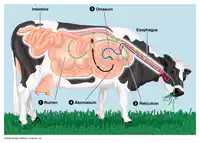
The ruminant structures are :
espohgus , mouth, teeth and cecum
rumen, reticulum, omasum and abomasum
stomach, small intestine large intestine
13
Multiple Choice
What is the abomasum often referred to as?
The false stomach.
The digestive pouch.
The true stomach.
The fermentation chamber.
14
Multiple Choice
What is the significance of microbial fermentation in the rumen?
It breaks down complex carbohydrates into simpler compounds.
It produces oxygen for aerobic respiration.
It synthesizes vitamins that are not available in the diet.
It increases the acidity of the rumen contents.
15
Multiple Choice
What role does the reticulum play in ruminant digestion?
It helps in the formation of cud.
It absorbs nutrients from the food.
It secretes digestive enzymes.
It regulates the pH of the stomach.
16
Multiple Choice
What is cud and how is it formed?
Cud is a type of food that is eaten raw.
Cud is regurgitated food that is re-chewed for further digestion.
Cud is a digestive enzyme produced in the stomach.
Cud is a type of plant that grows in wet areas.
17
Multiple Choice
How does the structure of the rumen aid in digestion?
Its large size allows for fermentation and microbial action.
It has a smooth lining that prevents food from sticking.
It contains enzymes that break down carbohydrates.
It is connected directly to the intestines for quick absorption.
18
Multiple Choice
What is the main purpose of the omasum?
Absorption of water and nutrients.
Production of bile.
Secretion of digestive enzymes.
Storage of food.
19
20
Multiple Choice
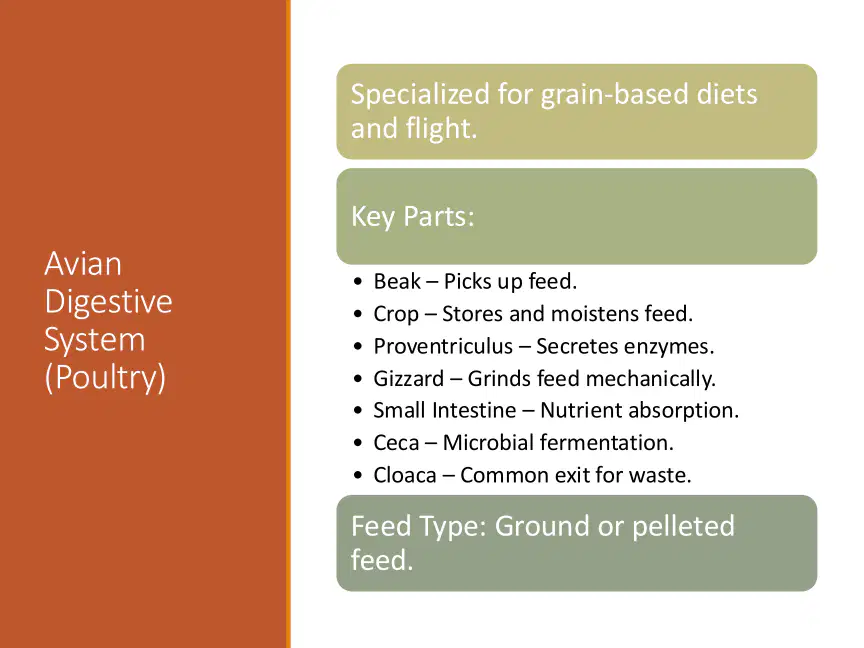
How do birds mechanically break down their food without having teeth?
21
Multiple Choice
How does the digestive system of avians accommodate their flying lifestyle?
By having a larger liver for detoxification
By having a more efficient gizzard for grinding food quickly
By having a shorter intestine for faster digestion
By having a lightweight, compact digestive system
22
Multiple Choice
SWALLOWED FEED AND WATER ARE STORED HERE UNTIL THEY ARE PASSED TO THE REST OF THE DIGESTIVE TRACT.
CROP
GIZZARD
CECA
ESOPHAGUS
23
Multiple Choice
THIS PART OF THE AVIAN DIGESTIVE SYSTEM IS ALSO KNOWN AS THE "TRUE STOMACH".
PROVENTRICULUS
GIZZARD
VENTRICULUS
SMALL INTESTINE
24
Multiple Choice
THE GIZZARD IS ALSO KNOWN BY THIS NAME.
VENTRICULUS
PROVENTRICULUS
DUODENUM
COLON
25
Multiple Choice
THIS ORGAN OF THE AVIAN DIGESTIVE SYSTEM ACTS AS THE BIRD'S TEETH.
CROP
GIZZARD
SMALL INTESTINE
JEJUNUM
26
27
Multiple Choice
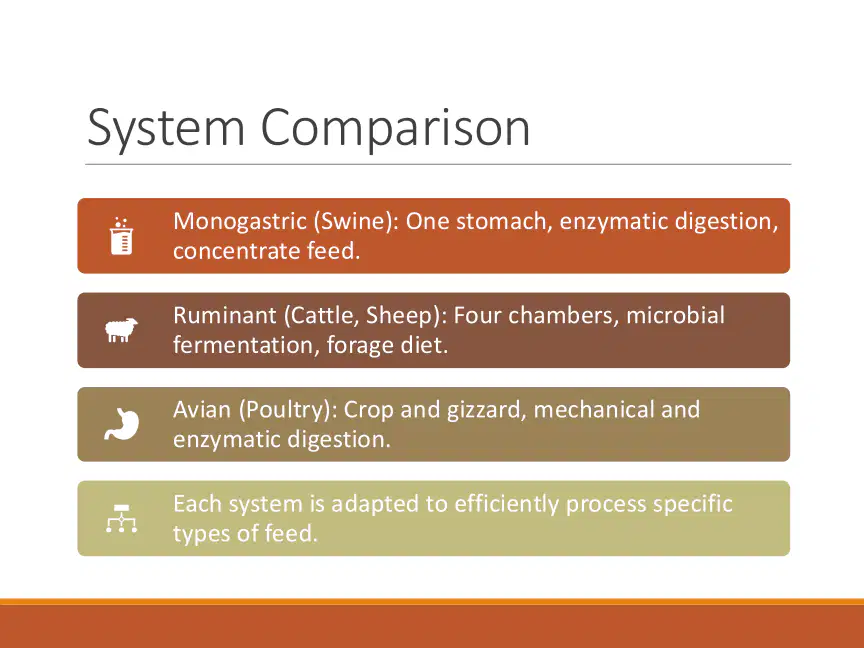
What are the main differences between monogastric, ruminant, and avian digestive systems?
Monogastric has one stomach, ruminants have four chambers, avians have crop and gizzard.
All systems have the same digestive process.
Ruminants only eat grass, while monogastrics can eat anything.
Avians do not digest food at all.
28
Show answer
Auto Play
Slide 1 / 28
SLIDE
Similar Resources on Wayground

21 questions
Germ Theory EOC Review
Presentation
•
9th - 12th Grade
22 questions
Chemical Bonding Notes
Presentation
•
9th - 12th Grade
20 questions
Human Population Growth Lesson
Presentation
•
9th - 12th Grade
20 questions
States of Matter Review
Presentation
•
3rd Grade
21 questions
Lesson: Hydrocarbons
Presentation
•
9th - 12th Grade
22 questions
Day 1 of Classification of Matter
Presentation
•
9th - 12th Grade
21 questions
Climate Change and Weather
Presentation
•
9th - 12th Grade
Popular Resources on Wayground
10 questions
HCS SCI 03 Summer School Assessment 1

Quiz
•
3rd Grade
15 questions
HCS SCI 05 Summer School Assessment 1 Review
Quiz
•
5th Grade
22 questions
Day 9 Equations and Inequalities Review
Quiz
•
9th Grade
10 questions
Writing and Identifying Ratios Practice
Quiz
•
5th - 6th Grade
7 questions
PYRAMID PERSPECTIVES part 1
Presentation
•
9th - 12th Grade
12 questions
Understanding the Fourth of July
Quiz
•
9th Grade
15 questions
Soccer World Cup Quiz Questions
Quiz
•
7th Grade