

Unit 3 GDP

Presentation
•
Social Studies
•
9th - 12th Grade
•
Practice Problem
•
Easy

Christina Purvis
Used 11+ times
FREE Resource
12 Slides • 33 Questions
1
Reviewing GDP & adding new information.
Carefully read the slides and answer the quetions.
Some of this will be based on the notes and some of this will be new information you need to add to understanding of GDP so far. IT IS IMPORTANT YOU READ EACH SLIDE.
2
Match
Match each component of GDP with is definition.
C
I
G
X
M
Spending by households
Spending by businesses on inventory
Spending by gov on goods & services
Goods purchased in other countries
Goods produced in other countries
Spending by households
Spending by businesses on inventory
Spending by gov on goods & services
Goods purchased in other countries
Goods produced in other countries
3
Multiple Choice
In the context of GDP, "investment" means financial assets such as stocks and bonds.
True
False
4
Multiple Choice
Why are transfer payments not included in the calculation of GDP?
They don't reflect the production of a good or service.
They only include investment spending.
They reflect actual production of a good which is not counted in GDP.
5
Match
Match
Exports
Imports
Trade Balance
domestically produced goods
goods produced in other countries
the gap betwen exports and imports
domestically produced goods
goods produced in other countries
the gap betwen exports and imports
6
Multiple Choice
Country A reports the following economic activity for one year (in billions of dollars):
Consumption (C): 500
Investment (I): 200
Government Spending (G): 300
Exports (X): 150
Imports (M): 100
Using the expenditures approach, what is Country A’s GDP?
1,150 billion
1,050 billion
200 billion
1,250 billion
7
Multiple Choice
Net exports = X − M
What is true about trade surplus?
X > M → trade surplus
M > X → trade surplus
X = M → trade surplus
8
Multiple Choice
What types of products are excluded from GDP because they are used to make other products?
Intermediate products
Secondhand sales
Non-market transactions
9
Multiple Choice
Which of the following would increase GDP?
You mow your own lawn this weekend.
You buy a used car from a friend.
A bakery sells a loaf of bread to a customer.
You sell cookies at a neighborhood bake sale for cash that you don’t report.
10
Multiple Choice
Why are replacement tires for your car counted in GDP, but tires on a new car are not counted separately?
Replacement tires are more expensive than tires on a new car.
Tires on a new car are considered intermediate goods, already included in the car’s price.
Replacement tires are part of the underground economy.
Tires on a new car are secondhand goods.
11
12
Multiple Choice
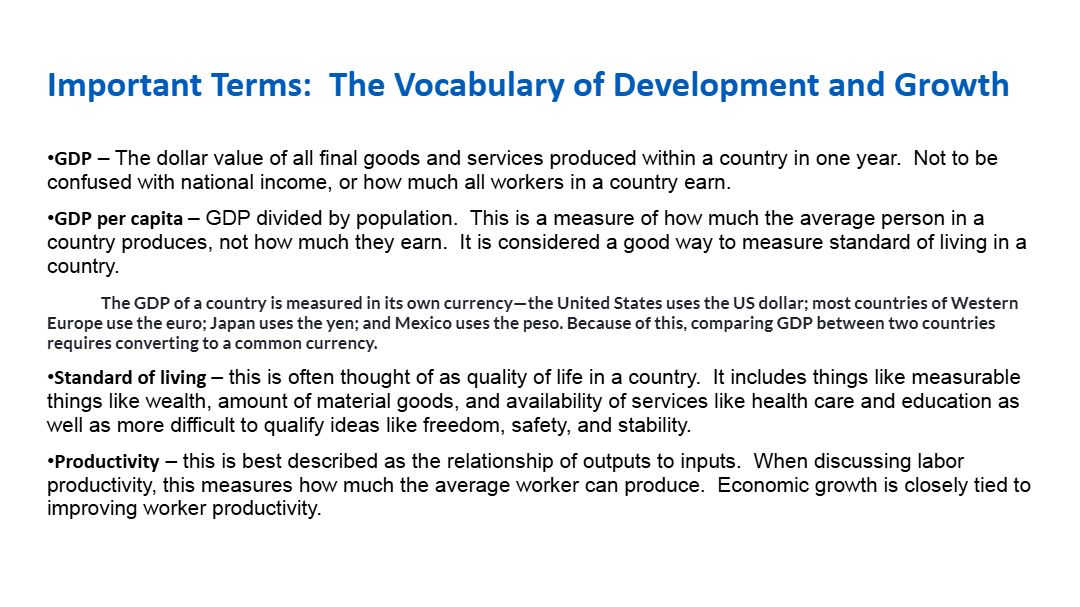
What is GDP?
national income within one year
the value of all final goods and services produced within one year
how much all workers in a country earn per year
a population's standard of living across one year
13
Multiple Choice
How do we find per capita GDP?
GDP divided by inflation
exports minus imports
GDP divided by population
how much someone earns on average
14
Multiple Choice
What is the standard of living?
quality of life in a country
how much the average person makes
how much the average company sells
minimum wage
15
Multiple Choice
How does the standard of living relate to GDP and what factors contribute to it?
Wealth and material goods
Health care and education
Freedom, safety, and stability
All of the above
16

17
Multiple Choice
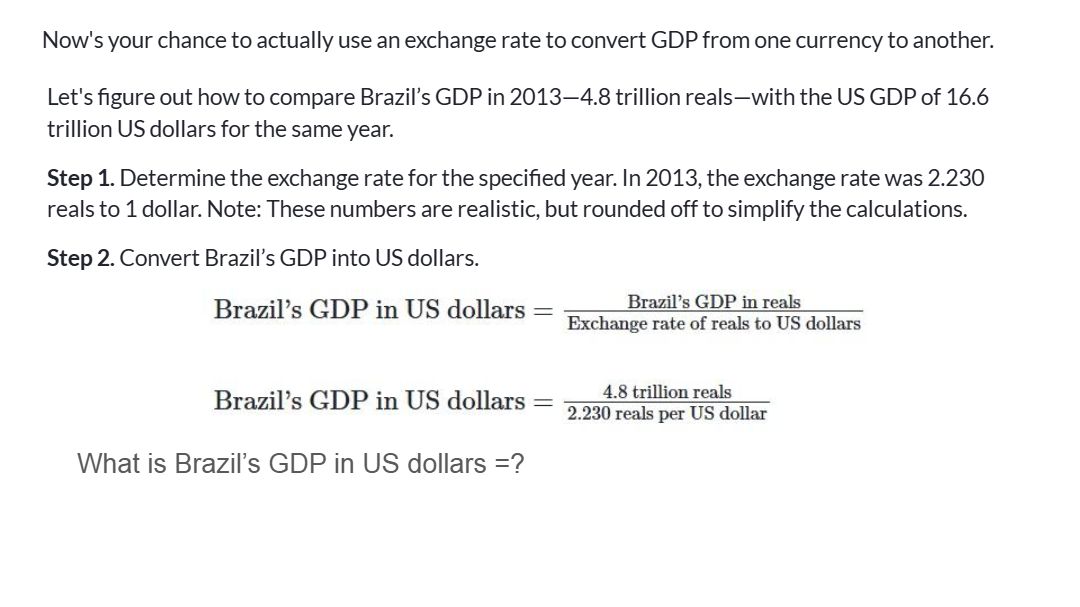
What is the purpose of using an exchange rate when comparing the GDP of countries with different currencies?
To determine the population of a country
To convert currencies to a common denominator
To calculate the interest rates
To analyze the stock market
18
19
Poll

Mexico's currency is called the ....
La moneda de México se llama...
Peso
Dollar
Yen
Ruble
20
Multiple Choice

21

22
Reorder

Put in order the countries with the largest GDP in billions of US dollars from the largest to the smallest.
USA
China
Japan
United Kingdom
Egypt
23
24
POPULATION
Changes in population can distort some macroeconomic measures like GDP.
Population growth can have several consequences. If a nation’s population grows faster than its output, per capita output grows more slowly, & the country could end up with more mouths than it can feed. This is not a good situation.
On the other hand, if a nation’s population grows too slowly, there may not be enough workers to sustain economic growth. This is also not a good situation.
In addition, a growing population puts more demand on resources. When a growing population shifts toward certain areas, such as cities or suburbs, it puts different pressures on existing resources. In Atlanta, Georgia, for example, urban sprawl and traffic congestion have become major problems. In heavily populated areas of Arizona, Nevada, and southern California, adequate supplies of fresh water have become concerns. Because it takes a long time to plan and construct a country’s infrastructure— the highways, levees, mass transit, communications systems, electricity, water, sewer, and other public goods needed to support a population—we need to pay attention to future population trends. If we neglect them, even modest shifts in the population can cause enormous problems in the future.
25
Multiple Choice
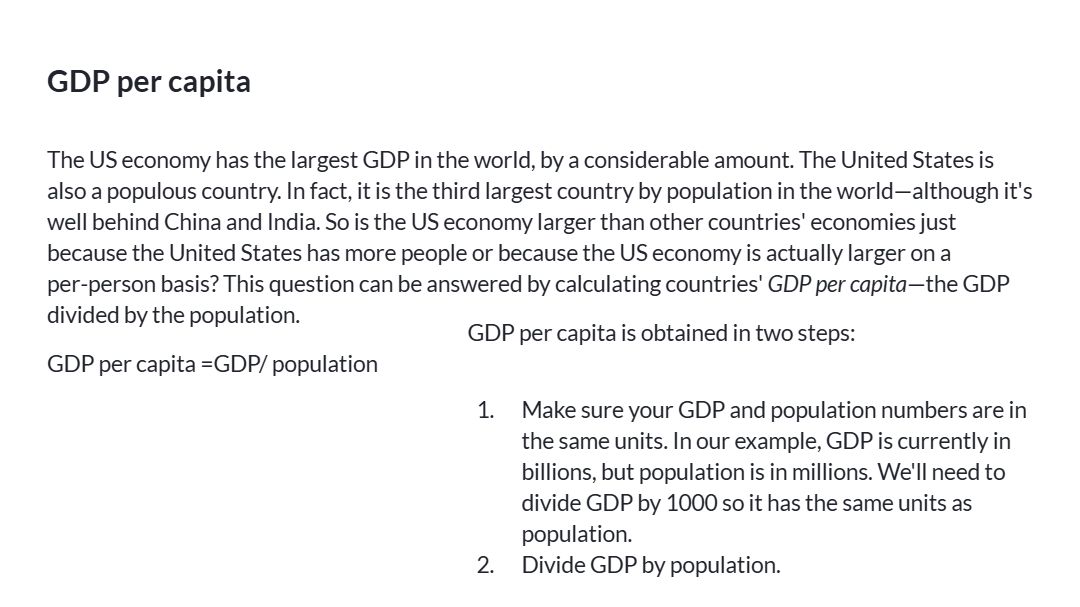
Think Back and Review: What is the formula for calculating GDP per capita?
GDP/ population
GDP x population
GDP + population
GDP - population
26
Multiple Choice
What happens if a nation’s population grows faster than its output?
Economic growth is guaranteed
The country could have more people than it can feed
27
Multiple Choice
What is a potential problem if a nation’s population grows too slowly?
There may not be enough workers to sustain economic growth
Traffic congestion becomes a major problem
Freshwater supplies increase
Per capita output decreases
28
Multiple Choice
Why is it important to plan infrastructure with population trends in mind?
Infrastructure only affects rural populations
Population growth does not impact infrastructure needs
Infrastructure construction takes a long time, and neglecting trends can cause future problems
Population shifts only affect agricultural areas
29
30
Multiple Choice

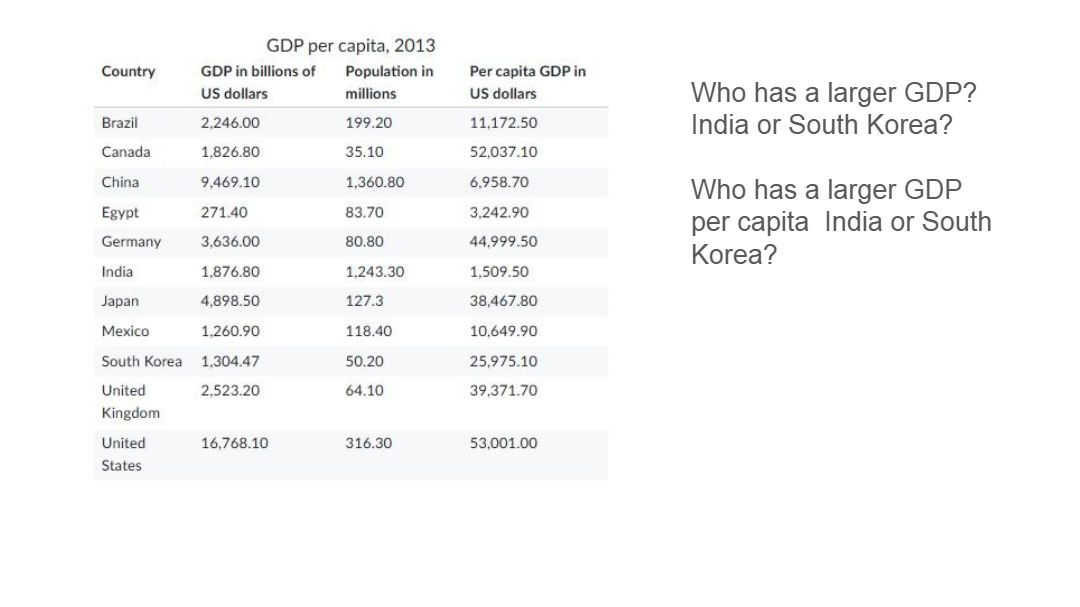
Who has a larger GDP per capita? India or South Korea?
India
South Korea
31
Multiple Choice

Who has a larger GDP in billions of US dollars? India or South Korea?
India
South Korea
32
Multiple Choice
A high standard of living is typically characterized by:
Low GDP per capita
High levels of poverty
High GDP per capita
High levels of unemployment
33
Multiple Choice
Economists use different indicators to understand how well people in a country are living — known as the standard of living.
Life Expectancy – The average number of years a person is expected to live in a country.
Literacy Rate – The percentage of people who can read and write.
Infant Mortality Rate – The number of babies who die before their first birthday for every 1,000 born.
Based on the info above, which of the following is NOT commonly used to measure a country's standard of living?
Life Expectancy
Literacy Rate
Infant Mortality Rate
National Debt
34
Open Ended
Life Expectancy – The average number of years a person is expected to live in a country.
Example: Japan – 84 years; Nigeria – 55 years
Literacy Rate – The percentage of people who can read and write.
Example: United States – 99%; Afghanistan – 38%
Infant Mortality Rate – The number of babies who die before their first birthday for every 1,000 born.
Example: Canada – 4 deaths per 1,000 births; Somalia – 73 deaths per 1,000 births
What can differences in life expectancy between Japan and Nigeria tell you about their healthcare systems and overall living conditions?
35
Open Ended
Life Expectancy – The average number of years a person is expected to live in a country.
Example: Japan – 84 years; Nigeria – 55 years
Literacy Rate – The percentage of people who can read and write.
Example: United States – 99%; Afghanistan – 38%
Infant Mortality Rate – The number of babies who die before their first birthday for every 1,000 born.
Example: Canada – 4 deaths per 1,000 births; Somalia – 73 deaths per 1,000 births
How might the difference in literacy rates between the United States and Afghanistan affect job opportunities and economic growth in each country?
36
37
Multiple Choice
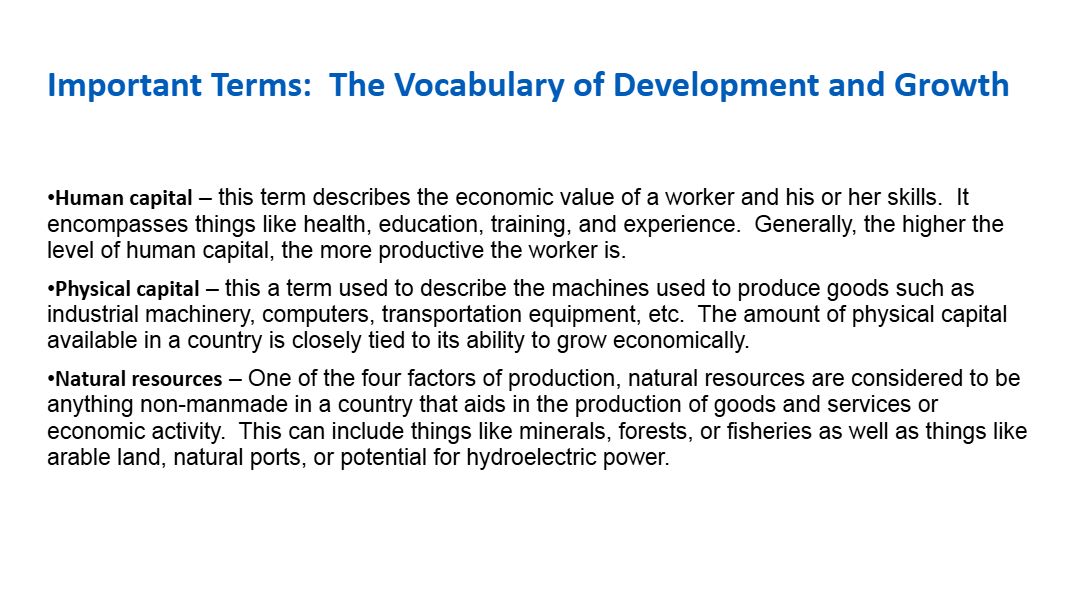
The ultimate source of the region’s wealth is Washington’s unparalleled human capital. The population is the best educated of any large metro’s in the United States; about half the region’s adults hold bachelor’s degrees, and nearly a quarter have graduate degrees.
—Richard Florida, “The Boom Towns and Ghost Towns of the New Economy,” The Atlantic, October 2013
Which statement can best be inferred from the excerpt?
The region’s wealth is primarily based on its investment in education and skilled workers.
The region’s economy is strong because it exports more goods than it imports.
The region’s wealth depends mainly on its access to raw materials and land.
38
Multiple Choice
What does Human Capital refer to in economics?
The size of a country's labor force
The ratio of workers to physical capital
The economic value of a worker's skill set
The number of workers needed to build the Capitol
39
Multiple Select

A Natural Resource comes from Earth. Which items are natural resources? Select ALL that apply...
wood
plastic
bricks
water
wind
40
Multiple Choice
Physical capital refers to the tools, machines, buildings, and equipment that help produce goods and services. When countries invest in physical capital, workers can produce more in less time, helping to increase Gross Domestic Product (GDP) — the total value of goods and services a nation produces.
Document A:
In Country A, most factories use modern machinery and technology to manufacture cars. Each worker produces 10 cars per week.
Document B:
In Country B, factories rely on old equipment that often breaks down. Each worker produces only 4 cars per week.
Based on the documents above, what can be inferred about the relationship between physical capital and a country's GDP?
Investing in modern tools and equipment helps workers become more productive, increasing GDP.
Older tools and machinery make workers more efficient and reduce production costs.
GDP decreases when countries invest in physical capital instead of labor.
41
What else impacts economic growth and development?
The Dependency Ratio
Dependents rely on workers for support (like money for food, healthcare, schools, and pensions).
A high dependency ratio means fewer workers supporting more dependents → more pressure on the economy.
A low dependency ratio means more workers per dependent → easier to support services and grow the economy.

42
Dependency Ratio
Imagine a small town with: 10 children, 5 elderly, and 50 working age adults.

43
Multiple Choice

Now imagine a city with: 40 children, 20 elderly, 50 working-age adults.
Step 1- Add the dependents
Step 2- Find the amount of the working age adults.
Step 3- Calculate-
What is the dependency ratio and what does it mean?
120%- There are more dependents than workers! This is tough on the economy because fewer workers must support more people.
100%- There are more dependents than workers! This is tough on the economy because fewer workers must support more people.
30%- Not too high—workers can handle supporting the dependents.
25%- Not too high—workers can handle supporting the dependents.
44
Match
The dependency ratio is like a balance scale between people who work and people who depend on them.
Match.
High dependency
low dependency
dependents
more stress on workers and the economy.
easier to provide services, save money,
People that cannot work
more stress on workers and the economy.
easier to provide services, save money,
People that cannot work
45
Robert F. Kennedy
"GDP is a very important measurement of everything except that which makes life worthwhile."
"It measures neither our wit nor our courage, neither our wisdom nor our learning, neither our compassion nor our devotion to our country."
Reviewing GDP & adding new information.
Carefully read the slides and answer the quetions.
Some of this will be based on the notes and some of this will be new information you need to add to understanding of GDP so far. IT IS IMPORTANT YOU READ EACH SLIDE.
Show answer
Auto Play
Slide 1 / 45
SLIDE
Similar Resources on Wayground

39 questions
The Spread of Industrialization
Presentation
•
9th - 12th Grade
39 questions
The End of the Civil War
Presentation
•
9th - 12th Grade
39 questions
Industrialization
Presentation
•
9th - 12th Grade
40 questions
Introduction to Environmental Science Lesson
Presentation
•
9th - 12th Grade
38 questions
Unit 4 Test Review
Presentation
•
9th - 12th Grade
39 questions
3.5 Industrialization
Presentation
•
9th - 12th Grade
38 questions
Voting and Elections
Presentation
•
9th - 12th Grade
41 questions
Explanatory Essay Timed Write
Presentation
•
9th - 12th Grade
Popular Resources on Wayground
6 questions
PRIDE Always and Everywhere
Presentation
•
12th Grade
20 questions
Lab Safety Quiz

Quiz
•
6th Grade
26 questions
KOR Review Kahoot Questions
Quiz
•
8th Grade
21 questions
Continents and Oceans
Quiz
•
6th Grade
12 questions
Unit Zero lesson 2 cafeteria
Presentation
•
9th - 12th Grade
20 questions
Parts of Speech
Quiz
•
5th Grade
10 questions
Riddles Riddles fun Riddles
Quiz
•
6th - 12th Grade
16 questions
Subject & Predicate
Quiz
•
5th Grade
Discover more resources for Social Studies
6 questions
PRIDE Always and Everywhere
Presentation
•
12th Grade
6 questions
PRIDE in the Hallways and Bathrooms
Presentation
•
12th Grade
10 questions
Exploring the Age of Exploration: Key Events and Figures

Interactive video
•
6th - 10th Grade
8 questions
Pre Civil Formative
Quiz
•
11th Grade
30 questions
AP Human Geography Unit 1
Quiz
•
9th - 12th Grade
42 questions
Unit 3 Key Terms
Quiz
•
11th Grade
8 questions
Source Analysis Formative
Quiz
•
10th Grade
64 questions
USHC 4 Key Terms 22-23
Quiz
•
11th Grade - University