

Abiotic components

Presentation
•
Science
•
7th Grade
•
Practice Problem
•
Easy

teresita moreno
Used 2+ times
FREE Resource
19 Slides • 44 Questions
1

2

3
Multiple Choice
Which of the following best describes the difference between abiotic and biotic components of an ecosystem?
Abiotic components are non-living, while biotic components are living.
Abiotic components are living, while biotic components are non-living.
Both abiotic and biotic components are living.
Abiotic components only include animals.
4
Open Ended
Why is it important to understand the abiotic components of an ecosystem?
5

6
Multiple Choice
Plants, mushroom, and animals are examples of abiotic components of an ecosystem
TRUE
FALSE
7
Multiple Choice
An abiotic component is a living part of an ecosystem that shapes its environment.
TRUE
FALSE
8
Multiple Choice
Abiotic components are very important to the biotic components of the ecosystem.
TRUE
FALSE
9

10
Multiple Choice
A cow that is a living thing can survive without water and air.
TRUE
FALSE
11
Multiple Choice
Oxygen is used in the process of respiration in our cells.
TRUE
FALSE
12
Multiple Choice
Water is unimportant to survival of life.
TRUE
FALSE
13
Multiple Choice
Humans can lessen its disturbance to the abiotic components of an ecosystem by contaminating the bodies of water.
TRUE
FALSE
14
Multiple Choice
Plant conducts the process of photosynthesis without the presence of sunlight.
TRUE
FALSE
15
Multiple Choice
Earthquake is a major environmental disturbance to the abiotic components of an ecosystem.
TRUE
FALSE
16
Multiple Choice
Wildfires, earthquakes and building constructions are major environmental disturbances..
TRUE
FALSE
17
Open Ended
Why are abiotic components important for the survival of living organisms in an ecosystem?
18

19
Multiple Choice
Which of the following statements about biotic and abiotic components is correct?
Biotic components are living things, and abiotic components are non-living things.
Abiotic components are living things, and biotic components are non-living things.
Both biotic and abiotic components are living things.
Both biotic and abiotic components are non-living things.
20
Fill in the Blanks
Fill in the blank: The branch of Biology that studies how organisms interact with each other and their environment is called
21
Multiple Choice
Which of the following are examples of abiotic components in an ecosystem?
Sunlight, water, soil, air
Plants, animals, fungi, bacteria
Trees, birds, caterpillars, microbes
Mushrooms, grass, insects, fish
22
Open Ended
Explain how organisms interact with each other and their environment in an ecosystem.
23
Multiple Choice
Which of the following best describes the two main components of an ecosystem?
Living (biotic) and non-living (abiotic) things
Plants and animals only
Water and soil only
Sunlight and air only
24

25

26
Multiple Choice
Which of the following is NOT a non-living component needed by living things in an ecosystem?
Sunlight
Water
Soil
Food
27

28
Multiple Select
Which of the following statements about water is/are correct?
Water is considered a universal solvent.
All living things need water.
Water is not necessary for nutrient transport.
50% of most living things is composed of water.
29
30
Fill in the Blanks
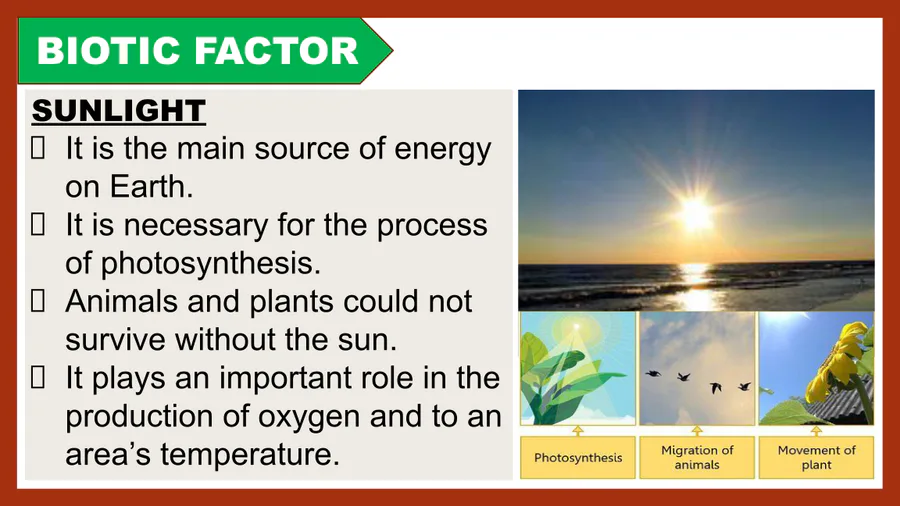
Fill in the blank: Sunlight is necessary for the process of
31

32
Open Ended
Describe two important roles of soil in the growth and development of plants.
33

34
Multiple Choice
Which gases are found in the air that humans, plants, and animals breathe?
Oxygen, carbon dioxide, nitrogen, hydrogen
Oxygen, methane, helium, neon
Oxygen, carbon dioxide, argon, krypton
Oxygen, nitrogen, chlorine, fluorine
35
Open Ended
Explain why carabaos cannot survive without water and air, using information from the images.
36

37
Multiple Choice
Which of the following is an example of how temperature as an abiotic factor influences the survival of living organisms?
A polar bear cannot live in a desert due to high temperatures.
A cactus grows in the rainforest due to high rainfall.
A fish lives on land because of oxygen availability.
A frog survives in the desert due to lack of water.
38

39
Open Ended
List three abiotic factors mentioned in the slides that are important for shaping healthy ecosystems.
40

41
Fill in the Blanks
Animals and plants are dependable on
Type answer...
42

43
Open Ended
Why can't a carabao survive in the polar region according to the slides?
44

45
Multiple Select
Which of the following changes in abiotic factors can negatively affect fish in an ecosystem? Select all that apply.
Increase in sea acidity
Decrease in sunlight
Stable temperature
Increase in rainfall
46

47
Open Ended
How does climate change impact polar bears in cold regions, as described in the slides?
48

49
Fill in the Blanks
Fill in the blank: Sunlight and heat are examples of
50
Open Ended
Why is it important for humans to take care of both biotic and abiotic components in an ecosystem?
51

52
Multiple Choice
Which of the following describes abiotic component?
It has a living and non–living organism.
It is a living organism in an ecosystem.
It is a non–living thing in an ecosystem.
It is an organism that lives in an ecosystem
53
Multiple Choice
The following are examples of abiotic components of an ecosystem EXCEPT.
bird
rock
Sunlight
water
54
Multiple Choice
Why is water said to be universal solvent?
It dissolves some substances.
It dissolves almost all substances.
It is dissolved by some substances.
It is dissolved by almost all substances.
55
Multiple Choice
How important is oxygen to the living things?
It is important since we can live without it.
It is important since it is used in the process of photosynthesis.
It is important since we cannot produce carbon dioxide without it.
It is important since it is used by our cells in the process of respiration.
56
Multiple Choice
Which Abiotic components influence the survival of plants and animals that living in a certain location?
Boulder, Peebles, Sand
Minerals, Nutrients, Rocks
Nitrogen, Carbon, Oxygen
Temperature, Water, Soil
57
Multiple Choice
What abiotic component is made up of small particles of rock mixed with decomposed living things like animals?
Oxygen
Soil
Temperature
Water
58
Multiple Choice
Which is the main source of energy on Earth?
Moonlight
Radiation
Sunlight
Ultraviolet rays
59
Multiple Choice
Which of the following is a manmade disturbance to the abiotic components of an ecosystem?
climate change
earthquake
Migration
typhoon
60
Multiple Choice
The following animals can survivr in a warm region EXCEPT.
Crocodile
Polar bear
Maya
Tamaraw
61
Multiple Choice
Which of the following is NOT a natural disturbance to the abiotic components in an ecosystem?
disease
earthquake
land clearing
typhoon
62
Open Ended
What questions do you still have about abiotic and biotic components of an ecosystem, or is there anything you would like to know more about this topic?
63
Open Ended
How do abiotic components influence the living organisms in an ecosystem?
Show answer
Auto Play
Slide 1 / 63
SLIDE
Similar Resources on Wayground

59 questions
Civil War
Presentation
•
7th Grade
56 questions
Phase changes and States of Matter
Presentation
•
8th Grade
62 questions
Oceans
Presentation
•
8th Grade
58 questions
What is FACS?!
Presentation
•
7th Grade
58 questions
CFE Review (Comp 3)
Presentation
•
8th Grade
63 questions
SPEED and VELOCITY
Presentation
•
7th Grade
56 questions
Weathering Part 1
Presentation
•
6th Grade
59 questions
Yo go verbs & Tener
Presentation
•
7th Grade
Popular Resources on Wayground
21 questions
Continents and Oceans

Quiz
•
6th Grade
20 questions
Parts of Speech
Quiz
•
5th Grade
16 questions
Subject & Predicate
Quiz
•
5th Grade
25 questions
Multiplication Facts
Quiz
•
5th Grade
12 questions
Map Skills
Quiz
•
3rd Grade
22 questions
Continents and Oceans
Quiz
•
5th Grade
15 questions
Rounding Decimals
Quiz
•
5th Grade
20 questions
Brand Labels
Quiz
•
5th - 12th Grade
Discover more resources for Science
17 questions
7.6D Aqueous Solutions
Quiz
•
7th Grade
20 questions
Claim, Evidence and Reasoning (CER)
Quiz
•
6th - 8th Grade
10 questions
Exploring Chemical and Physical Changes

Interactive video
•
6th - 10th Grade
16 questions
Photosynthesis and Cellular Respiration Review
Quiz
•
7th Grade
20 questions
Food Webs + Energy Pyramids
Quiz
•
7th Grade
24 questions
Cell Organelles
Quiz
•
7th Grade
20 questions
Human Body Systems
Quiz
•
7th Grade
10 questions
Exploring the Periodic Table
Interactive video
•
6th - 10th Grade