Search Header Logo
Phase changes and States of Matter

Phase changes and States of Matter

Assessment

Presentation

Science

8th Grade

Medium

NGSS
MS-PS1-4, 5-PS1-3, MS-PS1-1

+9

Standards-aligned

Created by

Laura Terry

Used 30+ times

FREE Resource

0 Slides • 56 Questions

1

Multiple Choice

Question image

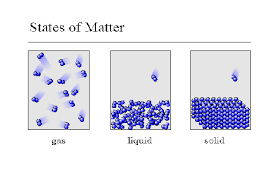
What state of matter does the picture below represent?

1

solid

2

liquid

3

gas

4

plasma

2

Multiple Choice

The state of matter that keeps its shape and volume when it is placed in a different container is called ______.

1

gas

2

liquid

3

solid

3

Multiple Choice

The state of matter that expands to fill its container is called ______.

1

gas

2

liquid

3

solid

4

Multiple Choice

What is a Solid?

1

Matter that has a fixed shape and size.

2

Matter that has a fixed size and no fixed shape

3

Matter that has no fixed shape or size

4

Matter that has no fixed shape and size

5

Multiple Choice

Which state of matter has its own shape

1

Gas

2

Solid

3

LIquid

6

Multiple Choice

Define a liquid.

1

Matter that has fixed shape but no fixed volume

2

Matter that has fixed shape and fixed volume

3

Matter that has fixed volume, but no fixed shape

7

Multiple Choice

Question image

The particles in the picture are tightly held together with very tiny movement. They have shape and fixed volume. Therefore, the picture represents _________.

1

solid

2

liquid

3

gas

4

plasma

8

Multiple Choice

In which state of matter will there be the LARGEST space between molecules?

1

Solid

2

Liquid

3

Gas

9

Multiple Choice

What is a gas?

1

Matter that has fixed shape but no fixed volume

2

Matter that has no fixed shape and no fixed volume

3

Matter that has no fixed shape but fixed volume

4

compounds

10

Multiple Choice

Question image

What state is represented in the gif?

1

Solid

2

Liquid

3

Gas

11

Multiple Choice

What determines the states of matter a material is in?

1

solid

2

liquid

3

temperature

4

gas

12

Multiple Choice

Liquid has a fixed shape

1

True

2

False

13

Multiple Choice

Solid has a fixed shape

1

True

2

False

14

Multiple Choice

Question image

Evaporation is the change of state of a

1

Gas to solid

2

Liquid to Gas

3

Solid to liquid

4

Liquid to Solid

15

Multiple Choice

Question image

What is the state change that occurs, when ice turns into a liquid?

1

Boiling

2

Condensation

3

Melting

4

evaporation

16

Multiple Choice

Question image

Condensation is when

1

Liquid turns to a solid

2

Gas turns to liquid

3

Solid turns to liquid

4

Liquid turns to a gas

17

Multiple Choice

Solid particles are

1

Far apart

2

Close, but able to move

3

Closest together

4

Fast moving

18

Multiple Choice

Question image

This image is an example of what particle

1

Solid

2

Liquid

3

Gas

19

Multiple Choice

What particles move the fastest?

1

Solid

2

Liquid

3

Gas

20

Multiple Choice

What is the state of matter of ice

1

Gas

2

Liquid

3

Solid

21

Multiple Choice

What is the name of the change when a liquid becomes a solid?

1

Precipitation

2

Freezing

3

boiling

4

evaporation

22

Multiple Choice

Why do solids have a fixed shaped?

1

The particles vibrate

2

The particles are fixed in place

3

The particles are closely packed together

4

The particles are free moving

23

Multiple Choice

When a gas reaches its condensation point what does it become?

1

Solid

2

Gas

3

Liquid

24

Multiple Choice

When a liquid reaches its freezing point what does it become?

1

Liquid

2

Gas

3

Solid

4

Plasma

25

Multiple Choice

Question image
At higher temperatures
1
particles in an object have less energy
2
particles in an object move faster
3
a gas contracts

26

Multiple Choice

The slower the particles in a substance move,

1

the colder it is.

2

the warmer it is.

3

the more energy it has.

27

Multiple Choice

5. What is it called when a solid turns directly into a gas?
1
Sublimation
2
Condensation
3
Liquid

28

Multiple Choice

Change from Gas to Solid is called........
1
Sublimation
2
Deposition
3
Fusion
4
condensation

29

Multiple Choice

Question image
What is the correct order of the states of matter?
1
Solid, Liquid, Gas
2
Gas, Liquid, Solid
3
Liquid, Gas, Solid
4
Solid, Gas, Liquid

30

Multiple Choice

Question image
If the tops were removed from the cylinders, the following would happen:
1
The solid would fly out of the container
2
The liquid would fly out of the container.
3
The gas would fly out of the container.
4
They ALL would fly out of the container.

31

Multiple Choice

What is matter?

1

Only the things we can see with our eyes.

2

Anything that has mass and takes up space.

3

Only liquids and solids.

4

The things that are important to us like happiness.

32

Multiple Choice

Question image

What effect is heat having on the ice?

1

Thermal expansion.

2

Temperature increase.

3

Temperature decrease.

4

Change in state.

33

Multiple Choice

What is the freezing in celsius

1

32°

2

100°

3

0°

4

965°

34

Multiple Choice

What is boiling in celsius

1

212°

2

32°

3

100°

4

1,000,000°

35

Multiple Choice

When it is cold the atoms move...

1

slow

2

fast

3

still

4

there are no atoms

36

Multiple Choice

when it is hot the atoms move...

1

slow

2

fast

3

still

4

there are no atoms

37

Multiple Choice

in the kelvin scales what degree stands for when the atoms are not moving

1

50°

2

32°

3

0°

4

100°

38

Multiple Choice

100 Celsius is ? Kelvin (K = Celsius + 273)

1

173 K

2

373K

3

273 K

4

0 K

39

Multiple Choice

Absolute Zero is which value:

1

0 K

2

0 °F

3

0 °C

40

Multiple Choice

Heat is the movement of ______.
1
radiation
2
thermal energy
3
cold
4
fire

41

Multiple Choice

the temperature scale on which 0 is the temp at which no more energy can be removed

1

absolute zero

2

Fahrenheit scale

3

Kelvin scale

4

Celsius scale

42

Multiple Choice

the temperature scale on which water freezes at 0 and boils at 100

1

Kelvin scale

2

conduction

3

Fahrenheit scale

4

Celsius scale

43

Multiple Choice

°C = (°F-32) x (5/9)

°F = (9/5) x °C + 32

Celsius = Kelvin - 273

Kelvin = Celsius + 273


Convert the temperature:

25 C = _______ F

1

77 °F

2

32 °F

3

28 °F

44

Multiple Choice

°C = (°F-32) x (5/9)

°F = (9/5) x °C + 32

Celsius = Kelvin - 273

Kelvin = Celsius + 273


Convert the temperature:

97 °C = _______ °F

1

97.3 °F

2

10.2 °F

3

206.6 °F

45

Multiple Choice

°C = (°F-32) x (5/9)

°F = (9/5) x °C + 32

Celsius = Kelvin - 273

Kelvin = Celsius + 273


Convert the temperature:

2 °C = _______ °F

1

56.9 °F

2

35.6 °F

3

0 °F

46

Multiple Choice

°C = (°F-32) x (5/9)

°F = (9/5) x °C + 32

Celsius = Kelvin - 273

Kelvin = Celsius + 273


Convert the temperature:

-40 °C = _______ °F

1

-40 °F

2

32 °F

3

0 °F

47

Multiple Choice

°C = (°F-32) x (5/9)

°F = (9/5) x °C + 32

Celsius = Kelvin - 273

Kelvin = Celsius + 273


Convert the temperature:

25 °F = _______ °C

1

-3.9 °C

2

-10 °C

3

13 °C

48

Multiple Choice

What is the freezing temperature of water in Kelvin?

1

0

2

32

3

273.1

49

Multiple Choice

What is the boiling point of water in Kelvin?

1

212

2

100

3

373.1

50

Multiple Choice

A measure of the average kinetic energy of the individual particles in an object is called:
1
thermal energy
2
conduction
3
convection
4
temperature

51

Multiple Choice

A thermometer takes the temperature as the liquid inside will _______ or _______ as the temperature changes.

1

expand or contract

2

move faster or move slower

3

become more or become less

52

Multiple Choice

Thermal expansion happens when _____________.

1

temperatures increase

2

temperatures decrease

3

temperatures fluctuate

53

Multiple Choice

Heat loss causes matter to ________. Heat gain causes matter to ________.

1

contract ; expand

2

expand ; contract

3

stay ; change

4

change ; stay

54

Multiple Choice

Question image

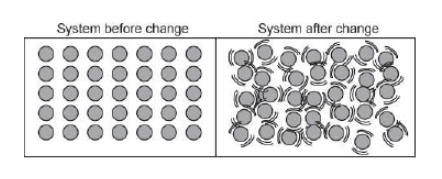
The picture below shows a closed system before and after undergoing a change.


What was changed in the system?

1

Particles were added to the system.

2

Water was added to the system.

3

Heat was added to the system.

4

Air was added to the system.

55

Multiple Choice

Question image
The molecules of a liquid vs. a solid....
1
Move slower in a liquid.
2
Move slower in a solid.

56

Multiple Choice

Question image
Why did the balloon come back down to the ground?
1
The air around it pushed it down.
2
The air inside cooled and became more dense forcing the balloon to descend. 
3
The air inside the balloon heated up and the air was too hot to rise. 
4
The balloon may have had a hole in it.
Question image

What state of matter does the picture below represent?

1

solid

2

liquid

3

gas

4

plasma

Show answer

Auto Play

Slide 1 / 56

MULTIPLE CHOICE