Temperature & Kinetic Energy
Presentation
•
Science
•
6th - 8th Grade
•
Practice Problem
•
Medium
+2
Standards-aligned
Amanda Taylor
Used 9+ times
FREE Resource
15 Slides • 16 Questions
1
Multiple Choice
Which explanation best describes what happens to the metal ball from step 1 to step 3 in the demonstration?
The particles in the ball gained kinetic energy when the temperature increased, and this caused them to spread out and increase the size of the ball.
The particles in the ball gained kinetic energy when the temperature increased, and this caused each particle to increase in size, so the ball expanded.
The particles in the ball lost kinetic energy to the air when the temperature increased, which caused the particles to spread out and make the ball larger.
The heat added particles to the ball, which made the ball increase in size.
2
3
Open Ended
How does the concept of thermal expansion help us understand changes in everyday objects when they are heated or cooled?
4
5
6
7
Fill in the Blank
8
Multiple Choice
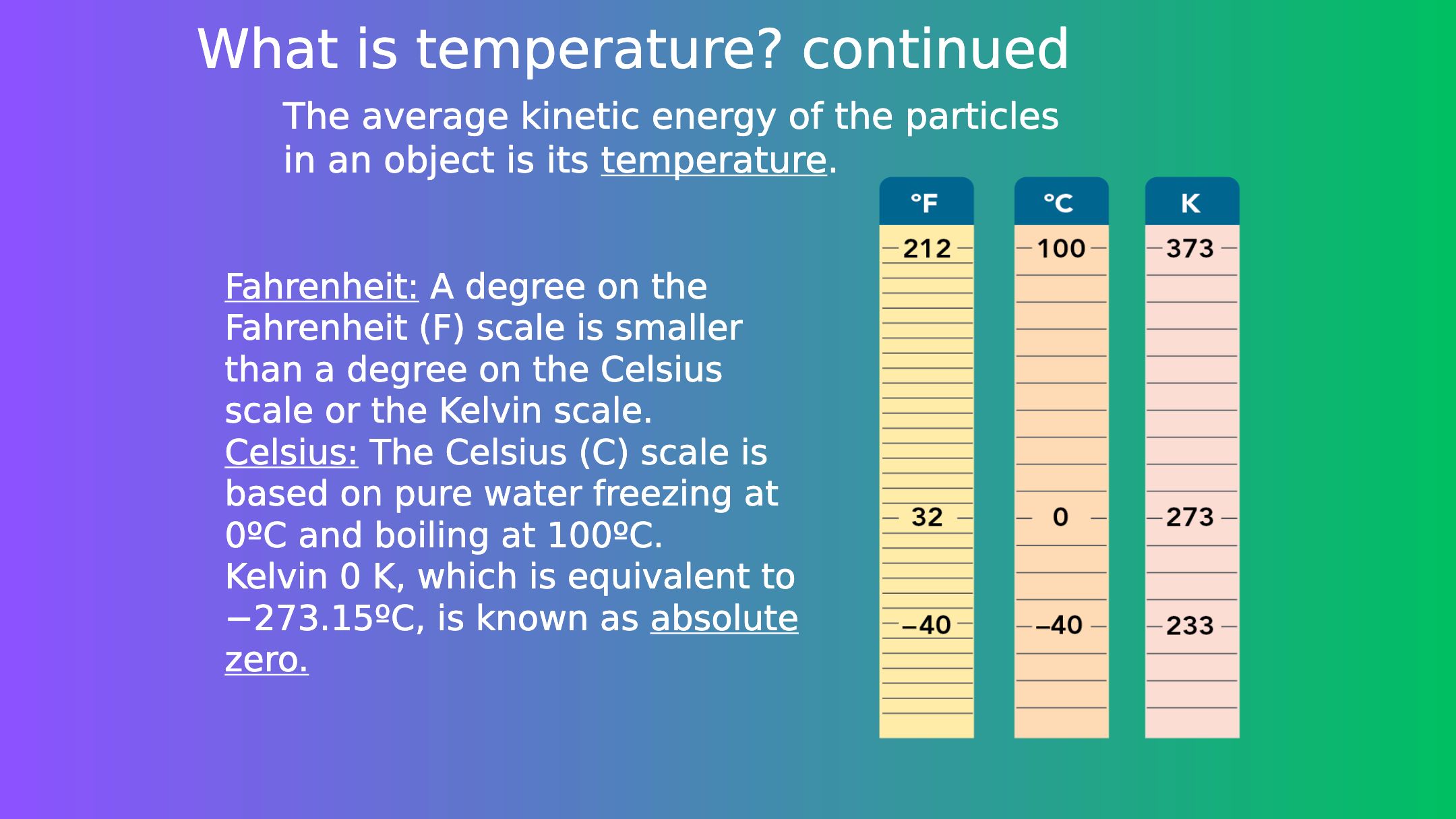
Which of the following best describes temperature?
The total energy of all particles in an object
The average kinetic energy of the particles in an object
The amount of heat required to raise the temperature of an object
The speed at which particles move in a solid
9
Open Ended
How does temperature relate to the movement of particles in a substance?
10
11
Labelling
Drag to the correct spot
32°
0°
37°
20°
98.6°
68°
12
13
14
Fill in the Blank
15
Multiple Choice
Which of the following best describes thermal energy?
The total kinetic energy of the particles in an object or system.
The amount of heat required to raise the temperature of an object.
The potential energy stored in chemical bonds.
The force that holds particles together in a solid.
16
17
Open Ended
How is thermal energy different from temperature?
18
Labelling
Type question here including an
Greater TE
Greater average KE
Greater average KE
Both greater
Greater TE
19
20
Multiple Select
Which of the following are true about the relationship between mass, temperature, and thermal energy?
An object with more mass at the same temperature has more thermal energy.
An object with higher temperature but less mass can have less thermal energy than a cooler, larger object.
Thermal energy depends on both the temperature and the amount of matter in an object.
Temperature alone determines the thermal energy of an object.
21
22
Open Ended
When comparing two systems, what does it mean if both have greater thermal energy and greater average kinetic energy?
23
24
Multiple Choice
Which of the following statements about thermal expansion is correct?
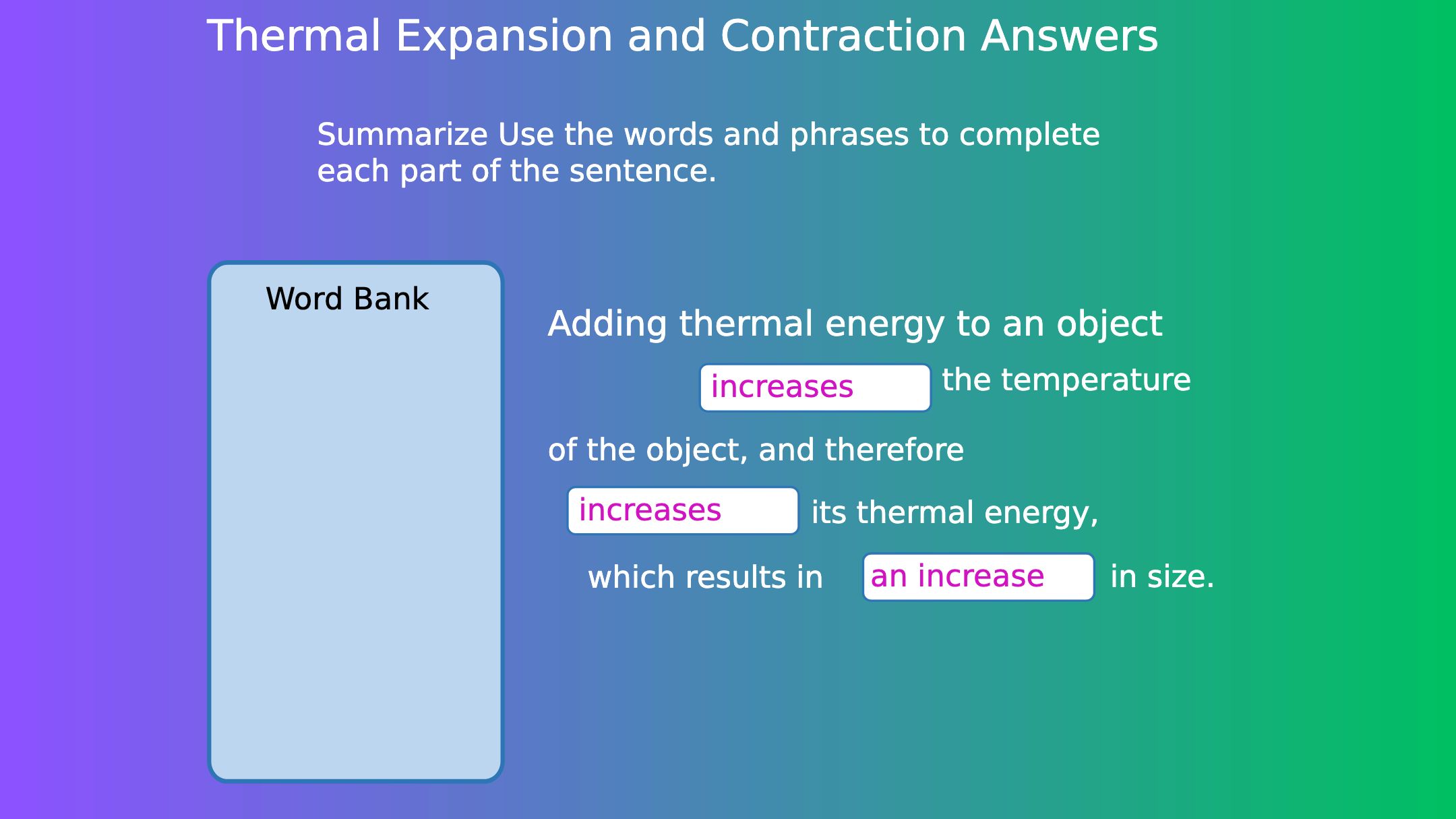
When an object gets warmer, its particles move faster and spread out, causing the object to expand.
When an object gets colder, its particles move faster and spread out, causing the object to expand.
When an object gets warmer, its particles slow down and get closer together, causing the object to contract.
Thermal expansion only occurs in liquids.
25
Open Ended
What happens to the particles of a material when it’s heated?
26
Dropdown
27
28
29
30
Open Ended
Reflecting on today’s lesson about temperature, kinetic energy, and thermal expansion, what is one question you still have or something you would like to know more about?
31
☕ Closure – Tuesday, Oct. 21
CO: I will explain how temperature affects the motion and spacing of particles and describe how heat causes materials to expand.
LO: I will discuss how adding or removing heat energy changes particle motion and temperature using science vocabulary.
“Today I learned that when heat is added, particles ________, and when heat is removed, particles ________.”
Which explanation best describes what happens to the metal ball from step 1 to step 3 in the demonstration?
The particles in the ball gained kinetic energy when the temperature increased, and this caused them to spread out and increase the size of the ball.
The particles in the ball gained kinetic energy when the temperature increased, and this caused each particle to increase in size, so the ball expanded.
The particles in the ball lost kinetic energy to the air when the temperature increased, which caused the particles to spread out and make the ball larger.
The heat added particles to the ball, which made the ball increase in size.
Show answer
Auto Play
Slide 1 / 31
MULTIPLE CHOICE

Similar Resources on Wayground
22 questions
Human Impact on Water
Presentation
•
6th - 8th Grade
25 questions
Physical and Chemical Changes Review
Presentation
•
8th Grade
25 questions
Nature of Science
Presentation
•
6th - 8th Grade
23 questions
Ecosystem Vocabulary
Presentation
•
6th - 8th Grade
23 questions
Scientific Method
Presentation
•
6th - 8th Grade
22 questions
STEMScopedia - Changes in Energy on the Molecular Level
Presentation
•
6th - 8th Grade
22 questions
Skeletal and Muscular System
Presentation
•
6th - 8th Grade
22 questions
Lab Safety
Presentation
•
6th - 8th Grade
Popular Resources on Wayground
10 questions
5.P.1.3 Distance/Time Graphs
Quiz
•
5th Grade
10 questions
Fire Drill
Quiz
•
2nd - 5th Grade
20 questions
Equivalent Fractions
Quiz
•
3rd Grade
22 questions
School Wide Vocab Group 1 Master
Quiz
•
6th - 8th Grade
20 questions
Main Idea and Details
Quiz
•
5th Grade
20 questions
Context Clues
Quiz
•
6th Grade
20 questions
Inferences
Quiz
•
4th Grade
12 questions
What makes Nebraska's government unique?
Quiz
•
4th - 5th Grade
Discover more resources for Science
8 questions
Amoeba Sister Asexual vs Sexual Reproduction
Interactive video
•
8th Grade
19 questions
Introduction to Properties of Waves
Presentation
•
6th - 8th Grade
16 questions
Interactions within Ecosystems
Presentation
•
6th - 8th Grade
10 questions
Exploring the Layers of the Earth
Interactive video
•
6th - 10th Grade
16 questions
Photosynthesis and Cellular Respiration Review
Quiz
•
7th Grade
20 questions
Abiotic & Biotic Factors
Quiz
•
7th Grade
15 questions
Punnett Squares
Quiz
•
6th Grade
10 questions
Exploring the Evolution of Cell Theory
Interactive video
•
7th Grade