Search Header Logo
  1. Resource Library
  2. Science
  3. Earth & Space Science
  4. Continental Drift
  5. Plate Tectonic G12
Plate Tectonic G12

Plate Tectonic G12

Assessment

Presentation

•

Science

•

12th Grade

•

Practice Problem

•

Medium

•
NGSS
MS-ESS2-2, MS-ESS2-3, MS-ESS3-2

+1

Standards-aligned

Created by

Joyme Avino

Used 2+ times

FREE Resource

32 Slides • 35 Questions

1

media

2

media

3

Open Ended

Explain why the outer core is liquid (molten) but the inner core is solid.

Answer in complete sentences.

4

Multiple Choice

Question image
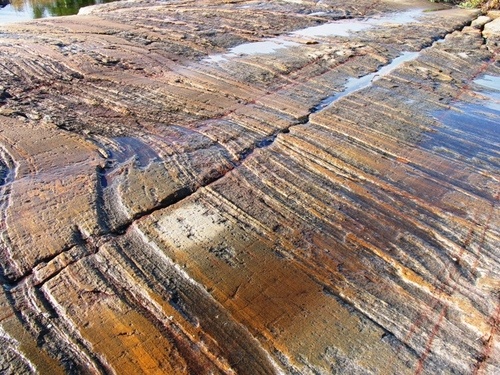
This is a picture of glacier scars found in Africa.  What are these evidence for?
1
Africa has always been near the equator
2
Africa was once in an area of the Earth that had a very cold climate
3
The continents have not moved
4
sea floor spreading

5

media

6

media

7

Multiple Choice

Which of the following best describes the Earth’s crust?

1

The thickest layer of the Earth

2

Less than 1% of Earth’s mass and includes continental and oceanic types

3


Composed mostly of iron and nickel

4


Hot ultramafic rock beneath the surface

8

Multiple Choice

Which of the following best describes the Earth’s crust?

1

The thickest layer of the Earth

2

Less than 1% of Earth’s mass and includes continental and oceanic types

3


Composed mostly of iron and nickel

4


Hot ultramafic rock beneath the surface

9

Multiple Select

Question image

Which layer(s) of Earth are made of less-dense materials such as silicates? Check all that apply.

1

crust

2

mantle

3

outer core

4

inner core

10

media

11

Multiple Choice

Oceanic plates are thinner and denser than continental plates.

1

TRUE

2

FALSE

12

Fill in the Blank

Which part of Earth is made mostly of iron and accounts for about 31% of its mass?

13

media

14

Multiple Choice

Question image

Which is the best description of the characteristics of the asthenosphere?

1
Rigid layer with no convection currents
2
Layer composed of only liquid rock
3
Semi-fluid layer beneath the lithosphere where convection currents occur
4

Solid layer above the lithosphere

15

media

16

Fill in the Blank

The theory that Earth’s plates are in constant motion is called the theory of ___.

17

media

18

Fill in the Blank

Question image

Ancient land mass where all continents were together

19

Multiple Choice

Question image

Why are similar fossils found all over the world?

1

The animals swam to new parts of the world before going extinct

2

The land masses were once connected

3

The organisms were transported to different areas of the world

4

They are not similar fossils.

20

media

21

media

22

media

23

Multiple Choice

What evidence did Wegener find regarding rock types and geologic features that supports the Continental Drift Theory?

1

2.2-billion-year-old igneous rocks in Brazil

2

Ice sheets in the Southern Hemisphere

3

Mountain belts in the Himalayas

4

Similar aged rocks in Antarctica

24

Multiple Choice

The matching coastlines across the Atlantic Ocean support continental drift.

1

TRUE

2

FALSE

25

Multiple Choice

Glossopteris fossils are found in Australia, Africa, South America, Antarctica, and India—not just South America.

1

TRUE

2

FALSE

26

Multiple Choice

Which is NOT used by Wegener to advance the theory of “continental

          drift

1

Rock types and geologic Features

2

Fossils Matching across the seas

3

Palaeomagnetism

4

Paleoclimatology  

27

media

28

Fill in the Blank

Two tectonic plates interact at a _____

29

Open Ended

Question image

Can people living on the North American and Eurasian plates feel them moving apart? Why or why not?

30

media

31

Multiple Choice

What process moves Earth's plates according to the image?

1

Mantle convection

2

Plate tectonics

3

Subduction

4

Earthquake activity

32

media

33

media

34

Fill in the Blank

Question image

__________ is the process by which the excess heat in the Earth's deep interior is transferred to its surface through the fluid-like motions of the rocks in the mantle.

35

media

36

media

37

media

38

media

39

media

40

Multiple Choice

Question image
When an oceanic plate is subducted under a continental plate, a deep valley is formed in the ocean. What is this valley called? 
1
a trench
2
a rift zone
3
ocean spreading ridge
4
Continental crust

41

media

42

media

43

Multiple Choice

In which kind of convergent boundary does subduction not occur?

1

continent-continent

2

continent-ocean

3

ocean-ocean

4

Subduction occurs in all of these.

44

media

45

Multiple Choice

Mountains are created when....
1
Two continental plates collide
2
Two oceanic plates pull apart
3
An Oceanic plate subducts under a Continental Plate
4
Two continental plates pull apart

46

Multiple Choice

Question image

The Himalayan mountain range (Mt. Everest) is a result of two _______ plates converging and causing uplift.

1

Oceanic

2

Continental

47

Multiple Choice

Which of the following is a result of oceanic-to-oceanic crust converging?

1

Mountains

2

Mid Ocean Ridge

3

volcanic island arcs

48

Multiple Choice

Question image

The process by which the ocean floor sinks beneath a deep-ocean trench and back into the mantle is known as _______

1

convection.

2

continental drift.

3

subduction.

4

conduction.

49

Multiple Choice

Question image

When oceanic and continental crust converge, the oceanic plate will dive beneath the continental plate. What best explains the results of this action?

1

The oceanic crust is moved upward by the radiation of heat

2

The oceanic crust will melt as it moves deeper in the earth.

3

The continental crust will form a mountain range.

4

The two crusts will form an ocean basin

50

Multiple Choice

What is the process that occurs when the denser oceanic lithosphere sinks beneath the buoyant continental lithosphere?

1

Subduction

2

Eruption

3

Melting

4

Convergence

51

Multiple Choice

What is formed as a result of continuous subduction of oceanic slabs?

1

Volcanic island arc

2

Mountain range

3

Ocean trench

4

Continental shelf

52

media

53

media

54

media

55

media

56

media

57

media

58

Multiple Choice

Question image

Which model is depicting a divergent boundary between two plates?

1

top

2

middle

3

bottom

4

none

59

Reorder

Question image

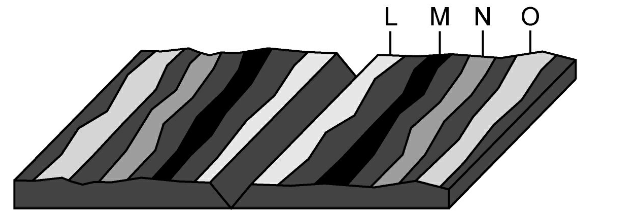
The image shows a diagram of the ocean floor near a mid-ocean ridge. Reorder the letters to indicate the age of the rocks on the seafloor from OLDEST to YOUNGEST

O

N

M

L

1
2
3
4

60

Multiple Choice

Question image
What feature is shown by the arrows?
1
Mid-Atlantic Ridge
2
Himalayan Mountains
3
San Andreas Fault
4
Andes Mountains

61

Open Ended

Compare and contrast divergent plate boundaries and convergent plate boundaries. (Think about how do the plates move? What landforms are formed? How do the plates interact with the mantle at this boundary?

62

media

63

media

64

media

65

Multiple Choice

Question image

What type of Boundary is this? What event will occur at this boundary?

1

Transform / Earthquakes

2

Subduction / Volcano Eruption

3

Tornado / Rain

4

Mountain Building / Volcanism

66

Multiple Choice

Question image

What is this natural disaster?

1

Huricane

2

Landslide

3

Earthquake

4

Avalanche

67

Fill in the Blank

A phenomenon of Earth produced at a transform boundary is an ___.

media

Show answer

Auto Play

Slide 1 / 67

SLIDE