Cycles and Ecology Review
Presentation
•
Science
•
University
•
Practice Problem
•
Hard
+15
Standards-aligned
Brittany Hinojosa
FREE Resource
25 Slides • 38 Questions
1
Biogeochemical Review
+ some Ecology at the end
Based on questions from the quiz tbh
2
3
Multiple Choice
Why is understanding the carbon cycle important for addressing environmental issues?
It helps us understand climate change and global warming.
It explains the process of photosynthesis only.
It is only relevant to plant biology.
It has no impact on human activities.
4
Multiple Choice
Which of the following is considered a carbon sink in the carbon cycle?
Atmosphere
Fossil fuels
Ocean (algae & sediments)
Animal agriculture
5
Multiple Choice
Which of the following is considered a carbon sink in the carbon cycle?
Igneous rocks
Forests
Atmosphere
Animal agriculture
6
Multiple Choice
Which of the following is considered a carbon source in the carbon cycle?
Planting trees
Photosynthesis
Using electric vehicles
Comustion of fossil fuels
7
Multiple Choice
Which of the following is considered a carbon source in the carbon cycle?
Deforestation
Photosynthesis
Respiration
8
9
Multiple Choice
Which process in the carbon cycle is responsible for releasing stored energy by breaking down glucose?
Photosynthesis
Respiration
Sedimentation
Burial
10
11
Multiple Select
Which of the following processes are involved in the exchange of carbon between the atmosphere and the ocean?
CO2 dissolving in and out of ocean
Respiration by algae
Combustion of fossil fuels
Sedimentation of organic matter on ocean floor
12
Multiple Select
Which of the following processes are involved in the exchange of carbon between the atmosphere and the ocean?
Deforestation
Algae and photosynthesis
Combustion of fossil fuels
Decomposition by bacteria
13
14
Open Ended
Explain how the extraction and combustion of fossil fuels impact the concentration of CO2 in the atmosphere. Remember: anthropogenic sources mean they are from human activities. It is a GREAT word to use on your AP exam FRQs!
15
Sequestered Carbon
Sequester means it is stored- in carbon sinks.
If CO2 is removed from the atmosphere and stored, that carbon is being sequestered.
For example, planting more trees helps remove CO2 from the atmosphere, so we can say forests help sequester carbon, and in turn help mitigate climate change.
16
Multiple Choice
How does burning fossil fuels contribute to the net increase in atmospheric carbon?
Burning fossil fuels creates smoke and haze which blocks the sun and slows photosynthesis
Carbon is released from newly planted forests as part of photosynthesis
Carbon that has been sequestered underground is added to carbon cycle
Burning fossil fuels releases CO2 that is absorbed to the atmosphere faster than natural CO2
17
18
Fill in the Blanks
19
Multiple Choice
Why is nitrogen so essential for plants and animals?
Required for lipids and cellular membranes
Required to make proteins and DNA
idk tbh
Required to make organelles in the cells
20
21
Multiple Choice
Which process in the nitrogen cycle converts atmospheric nitrogen (N2) into a form usable by plants?
Nitrification
Denitrification
Nitrogen fixation
Assimilation
22
Multiple Choice
Before: nutrient poor field was abandoned and an invasive plant took over
After: field is cleared of vegetation and soil has excess nitrogen
What happened?
The stones in the soil eroded and produced excess nitrogen and phosphorous
Nitrogen leached from an excess of plant fertilizer
The invasive plants were able to fix nitrogen and produced excess nitrogen in their leaves
The invasive plant had root nodules that fixed N2 into soil
23
24
Multiple Choice
Which of the following steps in the nitrogen cycle involves plants taking in nitrogen in the form of ammonium and nitrate to create proteins and DNA in their bodies
Assimilation
Nitrification
Ammonification
Denitrification
25
Multiple Choice
Which process in the nitrogen cycle converts a nitrogen compound in the soil back to atmospheric nitrogen
Nitrification
Denitrification
Nitrogen fixation
Assimilation
26
27
Multiple Select
Main source of nitrate leaching due to human activities?
High rates of precipitation
Plants used all the nitrogen and left phosphorous behind
Overabundance of Nitrogen and Phosphorus from synthetic fertilizers
Rock was eroded, releasing phosphorous
28
Multiple Select
Which of the following are impacts of human activities on the nitrogen cycle?
Increased greenhouse gas emissions
Eutrophication of water bodies
Decreased nitrogen fixation
Nitrate leaching
29
30
Open Ended
Explain why phosphorus is considered a limiting nutrient in many ecosystems and describe the consequences of this limitation.
31
Multiple Choice
Which of the following is a major reservoir of phosphorus in the phosphorus cycle?
Atmosphere
Rocks and sediments
Living organisms
Oceans
32
33
Multiple Select
Which of the following are natural and synthetic sources of phosphorus in the environment?
Weathering of rocks
Phosphorous being soluble in water
Synthetic fertilizers
Atmospheric deposition
34
35
Phosphorous Cycle
The ONLY biogeochemical cycle WITHOUT a gaseous component!
36
Multiple Choice
What is the primary reason phosphorus does not cycle through the atmosphere like carbon or nitrogen?
Phosphorus is too reactive
Phosphorus does not have a gaseous phase
Phosphorus is only found in living organisms
Phosphorus is only found in water
37
38
39
Multiple Choice
What is the primary cause of eutrophication in aquatic ecosystems?
Excessive nutrients from fertilizers
Overfishing
Increased sunlight
Low temperatures
40
Open Ended
Describe the process of eutrophication and explain how excess phosphorus contributes to this phenomenon in aquatic ecosystems.
41
42
Fill in the Blanks
43
44
Multiple Choice
Which process in the water cycle is responsible for moving water from plant leaves to the atmosphere?
Transpiration
Condensation
Precipitation
Infiltration
45
46
47
48
Multiple Choice
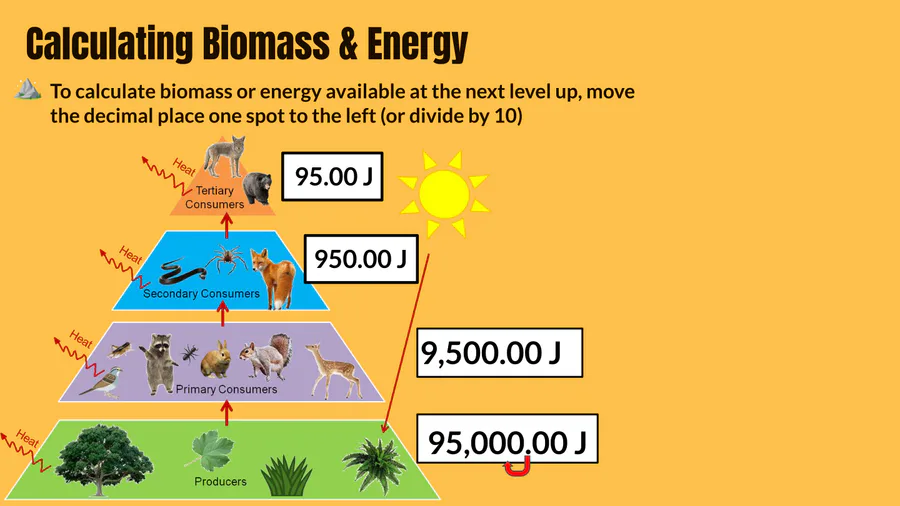
Generalized pyramid energy flow has only a 10% efficiency because 90% of the energy is lost to the environment as heat. This phenomenon is explained by
a. the second law of thermodynamics
b. the law of limiting factors
c. the law of conservation of matter
d. the greenhouse effect
49
50
51
52
Multiple Choice
53
Multiple Choice
In a given ecosystem, producers convert solar energy into 15,000kcal of chemical energy stored in organic compounds. Which of the following is the most likely amount of energy available to primary consumers?
1.5 Kcal
150 kcal
1,500 kcal
13,500 kcal
54
Multiple Choice
If producers capture 80,000 J of energy from the sun, how much will be passed on to the secondary consumers?
8,000 J
800 J
80 J
8 J
55
Multiple Choice
If producers capture 65,000 J of energy from the sun, how much will be passed on to the tertiary consumers?
6,500 J
650 J
65 J
6.5 J
56
Multiple Choice
If producers capture 55,000 J of energy from the sun, how much will be passed on to the primary consumers?
5,500 J
550 J
55 J
5.5 J
57
Multiple Choice
58
Multiple Choice
59
Multiple Choice
60
Multiple Choice
Ecological efficiency from one trophic level to the next is generally:
1%
10%
75%
90%
61
62
Multiple Choice
The removal of which of the following groups would cause an immediate decrease in the amount of energy flowing through the system?
63
Open Ended
Explain how a trophic cascade would occur in this food web if the grasshoppers were eradicated.
Biogeochemical Review
+ some Ecology at the end
Based on questions from the quiz tbh
Show answer
Auto Play
Slide 1 / 63
SLIDE

Similar Resources on Wayground
55 questions
Forms of Business Ownership
Presentation
•
University
60 questions
VNSA7 Whole Unit Recap Lesson - Christmas Edition
Presentation
•
12th Grade - University
60 questions
Herramientas Tecnológicas para la Recolección y Análisis
Presentation
•
University
54 questions
Community Health Week 1 FA 25
Presentation
•
University
57 questions
Module 9_Shelly C
Presentation
•
University
58 questions
B2 -C1 Travel and Holidays
Presentation
•
University
58 questions
Presentación sin título
Presentation
•
University
61 questions
Collision Theory and Reaction Rate
Presentation
•
12th Grade
Popular Resources on Wayground
20 questions
STAAR Review Quiz #3
Quiz
•
8th Grade
20 questions
Equivalent Fractions
Quiz
•
3rd Grade
6 questions
Marshmallow Farm Quiz
Quiz
•
2nd - 5th Grade
20 questions
Main Idea and Details
Quiz
•
5th Grade
20 questions
Context Clues
Quiz
•
6th Grade
20 questions
Inferences
Quiz
•
4th Grade
19 questions
Classifying Quadrilaterals
Quiz
•
3rd Grade
12 questions
What makes Nebraska's government unique?
Quiz
•
4th - 5th Grade